Home
» Horoscope
»
2027 Moon Phases: A Grounded Manifestation Guide for Every Zodiac Sign
2027 Moon Phases: A Grounded Manifestation Guide for Every Zodiac Sign
Moon-phase manifestation can be meaningful as a ritual for reflection, planning, and accountability, but it helps to separate what is measurable from what is symbolic. The Moon really does move through a repeating sequence of phases, and the dates and times of those phases can be calculated precisely. Astrology assigns symbolic themes to those phases and to zodiac signs. What has not been established is that a New Moon, Full Moon, or zodiac placement can cosmically cause a goal to come true.
That distinction makes this 2027 guide more useful, not less. You can use lunar dates as memorable checkpoints while grounding your goals in actions you can actually take. The U.S. Naval Observatory publishes the 2027 primary Moon phase dates and times in Universal Time, while NASA explains the physical geometry behind the Moon's eight visible phases. The zodiac themes below are interpretive prompts used in tropical Western astrology, not scientific predictions.
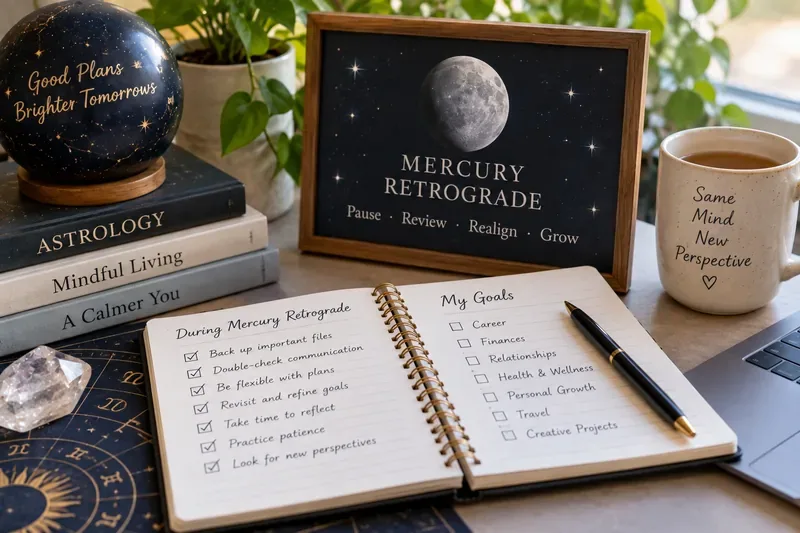
A moon-phase-themed journaling setup pairs a written intention list with a stylized lunar-cycle sequence, illustrating how lunar dates can be used as reflection checkpoints rather than guarantees of outcomes.
First, clear up four common Moon-manifestation myths
Myth 1: A New Moon can make a wish happen by itself
There is no established scientific evidence that the lunar phase attracts money, relationships, career opportunities, or other desired outcomes. Research on belief in manifestation examines the psychology of those beliefs rather than demonstrating a cosmic mechanism. One peer-reviewed study defined manifestation beliefs around positive self-talk, visualization, and symbolic action, but it did not establish that thoughts directly alter external events through the universe; see the original manifestation-belief study.
Useful action: Keep the ritual if it motivates you, but translate every intention into a behavior you control. “I manifest a better job” becomes “I will update two portfolio projects and submit three targeted applications this week.”
Myth 2: The New Moon is the first visible crescent
NASA's phase explanation makes the distinction clear: at New Moon, the Moon's night side faces Earth, and the Moon rises and sets with the Sun, so it is normally not visible in the daytime sky. The slim waxing crescent appears after the New Moon. The full lunar cycle repeats about every 29.5 days.
Useful action: If you want a visible-sky ritual, schedule it for the waxing crescent rather than expecting to see the exact New Moon.
Myth 3: A Moon phase has one universal calendar date everywhere
The U.S. Naval Observatory lists phase times in Universal Time (UT). Your local date can differ if the exact phase occurs near midnight relative to your time zone. That matters in 2027 because several primary phases occur in the early UT hours.
Useful action: Convert UT to your local time before placing a lunar checkpoint on your calendar. You do not need to perform a ritual at the exact minute; a practical review window of the same day or nearby evening is usually easier to sustain.
Myth 4: An eclipse automatically makes manifestation more powerful
2027 does contain notable eclipse-linked phases. NASA lists an annular solar eclipse on February 6, a total solar eclipse on August 2, and penumbral lunar eclipses on February 20, July 18, and August 17. Those astronomical events are verified. Claims that eclipses amplify wishes, cause sudden destiny shifts, or require special manifestation rules are astrological interpretations, not demonstrated physical effects.
Useful action: Treat eclipse dates as optional review markers. If you observe a solar eclipse, follow NASA's eclipse eye-safety guidance; an annular eclipse has no safe naked-eye totality phase.
How to use the lunar cycle as a practical goal framework
The four primary phases can form a simple monthly rhythm. The astronomy is real; the goal-setting meaning is a voluntary framework.
Moon phase
Astronomical status
Symbolic goal use
Practical action
New Moon
Moon is near the Sun in the sky; the Earth-facing side is mostly dark.
Choose a direction.
Write one outcome and one controllable next step.
First Quarter
About one-quarter of the orbital cycle has passed; half the visible disk appears lit.
Commit and act.
Do the uncomfortable task that creates momentum.
Full Moon
Moon is opposite the Sun as viewed from Earth; its dayside is largely visible.
Review results.
Measure progress and decide what to continue, change, or stop.
Last Quarter
The Moon is roughly three-quarters through the cycle; half the visible disk appears lit.
Release and simplify.
Remove one obstacle, unnecessary task, or unrealistic expectation.
This approach works best when “manifestation” means focusing attention and supporting action, not assuming that visualization guarantees an outcome. There is evidence for a much more concrete technique called an implementation intention: an if-then plan that specifies when, where, and how you will act. A meta-analysis of 94 independent tests reported that implementation intentions improved goal attainment overall; see the original meta-analysis on implementation intentions and goal achievement.
Useful action: Add one if-then sentence to every Moon intention: “If it is 7:00 p.m. on Tuesday, then I will work on my certification course for 30 minutes.”
2027 New Moon calendar: dates, tropical signs, and reflection themes
The following dates and times come from the U.S. Naval Observatory and are shown in UT. The zodiac labels use the tropical Western zodiac convention and can be checked against the Swiss Ephemeris resources from Astrodienst. The “theme” column is interpretive, not a prediction.
New Moon (UT)
Tropical sign
Optional reflection theme
January 7, 20:24
Capricorn
Structure, responsibility, long-term milestones
February 6, 15:56
Aquarius
Innovation, community, future-facing ideas
March 8, 09:29
Pisces
Imagination, compassion, creative vision
April 6, 23:51
Aries
Initiative, courage, a clean first step
May 6, 10:58
Taurus
Stability, resources, sustainable value
June 4, 19:40
Gemini
Learning, communication, experiments
July 4, 03:02
Cancer
Home, emotional security, support systems
August 2, 10:05
Leo
Creative confidence, visibility, leadership
August 31, 17:41
Virgo
Systems, habits, craft, practical improvement
September 30, 02:36
Libra
Partnership, fairness, negotiation
October 29, 13:36
Scorpio
Depth, commitment, difficult but necessary change
November 28, 03:24
Sagittarius
Learning, exploration, perspective
December 27, 20:12
Capricorn
Planning, accountability, 2028 foundations
There are 13 New Moons in the 2027 UT calendar because the synodic month is shorter than the calendar month cycle. August contains two New Moons in UT, on August 2 and August 31. That is a calendar consequence, not evidence that the second New Moon has extra physical power.
Useful action: Pick only the New Moons that support goals you are already pursuing. You do not need 13 separate “manifestations.” A few well-defined goals are easier to act on and review.
2027 Full Moon dates for progress reviews
If you want to use Full Moons as review points, the USNO lists these 2027 Full Moon times in UT: January 22 at 12:17; February 20 at 23:23; March 22 at 10:44; April 20 at 22:27; May 20 at 10:59; June 19 at 00:44; July 18 at 15:45; August 17 at 07:29; September 15 at 23:03; October 15 at 13:47; November 14 at 03:26; and December 13 at 16:09.
Three of those Full Moons coincide with penumbral lunar eclipses: February 20, July 18, and August 17. A penumbral eclipse can be visually subtle because the Moon passes through Earth's outer shadow. Astrologers may assign special meaning to eclipse Full Moons, but the practical question remains the same: what changed since you set the goal?
Useful action: At each Full Moon review, record one number or observable result: dollars saved, applications sent, workouts completed, pages written, lessons studied, or conversations held.
How to manifest your 2027 goals based on your zodiac sign
Use your Sun sign for a simple reading. If you already work with a full natal chart, you may also read your Rising sign because astrologers often use it to map house topics. The suggestions below are symbolic planning prompts; they are not claims that people born under one sign must pursue a particular goal.
Aries: turn urgency into a defined first move
The April 6 Aries New Moon is the clearest symbolic reset for your sign in 2027. Aries themes favor beginnings, courage, and direct action, but the common failure mode is starting several things and finishing none.
Manifestation prompt: “What goal would move if I stopped preparing and took one visible step?”
Action: Write an if-then plan that starts within 48 hours. If your goal is fitness, for example: “If it is Monday at 6:30 a.m., I will complete a 20-minute workout before checking messages.”
Taurus: build the environment that makes the goal easier
The May 6 Taurus New Moon can be used as a checkpoint for money, stability, craft, or health routines. Taurus symbolism is less about dramatic reinvention and more about creating conditions you can sustain.
Manifestation prompt: “What would become easier if my environment supported the behavior automatically?”
Action: Automate one supportive system: a recurring savings transfer, prepared ingredients, a scheduled practice block, or a standing weekly review.
Gemini: convert curiosity into a learning output
The June 4 Gemini New Moon suits goals involving study, communication, networking, writing, language learning, or experimentation. The symbolic strength is curiosity; the risk is collecting information without using it.
Manifestation prompt: “What can I publish, explain, practice, or test instead of merely reading about it?”
Action: Choose one output metric, such as one lesson completed, one page drafted, or one thoughtful outreach message per weekday.
Cancer: make your support system part of the goal
The July 4 Cancer New Moon can frame intentions around home, family, emotional security, belonging, or a more supportive daily base. A goal is often easier when the surrounding system is stable.
Manifestation prompt: “What kind of support would make this goal feel safer and more sustainable?”
Action: Ask for one specific form of support, create a boundary around your focus time, or improve one part of your home routine that repeatedly creates stress.
Leo: define the version of visibility you actually want
The August 2 Leo New Moon coincides with a total solar eclipse. That eclipse is a verified astronomical event; the idea that it multiplies manifestation power is not. Symbolically, Leo themes can still be useful for creative work, confidence, leadership, performance, and being seen.
Manifestation prompt: “Where do I want to be more visible because I have something real to contribute?”
Action: Create one public deliverable: publish the portfolio page, present the proposal, share the draft, apply for the role, or ask for the opportunity.
Virgo: make the system measurable
The August 31 Virgo New Moon is a natural symbolic point for habits, work systems, organization, and skill refinement. The trap is turning improvement into perfectionism.
Manifestation prompt: “Which small process change would improve my results even on an average day?”
Action: Track one behavior for four weeks and define a minimum version you can complete when energy is low.
Libra: replace vague harmony with a clear agreement
The September 30 Libra New Moon can support reflection on partnerships, collaboration, fairness, and negotiation. “Better relationships” is too vague to guide behavior.
Manifestation prompt: “What conversation or agreement would make this relationship more workable?”
Action: Schedule one conversation and arrive with a specific request, a boundary, and a question that invites the other person's perspective.
Scorpio: choose one difficult change worth committing to
The October 29 Scorpio New Moon can be used for goals involving deep focus, trust, shared resources, debt reduction, research, or personal change. Scorpio symbolism tends to emphasize intensity, but intensity is not the same as effectiveness.
Manifestation prompt: “What am I willing to stop, confront, or simplify so this goal has room to grow?”
Action: Remove one recurring drain and redirect the recovered time, money, or attention to the priority goal.
Sagittarius: turn expansion into a defined journey
The November 28 Sagittarius New Moon can frame goals around travel, education, publishing, teaching, or a broader worldview. The risk is confusing inspiration with a plan.
Manifestation prompt: “What experience would genuinely expand my capabilities by the end of 2027?”
Action: Put a date, budget, application deadline, or study schedule behind the aspiration.
Capricorn: use the year's two Capricorn New Moons as bookends
In UT, 2027 opens with a Capricorn New Moon on January 7 and closes with another on December 27. That creates a useful symbolic before-and-after structure for long-term goals involving career, credentials, finances, leadership, or responsibility.
Manifestation prompt: “What result would make December-me grateful that January-me began?”
Action: Set one annual target, break it into quarterly milestones, and use the December 27 New Moon to review what should carry into 2028.
Aquarius: connect the goal to a community or system
The February 6 Aquarius New Moon coincides with an annular solar eclipse. In astrology, Aquarius is associated with groups, innovation, technology, and future-oriented thinking. None of that means the eclipse will create an opportunity automatically.
Manifestation prompt: “Who else benefits if I solve this problem well?”
Action: Join or build a community around the goal, ask for expert feedback, or test the idea with real users instead of keeping it private.
Pisces: give the dream a boundary and a next step
The March 8 Pisces New Moon can be used for creative, spiritual, compassionate, or imaginative goals. Visualization can help clarify what matters to you, but a vivid mental picture is not evidence that the outcome will arrive without effort.
Manifestation prompt: “What does this dream look like in one observable behavior?”
Action: Give the goal a container: 30 minutes of creative work, one volunteer shift, one therapy appointment, one proposal draft, or one concrete step toward the project.
A five-question Moon ritual that keeps manifestation grounded
You do not need crystals, special candles, a particular pen color, or an exact lunar minute. If those objects make the ritual enjoyable, use them as personal symbols. The part most likely to affect progress is what you decide and do afterward.
What do I want? Write one outcome in plain language.
What is in my control? Separate your behavior from other people's decisions, market conditions, luck, and timing.
What is the next visible action? Choose something small enough to start.
When will I do it? Create an if-then implementation plan.
What will I review at the next Full Moon? Pick one observable measure of progress.
This format preserves the reflective value of a lunar ritual without turning the Moon into a promise. It also gives you a way to change course. If a goal has not moved after several cycles, the answer is not necessarily to “manifest harder.” The plan may need a different strategy, more skill, more time, more resources, outside help, or a goal that better fits your circumstances.
Useful action: If you miss a lunar checkpoint, continue on the next available day. Consistency matters more than ritual precision.
What is verified, what depends on interpretation, and what remains unknown?
Category
What can reasonably be said
How to use it
Verified astronomy
The timing and geometry of Moon phases and eclipses can be calculated and checked.
Use reliable astronomy sources for dates and viewing safety.
Astrological interpretation
Assigning themes such as Aries to initiative or Virgo to systems belongs to a symbolic astrological framework.
Use those themes as optional prompts, not predictions.
Goal-setting evidence
Specific planning techniques such as implementation intentions have research support for helping people translate intentions into behavior.
Add concrete when-where-how plans to your goals.
Cosmic manifestation claims
There is no established evidence that a Moon phase or zodiac placement directly attracts external outcomes.
Do not use lunar rituals in place of action, professional advice, or realistic risk assessment.
The bottom line for 2027 Moon manifestation
2027 gives you a clear lunar calendar, including 13 New Moons in UT, 12 Full Moons, two solar eclipses, and three lunar eclipses. Those events are real and predictable. Their use as manifestation portals, emotional resets, or zodiac-specific opportunities is interpretive.
The most productive way to combine the two is simple: let the Moon provide the rhythm, let astrology provide optional reflection prompts, and let your behavior provide the mechanism. Set an intention at the New Moon, act through the waxing phases, review at the Full Moon, and simplify during the waning phases. Then repeat without assuming that a disappointing cycle means you failed spiritually or that a successful one proves cosmic causation.
Your sign can suggest a theme. Your calendar can give you a checkpoint. Your actual progress will still depend on choices, skills, resources, relationships, constraints, and circumstances. That is a more grounded form of manifestation—and one that leaves room for both wonder and reality.