Home
» Horoscope
»
Chinese Horse Personality: A Practical Guide to Traits, Love, and Work Style
Chinese Horse Personality: A Practical Guide to Traits, Love, and Work Style
In traditional Chinese zodiac interpretation, people born in a Horse year are often described as energetic, independent, sociable, quick-moving, and eager for freedom. The useful way to read that profile is not as a fixed personality test, but as a cultural framework: it highlights patterns traditionally associated with the Horse and gives you prompts for thinking about relationships, work habits, and personal growth.
The Horse is the seventh animal in the 12-sign Chinese zodiac cycle. Smithsonian resources note that the zodiac also combines the animal cycle with five elements—Wood, Fire, Earth, Metal, and Water—and that Chinese zodiac years begin at Lunar New Year rather than January 1. That boundary matters especially for people born in January or February. See the Smithsonian's Year of the Horse overview and the National Museum of Asian Art's Horse-year background for cultural context.
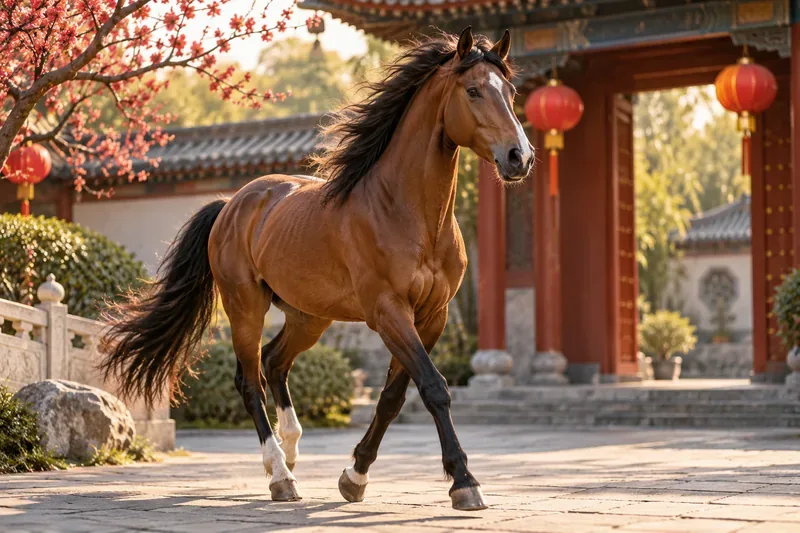
A chestnut horse moves through a traditional Chinese courtyard, reflecting the Horse sign's cultural associations with motion, vitality, and independence.
Chinese Horse personality at a glance
Area
Traditional Horse tendency
Practical watch-out
Core drive
Freedom, movement, self-direction
May resist structure too quickly
Social style
Warm, lively, expressive
Can dominate the pace of a conversation
Decision style
Fast and action-oriented
May move before checking details
Work style
Independent, energetic, adaptable
Routine can reduce motivation
Love style
Enthusiastic and affectionate
Needs space as well as closeness
Growth edge
Turning momentum into consistency
Finish what was started before chasing the next idea
Core traits traditionally associated with the Horse
Energetic and action-oriented
The Horse is commonly portrayed as a sign that prefers movement over prolonged hesitation. In everyday terms, that can look like volunteering first, learning by doing, starting conversations easily, or becoming restless when a plan remains theoretical for too long. This is one reason Horse descriptions often emphasize initiative and visible momentum.
A practical use of this trait is to give yourself short action windows. Instead of waiting for perfect certainty, define the next reversible step: make the call, build the draft, test the route, or schedule the meeting. The counterbalance is equally important—set one checkpoint where you deliberately slow down and review consequences before committing further.
Independent and freedom-seeking
Traditional Horse profiles place a high value on autonomy. A Horse personality is often said to do best when there is room to choose how to reach a goal rather than being micromanaged at every step. This can be a major strength in changing environments, but it can also create friction when collaboration requires shared procedures.
Useful question: are you rejecting a rule because it is genuinely inefficient, or simply because someone else imposed it? That distinction can help turn independence into mature self-direction rather than reflexive resistance.
Sociable, expressive, and quick to engage
The Horse is frequently associated with charisma, enthusiasm, and ease in social settings. That does not mean every person born in a Horse year is extroverted. Rather, the traditional stereotype emphasizes visible energy, responsiveness, and a preference for lively interaction.
In practice, this style can make Horse types good at breaking the ice, rallying a group, networking, or keeping a project emotionally energized. The growth task is to leave space for quieter people, listen through the end of an answer, and avoid mistaking fast rapport for deep agreement.
Strengths of the Chinese Horse personality
Initiative: comfortable getting started before every detail is settled.
Adaptability: often willing to change direction when conditions shift.
Social confidence: traditionally seen as approachable, lively, and persuasive.
Resilience: Smithsonian describes the Horse as representing hard work, bravery, and resilience in its current cultural overview.
Independence: motivated by ownership and room to make choices.
Momentum: good at turning an idea into visible activity.
These strengths are most useful when paired with follow-through. A Horse-style person who combines speed with systems—calendar blocks, written commitments, checklists, or a reliable partner—can preserve spontaneity without losing consistency.
Common weaknesses and how to manage them
Impatience
Fast-moving people can become frustrated when decisions, meetings, or processes take longer than expected. The risk is pushing for speed when the situation actually needs consultation or precision. A simple corrective is to label tasks as either “speed matters” or “accuracy matters” before starting.
Restlessness
Variety can be motivating, but constant novelty can scatter attention. If you recognize this tendency, keep an “ideas later” list. New ideas are captured without replacing the current priority.
Bluntness or emotional heat
Direct communication can be refreshing, yet speed and intensity can make a message sound harsher than intended. Before sending a difficult note, check whether it contains a clear observation, a specific request, and room for the other person to respond.
Overcommitting
Enthusiasm makes it easy to say yes while energy is high. The practical fix is to delay non-urgent commitments long enough to check time, money, and existing obligations. Freedom is easier to protect when the calendar is not overloaded.
How a Horse personality tends to love
Traditional interpretations usually portray the Horse as warm, demonstrative, playful, and strongly attracted to relationships that still allow personal freedom. A Horse-style partner may enjoy shared activities, spontaneous plans, travel, social outings, and a relationship that feels alive rather than overly controlled.
The tension is that closeness and independence need to coexist. When a Horse feels boxed in, the reaction may be to pull away; when a partner feels ignored, the same independence can be read as emotional distance. Healthy communication therefore matters more than any zodiac pairing rule.
Relationship checklist for a Horse-style person
Say directly when you need alone time instead of disappearing.
Keep at least one shared routine even if you value spontaneity.
Do not confuse intensity at the beginning with long-term compatibility.
Ask what makes your partner feel secure rather than assuming they want the same amount of freedom you do.
When conflict gets heated, slow the pace before trying to win the point.
For readers comparing signs, this section creates a natural connection to a Horse compatibility guide, while a more specific element-animal guide can explain how Wood Horse, Fire Horse, Earth Horse, Metal Horse, and Water Horse traditions differ.
Chinese Horse work habits and ideal working conditions
At work, the Horse stereotype fits roles with autonomy, variety, human interaction, visible progress, and changing problems. That can include entrepreneurial work, sales, consulting, events, leadership, field operations, creative production, client-facing roles, and project environments where initiative is rewarded. The important point is not the job title itself, but the working conditions.
Horse-friendly condition
Why it may help
What to add for balance
Autonomy
Supports ownership and initiative
Clear goals and accountability
Variety
Reduces boredom
Stable priorities
Fast feedback
Keeps momentum visible
Long-term review points
People contact
Uses social energy
Protected focus time
Challenge
Channels competitive drive
Recovery time and realistic workload
A Horse-style worker may struggle most in environments that combine heavy repetition, close supervision, slow decision-making, and little connection between effort and outcome. Even then, the answer is not automatically to quit. First try changing the job design: batch repetitive tasks, request ownership of a defined area, create milestone-based progress, or alternate deep work with collaborative work.
How the five elements modify a Horse reading
Chinese zodiac tradition does not use the animal alone. The 12-animal cycle combines with five elements in a 60-year cycle. That is why two people born 12 years apart can both be Horses but have different element labels. Common Horse-year labels include 1942 Water Horse, 1954 Wood Horse, 1966 Fire Horse, 1978 Earth Horse, 1990 Metal Horse, 2002 Water Horse, 2014 Wood Horse, and 2026 Fire Horse.
In popular traditional interpretation, the element is used to shade the basic Horse profile: Wood is often linked with growth and cooperation, Fire with intensity and expressiveness, Earth with steadiness, Metal with determination, and Water with flexibility. Treat those descriptions as cultural symbolism rather than measured psychological categories.
How to confirm whether you are actually a Horse
Do not use January 1 as the zodiac cutoff. Chinese zodiac years change at Lunar New Year, whose Gregorian date varies from year to year. For example, the Smithsonian records that the 2026 Fire Horse year begins on February 17, 2026. Someone born earlier in 2026 belongs to the preceding Snake year under that calendar system.
If your birthday falls in January or February, check the Lunar New Year date for your exact birth year before using a Horse profile. This is especially important in birth-year guides, compatibility articles, and element calculations.
A practical way to use Horse personality descriptions
Use the Horse profile as a reflection prompt, not a verdict. Modern personality science measures individual differences with validated instruments rather than birth-year categories. Research on Chinese-language personality assessment, for example, evaluates psychometric tools such as the NEO personality inventories rather than zodiac signs; see the peer-reviewed study indexed by PubMed.
A useful three-step check is simple:
Recognize: Which Horse traits genuinely sound like your recurring behavior?
Test: Can you point to real examples across several situations, not just one memorable moment?
Adjust: Keep the strengths that help you and build systems around the weaknesses that repeatedly cost you.
The Chinese Horse personality is traditionally associated with movement, courage, independence, sociability, and a strong desire to act. Its most practical lesson is balance: freedom works better with follow-through, confidence works better with listening, and speed works better when paired with a deliberate pause for important decisions.
Related reading opportunities: Chinese Horse zodiac guide; Wood Horse personality guide; Fire Horse personality guide; Horse compatibility guide; Horse birth-year guide; and the 2027 Chinese zodiac outlook.