Home
» Horoscope
»
Chinese Wood Monkey Zodiac: Birth Years, Traits, Compatibility, Career, and Luck
Chinese Wood Monkey Zodiac: Birth Years, Traits, Compatibility, Career, and Luck
The Chinese Wood Monkey is the Monkey sign paired with the Wood element in the traditional 60-year zodiac cycle. The principal modern Wood Monkey birth years are 1944 and 2004, with 2064 as the next occurrence. But a birth year alone is not enough for people born in January or February: their animal and element depend on the date of Chinese Lunar New Year.
In traditional interpretations, the Monkey symbolizes cleverness, adaptability, and curiosity, while Wood adds an emphasis on growth, collaboration, and long-term development. These are cultural personality descriptions, not scientifically established characteristics or predictions about an individual.
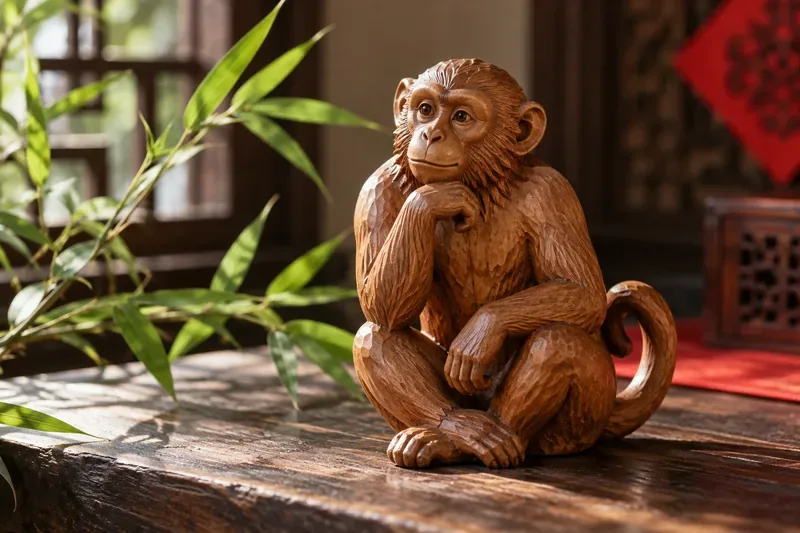
A carved wooden monkey sits beside bamboo leaves; the wood grain and greenery echo the Wood Monkey's traditional element symbolism.
Which birth dates are actually Wood Monkey years?
For the commonly used Lunar New Year method, the correct Wood Monkey date ranges are shown below. The starting dates are the first days of the lunar years; the ending dates are the days before the following Lunar New Year.
Someone born on January 15, 2004, is not a Wood Monkey under the lunar-year method; that birthday falls in the preceding Water Goat year. A person born on January 22, 2004, is a Wood Monkey. Likewise, a January 1944 birthday before January 25 belongs to the preceding lunar year. Always look up the exact birthday rather than treating January 1 as the zodiac cutoff.
Some schools of Chinese metaphysics, especially Four Pillars (BaZi) calculations, use the solar term Start of Spring (Li Chun) as a year boundary instead. If a chart disagrees near early February, first check which convention it follows. This article uses the Lunar New Year convention throughout.
What makes a Wood Monkey different from other Monkeys?
Chinese astrology pairs twelve earthly branches, associated with animals, with ten heavenly stems in a repeating 60-year sequence. Jia-Shen is the traditional stem-branch designation of a Wood Monkey year: Jia is associated with Yang Wood, while Shen corresponds to Monkey. The Hong Kong Observatory's stem-branch table documents the Jia-Shen position in the cycle.
The Monkey side of this traditional portrait emphasizes quick thinking, humor, resourcefulness, and a desire to explore possibilities. The Wood side is commonly interpreted as a growth-oriented influence: instead of solving only today's puzzle, a Wood Monkey may be portrayed as wanting to develop an idea, improve a system, or build useful connections over time.
Compare that with a general Monkey profile, which concentrates on curiosity and improvisation without the particular Wood emphasis. The Smithsonian's Year of the Monkey collection identifies agility, cleverness, and curiosity as traditional Monkey associations. It does not claim that a person's date of birth determines these traits.
Which personality strengths and weaknesses are traditionally associated with Wood Monkeys?
Strengths: inventive thinking with a cooperative streak
A Wood Monkey is often described as someone who learns quickly, notices unexpected connections, and enjoys trying a new approach. The Wood interpretation adds a preference for sharing ideas and developing projects, rather than simply winning an argument. For example, in a group assignment, this archetype might suggest several possible solutions and then help teammates choose the most workable one.
Challenges: scattered attention and too many promises
The same curiosity can have a downside: moving to the next exciting idea before finishing the current one. Quick humor may also be misunderstood as dismissiveness. A practical response is to limit active projects, write down commitments, and ask for feedback before assuming that an inventive solution is welcome. None of these habits is unique to a birth sign.
Which zodiac signs are considered most compatible with a Wood Monkey?
In traditional zodiac matching, Rat and Dragon share a three-sign harmony group with Monkey. Snake appears as Monkey's partner in the six-harmony pairing system. Tiger is commonly listed as an opposing or clash sign, while Pig appears in a separate traditional harm pairing. These categories describe customary belief systems, not measured romantic success rates.
Other sign
Traditional connection
Useful real-life question
Rat or Dragon
Same harmony group as Monkey
Can you support each other's ambitions without competing constantly?
Snake
Six-harmony partner
Are trust, privacy, and communication expectations compatible?
Tiger
Traditional clash
How do you handle different needs for independence and control?
Pig
Traditional harm relationship
Can you discuss boundaries and misunderstandings early?
For the historical pairing rules, see the discussion of three-harmony groups, six-harmony pairs, clashes, and harms in the Chinese University of Hong Kong research paper on astrology and marriage, Appendix B.2. The paper studies beliefs and marriage behavior; its documentation of a matching tradition should not be mistaken for proof of astrological destiny.
Should a Wood Monkey avoid a Tiger partner?
No. An animal-sign clash should not decide whether to date, marry, befriend, or work with someone. Shared values, emotional safety, honesty, and the ability to resolve disagreements are more meaningful criteria. Even within traditional chart-reading, the birth-year animal is only one part of a broader interpretation.
What does the Wood Monkey symbolism suggest about love?
In popular readings, Wood Monkeys may prefer lively conversation, playfulness, and room to explore. They can be portrayed as attentive partners when they feel mentally engaged, but they may need to avoid treating serious conversations as puzzles to solve too quickly. A useful habit for anyone fitting this description is to ask whether the other person wants advice or simply wants to be heard.
For someone choosing a partner, the responsible sequence is to check mutual respect and compatibility in daily life first, then enjoy zodiac symbolism as a shared cultural interest if both people find it meaningful.
Which careers and work habits fit the Wood Monkey archetype?
Traditional personality language points toward work that rewards experimentation, communication, and adaptable problem-solving. Examples could include product design, education, software development, research, marketing, entrepreneurship, or project coordination. This is a way to explore preferences, not a career assessment: training, interests, working conditions, and opportunities matter much more than a zodiac label.
If you identify with the restless side of the Monkey description, test a simple work method: define one deliverable for the week, reserve uninterrupted time to finish it, and keep new ideas in a separate backlog. If you identify with the Wood emphasis on growth, choose roles that give you a chance to mentor others or improve a process over several months.
What about money and financial luck?
Wood Monkey readings often portray an inventive person who recognizes opportunities quickly. In financial decisions, that same impulse can lead to chasing too many ideas at once. Treat the symbolism as a prompt to apply ordinary financial safeguards: keep an emergency reserve suited to your circumstances, compare costs, understand risks, and avoid decisions made solely from excitement or a favorable horoscope.
There is no reliable evidence that being born in a Wood Monkey year increases income, investment returns, or the odds of winning a prize. Lucky numbers and colors differ among modern guides, so presenting a universal set as factual would be misleading. Green plants or wooden objects can serve as personal reminders of the Wood symbol, but they cannot alter probabilities.
Does 2027 change the Wood Monkey's luck?
2027 is the Fire Goat year beginning February 6, 2027, according to the Smithsonian National Postal Museum's 2027 lunar-year reference. Goat is also sometimes called Sheep or Ram in English-language zodiac traditions. This calendar fact does not establish any particular love, career, money, or health outcome for people born in 1944 or 2004.
For a symbolic 2027 reflection, Wood Monkey readers can focus on one constructive theme: balance inventive momentum with steady follow-through. In relationships, allow time for important conversations; at work, finish high-value projects before adding more; with money, review obligations before taking risks; and for well-being, use regular sleep, movement, and healthcare instead of astrological health claims. No month can be verified as universally lucky or unlucky for all Wood Monkeys.
How should you use a Chinese Wood Monkey reading?
First, verify your date. Use an authoritative lunar calendar if your birthday falls in January or February.
Then, treat traits as reflection prompts. Keep descriptions that help you examine your habits; set aside those that do not fit.
For relationships, discuss actual behavior. Zodiac matching is optional cultural context, never a reason to dismiss someone.
For career, money, and health, use real evidence. Skills, budgets, professional advice, and circumstances should drive decisions.
Related reading to explore: Chinese Monkey zodiac personality, the five Chinese elements, the 1944 Wood Monkey birth-year guide, the 2004 Wood Monkey birth-year guide, Monkey zodiac compatibility, and the 2027 Fire Goat horoscope. These make natural internal-link topics when corresponding pages are available.
The most useful takeaway is straightforward: Wood Monkey is a verified calendrical category within a historic 60-year cycle, while its personality associations and lucky meanings remain traditional interpretations. Understanding that distinction lets readers enjoy the symbolism without confusing it with a prediction.