Home
» Horoscope
»
Feng Shui and Astrology 2027: A Practical Sign-by-Sign Guide to Positive Energy
Feng Shui and Astrology 2027: A Practical Sign-by-Sign Guide to Positive Energy
“Positive energy” is most useful when it describes something you can actually notice: a calmer bedroom, a desk that makes it easier to focus, a living room people want to use, or an entryway that no longer creates friction every morning. In 2027, you can use feng shui and astrology as reflective frameworks for those goals without treating either one as a guarantee of luck.
There is also an important calendar detail. The Hong Kong Observatory identifies 2027 as the Ding-Wei year of the Goat, with Lunar New Year beginning on February 6, 2027. In the traditional Five Phases correspondence, Ding is associated with Fire, which is why 2027 is commonly described as a Fire Goat year. See the Hong Kong Observatory’s 2027 Gregorian-Lunar calendar, its explanation of the Heavenly Stems and Earthly Branches, and the Five Phases mapping summarized in this Harvard Asia Center reference table. If you follow the Chinese lunar calendar, January 1 through February 5, 2027 still belongs to the preceding lunar year.
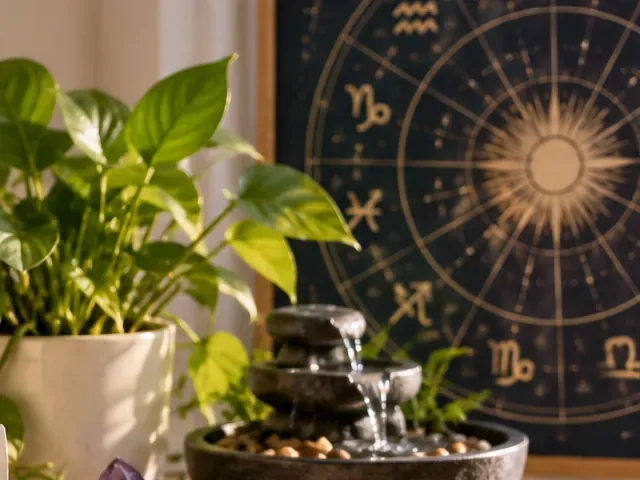
A calm indoor arrangement pairs greenery and flowing water with a zodiac wheel, illustrating how physical space and astrological symbolism can be used together as a reflective planning theme.
What should you decide before changing your space?
Start with the result you want, not with a lucky object. A useful 2027 plan should answer four questions: What feels difficult now? Which room or surface contributes to that difficulty? What small change could improve it? How will you know whether the change helped?
Goal
Useful space to examine
Observable sign of improvement
More calm
Bedroom, entryway, evening lighting
Less visual overload, easier wind-down, fewer misplaced essentials
Better focus
Desk, study area, charging station
Longer uninterrupted work periods and less time searching for tools
Stronger relationships
Dining area, living room, shared surfaces
More comfortable conversation and fewer conflicts over clutter or storage
More creativity
Studio, desk, hobby shelf
Projects are easier to start and supplies are easier to reach
Better money habits
Paperwork area, bills, budget tools
More consistent tracking, fewer late payments, clearer spending decisions
This approach keeps the symbolic layer in perspective. A plant, color, crystal, fountain, or zodiac object can be meaningful, but it should support the function of the room rather than replace it.
How should feng shui and Western astrology be combined?
Carefully. They come from different traditions. Feng shui is a Chinese geomantic and architectural tradition concerned with relationships among people, buildings, orientation, landscape, and environmental flow. UNESCO’s description of the Citadel of the Ho Dynasty, for example, notes that the site was planned according to feng shui principles in relation to mountains, rivers, and the surrounding landscape.
Western astrology organizes symbolic interpretation around zodiac signs and planetary positions. It should not be confused with astronomy. NASA explains that astronomy is evidence-based science, while astrology is a belief system whose predictive claims are not supported by scientific evidence; see NASA’s overview of constellations and the distinction between astronomy and astrology.
For that reason, the sign-by-sign recommendations below are a modern practical synthesis, not a claim that classical feng shui assigns a particular room treatment to each Western Sun sign. Use your sign as a prompt for attention: What tendency do you want to strengthen, moderate, or make easier in daily life?
2027 quick reference: what should each zodiac sign focus on?
Sign
2027 intention
Feng shui-inspired practical move
What to watch
Aries
Momentum without constant urgency
Clear the main path from the door to your work area and create one visible “launch zone” for the project that matters most.
If you keep starting new tasks without finishing current ones, reduce what is visible rather than adding more motivational objects.
Taurus
Comfort that supports stability
Improve one seating or rest area with durable natural textures, good lighting, and uncluttered walking space.
Comfort should not turn into accumulation. If the room feels crowded, remove before you decorate.
Gemini
Clearer information flow
Consolidate chargers, notebooks, mail, and frequently used devices into one organized communication station.
If your attention still fragments, reduce notifications and visible media sources rather than reorganizing them again.
Cancer
A more restorative home base
Protect the bedroom from work spillover. Move laptops, bills, and unfinished work out of the sleep area when possible.
Judge the change by sleep quality and evening tension, not by whether the room looks “spiritual.”
Leo
Creative visibility with substance
Create a well-lit place to make or display one completed piece of work, instead of filling the room with unfinished ideas.
If display becomes performance pressure, shift attention back to the work surface and the making process.
Virgo
Order that saves time
Choose storage based on frequency of use. Keep daily tools accessible and archive rarely used items out of sight.
If organizing takes more time than the activity itself, simplify the system.
Libra
Better balance in shared spaces
Arrange seating so conversation feels natural, then clear the dining or coffee table enough that people can actually use it.
If the room looks balanced but no one uses it, prioritize comfort, acoustics, and practical access over symmetry.
Scorpio
Privacy and deeper concentration
Create one low-distraction corner and secure storage for private papers, devices, or emotionally significant items.
If the space feels isolating, add better light or an easy transition back into shared areas.
Sagittarius
Expansion without chaos
Give travel plans, books, courses, and learning materials a defined shelf or board instead of spreading them throughout the home.
If inspiration produces too many commitments, limit the visible plan to the next one or two priorities.
Capricorn
Sustainable ambition
Improve your work zone, then create an end-of-day closure ritual: clear the desk, store paperwork, and shut down work devices.
If work keeps occupying rest time, the problem may be boundaries rather than décor.
Aquarius
Innovation with less digital noise
Centralize charging, cables, and smart-home controls, and keep at least one nearby surface free of electronics.
If technology adds friction, remove or automate a device rather than adding another one.
Pisces
Imagination with grounding
Contain creative supplies in easy-to-reach storage and build one calm sensory corner with comfortable light and minimal visual clutter.
If soft lighting makes you sleepy when you need to work, separate the relaxation and creation zones.
Can you use the four Western elements as a shortcut?
Yes, as long as you treat this as an organizational shortcut rather than traditional feng shui doctrine. Western astrology groups the signs into Fire, Earth, Air, and Water. Classical Chinese cosmology uses a different Five Phases framework: Wood, Fire, Earth, Metal, and Water. They are not interchangeable systems.
Fire signs — Aries, Leo, Sagittarius: emphasize clear action, visible priorities, and enough open space to move.
Earth signs — Taurus, Virgo, Capricorn: emphasize durability, storage, maintenance, and routines that reduce friction.
Air signs — Gemini, Libra, Aquarius: emphasize communication, light, flexible layouts, and control of information clutter.
Water signs — Cancer, Scorpio, Pisces: emphasize privacy, sensory comfort, emotional restoration, and boundaries between work and rest.
Which “positive energy” changes have practical evidence behind them?
1. Reduce stressful clutter before buying symbolic objects
A frequently cited home-environment study followed 60 dual-income spouses and found that women who described their homes with more “cluttered” or “unfinished” language showed less favorable daily cortisol patterns and worsening mood across the day. The study does not prove that removing a pile of objects will automatically reduce stress, and its sample was limited, but it supports a useful principle: the way a home is experienced can relate to stress. You can read the original study record at PubMed.
Practical use: before adding crystals, mirrors, coins, statues, or “lucky” décor, clear one surface that repeatedly causes frustration. If daily life becomes easier, that is a meaningful result.
2. Treat light as a functional tool, not just an aesthetic choice
Light has a direct relationship with circadian timing, alertness, and sleep. CDC/NIOSH guidance notes that brighter light during the day can support alertness, while reducing bright light before bedtime can make it easier to fall asleep. See the agency’s guidance on light and circadian rhythms.
Practical use: brighten work and morning zones, especially with daylight where available, and keep the bedroom darker and less stimulating at night. If a feng shui-inspired lamp, curtain change, or furniture move helps you manage light better, it is doing real practical work.
3. Keep sleep spaces simple
CDC/NIOSH also recommends a sleep environment that is dark, quiet, cool, and comfortable. Its sleep guidance advises limiting disturbances and keeping the bedroom oriented toward rest.
Practical use: if your astrological theme for 2027 is “renewal” or “emotional safety,” improving sleep conditions is more defensible than relying on a particular color or object to create that outcome.
What about mirrors, crystals, fountains, plants, candles, and lucky objects?
Use them if they improve the room for you, but separate symbolic meaning from measurable effects.
Mirrors: useful for light and spatial perception, but poorly placed mirrors can create glare or visual distraction. In bedrooms, notice whether reflections interfere with rest.
Crystals and lucky objects: can serve as reminders of an intention. There is no reliable evidence that they attract money, love, or health outcomes on their own.
Water features: may provide a soothing sound for some people, but they require cleaning and can be annoying in a quiet room. Do not add one if maintenance, moisture, or noise becomes a problem.
Plants: can make a space feel lively, but choose species that match your available light, maintenance habits, and pet safety needs.
Candles and incense: may help establish a ritual atmosphere, but fire safety and indoor-air considerations come first. Never leave flame unattended.
How can you use the 2027 Fire Goat theme without overcomplicating it?
If the Fire Goat symbolism resonates with you, treat it as a yearly design prompt rather than a prediction. “Fire” can remind you to increase visibility, warmth, creativity, or deliberate action. “Goat” can serve as a prompt for gentleness, community, craft, or a calmer pace. Those meanings are interpretive, not scientific outcomes.
A restrained approach works best: choose one annual theme and reflect it in a functional change. For example, “warmth” might mean improving evening lighting in the living room. “Creativity” might mean leaving a sketchbook accessible. “Community” might mean making the dining table usable again. “Calm” might mean removing a work setup from the bedroom.
2027 positive-energy checklist
Define one result you want: calm, focus, creativity, connection, or financial organization.
Choose the one room that most affects that result.
Remove one recurring source of clutter or friction before adding anything new.
Add no more than one or two symbolic items at first.
Use your zodiac sign as a reflection prompt, not as a rule you must obey.
Track the result for two to four weeks using a simple observable measure.
Change course if the setup increases maintenance, distraction, expense, or stress.
How do you know whether the approach is working?
Look for behavior and experience, not coincidences. “I found money after moving a plant” is not a reliable test. “I now review my budget every Friday because the paperwork has a clear home” is.
Desired outcome
Good evidence in daily life
When to change the approach
Calm
You settle down more easily and the room feels less demanding
You added so many objects that cleaning and maintenance increased
Focus
You start work faster and interrupt yourself less often
The redesigned desk looks attractive but creates glare, discomfort, or cable clutter
Connection
Shared areas are easier to use and invite conversation
The layout prioritizes symmetry or symbolism over comfortable seating
Creativity
Materials are accessible and you finish more small projects
The room becomes a storage area for unfinished ideas
Financial clarity
Bills, records, and budgeting become easier to manage
You are spending heavily on “wealth cures” instead of improving financial habits
What are the limits of this guide?
Feng shui has genuine historical and cultural importance, including documented influence on architecture and landscape planning. Astrology also has a long cultural history. Neither, however, should be presented as a scientifically established way to predict personal events or guarantee health, wealth, relationships, or luck.
This guide therefore uses both traditions as tools for reflection and environmental intention. The practical recommendations—reducing friction, managing light, improving sleep conditions, keeping pathways usable, organizing work materials, and monitoring how a space functions—stand on their own even if you do not believe in astrological prediction or metaphysical energy.
For major renovations, electrical changes, structural work, ventilation problems, mold, accessibility needs, or health concerns, use qualified professionals and established safety guidance. Symbolic placement should never override building codes, fire safety, sound sleep practices, or basic financial judgment.
The most useful 2027 rule: make the space support the life you want to practice
You do not need to redesign your entire home for 2027. Pick one meaningful outcome, use your zodiac sign as a prompt if it helps, borrow selectively from feng shui’s emphasis on relationship between people and place, and then judge the result by what actually changes in daily life.
A positive-energy space is successful when it becomes easier to rest, think, create, connect, or manage your responsibilities. If a symbolic object supports that purpose, keep it. If it adds clutter, expense, or anxiety, change the approach. That practical feedback loop is more useful than chasing a perfect arrangement.