Home
» Horoscope
»
October 2026 Haircut Moon Calendar Q&A: Which Days Suit Growth, Shape or Low Maintenance?
October 2026 Haircut Moon Calendar Q&A: Which Days Suit Growth, Shape or Low Maintenance?
Quick answer: If you enjoy using moon lore as a planning tradition, the waxing-Moon window in October 2026 is October 11–25, often chosen for a trim while growing hair out. For a cut you hope will feel lower-maintenance as it grows, lunar calendars commonly point to the waning-Moon periods, October 1–2, October 4–9, and October 27–31. These are folklore-based date suggestions, not proven ways to change how quickly hair grows or how long a haircut keeps its shape. The actual phase dates are October 3 (last quarter), October 10 (new Moon), October 18 (first quarter), and October 26 (full Moon), based on U.S. Naval Observatory times in UTC.
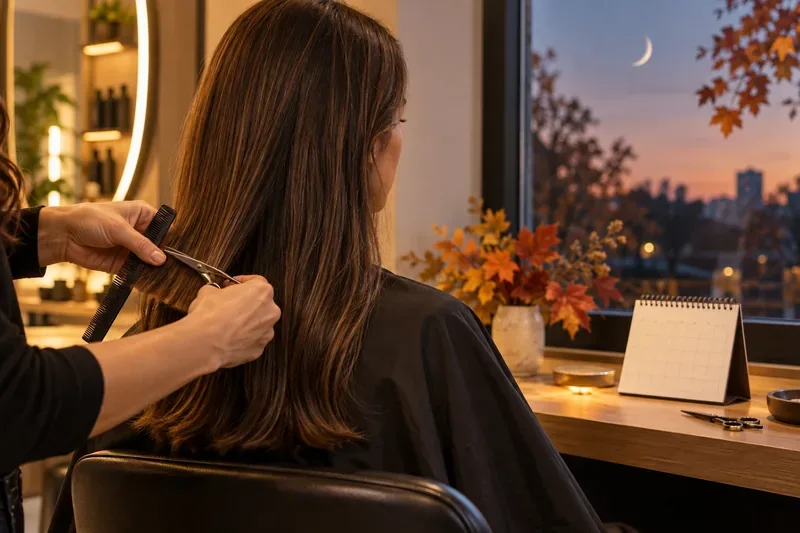
A stylist trims long hair in a salon while a blank calendar and autumn leaves sit by the window.
Which October dates are best for hair growth?
In traditional moon calendars, a waxing Moon—the period from new Moon toward full Moon—is associated with growth. If that symbolism helps you choose a date, the waxing-Moon period in October 2026 runs from October 11 through October 25. The new Moon occurs on October 10 at 15:50 UTC and the full Moon on October 26 at 04:12 UTC. Because the full Moon happens shortly after midnight in U.S. Eastern Daylight Time, some western U.S. time zones will still be on October 25 at that instant; the dates above use the UTC sequence as the reference.
Phase
U.S. Naval Observatory (UTC)
Eastern Daylight Time
Last quarter
October 3, 13:25
October 3, 9:25 a.m.
New Moon
October 10, 15:50
October 10, 11:50 a.m.
First quarter
October 18, 16:12
October 18, 12:12 p.m.
Full Moon
October 26, 04:12
October 26, 12:12 a.m.
Eastern times are shown for a U.S. reference. Because phase moments are worldwide instants, the full Moon falls at 9:12 p.m. Pacific Daylight Time on October 25; check the local date if you live in a western time zone.
A haircut cannot make hair grow from the follicle faster. Hair grows from follicles in the scalp, while scissors remove only the visible shaft. Cleveland Clinic explains that a haircut does not speed growth; regular trims can help remove split ends and reduce breakage, which may help you retain length. So, if your goal is longer hair, a waxing-Moon date can be a personal ritual, but gentle care and avoiding breakage are more relevant to the length you keep.
What dates suit a low-maintenance cut?
Moon-calendar traditions often connect the waning Moon—the period after full Moon and before new Moon—with slower growth or a style that holds its shape longer. In October, that gives the waning-Moon spans run October 1–9 and October 26–31. If you prefer to skip the exact phase dates, choose October 1–2 or October 4–9 before the new Moon, or October 27–31 after the full Moon. Some calendars may interpret the dates differently, so use these as a simple phase-based option rather than a universal rule.
“Low maintenance” depends more on the haircut than the Moon. A blunt bob, a short fringe, a close fade, and long layers each need different upkeep. Hair texture, curl pattern, styling habits, and how quickly your hair visibly changes the outline also matter. If you want fewer salon visits, ask your stylist which length and shape will grow out gracefully for your hair type. A date in a waning window may fit the tradition; a cut designed for your routine is what makes the result practical.
Are there dates to avoid?
Some moon calendars treat the exact phase days—October 3, 10, 18, and 26—as days to skip or use cautiously because the Moon is changing from one phase to another. There is no established scientific reason to avoid a haircut on those dates. The phase itself is an astronomical event, but claims that cutting hair on a particular phase changes growth, thickness, or the haircut’s durability have not been demonstrated by the phase calendar.
If you like having a simple rule, avoid those four dates and choose another day in the window for your goal. If a convenient appointment falls on one of them, there is no evidence-based need to reschedule. A stylist’s availability, your budget, and whether you have enough time to discuss the cut are more useful deciding factors.
How should you choose between growth, shape, and convenience?
Start with the outcome you care about. A trim while growing out your hair is different from reshaping bangs or maintaining a short cut. Then decide whether moon timing is meaningful to you. The calendar can be a small preference among several; it cannot predict how a specific haircut will sit or how fast your hair will grow.
Your priority
Moon-calendar option
What matters in practice
Grow out length
October 11–25 (waxing)
Ask for only the amount of trimming needed to remove damaged ends; reduce breakage between appointments.
Keep a style looking neat longer
October 1–2, 4–9, or 27–31 (waning; skipping exact phase dates)
Choose a shape that grows out well for your texture, routine, and usual time between appointments.
Get the cut done soon
Any open date that works, including a phase date
Book a stylist who understands your goal and bring a clear reference photo if useful.
What would this look like for a real schedule?
Imagine that Alex has shoulder-length curls, wants to keep growing them, and usually trims only when the ends feel rough. This is a hypothetical example, not a report of a real client or a test. Alex could choose October 14, within the waxing-Moon period, because the traditional association with growth feels motivating. At the appointment, Alex would explain the length goal and ask the stylist to assess split ends rather than request a larger cut solely because of the date.
If the ends are healthy and the appointment is not needed yet, Alex could wait. If the hair is breaking or the shape is bothering them, an earlier appointment may make more sense, regardless of lunar phase. A calendar should support a decision, not create pressure to cut hair on a supposedly perfect day.
Do moon phases affect haircut results?
The dates and times of the Moon’s principal phases can be calculated and checked. The suggested links between a phase and hair growth or style longevity belong to cultural and astrological traditions; they are not established hair-care science. The U.S. Naval Observatory’s phase calendar verifies the October dates, but it does not assign haircut outcomes to them.
In short, use October 11–25 if you prefer the waxing-Moon tradition for a growth-focused trim; use October 1–2, 4–9, or 27–31 if the waning-Moon tradition suits a lower-maintenance goal and you prefer to skip exact phase dates. Treat all four ranges as optional. The best appointment is one that matches the cut you want, your hair’s condition, and your schedule.