01. Quick Answer
The most reasonable AEX 2030 forecast is constructive, but it depends on whether Dutch quality leadership broadens beyond semiconductor enthusiasm
The AEX closed at 1,010.44 on 2026-05-15, up from 435.88 at the start of its 10-year Yahoo Finance monthly series on 2016-06-01, for a price-only CAGR of about 8.77% (Yahoo Finance 10-year history; recent daily closes). That historical gain already reflects a major rerating in Dutch large caps, especially around semiconductor and quality-growth names.
A serious 2030 framework therefore needs to separate historical compounding from forward-looking drivers. OECD snapshots and the IMF 2025 Article IV both describe the Dutch economy as resilient but not immune to external trade shocks, housing constraints, and labor shortages. That makes a scenario range more defensible than a single heroic target.
| Point | Why it matters |
|---|---|
| The AEX is more concentrated than its calm reputation suggests | ASML, Shell, Prosus, RELX, Adyen, and other large weights can swing the whole benchmark. |
| Semiconductors still set the tone | ASML remains a genuine structural asset, but its weight also raises concentration risk. |
| Dutch defensives add resilience | RELX, Wolters Kluwer, Ahold Delhaize, and Unilever help prevent the index from being only a chip trade. |
| 2030 should be framed as scenarios | Available data suggests upside remains plausible, but valuation and export sensitivity matter. |
02. Historical Context
The AEX has already compounded well, so the 2030 debate is about quality and concentration rather than recovery from distress
The AEX closed at 1,010.44 on 2026-05-15, up from 435.88 at the start of its 10-year Yahoo Finance monthly series on 2016-06-01, for a price-only CAGR of about 8.77% (Yahoo Finance 10-year history; recent daily closes). That is a strong 10-year run for a mature European benchmark, and it means the AEX is no longer a neglected market in need of simple rerating.
Euronext's AEX factsheet shows an index shaped by semiconductors, information services, energy, payments, internet exposure through Prosus, and defensives. That mix matters because the AEX is not a clean domestic Netherlands GDP trade. It is a concentrated basket of globally exposed Dutch and Netherlands-listed champions.
Historical context also warns against lazy extrapolation. A decade helped by lower discount rates, semiconductor scarcity, and global digitalization is unlikely to repeat in identical form. The more realistic question is whether the AEX can keep compounding from a much higher base through earnings quality, not simply through multiple expansion.
| Metric | Latest reading | Why it matters |
|---|---|---|
| Current index level | 1,010.44 | Anchors every forecast to the latest available close instead of an older cycle high. |
| 52-week range | 882.42 to 1,036.02 | Shows that Amsterdam is already near the top of its recent range, so upside now needs earnings support. |
| 10-year start point | 435.88 | Creates discipline around long-run compounding assumptions. |
| Editorial base range | 1,180-1,320 | Scenario ranges are more credible than one-number forecasts in a concentrated European index. |
| Feature | Implication | Forecast effect |
|---|---|---|
| Semiconductor concentration | ASML and chip-adjacent sentiment carry unusual weight | AI and export controls matter more here than in many peer benchmarks. |
| Global revenue mix | Shell, RELX, Prosus, Adyen, and Unilever depend heavily on non-Dutch demand | Dutch GDP alone does not determine the index path. |
| High quality software and information services | RELX, Wolters Kluwer, and Adyen support recurring-revenue resilience | Can cushion drawdowns better than a pure cyclical market. |
| Defensive and cyclical mix | Healthcare, staples, finance, and semis coexist | Leadership can rotate sharply as macro conditions change. |
03. Main Drivers
Five structural forces are most likely to shape the Dutch benchmark into 2030
1. Semiconductor capital spending and export policy. ASML remains the most obvious AEX driver. If AI infrastructure spending stays strong and export-control constraints remain manageable, the AEX retains a rare structural growth engine for Europe.
2. Software, information, and recurring revenue resilience. RELX and Wolters Kluwer matter because they reduce dependence on cyclical industry and provide high-quality cash flow.
3. Fintech and digital commerce execution. Adyen and Prosus create upside if payments, classifieds, and e-commerce monetization remain healthy, but they also increase sensitivity to global growth sentiment.
4. Energy and global macro sensitivity. Shell keeps commodity and geopolitical exposure inside the index even when technology gets the headlines.
5. The Dutch macro base still matters at the margin. DNB still sees growth, but with uncertainty around trade and investment. That is good enough for support, not enough for complacency.
04. Institutional Forecasts and Analyst Views
Official macro projections are constructive but moderate, so the AEX still needs company-level execution to justify a higher 2030 range
The public institutional backdrop is not euphoric. OECD and IMF work suggests the Dutch economy should remain resilient, but labor tightness, trade exposure, and housing-related bottlenecks still cap the macro narrative.
That is why analysts remain divided. The evidence is mixed: ASML gives Amsterdam a world-class technology franchise, while RELX and Wolters Kluwer provide quality defensiveness. But the index is concentrated enough that any slowdown in semiconductors or global digital spending can still matter materially. The most defensible 2030 estimate is therefore a range modestly above current levels, not a certainty call.
| Source | What it says | Implication for AEX |
|---|---|---|
| OECD | Dutch growth should continue, but not at a boom pace | Supports a constructive but measured market outlook. |
| IMF | The Netherlands remains resilient but externally exposed | Confirms that global trade and technology matter heavily for the index. |
| DNB | The economy keeps growing despite global uncertainty | Helps the base case, but still leaves room for valuation swings. |
| Company updates | ASML, RELX, Wolters, Adyen, Shell, and Prosus all provide identifiable drivers | Index-level upside can continue even without an aggressive macro boom. |
05. Scenarios, Risks, and Invalidation
Bull, bear, and base cases imply a 2030 range rather than a single deterministic endpoint
Bullish scenario
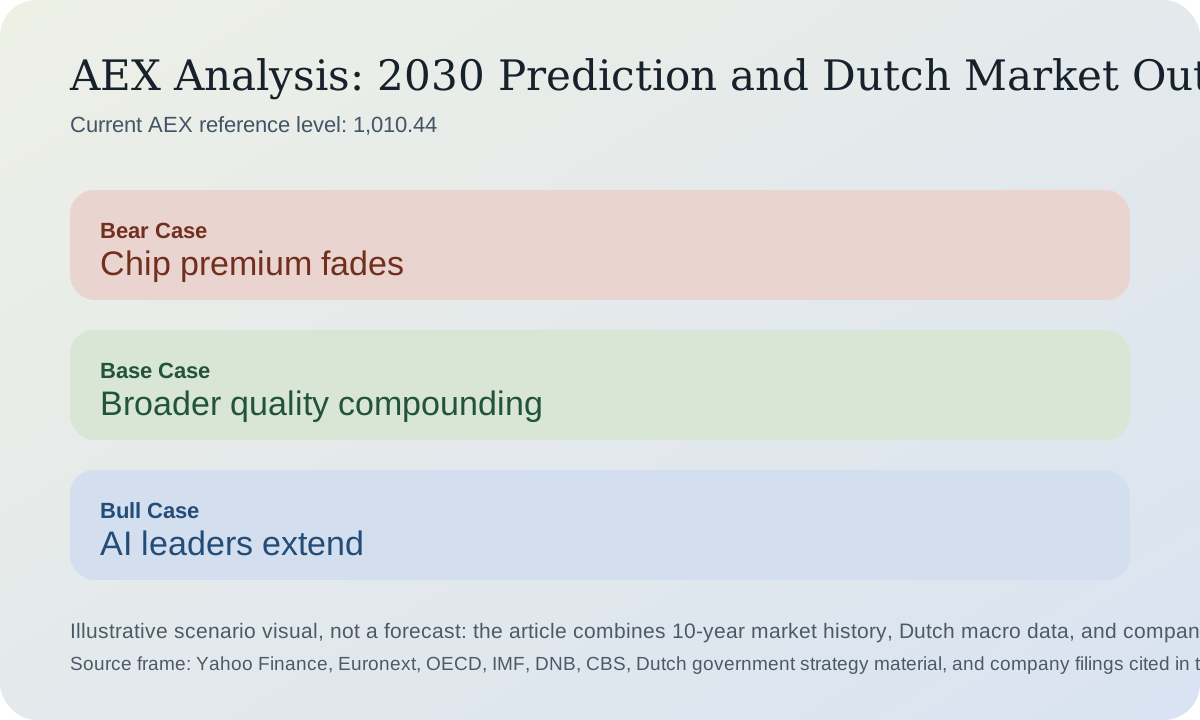
The bull case for 2030 is roughly 1,350 to 1,500. This scenario depends heavily on ASML staying in a long AI-capex upcycle, digital-information businesses sustaining premium multiples, and Dutch macro conditions remaining stable enough to avoid a broader European risk-off rerating.
Bearish scenario
The bear case is 900 to 1,020. That path would likely need a semiconductor slowdown, export-control or tariff friction, softer global growth, and multiple compression in expensive quality names.
Base-case scenario
The base case is 1,180 to 1,320. That assumes moderate earnings growth, some leadership broadening beyond semiconductors, and no serious macro-policy accident.
Risks to watch
Watch semiconductor order trends, export-control policy, consumer spending in Europe, digital-advertising and payments momentum, and whether energy-price shocks pressure valuation sentiment.
What could invalidate the forecast
This range would be too optimistic if the AEX remains far more dependent on one or two growth franchises than expected. It would be too conservative if AI-driven capital spending keeps feeding ASML and adjacent quality names for longer than today’s market assumes.
Conclusion
The most credible AEX 2030 outlook is constructive, but not carefree. Amsterdam still offers rare quality assets for Europe, yet concentration risk means the market should be modeled with scenarios rather than slogans.
Disclaimer: This article is for research and informational purposes only. Scenario ranges are editorial judgments based on public information, not guarantees or personalized investment advice.
| Scenario | Range | Key conditions | Probability |
|---|---|---|---|
| Bull | 1,350-1,500 | AI-capex strength, resilient quality multiples, and stable Dutch macro conditions | 25% |
| Base | 1,180-1,320 | Moderate compounding and broader leadership | 50% |
| Bear | 900-1,020 | Chip slowdown and multiple compression | 25% |
| Path | Estimated probability | Why |
|---|---|---|
| Rising from current levels by 2030 | 55% | The index still contains world-class compounders with real global pricing power. |
| Falling below current levels by 2030 | 20% | A lower 2030 level likely needs both semiconductor weakness and broader quality de-rating. |
| Moving broadly sideways | 25% | Valuation pressure can offset earnings growth in mature quality markets. |
06. Investor Positioning
Different investor profiles should approach the AEX differently into 2030
| Investor type | Cautious approach | What to watch |
|---|---|---|
| Investor already in profit | Hold core exposure but trim if ASML or other growth names have made the position too concentrated. | Chip-capex updates, valuation, and whether leadership broadens. |
| Investor currently at a loss | Separate entry timing from thesis quality before averaging down. | If the thesis depends only on semiconductors, concentration risk is the issue. |
| Investor with no position | Build exposure in stages or wait for pullbacks instead of chasing quality at any price. | Relative valuation and the balance between growth and defensives. |
| Trader | Use stop-losses and trade around earnings, export-control headlines, and macro data. | Short-term volatility in ASML, Adyen, Prosus, and Shell can move the whole index. |
| Long-term investor | Dollar-cost averaging is more defensible than all-in timing calls. | Total return, concentration, and sector balance over time. |
| Risk-hedging investor | Use hedges and rebalance rather than assuming a quality-heavy index is inherently defensive. | Semiconductor cycle risk and global growth shocks. |
07. FAQ
Frequently asked questions about the AEX outlook
Is the AEX basically an ASML trade?
Not entirely, but ASML is influential enough that semiconductor sentiment can shape the whole benchmark more than casual observers expect.
Why use scenario ranges instead of one 2030 target?
Because the index is concentrated, export sensitive, and valuation sensitive. A range is more credible than false precision.
What matters most right now for the AEX?
Semiconductor capex, export-control policy, digital commerce trends, and whether defensive compounders keep supporting the index if growth stocks wobble.
References
Sources
- Yahoo Finance chart API for ^AEX, 10-year monthly history
- Yahoo Finance chart API for ^AEX, recent daily closes
- Euronext AEX index factsheet
- Euronext Amsterdam market page
- OECD economic snapshot for the Netherlands
- OECD Economic Survey of the Netherlands 2025
- IMF 2025 Article IV consultation for the Netherlands
- De Nederlandsche Bank economic outlook, March 2026
- Statistics Netherlands consumer prices archive
- Dutch government Semiconductor Vision 2035
- Dutch government Generative AI vision
- Dutch Authority for the Digital Infrastructure AI supervision update
- ASML Q1 2026 results
- Adyen Q1 2026 business update
- ING Q1 2026 results
- ABN AMRO Q1 2026 results
- RELX trading update 2026
- Wolters Kluwer 2026 trading update
- Shell first quarter 2026 results
- Philips Q1 2026 results
- Prosus annual results 2026