01. Quick Answer
The most realistic 2035 AEX forecast is higher than today, but the path depends on quality persistence more than on Dutch macro excitement
The AEX closed at 1,010.44 on 2026-05-15, up from 435.88 at the start of its 10-year Yahoo Finance monthly series on 2016-06-01, for a price-only CAGR of about 8.77% (Yahoo Finance 10-year history; recent daily closes). That is a strong decade for a developed-market index, but it also means 2035 cannot be treated as a simple continuation of the same cycle.
The long-range evidence base is mixed in a useful way. OECD analysis and the IMF both support the idea that the Netherlands should remain institutionally strong and innovative, yet still exposed to external demand, housing, labor scarcity, and global trade regimes. That combination argues for constructive long-term compounding, but in a wide range.
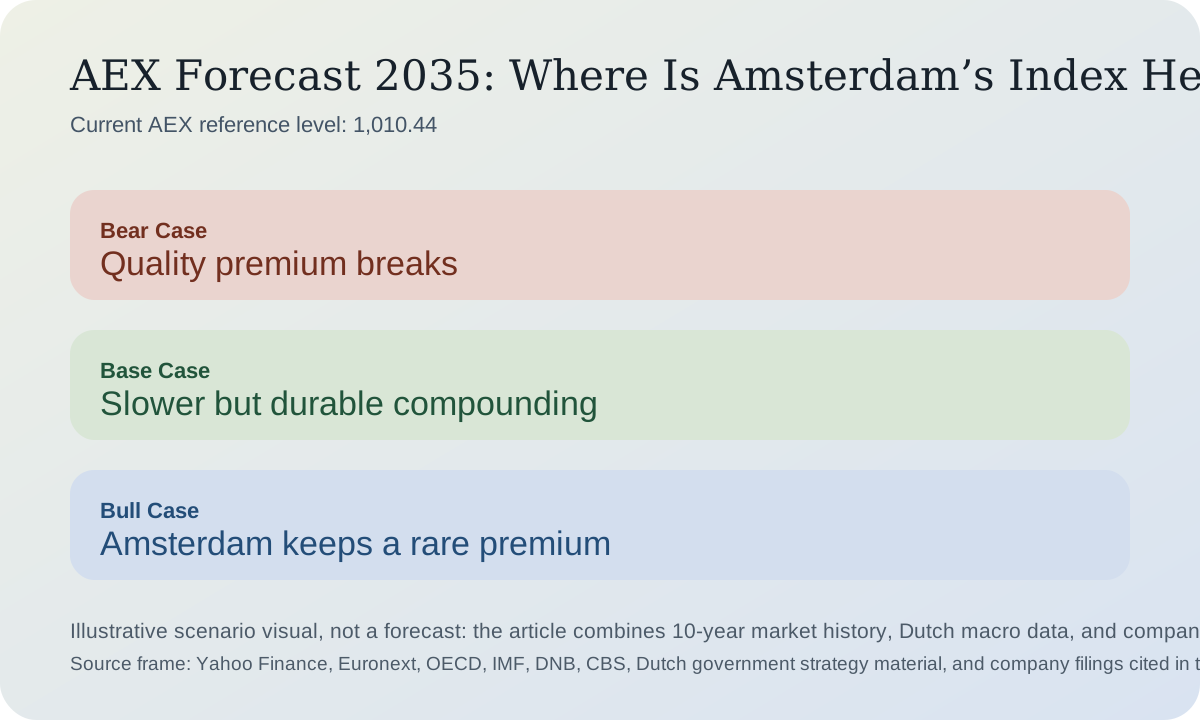
| Point | Why it matters |
|---|---|
| 2035 is a regime question, not a short-term target | Semiconductors, AI, trade policy, and valuation discipline matter more than one quarter of results. |
| Dutch quality can still compound | RELX, Wolters Kluwer, ASML, and Adyen give Amsterdam a stronger quality profile than many European peers. |
| The bear case is still real | Concentration risk means a mature quality index can still underperform for years if growth narratives cool. |
| Total return matters more than the headline price chart | Cash generation, buybacks, and reinvestment discipline support long-run outcomes even without endless multiple expansion. |
02. Historical Context
The last decade proves the AEX can rerate hard, but a nine-year forecast needs a slower and more disciplined logic
The AEX closed at 1,010.44 on 2026-05-15, up from 435.88 at the start of its 10-year Yahoo Finance monthly series on 2016-06-01, for a price-only CAGR of about 8.77% (Yahoo Finance 10-year history; recent daily closes). The significance of that run is not only that the index climbed. It is that the climb was driven by genuinely differentiated assets, especially ASML and several recurring-revenue franchises.
Euronext's factsheet shows a benchmark that is not a commodity-heavy value index and not a US-style platform index either. It sits somewhere in between, with quality growth, information services, payments, consumer franchises, and energy all contributing. That matters because 2035 upside may come from a more diversified quality stack than the market already assumes.
The more cautious historical lesson is that mature quality markets rarely compound in a straight line. Long stretches of sideways performance can coexist with strong business quality when starting valuations are high or when rates shift. A credible 2035 framework must therefore allow for both compounding and valuation compression within the same decade.
| Metric | Latest reading | Why it matters |
|---|---|---|
| Current index level | 1,010.44 | Anchors every forecast to the latest available close instead of an older cycle high. |
| 52-week range | 882.42 to 1,036.02 | Shows that Amsterdam is already near the top of its recent range, so upside now needs earnings support. |
| 10-year start point | 435.88 | Creates discipline around long-run compounding assumptions. |
| Editorial base range | 1,450-1,750 | Scenario ranges are more credible than one-number forecasts in a concentrated European index. |
| Feature | Implication | Forecast effect |
|---|---|---|
| Semiconductor concentration | ASML and chip-adjacent sentiment carry unusual weight | AI and export controls matter more here than in many peer benchmarks. |
| Global revenue mix | Shell, RELX, Prosus, Adyen, and Unilever depend heavily on non-Dutch demand | Dutch GDP alone does not determine the index path. |
| High quality software and information services | RELX, Wolters Kluwer, and Adyen support recurring-revenue resilience | Can cushion drawdowns better than a pure cyclical market. |
| Defensive and cyclical mix | Healthcare, staples, finance, and semis coexist | Leadership can rotate sharply as macro conditions change. |
03. Main Drivers
Six long-range forces are likely to decide where the AEX stands by 2035
1. The semiconductor cycle becomes structural or not. ASML is the single biggest reason the AEX has a unique long-term growth profile in Europe. If AI and advanced chip demand stay investment priorities for years, Amsterdam retains a rare structural premium.
2. AI broadens from hardware into software and information services. RELX and Wolters Kluwer are positioned to benefit from workflow digitization and data-productivity adoption, even if they are not marketed as pure AI names.
3. Payments and digital marketplaces either mature gracefully or compress. Adyen and Prosus can add meaningful upside, but both also raise sensitivity to global risk appetite.
4. Energy transition and geopolitics remain relevant. Shell ensures the AEX never becomes a pure growth benchmark.
5. Dutch policy and European competitiveness matter. The Semiconductor Vision 2035 matters because government support for the ecosystem can reinforce long-term industrial relevance.
6. Valuation discipline still rules. A high-quality index can still deliver poor price returns for long stretches if the starting multiple is too generous.
04. Institutional Forecasts and Analyst Views
The best 2035 framework combines official macro caution with the unusual quality of the AEX leadership group
There are few credible long-dated institutional point targets for the AEX, which is normal. The better evidence base combines OECD, IMF, DNB, and company plans rather than trying to force artificial precision into a nine-year market call.
Analysts remain divided because the evidence is mixed. The AEX has better structural assets than many regional peers, yet it also trades with a higher concentration premium. The long-range base case therefore assumes respectable compounding with several drawdown phases rather than a smooth upward slope.
| Source | What it implies | Why it matters |
|---|---|---|
| OECD and IMF | The Netherlands should remain stable and productive, but still externally exposed | Supports long-run upside without justifying complacency. |
| DNB | Growth continues despite uncertainty | Helps the macro floor, not necessarily the multiple ceiling. |
| Semiconductor Vision 2035 | The Dutch state recognizes the strategic value of the chip ecosystem | Reinforces the long-duration ASML and supplier thesis. |
| Company updates | ASML, RELX, Wolters Kluwer, Adyen, Prosus, and Shell all provide identifiable long-run drivers | AEX performance can rest on multiple earnings channels rather than one macro story. |
05. Scenarios, Risks, and Invalidation
A long-range bull case exists, but the base case still assumes periods of valuation digestion
Bullish scenario
The long-range bull case is 1,800 to 2,100 by 2035. This would likely require an extended semiconductor and AI-infrastructure cycle, durable premium valuations for information-service leaders, and no major Dutch or European competitiveness shock.
Bearish scenario
The bear case is 1,000 to 1,250. That would imply that quality multiples compress materially, semiconductors cool, and the index spends years digesting earlier gains.
Base-case scenario
The base case is 1,450 to 1,750. That assumes moderate earnings growth, recurring cash generation, and periodic drawdowns that do not break the long-run thesis.
Risks to watch
Watch the chip capex cycle, European competitiveness policy, export controls, digital-commerce regulation, and whether the AEX becomes too dependent on a narrow set of expensive growth assets.
What could invalidate the forecast
The range would be too optimistic if semiconductors and high-quality software names both derated at once. It would be too cautious if AI spending and workflow digitization create a broader and longer premium than current markets are pricing.
Conclusion
The most credible 2035 AEX view is constructive, but only inside a broad range. Amsterdam still offers one of Europe’s most interesting large-cap quality mixes, yet concentration and valuation discipline remain central to the outcome.
Disclaimer: This article is for research and informational purposes only. Long-range scenarios are conditional frameworks, not guarantees or personalized advice.
| Scenario | Range | Conditions | Probability |
|---|---|---|---|
| Bull | 1,800-2,100 | AI and semiconductor premium stays durable for most of the decade | 20% |
| Base | 1,450-1,750 | Respectable compounding with periodic deratings | 50% |
| Bear | 1,000-1,250 | Long quality de-rating and slower chip cycle | 30% |
| Direction | Probability | Comment |
|---|---|---|
| Higher than today by 2035 | 60% | Nine years is enough time for high-quality earnings to matter even if valuation compresses at times. |
| Lower than today by 2035 | 15% | This likely requires a material and prolonged technology or quality-growth disappointment. |
| Sideways to moderate gains | 25% | Still plausible because valuation digestion can absorb a lot of business progress. |
06. Investor Positioning
A long horizon changes how investors should think about the AEX
| Investor type | Cautious approach | What to watch |
|---|---|---|
| Investor already in profit | Rebalance concentration and let quality compounders keep a role without dominating the whole portfolio. | Whether performance is too dependent on ASML or one growth factor. |
| Investor currently at a loss | Check if the thesis is long enough to justify holding a quality-heavy index through de-rating phases. | Short-term frustration does not necessarily invalidate a 2035 case. |
| Investor with no position | Use staged entries instead of chasing quality at stretched valuations. | Valuation matters more over a nine-year horizon than headline optimism. |
| Trader | Do not confuse a decade scenario with a short-term setup. | The AEX can remain fundamentally attractive while still correcting sharply over months. |
| Long-term investor | Dollar-cost averaging and periodic rebalancing remain the most defensible approach. | Total return and concentration management. |
| Risk-hedging investor | Pair AEX exposure with explicit hedges if you are uncomfortable with semiconductor-cycle risk. | Export policy, euro strength, and global growth shocks. |
07. FAQ
Frequently asked questions about the AEX outlook
Can the AEX still compound after such a strong decade?
Yes, but probably at a slower pace and with more valuation-driven pauses. Business quality can outlast market enthusiasm.
What matters most over a nine-year horizon?
The persistence of the semiconductor cycle, the strength of recurring-revenue leaders, and whether Dutch competitiveness remains supportive.
Why not give one exact 2035 target?
Because a concentrated index can travel through multiple valuation regimes before 2035, so a range is more credible.
References
Sources
- Yahoo Finance chart API for ^AEX, 10-year monthly history
- Yahoo Finance chart API for ^AEX, recent daily closes
- Euronext AEX index factsheet
- Euronext Amsterdam market page
- OECD economic snapshot for the Netherlands
- OECD Economic Survey of the Netherlands 2025
- IMF 2025 Article IV consultation for the Netherlands
- De Nederlandsche Bank economic outlook, March 2026
- Statistics Netherlands consumer prices archive
- Dutch government Semiconductor Vision 2035
- Dutch government Generative AI vision
- Dutch Authority for the Digital Infrastructure AI supervision update
- ASML Q1 2026 results
- Adyen Q1 2026 business update
- ING Q1 2026 results
- ABN AMRO Q1 2026 results
- RELX trading update 2026
- Wolters Kluwer 2026 trading update
- Shell first quarter 2026 results
- Philips Q1 2026 results
- Prosus annual results 2026