01. Quick Answer
The most likely 2027 AEX path is moderately constructive, but today’s starting point leaves less room for easy upside
The AEX closed at 1,010.44 on 2026-05-15, up from 435.88 at the start of its 10-year Yahoo Finance monthly series on 2016-06-01, for a price-only CAGR of about 8.77% (Yahoo Finance 10-year history; recent daily closes). With the index already close to its recent highs, the short-term case is less about catching up and more about proving that earnings can keep pace with expectations.
The macro backdrop is supportive but not booming. DNB still sees Dutch growth, while OECD and IMF remain measured rather than euphoric. Available data suggests 2027 is more likely to be a year of digestion and selective upside than a one-way melt-up.
| Point | Why it matters |
|---|---|
| The semiconductor cycle matters most in the near term | ASML remains the clearest upside and downside lever for the index. |
| Defensives can stabilize but not fully neutralize volatility | RELX, Wolters Kluwer, and staples help, but they do not erase concentration risk. |
| 2027 should be modeled tactically | A one- to two-year horizon is too short for grand narratives and too long for pure chart-based guessing. |
| Global trade headlines matter for Dutch stocks | Export controls and cross-border demand can move Amsterdam quickly. |
02. Historical Context
The AEX is now operating from strength, which makes 2027 more about consolidation risk than rescue-level upside
The AEX closed at 1,010.44 on 2026-05-15, up from 435.88 at the start of its 10-year Yahoo Finance monthly series on 2016-06-01, for a price-only CAGR of about 8.77% (Yahoo Finance 10-year history; recent daily closes). That historical strength is precisely why near-term forecasting gets harder. A lot of optimism has already been priced, especially in high-quality technology and software-heavy names.
Euronext and company filings suggest that Amsterdam’s leadership still sits with semiconductors, digital commerce, information services, and a handful of defensive multinationals. That is a healthy mix, but it also means the AEX can remain fundamentally strong while producing a flat or choppy 2027 outcome if valuation fatigue sets in.
A 2027 call therefore needs to focus on a small set of observable variables: semiconductor order flow, export-control policy, digital-payments growth, the euro-rate path, and whether defensive quality continues to command a premium.
| Metric | Latest reading | Why it matters |
|---|---|---|
| Current index level | 1,010.44 | Anchors every forecast to the latest available close instead of an older cycle high. |
| 52-week range | 882.42 to 1,036.02 | Shows that Amsterdam is already near the top of its recent range, so upside now needs earnings support. |
| 10-year start point | 435.88 | Creates discipline around long-run compounding assumptions. |
| Editorial base range | 1,030-1,110 | Scenario ranges are more credible than one-number forecasts in a concentrated European index. |
| Feature | Implication | Forecast effect |
|---|---|---|
| Semiconductor concentration | ASML and chip-adjacent sentiment carry unusual weight | AI and export controls matter more here than in many peer benchmarks. |
| Global revenue mix | Shell, RELX, Prosus, Adyen, and Unilever depend heavily on non-Dutch demand | Dutch GDP alone does not determine the index path. |
| High quality software and information services | RELX, Wolters Kluwer, and Adyen support recurring-revenue resilience | Can cushion drawdowns better than a pure cyclical market. |
| Defensive and cyclical mix | Healthcare, staples, finance, and semis coexist | Leadership can rotate sharply as macro conditions change. |
03. Main Drivers
Five near-term forces should dominate Amsterdam into 2027
1. ASML order visibility and AI capex. ASML remains the most important catalyst because the AEX still behaves partly like Europe’s public semiconductor proxy.
2. Export controls and geopolitical friction. Dutch stocks are unusually exposed to technology-export policy for a European benchmark, and that can change sentiment quickly.
3. Defensive quality support. RELX, Wolters Kluwer, and consumer staples can soften the downside if growth names wobble.
4. Payments and internet exposure. Adyen and Prosus can amplify both upside and downside because they are sensitive to global growth sentiment.
5. Energy and rates. Shell and euro-area rate expectations still influence index tone even when technology dominates the narrative.
04. Institutional Forecasts and Analyst Views
The institutional backdrop suggests 2027 should be framed as resilience versus valuation risk, not as a one-way trend
Official sources are not calling for a dramatic Dutch acceleration. OECD, IMF, and DNB all point to growth, but not a boom. That means any 2027 upside probably has to come from stable quality premiums and continued execution by the largest constituents.
The evidence is mixed, which is why scenario analysis remains more credible than certainty language. If AI capex stays strong and defensives keep delivering, the AEX can edge higher. If semiconductors cool and multiples compress, the index can easily spend 2027 moving sideways or lower.
That balance matters for positioning because the AEX is not obviously cheap enough to forgive disappointments. A market can still contain excellent businesses and deliver mediocre one-year returns if the starting multiple is already demanding. For 2027, investors should therefore separate business quality from entry-point quality rather than assuming the two are the same thing. That caution is central to any serious Dutch market forecast.
| Source | Signal | Implication |
|---|---|---|
| ASML | Demand remains structurally important, but the cycle stays watched closely | Still the biggest upside and downside lever. |
| OECD, IMF, DNB | Dutch growth remains positive but moderate | Supports a floor, not an aggressive multiple re-rating. |
| Adyen and Prosus | Digital commerce and payments remain active but sentiment-sensitive | Adds upside optionality and volatility. |
| RELX and Wolters Kluwer | Recurring-revenue defensives remain healthy | Can cushion drawdowns if growth stocks wobble. |
05. Scenarios, Risks, and Invalidation
The 2027 path is narrower and more tactical than long-range AEX forecasts
Bullish scenario
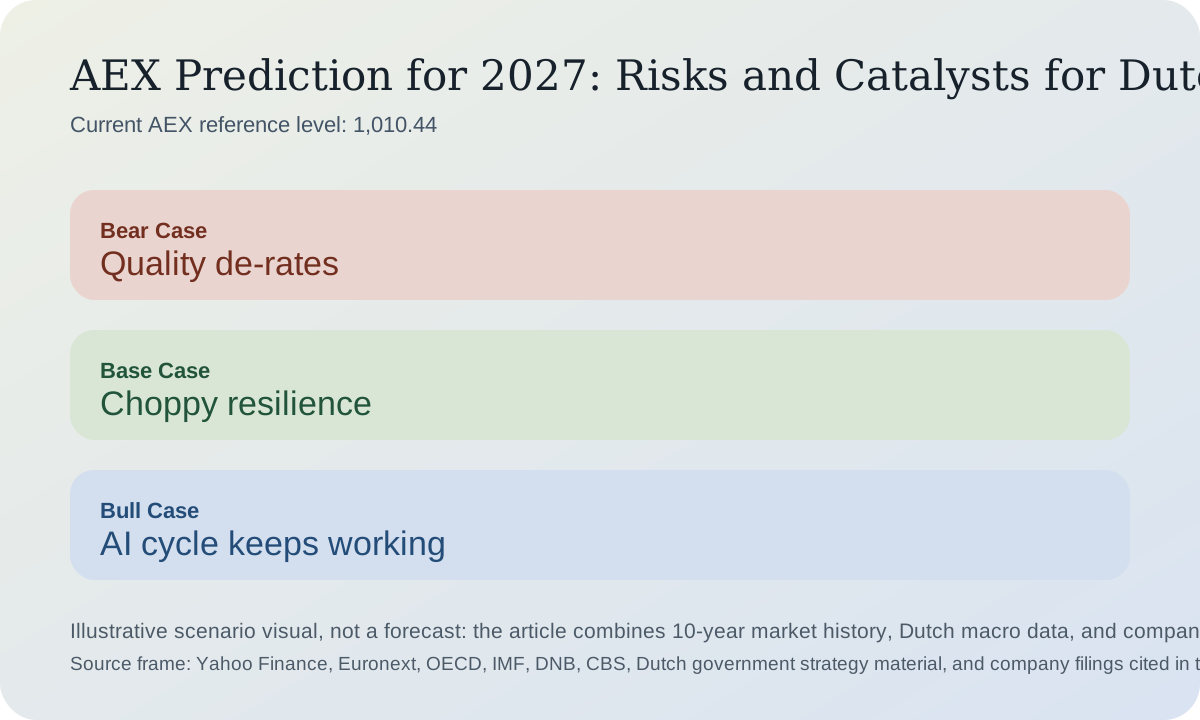
The bull case for 2027 is 1,120 to 1,180. This requires orderly global growth, stable export policy, and enough semiconductor and quality-growth support to justify another leg higher.
Bearish scenario
The bear case is 900 to 980. That likely needs a semiconductor slowdown, valuation compression in premium names, and softer global demand.
Base-case scenario
The base case is 1,030 to 1,110. That implies modest upside from current levels, but with choppier price action and less rerating fuel than earlier in the cycle.
Risks to watch
Watch ASML order commentary, export-control headlines, payments and internet consumer trends, European rates, and whether defensive compounders keep absorbing market stress.
What could invalidate the forecast
This forecast would be too cautious if AI-related capex stays much stronger for longer and the index broadens cleanly beyond semiconductors. It would be too optimistic if valuation discipline finally catches up with expensive quality assets at the same time growth slows.
Conclusion
The most reasonable 2027 AEX forecast is constructive but tactical. Amsterdam still has quality support, yet the market no longer looks cheap enough to assume upside comes easily.
Disclaimer: This article is for research and informational purposes only. It is not a recommendation to buy, sell, or hedge any specific security or index exposure.
| Scenario | Range | Key conditions | Probability |
|---|---|---|---|
| Bull | 1,120-1,180 | Strong AI capex and resilient quality multiples | 25% |
| Base | 1,030-1,110 | Moderate gains with choppy sector rotation | 45% |
| Bear | 900-980 | Chip slowdown and multiple compression | 30% |
| Path | Estimated probability | Why |
|---|---|---|
| Higher into 2027 | 45% | The index still has quality support and strong technology exposure. |
| Lower into 2027 | 30% | The market is near the upper part of its range and remains valuation sensitive. |
| Broadly sideways | 25% | A mature quality market can digest gains while earnings catch up. |
06. Investor Positioning
Near-term positioning should stay disciplined
| Investor type | Cautious approach | What to watch |
|---|---|---|
| Investor already in profit | Use trailing stops or light trimming if gains are dominated by one growth sector. | How much of the portfolio depends on semiconductors or fintech. |
| Investor currently at a loss | Avoid reflex averaging unless the core quality thesis is still intact. | Check whether the loss came from entry timing or valuation overreach. |
| Investor with no position | Wait for pullbacks or build exposure in layers rather than chasing momentum. | There is no need to pay any price for quality. |
| Trader | Trade around earnings, export-control news, and macro catalysts with defined stops. | Short-term headlines can move the AEX quickly. |
| Long-term investor | Use short-term weakness as an accumulation window only if valuation improves and concentration remains acceptable. | Sector balance and total return. |
| Risk-hedging investor | Use explicit hedges if semiconductor-cycle exposure is uncomfortable. | Global trade friction and euro-area growth shocks. |
07. FAQ
Frequently asked questions about the AEX outlook
Why is 2027 mostly a tactical AEX call?
Because one to two years are dominated by the chip cycle, export policy, and valuation swings more than by decade-long structural narratives.
What is the main 2027 downside risk?
A simultaneous semiconductor slowdown and multiple compression in quality-growth names.
What could surprise to the upside?
If AI capex remains strong and the index broadens beyond ASML into information services, payments, and defensives.
References
Sources
- Yahoo Finance chart API for ^AEX, 10-year monthly history
- Yahoo Finance chart API for ^AEX, recent daily closes
- Euronext AEX index factsheet
- Euronext Amsterdam market page
- OECD economic snapshot for the Netherlands
- OECD Economic Survey of the Netherlands 2025
- IMF 2025 Article IV consultation for the Netherlands
- De Nederlandsche Bank economic outlook, March 2026
- Statistics Netherlands consumer prices archive
- Dutch government Semiconductor Vision 2035
- Dutch government Generative AI vision
- Dutch Authority for the Digital Infrastructure AI supervision update
- ASML Q1 2026 results
- Adyen Q1 2026 business update
- ING Q1 2026 results
- ABN AMRO Q1 2026 results
- RELX trading update 2026
- Wolters Kluwer 2026 trading update
- Shell first quarter 2026 results
- Philips Q1 2026 results
- Prosus annual results 2026