01. Historical Context
How Airbus' last decade shapes a 2030 AIR forecast
Airbus is one of the rare industrial companies where the long-term demand case can look obvious while the near-term execution case remains difficult. Airlines still need more fuel-efficient aircraft, the global fleet still needs renewal, and Airbus still holds a historically large commercial backlog. Yet a 2030 AIR forecast cannot just extrapolate demand. It has to judge whether Airbus can convert demand into deliveries, cash flow, and durable earnings despite supply-chain friction, engine shortages, tariffs, and geopolitics (Airbus Global Market Forecast 2025; FY 2025 results).
| Point | Why it matters |
|---|---|
| Demand is not the main debate | The backlog already shows demand. The real question is execution against that demand. |
| Ramp-up quality will drive valuation | Aerospace investors care less about orders than about reliable deliveries and cash flow. |
| Defence and services add resilience | Airbus is more diversified than a pure commercial-aviation story. |
| 2030 should be modeled as scenarios | Too many variables, from engines to trade policy, make one-number forecasts weak. |
Historical context is favorable but not forgiving. AIR.PA rose from roughly EUR 51.73 in May 2016 to EUR 167.68 in May 2026, a price-only CAGR of around 12.48%. The stock peaked near EUR 213.40 in September 2025 before pulling back into 2026 as investors questioned delivery pacing and near-term cash conversion (10-year Yahoo Finance history; recent daily pricing). Even Airbus, with its strong market position, remains highly sensitive to execution confidence.
| Metric | Latest public reading | Why it matters for 2030 |
|---|---|---|
| FY 2025 commercial deliveries | 793 aircraft | Confirms progress, but also underlines that execution still matters more than demand alone. |
| 2025 commercial backlog | 8,754 aircraft | Gives Airbus a long visibility runway for production and revenue. |
| FY 2025 revenues | EUR 73.4 billion | A strong base from which to scale if the ramp-up works. |
| FY 2025 EBIT Adjusted | EUR 7.1 billion | Shows that profitability can remain high in a complex environment. |
| 2026 guidance | Around 870 deliveries, EUR 7.5bn EBIT Adjusted, EUR 4.5bn FCF before customer financing | The market will judge whether Airbus can turn backlog into financial delivery. |
Available data suggests the 2030 thesis is fundamentally constructive, but not linear. Airbus has a stronger structural setup than many industrial peers because the global air-travel and fleet-renewal story is still intact. The main challenge is that aerospace investors have learned not to trust backlog alone. They want proof that the industrial system can actually convert it.
That is why 2030 should be seen as an execution-weighted aerospace outlook rather than a simple demand forecast.
In practical terms, investors should think of Airbus as a company with unusually strong strategic demand but still ordinary industrial constraints. That combination is powerful, yet it also explains why the stock can oscillate between optimism and frustration even when the long-run thesis remains intact.
02. Key Drivers
What will move Airbus shares over the long term
1. Commercial aircraft ramp-up is still the main driver
Management's 2026 guidance still implies a meaningful step up in deliveries, but Q1 2026 showed how uneven the year can look when aircraft handovers are back-end loaded and engines remain constrained (Q1 2026 results). If Airbus proves it can ramp smoothly, the long-term case strengthens materially.
2. Backlog quality gives Airbus unusual visibility
A year-end 2025 commercial backlog of 8,754 aircraft is a genuine strategic asset. It supports multi-year revenue visibility and gives Airbus leverage over a replacement cycle that still looks far from finished (2025 deliveries release).
3. Defence and Space can matter more than some investors think
Airbus is not just a commercial-aviation manufacturer. Defence and Space posted stronger order momentum in 2025, and the geopolitical backdrop in Europe has made defence capacity more strategically important (FY 2025 segment discussion; board report).
4. Industry demand remains supportive
Airbus' own GMF 2025 and Boeing's 2025 CMO both point to large long-term aircraft needs, even if they differ on some assumptions. IATA also expects the airline industry to remain profitable in 2026 despite persistent supply-chain issues (Airbus GMF 2025; Boeing CMO; IATA 2026 airline-profitability outlook).
5. Cash conversion still separates the story from the hype
Q1 2026 free cash flow before customer financing was negative EUR 2.5 billion, mainly because of low deliveries and planned inventory build. That does not break the thesis, but it reminds investors that Airbus is still an industrial execution story, not a pure backlog fantasy.
03. Institutional View
What company guidance and industry research imply for 2030
A serious 2030 AIR forecast should start from institutional signals that are already public. Airbus achieved its 2025 guidance, issued 2026 guidance of around 870 deliveries, around EUR 7.5 billion of EBIT Adjusted, and around EUR 4.5 billion of free cash flow before customer financing. At the same time, the company continues to describe an operating environment shaped by engine shortages, supply constraints, and trade uncertainty (FY 2025 guidance and 2026 targets; Q1 2026 guidance unchanged).
| Input | Current signal | Forecast implication |
|---|---|---|
| Airbus 2026 guidance | Delivery ramp-up still targeted | Supports the constructive side of the long-term range if execution improves. |
| GMF 2025 | Long-run traffic and fleet demand remain strong | Backs the secular demand case into the 2030s. |
| IATA outlook | Airline profitability remains positive, though margins are not huge | Suggests customers still want aircraft, but balance sheets are not unlimited. |
| Boeing CMO | Large industry demand remains industry-wide, not Airbus-only | Confirms the market size while reminding investors competition still matters. |
The evidence is mixed not on whether Airbus has opportunity, but on how efficiently that opportunity will be monetized. That distinction is critical. A backlog-heavy industrial name can still disappoint shareholders if ramp-up friction, inventory build, or cash-conversion slippage persist longer than expected.
That is why this article uses scenario ranges rather than a single target. Airbus' 2030 outlook depends on a chain of execution events, not just one macro theme.
Another reason to stay probabilistic is that delivery trajectories tend to affect more than revenue. They influence supplier confidence, working capital, investor patience, and ultimately how much premium the market is willing to pay for a company with such an enviable order book.
04. Scenarios
Bull, bear, and base cases for AIR.PA into 2030
Bullish scenario
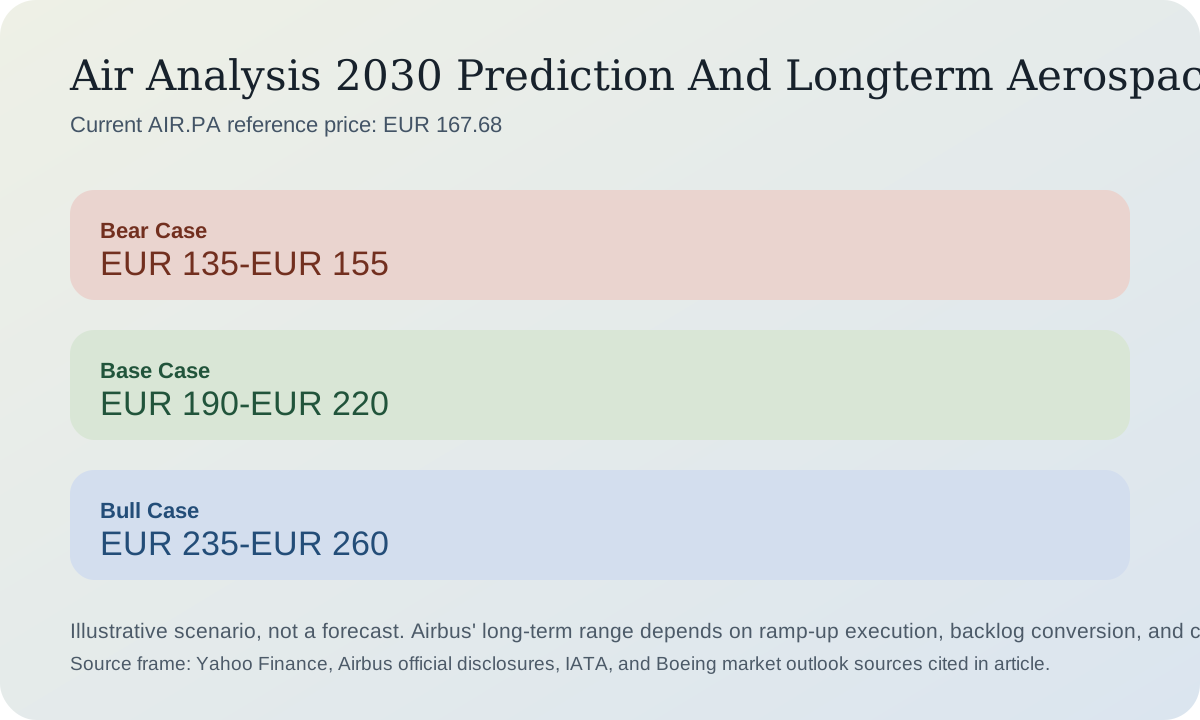
The bull case points to roughly EUR 235 to EUR 260 by 2030. That would likely require Airbus to prove that commercial-aircraft ramp-up can continue with fewer disruptions, that free cash flow normalizes strongly as deliveries rise, and that defence and services contribute more visibly to valuation quality.
Bearish scenario
The bear case points to roughly EUR 135 to EUR 155. That would fit a world where delivery bottlenecks, engine shortages, trade friction, or customer stress keep Airbus from converting demand into the expected level of earnings and cash.
Base-case scenario
The base case is EUR 190 to EUR 220. That assumes Airbus remains the structural winner in a favorable long-term market, but that the valuation continues to reflect industrial complexity rather than treating the stock like a frictionless growth story.
| Path | Editorial probability | Reasoning |
|---|---|---|
| Rising meaningfully by 2030 | 46% | Backlog, demand, and Airbus' competitive position support a constructive long-term path. |
| Moving broadly sideways | 28% | Possible if cash conversion and ramp-up stay frustratingly uneven. |
| Falling meaningfully | 26% | Execution risk is still large enough to matter, especially if the cycle cools. |
| Investor type | Prudent approach | What to watch |
|---|---|---|
| Investor already in profit | Hold core exposure, but trim if AIR has become an oversized cyclical position. | Deliveries, ramp-up quality, and free cash flow. |
| Investor currently at a loss | Reassess whether the original thesis was demand-driven or execution-aware. | Cash conversion and production bottlenecks. |
| Investor with no position | Wait for either a pullback or cleaner evidence that ramp-up is de-risking. | Quarterly deliveries and guidance credibility. |
| Trader | Respect delivery-cycle volatility and earnings-event gaps. | Monthly/quarterly handover cadence and macro risk tone. |
| Long-term investor | Dollar-cost averaging can make sense if expectations stay scenario-based rather than heroic. | Backlog quality, services, and defence momentum. |
| Risk-hedging investor | Do not treat Airbus as a hedge; it is still a cyclical industrial equity. | Airline profitability and trade-policy risk. |
How this forecast range was built: the range combines Airbus' current price, 10-year price history, the scale of the backlog, current guidance, and the observation that aerospace valuations can stay below the theoretical demand opportunity for long periods if industrial friction remains high.
Risks to watch: engine shortages, supply-chain disruption, tariffs, defence execution, airline health, and working-capital pressure during the ramp-up.
What would invalidate the forecast: a major strategic acquisition, a severe aviation demand shock, a surprisingly fast industrial de-bottlenecking, or a structural deterioration in the duopoly economics of commercial aircraft.
Disclaimer: This article is for informational and research purposes only. Scenario ranges are editorial judgments based on public sources, not guarantees or personal investment advice.
On balance, Airbus looks better framed as a high-quality long-term aerospace compounder with stubborn near-term execution risk. That combination can still be attractive, but only if investors respect both halves of the story.
The long-run opportunity is real, but so is the discipline required to own it well.
05. FAQ
Frequently asked questions about Airbus and a 2030 forecast
Is Airbus mainly a growth stock or a cyclical industrial?
It is both. The secular demand story is strong, but the share price still behaves like a cyclical industrial whenever execution or cash conversion wobbles.
Why does backlog not guarantee upside?
Because backlog must still be converted into deliveries, margins, and cash flow, and that conversion is sensitive to the supply chain.
What matters most for a 2030 AIR forecast?
The most important variable is whether Airbus can steadily industrialize the ramp-up without recurring financial frustration.
Could Airbus outperform even if airline profits stay modest?
Yes, because fleet renewal and constrained supply can still support deliveries, but airline stress would eventually matter.
06. Sources
Reference list
- Yahoo Finance chart API for AIR.PA, 10-year monthly history
- Yahoo Finance chart API for AIR.PA, recent daily closes
- Airbus Full-Year 2025 results release
- Airbus First Quarter 2026 results release
- Airbus annual reports page
- Airbus 2025 Report of the Board of Directors
- Airbus financial results page
- Airbus 2025 deliveries and backlog release
- Airbus Global Market Forecast 2025
- Airbus services-market outlook 2026
- IATA 2026 airline profitability outlook
- IATA global outlook for air transport, December 2025
- Boeing Commercial Market Outlook 2025-2044