01. Current Setup
Why the 2027 Airbus forecast is a catalyst question
The 2027 question for Airbus is narrower than the 2030 or 2035 debate. Investors already know the long-run demand case. What they want to know is which specific catalysts can move AIR over the next 12 to 18 months: delivery cadence, supply-chain normalization, cash conversion, defence momentum, and whether management can keep 2026 guidance credible despite a weak first-quarter cash-flow profile.
| Catalyst | Why it matters |
|---|---|
| 2026 delivery execution | The stock still trades heavily on whether Airbus can hit or miss its guidance. |
| Free cash flow recovery | Investors want to see negative Q1 cash flow reverse as deliveries rise. |
| Supply-chain stabilization | Engine and component availability still shape sentiment quickly. |
| Defence and services support | These can cushion commercial volatility if performance remains strong. |
Recent price history shows why 2027 must be framed as a catalyst call. AIR.PA traded above EUR 200 in late 2025 and then fell back toward EUR 167.68 as investors digested softer near-term cash conversion, tariffs, and supply-chain friction (recent Yahoo pricing). That does not mean the long-term thesis broke. It means the market is still demanding fresh proof.
| Metric | Latest reading | 2027 implication |
|---|---|---|
| Q1 2026 revenues | EUR 12.7 billion | Confirms activity remains solid even if deliveries were light. |
| Q1 2026 EBIT Adjusted | EUR 0.3 billion | Shows the quarter was profitable but not strong enough to silence near-term concerns. |
| Q1 2026 FCF before customer financing | EUR -2.5 billion | A reminder that the year is back-end loaded and execution-sensitive. |
| 2026 guidance | Unchanged | Supports a recovery thesis if Airbus delivers strongly through the rest of the year. |
| Commercial backlog | Still exceptionally large | Provides strategic support even when quarterly noise is uncomfortable. |
The evidence is mixed in a classic aerospace way. Demand still looks excellent, but the stock will react much more to actual deliveries and cash flow than to long-run market forecasts over the next year.
That is why 2027 is best treated as a catalyst-driven setup, not a pure secular-growth call.
Near-term shareholders are effectively asking a narrower question than long-term believers are. They are not asking whether global aviation needs more aircraft by 2044. They are asking whether Airbus can make the next few quarters feel materially more dependable than the last few did.
That shift in focus is what turns a strategic winner into a tactical debate.
It also explains why the stock can rally hard on apparently boring developments. A few quarters of cleaner handovers, calmer supplier commentary, and improving cash conversion can do more for AIR than another reminder that the industry needs thousands of aircraft over the next two decades.
02. Catalysts
Five developments that can move AIR over the next 12 to 18 months
1. Hitting or missing the 2026 delivery target
This is likely the single biggest near-term driver. If Airbus stays on track for around 870 deliveries, investor confidence can recover quickly. If slippage appears, the stock may struggle even with a strong backlog.
2. Free cash flow normalization
Q1's negative cash flow is tolerable only if later quarters do the work. Investors will watch whether inventory build and lower early deliveries genuinely unwind as management expects (Q1 2026 results).
3. Pratt & Whitney and broader supply-chain issues
Management explicitly cited engine shortages, which means the operational narrative can change quickly with supplier progress or setbacks.
4. Defence and Space performance
If Defence and Space continues to show momentum, it can strengthen the quality of the near-term thesis and reduce Airbus' dependence on commercial sentiment alone.
5. Market confidence in the aerospace cycle
IATA still expects the airline industry to remain profitable in 2026, which helps the delivery story. But airline margins are not huge, so investors will stay sensitive to any sign of demand fatigue or financing strain (IATA 2026 profitability view).
03. Institutional View
How guidance and industry conditions frame the 2027 range
Near-term institutional thinking on Airbus is best derived from official company guidance and current aviation-market conditions rather than any single outside target. Airbus kept 2026 guidance unchanged after Q1 2026, which is constructive on the surface. But the quarter also highlighted how much depends on the pace of deliveries and the release of working capital later in the year.
| Input | Signal | Why it matters |
|---|---|---|
| FY 2025 results | Record financial performance | Provides a strong starting point. |
| Q1 2026 results | Light deliveries and weak FCF, but guidance unchanged | Keeps both the bull and bear cases alive. |
| GMF 2025 | Secular demand remains robust | Supports the long-term demand floor under the near-term trade. |
| IATA outlook | Airline profitability stabilizes, not surges | Suggests customer demand stays healthy but not risk-free. |
Available data suggests analysts remain divided less on Airbus' strategic quality than on the pace at which current operational friction can ease. That distinction is essential. The company does not need to prove the market exists. It needs to prove the industrial machine can deliver against it smoothly enough for AIR to rerate.
That is why investors should keep the 2027 lens practical rather than ideological. The near-term stock outcome will likely be dominated by execution signals, not by admiration for the duopoly.
In other words, 2027 probably hinges less on being right about Airbus forever and more on being right about the sequence of industrial proof points that arrive over the next several reporting periods.
That sequencing matters because missed proof points can feed each other. A slow delivery quarter can hurt cash flow, which can then increase skepticism about guidance, which in turn can pressure the multiple even if the backlog itself remains outstanding.
04. Scenarios
Bull, base, and bear cases for Airbus in 2027
Bullish scenario
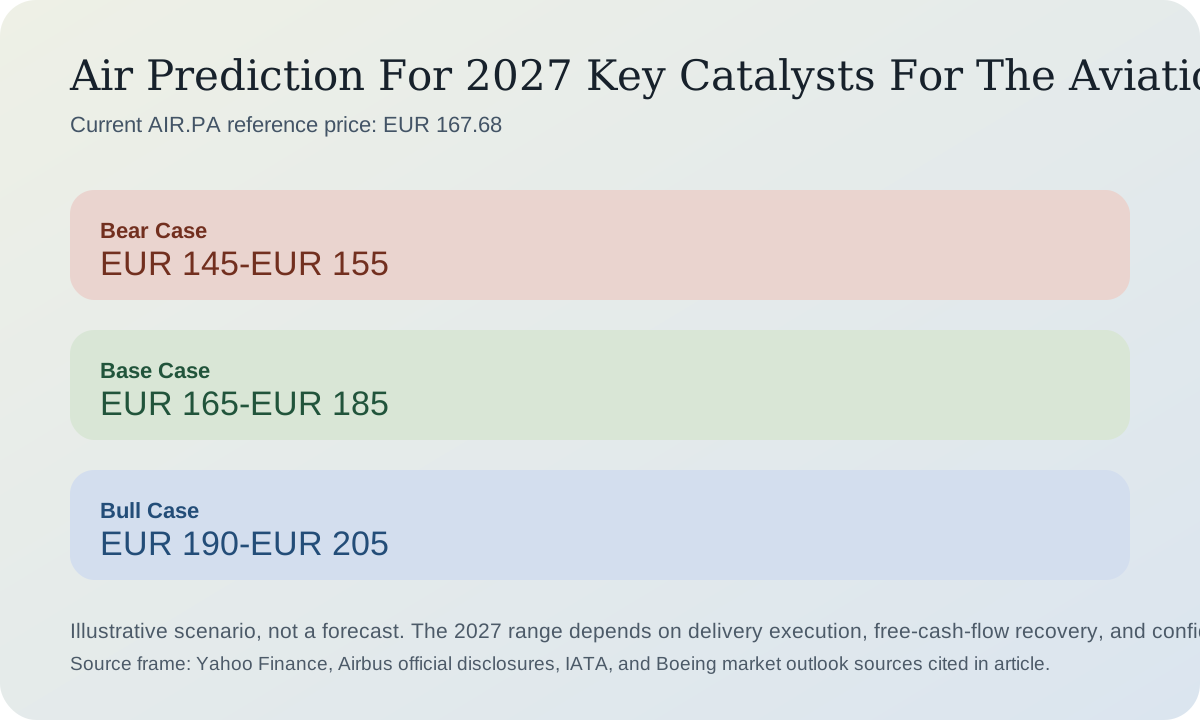
The bull range is EUR 190 to EUR 205. That would likely require Airbus to deliver strongly through the rest of 2026, restore confidence in free cash flow, and show that engine and component constraints are not worsening.
Bearish scenario
The bear range is EUR 145 to EUR 155. That would fit a scenario where delivery slippage persists, cash-flow recovery disappoints, or macro and trade conditions further pressure the industrial setup.
Base-case scenario
The base case is EUR 165 to EUR 185. That assumes Airbus remains strategically strong but still trades with some discount until execution looks cleaner.
| Path | Probability | Reasoning |
|---|---|---|
| Rising in 2027 | 45% | Supported by backlog, guidance, and the possibility of better delivery conversion later in the year. |
| Moving sideways | 31% | Possible if Airbus performs adequately but not decisively enough to change the market narrative. |
| Falling | 24% | Would likely require either execution disappointment or worsening supplier strain. |
| Investor type | Prudent approach | Catalyst to monitor |
|---|---|---|
| Investor already in profit | Hold or trim into strength if AIR is oversized after prior gains. | Delivery cadence and cash conversion. |
| Investor currently at a loss | Avoid emotional averaging until evidence improves. | Guidance credibility and supplier commentary. |
| Investor with no position | Prefer staged entry or a pullback rather than chasing a short-covering rally. | Quarterly delivery updates. |
| Trader | Use stops and respect industrial volatility around results. | Production/ramp headlines and tariff developments. |
| Long-term investor | Focus on whether 2027 de-risks the industrial thesis rather than demanding perfection. | Backlog conversion and segment quality. |
| Risk-hedging investor | Treat Airbus as cyclical industrial exposure, not as a portfolio hedge. | Aviation-cycle and macro risk tone. |
How this range was built: it blends the current share price, the 2025-2026 delivery and cash-flow picture, and the historical tendency for Airbus to rerate sharply when execution confidence changes.
Risks to watch: handover timing, supplier constraints, tariffs, airline economics, and working-capital pressure.
What would invalidate the forecast: either a much cleaner operational rebound than expected or a much larger macro shock to global aviation and trade than current public data suggests.
Disclaimer: This article is for informational purposes only and does not constitute individualized financial advice. Near-term scenarios are conditional and not guaranteed.
For 2027, Airbus looks less like a broken story than an impatient market waiting for evidence. That usually rewards selectivity and discipline more than narrative chasing.
If evidence improves in the right order, the stock can recover quickly. If it does not, even a strategically advantaged franchise can stay stuck longer than bulls initially expect.
That is why near-term AIR positioning should remain scenario-based rather than binary.
Investors who keep the horizon explicit are less likely to confuse a temporary execution wobble with a broken secular franchise, and less likely to overpay for optimism before the proof arrives.
That discipline matters because the stock's next meaningful move will probably follow operational sequencing, not narrative enthusiasm. For 2027, patience and timing are inseparable, especially in aerospace manufacturing cycles, capital markets, and investor psychology under pressure from uncertainty.
05. FAQ
Frequently asked questions about Airbus' 2027 outlook
What is the single biggest 2027 catalyst for Airbus?
The most important catalyst is whether Airbus can convert the rest of 2026 into a strong delivery and cash-flow recovery.
Why did AIR pull back from the 2025 highs?
Because investors became more cautious about cash conversion, delivery timing, and the operational friction still visible in the system.
Does the backlog make 2027 downside unlikely?
No. Backlog supports the strategic thesis, but near-term downside can still emerge if execution disappoints.
Could Airbus make a new high in 2027?
Yes, but it would likely require a meaningful recovery in confidence around deliveries and free cash flow.
06. Sources
Reference list
- Yahoo Finance chart API for AIR.PA, 10-year monthly history
- Yahoo Finance chart API for AIR.PA, recent daily closes
- Airbus Full-Year 2025 results release
- Airbus First Quarter 2026 results release
- Airbus annual reports page
- Airbus 2025 Report of the Board of Directors
- Airbus financial results page
- Airbus 2025 deliveries and backlog release
- Airbus Global Market Forecast 2025
- Airbus services-market outlook 2026
- IATA 2026 airline profitability outlook
- IATA global outlook for air transport, December 2025
- Boeing Commercial Market Outlook 2025-2044