01. Long-Term Setup
What matters most in an Airbus 2035 forecast
A 2035 forecast for Airbus is really a judgment about whether the company can spend another decade converting one of the strongest industrial demand setups in the world into disciplined financial performance. The market already believes in air-travel demand. The harder question is whether Airbus can hold pricing power, industrial credibility, and cash conversion as the production system scales further and the defence-and-services mix becomes more relevant.
| Topic | 2035 relevance |
|---|---|
| Backlog durability | Supports long-range visibility but does not remove execution risk. |
| Industrial scaling | The single most important factor in whether 2035 looks premium or disappointing. |
| Defence and services mix | Can improve resilience and quality if execution remains strong. |
| Competitive duopoly | A powerful structural support, but not a free pass. |
The 10-year market record gives Airbus real long-run credibility. A move from EUR 51.73 to EUR 167.68 over the last decade reflects not just aerospace optimism but also the market's recognition that Airbus remains one of the most strategically important manufacturers in Europe (Yahoo 10-year monthly chart). At the same time, the retreat from the 2025 peak shows that even a structurally advantaged manufacturer can rerate lower when execution tone softens.
| Anchor | Current evidence | Why it matters |
|---|---|---|
| Commercial demand visibility | Record backlog and strong long-range GMF | Supports a multi-cycle revenue runway. |
| Current profitability | EUR 7.1bn EBIT Adjusted in FY 2025 | A large starting earnings base lowers the need for fantasy assumptions. |
| Cash position | Net cash still positive despite Q1 2026 outflow | Gives Airbus room to absorb industrial volatility. |
| Business diversification | Commercial aircraft, defence, helicopters, services | Reduces dependence on any one sub-cycle. |
The evidence suggests Airbus can remain a long-term winner, but only if investors stay realistic about what sort of winner it is. This is not a software company. It is a giant aerospace system whose value creation comes through complex programme execution over many years.
That makes scenario work especially important for 2035. By then, several production cycles, multiple macro regimes, and at least one major strategic reset could have altered the story materially.
Another long-range nuance is capital allocation. Airbus has enough strategic opportunity that management will constantly face choices between protecting balance-sheet strength, investing for industrial scale, and returning capital. Over nine years, those choices can influence total returns almost as much as aircraft demand itself.
Investors should therefore think about 2035 as a test of disciplined compounding, not simply of output growth.
02. Core Drivers
The variables that can extend or weaken Airbus' compounding story
1. Can Airbus keep the narrowbody ramp-up credible?
The long-run equity story still depends heavily on whether the company can move from promise to repeatable delivery execution across the A320 family and related programmes.
2. Will widebody and services contributions deepen the quality of earnings?
If Airbus can broaden its commercial mix and grow services, its long-run earnings profile may look less exposed to any single programme rhythm (Global Services Forecast update).
3. Defence and Space may become structurally more valuable
European defence priorities have shifted, and Airbus has a credible role to play. If Defence and Space scales with better profitability and order quality, the valuation mix could improve materially over a decade.
4. Industry demand probably remains large, but not frictionless
Airbus GMF 2025 and Boeing's CMO both support large commercial-aircraft demand through 2044. Yet IATA also reminds investors that airline profitability, while positive, is not limitless. Customers still need financing capacity to absorb deliveries.
5. Digital and data layers can gradually improve the story
Skywise, digital services, and broader design-manufacturing-service integration could make Airbus more than a pure metal-bending story over time, though investors should stay careful not to overstate the effect (Skywise subsidiary launch; DDMS program).
03. Institutional Signals
How guidance and industry research shape the 2035 range
The strongest institutional input into a 2035 Airbus forecast comes from the company's own financial trajectory and the industry's long-range demand data. Airbus delivered record financial performance in 2025, still guided for higher 2026 deliveries, and continues to operate in a global market that both Airbus and Boeing describe as structurally large over the next two decades (FY 2025 results; Airbus GMF 2025; Boeing CMO 2025-2044).
| Source | Message | 2035 reading |
|---|---|---|
| Airbus FY 2025 and Q1 2026 | Strong long-term setup, but near-term execution remains uneven | Supports a constructive base case, not complacency. |
| Airbus GMF 2025 | Long-run traffic and fleet growth remain supportive | Backs the secular demand case into the 2030s. |
| IATA 2026 and Dec. 2025 outlook | Airline profitability is stable but not lavish | Demand likely persists, but customer economics still matter. |
| Boeing CMO | Industry need remains very large across the next 20 years | Confirms the scale of the addressable market. |
Analysts remain divided mainly on how much premium Airbus deserves for demand visibility when so much value still depends on industrial execution. That is the central tension in the 2035 forecast. A long-term bull case does not require a new market to appear. It requires the current market opportunity to be harvested with enough consistency that the market stops discounting execution risk so aggressively.
That would likely be built through repetition rather than surprise: year after year of reliable deliveries, better cash conversion, and an increasing contribution from services and defence that makes the total group look less exposed to any single operational bottleneck.
For a decade-long forecast, that kind of repetition matters more than any single heroic assumption about air traffic or market share.
It also matters because equity markets often reward aerospace leaders only after they have repeatedly proven the same point. The first clean year may be dismissed as cyclical luck; the third or fourth can change how the entire franchise is valued.
04. Scenario Matrix
Bull, base, and bear cases for AIR.PA into 2035
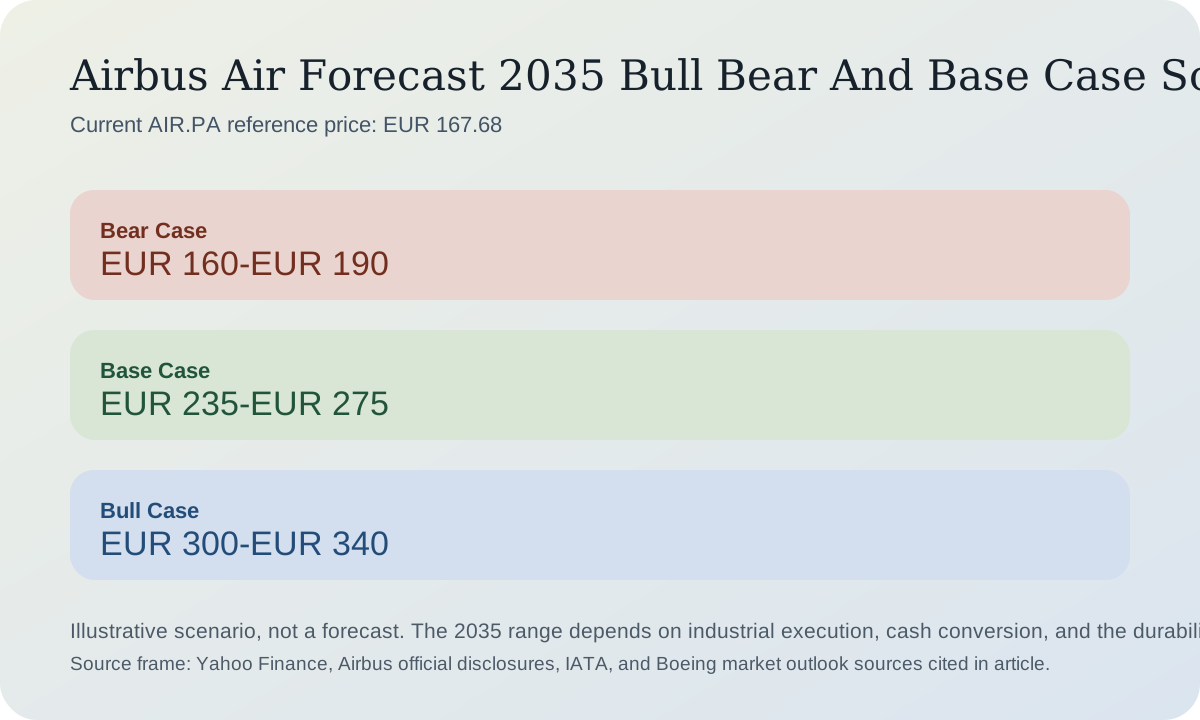
Bull case
The bull case is EUR 300 to EUR 340 by 2035. That would likely require many years of successful ramp-up, stronger free cash flow than currently embedded, a higher-quality contribution from defence and services, and no structural break in the Airbus-Boeing duopoly.
Bear case
The bear case is EUR 160 to EUR 190. That would fit a decade where industrial friction remains stubborn, airlines struggle to absorb deliveries cleanly, or the market decides backlog deserves less of a premium because cash conversion keeps disappointing.
Base case
The base case is EUR 235 to EUR 275. That assumes Airbus remains a global aerospace leader and compounds value, but that the stock continues to trade with some discount for complexity and cyclicality.
| Path | Editorial probability | Logic |
|---|---|---|
| Rising materially into 2035 | 44% | Airbus starts from a strong competitive position, but a decade brings many execution tests. |
| Broadly sideways to modestly higher | 31% | Possible if deliveries improve but the valuation never fully escapes industrial skepticism. |
| Meaningful downside | 25% | Would likely require more persistent execution or demand stress than current evidence implies. |
| Investor type | Prudent stance | 2035-specific focus |
|---|---|---|
| Investor already in profit | Rebalance if AIR has become a dominant cyclical winner in the portfolio. | Whether cash conversion catches up with demand visibility. |
| Investor currently at a loss | Separate short-term delivery volatility from long-term franchise deterioration. | Backlog health and margin discipline. |
| Investor with no position | Phase in rather than chase, especially after short bursts of aerospace optimism. | Ramp-up execution and valuation relative to industrial peers. |
| Trader | Treat Airbus as an industrial-results stock first, not a straight-line aviation theme. | Guidance, handovers, and macro headlines. |
| Long-term investor | Focus on total business quality rather than quarterly delivery noise, but keep diversification. | Commercial, defence, and digital-services balance. |
| Risk-hedging investor | Do not use Airbus as a hedge; it remains a growth-sensitive industrial. | Cyclical demand and geopolitical risk. |
How probability and range were set: the framework blends Airbus' decade-long share behavior, current earnings power, the size of the backlog, long-range demand forecasts, and the persistent market habit of discounting aerospace execution risk.
Risks to watch: engine bottlenecks, supply-chain stress, tariff policy, programme profitability, customer financing conditions, and defence execution.
What would invalidate the forecast: a major change in the competitive landscape, a prolonged global aviation downturn, or alternatively a surprisingly clean and sustained industrial de-bottlenecking that allows Airbus to compound faster than the current market expects.
Disclaimer: This article is for informational purposes only and does not constitute personalized investment advice. Long-term scenario ranges are conditional and not guaranteed.
The long-run Airbus thesis is compelling because it combines structural demand with strategic scarcity. The challenge is that scarcity alone does not eliminate execution risk, and investors should keep both truths in view.
If Airbus can keep proving that scale and complexity are becoming strengths rather than recurring sources of friction, the upper half of the 2035 range becomes much easier to defend.
That is ultimately the long-run bet: not that demand appears, but that a highly complex industrial leader learns to monetize its strategic position with fewer self-inflicted delays and less market skepticism.
05. FAQ
Frequently asked questions about Airbus' long-term outlook
Could Airbus double by 2035?
It is possible, but it would likely require many years of cleaner execution and stronger cash conversion than the market currently assumes.
What matters more for 2035: demand or execution?
Execution matters more, because demand already looks strong in the public data.
Is defence important enough to change the Airbus thesis?
It may not dominate the story, but over a decade it can make Airbus look more resilient and strategically valuable.
Why use ranges instead of one target price?
Because aerospace outcomes depend on too many uncertain operational steps over a nine-year period.
06. Sources
Reference list
- Yahoo Finance chart API for AIR.PA, 10-year monthly history
- Yahoo Finance chart API for AIR.PA, recent daily closes
- Airbus Full-Year 2025 results release
- Airbus First Quarter 2026 results release
- Airbus annual reports page
- Airbus 2025 Report of the Board of Directors
- Airbus financial results page
- Airbus 2025 deliveries and backlog release
- Airbus Global Market Forecast 2025
- Airbus services-market outlook 2026
- IATA 2026 airline profitability outlook
- IATA global outlook for air transport, December 2025
- Boeing Commercial Market Outlook 2025-2044
- Airbus Skywise subsidiary launch
- Airbus DDMS program