01. Quick Answer
A useful 2035 forecast for Allianz has to be scenario-driven, not falsely precise
A 2035 forecast for Allianz has to start with intellectual honesty. Publicly available sell-side research usually stops at 12 months, sometimes three years. That means a credible 2035 framework cannot pretend that banks or brokers know a precise destination nine years from now. Instead, the better method is to extend what is observable today: Allianz's medium-term targets, the economics of insurance compounding, the role of dividends and buybacks, and the possibility that AI and higher investment income lift productivity and returns over time (Allianz CMD 2024; 1Q 2026 results).
| Point | Why it matters |
|---|---|
| 2035 requires scenario thinking | No serious long-dated forecast should be reduced to one deterministic number. |
| Allianz starts from strength | The company already has strong solvency, ratings, earnings diversity, and capital return capacity. |
| Long-run upside depends on compounding quality | Shareholder returns by 2035 will likely come from disciplined execution, not from speculative excitement. |
| The bear case is still plausible | Insurance cycles, catastrophe severity, and regulatory changes can materially compress long-run outcomes. |
02. Historical Context
The past decade proves Allianz can compound, but the next decade starts from a stronger base
ALV.DE has already demonstrated that large insurers can compound over long stretches. From about €127.80 in May 2016 to €374.50 in May 2026, the stock delivered a price-only CAGR around 11.4% (Yahoo Finance). But investors should not lazily extend that figure for another decade. Allianz now trades from a stronger base, after higher reinvestment yields, firmer capital return discipline, and a long period in which the market rediscovered the value of insurance cash flows.
| Dimension | 2027 focus | 2035 focus |
|---|---|---|
| Earnings visibility | Near-term pricing, claims, and management guidance | Durability of the business model across multiple cycles |
| Capital return | Existing buybacks and dividend support | Whether per-share compounding stays strong for nearly a decade |
| Industry backdrop | Current rate and pricing environment | Climate, regulation, AI adoption, and structural demand for protection |
| Valuation debate | Whether the stock is fair after the rerating | Whether Allianz deserves a premium as a long-run financial compounder |
History also suggests that insurers do not rise in straight lines. Allianz's path has always been shaped by balance-sheet credibility, not just growth. In a low-rate world, the market worried about reinvestment pressure. In a higher-rate world, it rewards capital strength and the ability to recycle cash into dividends, buybacks, and productive underwriting capacity. By 2035, the real question is whether that discipline remains intact through several insurance and market cycles.
03. Main Drivers
Five structural forces will likely decide whether 2035 lands closer to the bull or bear case
1. The 2027 targets provide the starting point for any serious 2035 projection
Management's public targets of 7% to 9% EPS CAGR and 5% to 7% operating profit CAGR through 2027 are the best formal bridge between current facts and long-term scenarios (Allianz CMD 2024). If Allianz consistently hits or exceeds those goals, the probability of a stronger 2035 outcome rises materially.
2. Climate and natural-catastrophe trends could either widen or narrow the long-run range
Allianz itself continues to highlight climate and business-interruption risk in its research, while the wider industry has to price more volatile catastrophe exposures more intelligently (Allianz Risk Barometer; Allianz resilience research). Better data and pricing can preserve margins. Persistent underpricing or heavier severity would not.
3. Asset-management durability matters more over nine years than over nine months
By 2035, flow quality and fee resilience at Pimco and Allianz Global Investors could make the difference between a good insurer and a truly premium financial compounder. The upside is that Allianz has diversified earnings. The risk is that fee businesses can be cyclical and sentiment-sensitive.
4. The interest-rate regime is still structurally important
Insurers thrive when they can reinvest at respectable yields without provoking broad credit stress. A normalized rate regime is generally healthier for Allianz than the old negative-rate world, but the evidence is mixed if sharp rate moves destabilize capital markets or policyholder behavior.
5. AI could matter more by 2035 than almost any single year's pricing debate
Allianz's AI roadmap now includes responsible AI governance, an Anthropic partnership for enterprise deployment, and operational copilots in underwriting and service workflows (Responsible AI principles; Anthropic partnership). Over nine years, that can affect expense ratios, claim leakage, speed, and customer retention.
04. Institutional Forecasts and Analyst Views
The strongest public evidence comes from targets, ratings, and sector outlooks rather than published 2035 price targets
The phrase "institutional forecasts" should be handled carefully here. Public institutions and banks provide rich input on insurance markets, balance sheets, catastrophe pricing, and macro rates, but very few offer precise 2035 price targets for Allianz. That makes a bull-bear-base framework more rigorous than pretending a specific institution has already mapped 2035 to the euro.
| Source | Signal | Why it matters |
|---|---|---|
| Allianz management | 2027 EPS and operating-profit targets, 75% payout target | Offers the cleanest public baseline for compounding assumptions. |
| Ratings agencies | Strong credit and insurer financial-strength ratings | Long-run upside is more credible when capital quality is durable. |
| Swiss Re Institute | Industry premium growth, claims trends, and macro assumptions | Helps frame whether the sector can still grow profitably over a decade. |
| Deloitte and Aon | Insurance operating and pricing environment | Provides cross-checks on whether current margins are sustainable or peaking. |
In practical terms, the base case should assume that Allianz remains a high-quality compounder, but not a hyper-growth equity. The bull case assumes the company uses its balance sheet, data, and AI tooling to defend margins and accelerate per-share growth. The bear case assumes that catastrophe volatility, regulation, pricing pressure, or a more difficult asset-management environment slowly grind down returns.
05. Bull, Bear, and Base Cases
Long-dated ALV scenarios should be tied to explicit conditions, not narratives alone
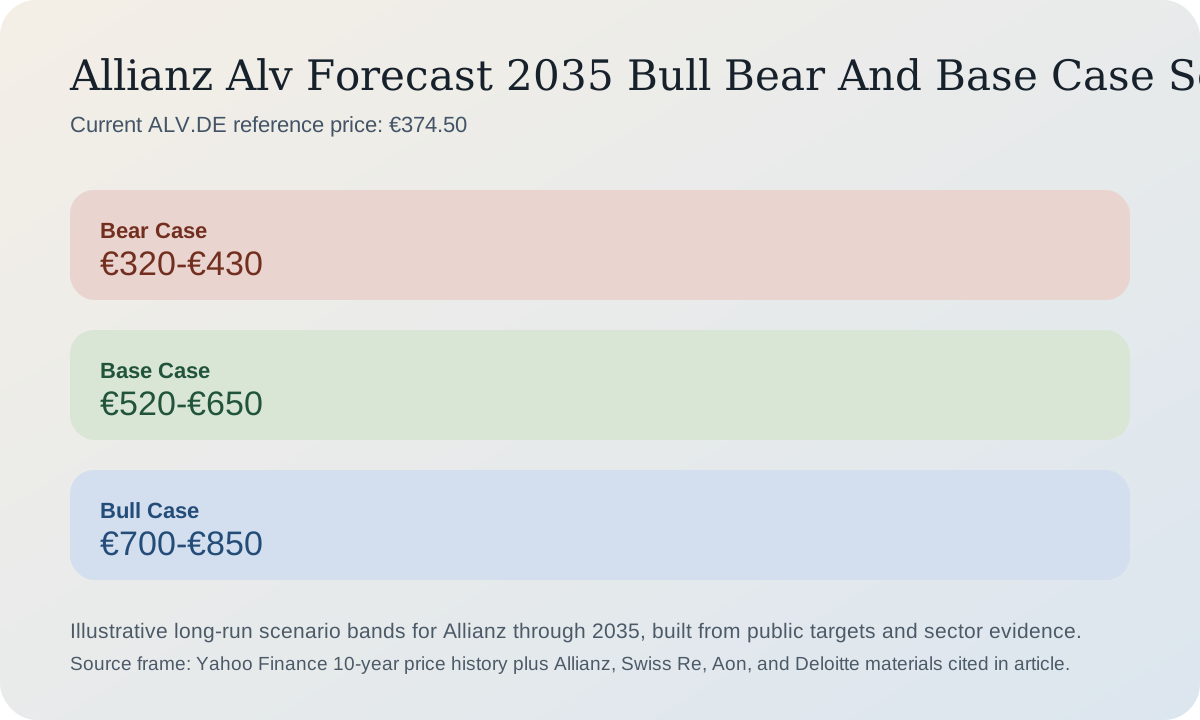
Bull case for 2035
A plausible bull range is €700 to €850. That would require Allianz to keep compounding earnings and capital returns well beyond the current target window, while AI reduces frictional costs and better pricing preserves underwriting margins. This is not an extreme fantasy scenario. It is simply the upper end of what a strong insurer-financial hybrid could deliver if management keeps executing for another decade.
Base case for 2035
The base case is €520 to €650. That range assumes moderate earnings growth, dependable dividends, recurring buybacks, and no structural damage to the insurance business model. It implies slower price appreciation than the last decade, which is reasonable after such a large rerating.
Bear case for 2035
The bear case is €320 to €430. This path would likely emerge if catastrophe losses remain elevated, pricing power fades, asset-management franchises struggle, or Europe enters a lower-growth and more heavily regulated financial environment. Importantly, the bear case is a long period of weak compounding, not necessarily a collapse in franchise quality.
| Scenario | Range | Core assumptions | Probability |
|---|---|---|---|
| Bull | €700-€850 | AI lifts productivity, pricing remains rational, and per-share capital return stays aggressive. | 20% |
| Base | €520-€650 | Allianz compounds steadily and preserves its fortress balance sheet. | 55% |
| Bear | €320-€430 | Cat losses, regulation, and softer pricing compress long-run returns. | 25% |
| Direction | Estimated probability | Interpretation |
|---|---|---|
| Rising by 2035 | 60% | The balance sheet and payout framework make a higher long-run outcome more likely than not. |
| Falling from current levels by 2035 | 15% | A durable decline requires several headwinds to persist for years. |
| Mostly sideways over a long span | 25% | Mature financials can still spend years marking time even with decent fundamentals. |
Risks to watch
Climate-related severity, reserve adequacy, political pressure on pricing, fee compression in asset management, and weaker-than-expected AI execution are the big variables. None of them alone destroys the case, but together they widen the range substantially.
What could invalidate the framework
The framework would be too cautious if Allianz became a genuinely premium platform that compounds per-share value faster than its current target window implies. It would be too bullish if the insurance sector enters a structurally worse profitability regime because catastrophe trends outrun pricing and risk selection.
Conclusion
The 2035 Allianz outlook is best framed as a quality-compounding debate, not a speculative moonshot. The base case stays positive because the company starts from strength. The bull case is real because capital, data, and productivity can reinforce each other. The bear case remains credible because insurance is still an underwriting business first.
Disclaimer: These scenario ranges are editorial judgments for research purposes only. They are not guarantees or personal investment recommendations.
06. Investor Positioning
Position sizing and patience matter more when the forecast horizon is nearly a decade
| Investor profile | Prudent stance | Scenario-based note |
|---|---|---|
| Investor already in profit | Let winners run, but rebalance if Allianz became too large a portfolio weight. | Trim into strength if the market prices a near-perfect long-run outcome. |
| Investor currently at a loss | Review whether the loss came from thesis drift or timing. | If the thesis still centers on balance-sheet quality, averaging should be gradual. |
| Investor with no position | Build slowly or wait for pullbacks. | Avoid chasing a 2035 narrative with no risk buffer. |
| Trader | Focus on earnings, rate moves, and catastrophe news flow. | Long-duration stories do not remove short-term volatility. |
| Long-term investor | Dollar-cost averaging remains the most defensible approach. | Total return, including dividends, matters more than any single quarter. |
| Risk-hedging investor | Use Allianz as part of a diversified financial sleeve, not a hedge substitute. | Pair with genuine hedges if macro risk is the main concern. |
07. FAQ
Frequently asked questions about a 2035 Allianz forecast
Why is the 2035 range so wide?
Because the key drivers are long-cycle variables: catastrophe severity, rate regimes, AI productivity, pricing discipline, and capital returns. Pretending those can be forecast with narrow precision would be less credible.
Could Allianz reach the bull case without major acquisitions?
Yes. The bull case does not require a transformational deal. It mostly requires sustained per-share compounding from underwriting, investment income, fee businesses, and disciplined buybacks.
Does the 2035 view depend heavily on Europe?
Europe still matters, but Allianz is not only a Europe story. Its mix of global insurance and asset management means the long-run thesis is broader than domestic GDP alone.
References
Sources
- Yahoo Finance chart API for ALV.DE, 10-year monthly history and recent daily closes
- Allianz 1Q 2026 earnings release
- Allianz full-year 2025 earnings release
- Allianz Group Annual Report 2025
- Allianz Capital Markets Day 2024: 2027 targets and capital framework
- Allianz ratings page
- Swiss Re Institute insurance industry outlook and sigma research
- Aon Global Insurance Market Insights, Q1 2026 overview
- Deloitte insurance industry outlook
- Allianz Risk Barometer
- Allianz natural catastrophe resilience research
- Allianz Responsible AI principles
- Anthropic and Allianz enterprise AI partnership