01. Quick Answer
The most credible 2030 ALV forecast is constructive, but not detached from insurance-cycle reality
Allianz does not need a heroic macro backdrop to justify a constructive 2030 outlook. With ALV.DE around €374.50, a roughly 11.4% 10-year price CAGR, a Solvency II ratio of 221%, and a fresh €2.5 billion buyback authorization, the company enters the back half of the decade from a position of unusual financial strength (Allianz 1Q 2026; Yahoo Finance). The harder question is whether insurance pricing, asset-management flows, and regulatory capital stay supportive enough for returns to keep compounding from a much higher base.
| Point | Why it matters |
|---|---|
| Allianz is already a mature compounder | The next phase depends more on steady execution and capital efficiency than on a turnaround rerating. |
| Capital strength remains the anchor | Solvency, ratings, and payout capacity shape both downside protection and long-run upside. |
| The insurance cycle still matters | P&C pricing, catastrophe costs, and reinvestment yields can widen or compress the earnings range. |
| 2030 is better framed as scenarios | Public long-dated institutional point targets are scarce, so scenario analysis is more credible than one-number certainty. |
02. Historical Context
Allianz has already compounded well for a decade, which raises the bar for the next one
Historical context matters because Allianz has already delivered a substantial re-rating. The shares rose from about €127.80 in May 2016 to roughly €374.50 in mid-May 2026, with a 10-year high near €390.50 in late 2025 and a 10-year low near €127.80 at the beginning of the period (Yahoo Finance 10-year history). That path tells investors two things. First, Allianz has compounded through multiple regimes, including zero rates, COVID-era shocks, inflation, and the return of higher bond yields. Second, future returns probably rely less on multiple expansion and more on earnings quality, cash generation, and disciplined capital return.
| Metric | Latest reading | Why it matters |
|---|---|---|
| 1Q 2026 operating profit | €4.5 billion | Confirms Allianz is still growing operating profit despite catastrophe losses and a more demanding macro backdrop. |
| 1Q 2026 Solvency II ratio | 221% | A key buffer for dividends, buybacks, and confidence in stress periods. |
| 2025 total operating profit | €17.4 billion | Record-level profitability matters because it shows pricing and diversification are still working. |
| 2026 buyback | Up to €2.5 billion | Capital return remains an important support for per-share compounding. |
| Period | Approx. share price | What changed |
|---|---|---|
| 2016 | €127.80 | Allianz was still viewed through the lens of a lower-rate Europe and a less attractive reinvestment environment. |
| 2020 | €140-€180 range during COVID disruption | Claims trends, market volatility, and policy uncertainty created a temporary shock but not a balance-sheet break. |
| 2023 | Above €220 | Higher rates improved investment income and the market increasingly rewarded capital return discipline. |
| 2025 high | €390.50 | The rerating reflected stronger earnings, resilient solvency, and confidence in medium-term targets. |
The other historical point is strategic. Allianz is no longer just a plain-vanilla European insurer. It is a diversified financial group spanning property-casualty, life and health, and asset management. That diversification matters because it softens the volatility that any one business line can create. It also means investors should watch several engines at once: underwriting margins, natural-catastrophe trends, fixed-income reinvestment yields, Pimco and Allianz Global Investors flows, and the cost discipline management reinforced at its December 2024 Capital Markets Day (Allianz CMD 2024).
03. Main Drivers
Five forces are most likely to shape ALV into 2030
1. Insurance pricing and claims discipline still set the tone
Swiss Re and Aon both describe a market in which many commercial lines remain rationally priced, even if conditions are no longer as hard as they were in the immediate post-pandemic and post-inflation reset years (Swiss Re; Aon Q1 2026). For Allianz, that means the underwriting story is less about explosive growth and more about whether rate adequacy can keep offsetting claims inflation and catastrophe volatility.
2. Higher bond yields are still a medium-term tailwind for insurers
Life insurers and multiline carriers benefit when fresh premiums and maturing assets can be reinvested at higher yields than the ultra-low-rate years allowed. The evidence is mixed in the short run because mark-to-market volatility and customer behavior can cloud the picture, but structurally the return of positive real yields is better for insurers than the old negative-rate regime (Deloitte insurance outlook).
3. Asset management can amplify or mute the equity story
Allianz earns a meaningful part of its narrative through Pimco and Allianz Global Investors. When flows and fee margins cooperate, the stock can deserve a higher-quality multiple. When fixed-income flows slow or risk appetite turns, the market is reminded that the group is not a pure underwriting story.
4. Solvency and ratings remain strategic assets
Allianz's ratings profile and 221% Solvency II ratio make the group look more like a financial fortress than a fragile cyclical insurer (Allianz ratings; 1Q 2026 release). That matters because a strong capital base lets management keep buying back shares and supporting dividends without sacrificing resilience.
5. AI and productivity are likely to matter more by 2030 than by 2027
Management's recent AI announcements point to a practical rather than theatrical strategy: deploy AI in employee copilots, underwriting support, document handling, and broader workflow productivity (AllianzGPT; Insurance Copilot; BRIAN underwriting assistant). That is unlikely to transform next quarter's earnings, but it can widen operating leverage by the end of the decade.
04. Institutional Forecasts and Analyst Views
The best institutional guide is the operating and capital evidence base, not a forced long-range point target
Institutional long-range point forecasts for Allianz are limited in the public domain. What is public, and therefore more defensible, is the underlying evidence base: management's own 2027 targets, the latest earnings trajectory, industry pricing commentary, and the balance-sheet strength that ratings agencies continue to endorse. Allianz said at its December 2024 Capital Markets Day that it targets 2024-2027 EPS CAGR of 7% to 9%, an operating profit CAGR of 5% to 7%, and a 75% payout ratio, while preserving capital flexibility (Allianz CMD 2024). That is more useful for a 2030 forecast than forcing a false sense of precision from thin public 2030 sell-side targets.
| Source | What it indicates | Forecast implication |
|---|---|---|
| Allianz Capital Markets Day 2024 | Targets 7%-9% EPS CAGR through 2027 and continued capital return | Supports a constructive base case if management keeps delivering. |
| Allianz 1Q 2026 release | Operating profit rose and the group confirmed its full-year outlook | Near-term momentum remains intact rather than deteriorating. |
| Ratings agencies | Allianz keeps strong credit ratings across major agencies | The balance sheet still deserves a lower-risk equity framing than weaker insurers. |
| Swiss Re and Aon industry outlooks | Insurance pricing is normalizing but not collapsing | Suggests Allianz can still compound, though probably at a slower pace than a hard-market surge would imply. |
Available data suggests the most honest institutional reading is this: Allianz is still supported by a favorable strategic mix, but the market already knows that. The base case should therefore assume mid-single-digit operating profit growth, solid buybacks, and dividend support rather than a dramatic rerating. Analysts remain divided less on Allianz's quality than on how much of that quality is already in the share price.
05. Scenarios, Risks, and Invalidation
Bull, bear, and base cases show why a range is more credible than a promise
Bullish scenario
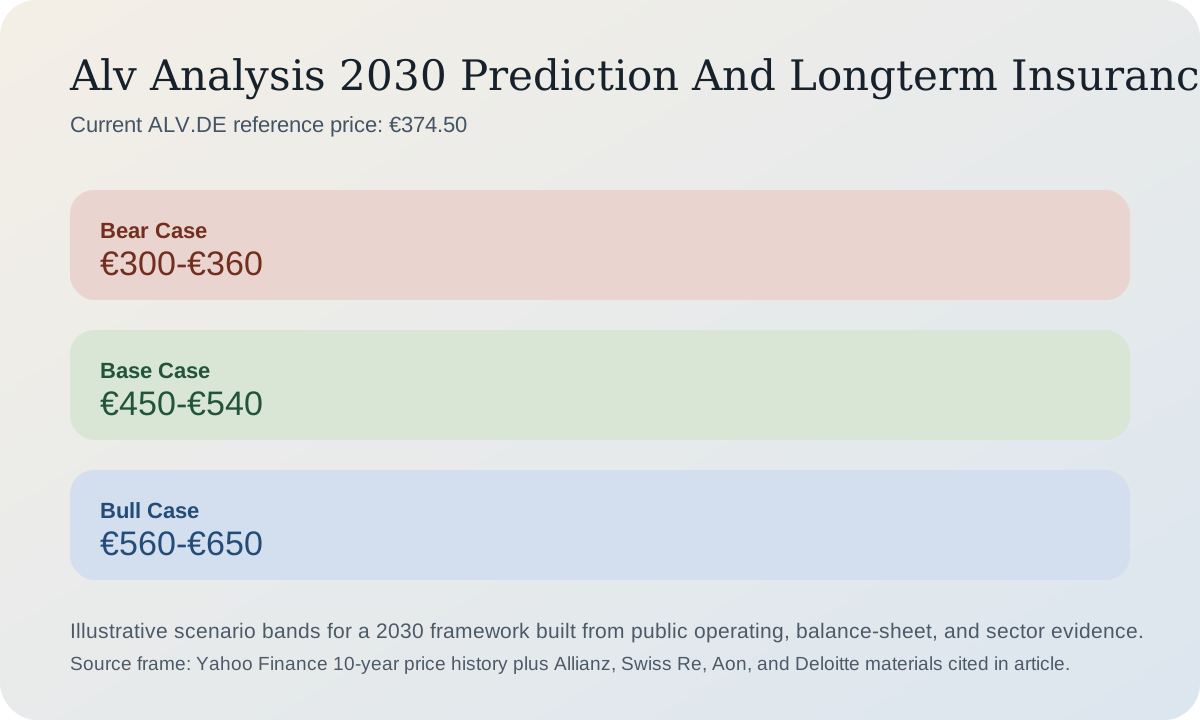
The bull case for 2030 puts ALV in roughly a €560 to €650 range. That would likely require Allianz to exceed its 2027 earnings targets, keep Solvency II comfortably above 200%, sustain large buybacks, and benefit from a benign but still disciplined insurance-pricing environment. The real upside driver would be per-share compounding rather than sensational top-line growth.
Bearish scenario
The bear case places the shares around €300 to €360 by 2030. That range does not require a collapse. It only requires several pressures to arrive together: softer pricing, heavier catastrophe years, weaker asset-management flows, tighter regulation, or a deeper European slowdown. In other words, this is more a rerating-down and earnings-stall scenario than an existential one.
Base-case scenario
The base case remains €450 to €540. That range assumes Allianz compounds from today's higher base at a more modest rate than the last 10 years, consistent with a mature insurer that keeps returning cash, benefits from reinvestment yields, and protects underwriting discipline.
| Scenario | Range | What must happen | Probability |
|---|---|---|---|
| Bull | €560-€650 | Pricing stays rational, investment income remains supportive, buybacks stay large, and AI improves productivity. | 25% |
| Base | €450-€540 | Management broadly delivers 2027 goals, pricing softens only gradually, and capital return stays steady. | 50% |
| Bear | €300-€360 | Cat losses, pricing pressure, or macro stress compress earnings and the valuation multiple. | 25% |
| Path | Estimated probability | Why |
|---|---|---|
| Rising from current levels by 2030 | 55% | Allianz starts from a position of high solvency, strong ratings, and an active payout policy. |
| Falling below current levels by 2030 | 20% | A durable pullback likely needs a cluster of underwriting, macro, and valuation pressures. |
| Moving broadly sideways | 25% | A mature insurer can spend years digesting gains if earnings growth remains solid but not exciting. |
Risks to watch
Investors should monitor catastrophe frequency, reserve adequacy, European regulation, Pimco net flows, and signs that commercial insurance pricing is slipping faster than loss costs. The evidence is mixed enough that none of these should be treated as background noise.
What could invalidate this forecast
This 2030 framework would be too conservative if Allianz meaningfully outperformed its 2027 EPS and operating-profit targets while preserving an exceptionally high payout ratio. It would be too optimistic if underwriting discipline eroded, if Solvency II fell materially, or if major acquisitions diluted the group's current capital-return discipline.
Conclusion
Allianz still looks like one of Europe's sturdier long-term financial compounds, but it is no longer an undiscovered story. The most defensible 2030 outlook is constructive rather than euphoric: higher than today in the base case, lower only if several risks line up at once, and materially higher in a bull case that depends on consistent execution rather than hope.
Disclaimer: This article is for research and informational purposes only. It is not personalized investment advice, and all scenario ranges are editorial judgments based on public data rather than guarantees.
06. Investor Positioning
Different investor types should treat Allianz differently
| Investor type | Cautious approach | What to watch |
|---|---|---|
| Investor already in profit | Hold core exposure, trim only if position sizing became excessive after the rerating. | Solvency trend, pricing discipline, and whether buybacks remain meaningful. |
| Investor currently at a loss | Avoid emotional averaging without a thesis refresh; use rebalancing rules instead. | Whether the original thesis was about quality compounding or short-term momentum. |
| Investor with no position | Prefer staged entries or wait for pullbacks rather than chasing a perceived fortress premium. | Commercial pricing, cat-loss seasons, and valuation relative to European peers. |
| Trader | Use stop-loss rules and respect catalysts such as earnings, cat events, and bond-yield swings. | Short-term volatility around results and macro-sensitive asset-management flows. |
| Long-term investor | Dollar-cost averaging is more defensible than aggressive lump-sum chasing at a mature multiple. | EPS compounding, payout discipline, and management's 2027 delivery. |
| Risk-hedging investor | Treat Allianz as a diversified financial, not as a pure hedge asset; pair it with broader portfolio protection if needed. | Correlation with rates, equities, and catastrophe-related sentiment. |
07. FAQ
Frequently asked questions about Allianz's long-term outlook
Can Allianz still outperform after such a strong 10-year run?
Yes, but probably at a slower rate than during the rerating phase. The more realistic case is steady compounding supported by dividends, buybacks, and disciplined underwriting.
What matters more for Allianz by 2030: insurance pricing or AI?
Insurance pricing still matters more today, but AI could become a significant operating-leverage story by the end of the decade if deployment scales across claims, underwriting, and service workflows.
Is Allianz mainly a defensive stock?
It is relatively defensive compared with many financials, but not immune to market drawdowns. Catastrophe losses, pricing cycles, and asset-management volatility still create meaningful equity risk.
References
Sources
- Yahoo Finance chart API for ALV.DE, 10-year monthly history and recent daily closes
- Allianz 1Q 2026 earnings release
- Allianz full-year 2025 earnings release
- Allianz Group Annual Report 2025
- Allianz Capital Markets Day 2024: 2027 targets and capital framework
- Allianz ratings page
- Swiss Re Institute insurance industry outlook and sigma research
- Aon Global Insurance Market Insights, Q1 2026 overview
- Deloitte insurance industry outlook
- Allianz Risk Barometer
- Allianz natural catastrophe resilience research
- Allianz Responsible AI principles