01. Quick Answer
A 2035 Amazon forecast should be read as a mix-shift and return-on-capital test, not a straight-line extension of the last decade
The long-run Amazon question is not whether the company will still matter in 2035. It almost certainly will. The deeper question is how much of the company’s scale converts into high-quality earnings power instead of lower-return reinvestment. That distinction matters because Amazon’s 10-year CAGR above 22% sets a high psychological anchor. Yet a mature mega-cap usually needs either new profit pools or stronger margin mix to repeat anything close to that pace over another nine years.
| Category | Evidence-based read | Implication |
|---|---|---|
| Historical data | Amazon has compounded from roughly \.78 to \.22 over 10 years | Long-run upside remains credible, but future ranges should be anchored to scale and changing mix |
| Current market conditions | AWS, ads, and stores are all executing well, but AI capex is unusually heavy | Forecasts should stay scenario-based, not blindly extrapolative |
| Institutional signals | Reuters and S&P both show strong AWS momentum with visible return-on-capital debate | Analysts remain constructive, but not unanimous |
| Most important watchpoints | AWS growth, ads growth, capex ROI, retail margins, tariff pass-through, and chips monetization | These variables will likely shape the stock range more than generic e-commerce optimism |
02. Historical Context
Amazon’s long-run equity story is no longer just retail, but retail still shapes the floor of the thesis
Amazon’s stock has compounded from roughly $35.78 to about $267.22 over the last 10 years based on Yahoo Finance monthly data, which implies a 10-year CAGR a little above 22%. That history matters because it captures multiple identities inside one company: e-commerce scale, logistics density, AWS, advertising, subscription economics, and now AI infrastructure. Yet the same history also warns against lazy extrapolation. A company that has already multiplied several times does not automatically deserve the same future rate of compounding unless new profit pools emerge or existing ones deepen materially.
| Metric | Latest official reading | Why it matters |
|---|---|---|
| Q1 2026 net sales | `$181.5 billion | Shows the total platform still compounds at exceptional scale |
| AWS revenue | `$37.6 billion, up 28% | AWS remains the highest-quality earnings engine in the story |
| Advertising revenue | `$17.2 billion, up 22% | Ads keeps growing into a second high-margin pillar |
| 10-year stock CAGR | About 22.27% | Useful as a long-run reasonableness check for future ranges |
03. Main Drivers
Five forces are most likely to shape Amazon’s stock over the next several years
1. AWS remains the central valuation lever
Reuters emphasized that the most recent quarter was really about whether AWS reacceleration was real, and the answer was yes. As long as AWS keeps growing strongly and monetizing AI workloads, Amazon’s valuation can stay more cloud-like than retail-like.
2. Retail efficiency still matters even when AWS gets the headlines
Amazon’s stores, delivery speeds, and same-day penetration still help determine the quality of the consumer business. That matters because a lower-margin retail engine becomes much more attractive when logistics efficiency and ads monetization keep improving.
3. Advertising is no longer a side story
At `\$17.2 billion` in Q1 2026, Ads is now one of the clearest reasons Amazon can justify a higher-quality multiple than a pure retailer. If Ads sustains a high-teens or low-20s growth profile, it meaningfully changes the long-run earnings mix.
4. AI capex can be both moat-building and risk-creating
Amazon’s planned 2026 capital expenditure profile of around `\$200 billion` is strategically ambitious. It can deepen AWS and chips leadership. It can also raise investor anxiety if returns appear to lag spending.
5. Tariffs, suppliers, and consumer elasticity still matter
Reuters reported that tariff pressures were starting to affect marketplace pricing. That is a reminder that Amazon is not insulated from macro frictions even when the AI and AWS story looks strong.
04. Institutional Forecasts and Analyst Views
The market still believes in Amazon’s quality, but it is re-rating the cost of staying ahead
Available data suggests Amazon has the ingredients to keep compounding: AWS, advertising, logistics density, chips, and AI services. But the evidence is mixed enough on capex intensity and macro retail exposure that a 2035 forecast needs a broad range. In other words, size does not kill upside, but it does raise the standard for what counts as a reasonable base case.
| Source | Message | Interpretation |
|---|---|---|
| Amazon official reporting | Revenue, AWS, and operating income remained strong in Q1 2026 | Operational quality remains strong |
| Reuters | AWS growth beat expectations, but capex scale keeps investors cautious | Supports a constructive but valuation-aware base case |
| S&P Global | AWS reacceleration, ads, and AI investment remain the critical questions | Keeps both upside and execution risk visible |
| Amazon shareholder letter | Jassy is framing AI, chips, and AWS as long-term pillars, not side projects | Strengthens the strategic quality of the thesis |
05. Bull, Bear, and Base Case
How the forecast range and probability table are built
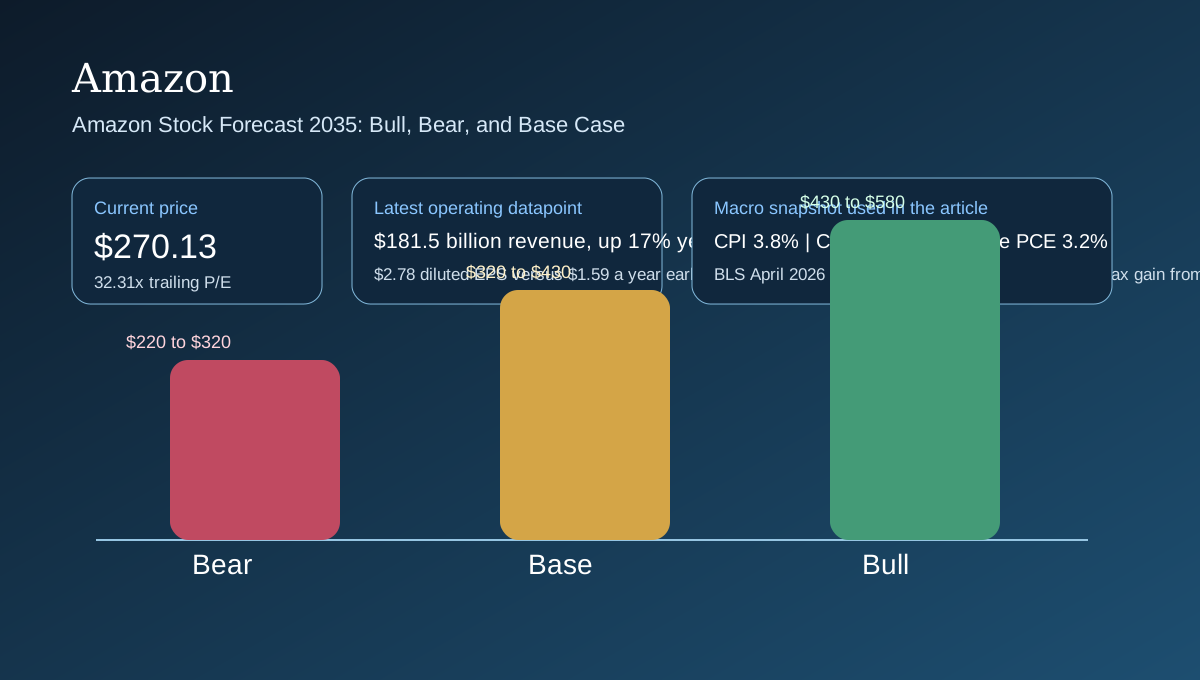
The ranges in this article are not point targets. They are editorial scenario matrices built from current price, 10-year compounding history, AWS growth durability, retail-margin quality, advertising scale, and AI return-on-capital assumptions. In practical terms, the probability weights ask how much of Amazon’s current mix shift toward AWS, ads, and chips becomes durable, high-quality earnings over the forecast horizon.
| Scenario | 2035 range | Conditions | Probability |
|---|---|---|---|
| Bull | $700-$950 | AWS, ads, chips, and AI services create a significantly higher-quality earnings mix while retail stays efficient | 25% |
| Base | $520-$700 | Amazon compounds well, but capex and scale keep valuation expansion from becoming excessive | 50% |
| Bear | $320-$520 | Cloud and AI remain important, but retail frictions and lower returns on spending cap upside | 25% |
| Direction | Probability | Comment |
|---|---|---|
| Higher | 40% | Possible if Amazon’s profit mix keeps improving and AI infrastructure spending creates durable value rather than just scale |
| Lower | 25% | Would most likely require AWS, ads, or AI payback to disappoint for an extended period |
| Sideways to measured gains | 35% | Likely if Amazon remains excellent but no longer compounds near the last decade’s rate |
| Investor type | Prudent approach | Main watchpoints |
|---|---|---|
| Investor already in profit | Hold a core stake, but trim if the position now assumes flawless AWS and AI capex execution | AWS growth, capex ROI, and position size |
| Investor currently at a loss | Reassess whether the thesis is AWS compounding, retail efficiency, or AI optionality and avoid averaging blindly | Cloud margins, ads growth, and sentiment resets |
| Investor with no position | Stage entries or wait for pullbacks instead of chasing AI-driven spikes | Guidance, tariff effects, and valuation |
| Trader | Use stop-loss discipline and trade around earnings, AWS commentary, capex updates, and macro retail data | Volatility, options pricing, and rate-sensitive tech rotation |
| Long-term investor | Dollar-cost average only if convinced AWS, ads, and chips can keep improving Amazon’s profit mix | Profit composition and return on invested capital |
| Risk-hedging investor | Rebalance if Amazon has become an oversized exposure to one AI-and-cloud thesis | Portfolio concentration and consumer slowdown risk |
Conclusion: the most realistic 2035 Amazon outlook is not endless hypergrowth or retail stagnation, but a still-powerful platform company whose upside depends on whether AWS, ads, and AI make the earnings mix meaningfully better than it is today. Disclaimer: This article is for informational and research purposes only and does not constitute personalized financial advice.
06. FAQ
Frequently asked questions
Is Amazon still primarily a retail stock?
No. Retail still matters, but AWS, advertising, subscriptions, and now chips and AI services increasingly shape the valuation.
What matters most for the next forecast revision?
AWS growth, AI monetization, ad growth, retail operating leverage, and capex returns are the most important inputs.
Is the biggest risk retail weakness or cloud spending?
Right now, the market is more sensitive to cloud and AI spending quality, but retail and tariff pressure can still influence margin confidence.
What would invalidate the optimistic case?
Meaningful AWS deceleration, weaker ad growth, capex outrunning monetization, or a more persistent consumer and tariff squeeze would all weaken the optimistic case.
Methodology and Invalidation
How to interpret this Amazon framework and what would change it
Amazon should not be modeled like a simple retailer, and it should not be modeled like a pure cloud stock either. The company now sits at the intersection of low-margin commerce, high-margin cloud, fast-growing advertising, subscriptions, logistics infrastructure, and AI capex. That mix is why point targets without context are usually misleading. The stock can look expensive relative to retail peers and still look reasonable relative to cloud and advertising peers. It can also look resilient in operating terms while still being vulnerable to re-rating if capex, tariffs, or AWS growth come under pressure.
These articles therefore use a range-based framework anchored to three things: current price, 10-year growth history, and the present mix of operating drivers. Yahoo Finance chart data place AMZN around `\$267.22` in mid-May 2026 and around `\$35.78` at the start of the 10-year comparison window, implying a 10-year CAGR above 22%. That historical compounding rate is useful, but it is not a forecast by itself. A company of Amazon’s size is unlikely to repeat that exact pace indefinitely without either a major expansion in margins or a new leg of very large incremental profit pools. That is why the 2030 and 2035 ranges in these articles are deliberately lower than a naive extension of the past decade, unless the bull case includes unusually favorable AWS, ads, and AI outcomes.
Primary sources matter most. Amazon’s Q1 2026 results showed `\$181.5 billion` in sales, `\$37.6 billion` from AWS, and `\$23.9 billion` of operating income. The 2025 Form 10-K and the latest shareholder letter add context around profitability mix, operating cash flow, capital expenditure direction, and risk factors ranging from regulation to foreign exchange to supplier relationships. About Amazon call excerpts provide further detail on ads growth, chips revenue run rate, and AI demand, which are especially important because they show how much of Amazon’s future upside is now tied to infrastructure and monetization beyond e-commerce.
External reporting and research then frame what the market is debating right now. Reuters highlighted that AWS beat expectations on strong AI demand, but it also emphasized that the planned `\$200 billion` capex budget made investors nervous about returns. Tariff-related Reuters reporting also shows that the consumer and marketplace side of Amazon can still face pricing and supplier pressure even when cloud looks strong. S&P Global’s preview work similarly emphasizes AWS reacceleration, ad growth, and the question of how much AI spending investors are willing to tolerate before demanding harder proof of payoff. Available data suggests the strongest Amazon thesis is no longer one-dimensional. It has to integrate retail, cloud, ads, chips, and capital intensity at the same time.
Investor positioning therefore depends on horizon. A trader may care most about AWS growth, Q2 guidance, and capex headlines. A long-term allocator should care more about whether AWS and advertising can keep increasing their share of profit, whether AI infrastructure earns acceptable returns, and whether retail logistics continue improving unit economics. Someone already in profit may trim if position size now depends on flawless AWS and AI execution. Someone with no position may prefer staged entries after pullbacks rather than chasing quarters where cloud growth surprises to the upside. What would invalidate a constructive Amazon outlook? A sharp slowdown in AWS, weaker ad growth, capex outrunning monetization for too long, or tariff and consumer pressure eroding retail quality would all matter. What would invalidate a more bearish Amazon view? Continued AWS strength, AI revenue acceleration, improving retail margins, and sustained advertising growth would weaken it. Inline evidence from Amazon’s own reporting, Yahoo’s price history endpoint, S&P research, and Reuters coverage is the reason the ranges here are conditional rather than theatrical certainty.
Inline evidence anchors the framework (Yahoo AMZN chart API; Amazon Q1 2026 results; Amazon 2025 Form 10-K; Reuters on AWS strength; Reuters on capex concerns). That is also what should let the ranges evolve as the facts evolve.
References
Sources
- Yahoo Finance chart API, AMZN 10-year monthly history and current price
- Amazon, Q1 2026 results
- Amazon, Q4 2025 and full-year 2025 results
- Amazon, Form 10-K for fiscal year ended December 31, 2025
- Amazon, Andy Jassy 2025 shareholder letter
- About Amazon, Q1 2026 highlights
- About Amazon, AWS AI commentary from Q1 2026 call
- About Amazon, chips business commentary from Q1 2026 call
- About Amazon, Ads growth commentary from Q1 2026 call
- S&P Global, Amazon earnings preview Q1 2026
- Reuters, Amazon tops cloud expectations on strong AI demand
- Reuters, Amazon shares slide as $200 billion outlay fans fears over AI returns
- Reuters, tariffs starting to bump up product prices
- Reuters, DOJ remedies context for big-tech regulation backdrop