01. Quick Answer
The most reasonable ASML 2030 forecast is constructive, but it still depends on customer spending and policy friction, not just on monopoly status
ASML closed at 1,306.60 on 2026-05-15, up from 88.39 at the start of its 10-year Yahoo Finance monthly series on 2016-06-01, for a price-only CAGR of about 30.91% (Yahoo Finance 10-year history; recent daily closes). That kind of decade-long compounding makes it dangerous to use a simple extrapolation model for 2030.
A serious 2030 framework has to balance two truths. First, ASML's own 2030 roadmap still points to a meaningful long-term revenue opportunity driven by advanced nodes, logic, memory, and service intensity. Second, the annual report and the 20-F both make clear that export restrictions, customer timing, and supply-chain execution remain real constraints. That combination argues for a 2030 range, not a slogan.
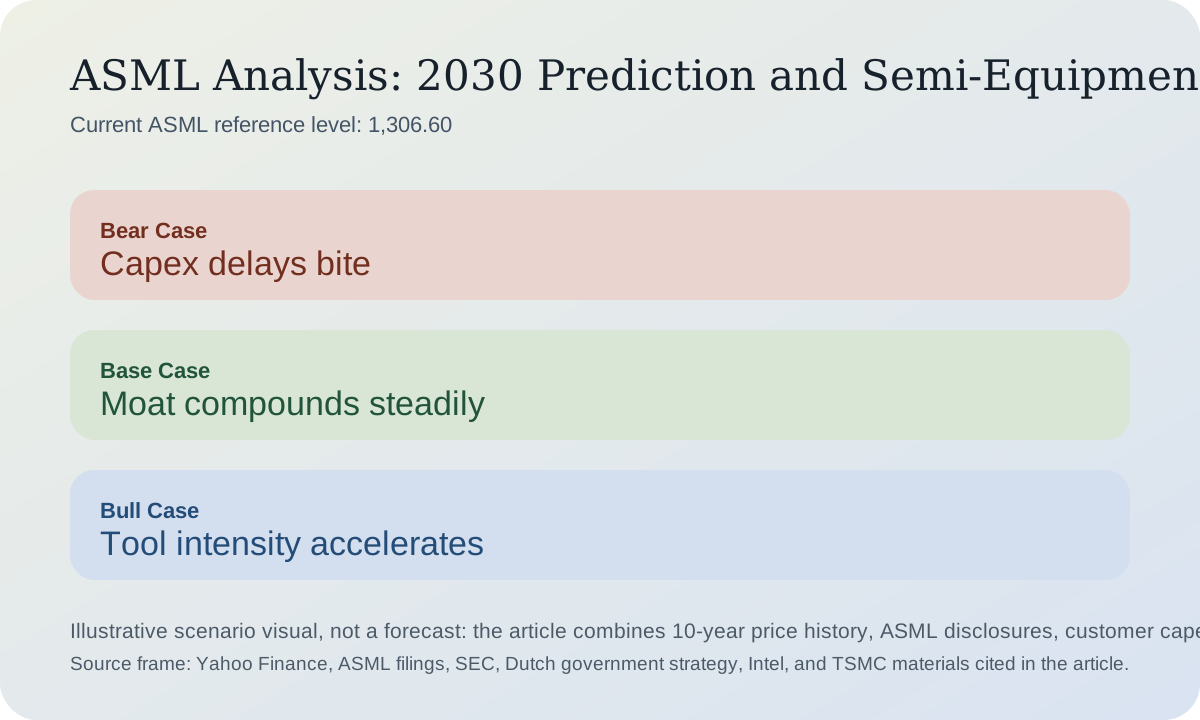
| Point | Why it matters |
|---|---|
| ASML is indispensable, but not immune to cycles | Monopoly-like positioning helps, yet customer capex timing still moves the stock. |
| AI matters because it raises tool intensity | Advanced logic and packaging demand can extend the lithography cycle, but only if spending persists. |
| Export controls remain central | China restrictions can alter revenue mix and sentiment without destroying the whole thesis. |
| 2030 should be modeled as scenarios | Available data suggests a higher long-term path is plausible, but the range should stay wide. |
02. Historical Context
ASML has already delivered extraordinary compounding, so the 2030 debate is about durability rather than discovery
ASML closed at 1,306.60 on 2026-05-15, up from 88.39 at the start of its 10-year Yahoo Finance monthly series on 2016-06-01, for a price-only CAGR of about 30.91% (Yahoo Finance 10-year history; recent daily closes). The significance of that move is not just that the stock rose. It is that the rise came from a company that turned process complexity into structural pricing power.
ASML's Q1 2026 results and 2025 annual report show a business shaped by EUV, High NA EUV, installed base service, and a small set of customers that collectively determine most of the advanced-node roadmap. That matters because ASML is not a standard semiconductor stock. It is a bottleneck supplier to the entire leading-edge ecosystem.
Historical returns also warn against lazy extrapolation. A company can remain strategically essential and still produce mediocre stock returns for several years if revenue timing disappoints or multiples compress. The right 2030 approach is therefore to combine long-run monopoly quality with cyclical humility.
| Metric | Latest reading | Why it matters |
|---|---|---|
| Current share price | 1,306.60 | Every scenario range in this set is anchored to the latest available close. |
| 52-week range | 587.80 to 1,371.60 | Shows how much ASML has already rerated inside a single year. |
| 10-year start point | 88.39 | Disciplines long-run compounding assumptions and avoids narrative-only projections. |
| Editorial base range | 1,650-2,050 | Scenario ranges are more credible than a single-number call in a cyclical monopoly-like stock. |
| Feature | Implication | Forecast effect |
|---|---|---|
| Near-monopoly in EUV lithography | ASML has unusual pricing power and strategic importance | Supports premium valuation but also attracts intense expectation risk. |
| Customer concentration | TSMC, Intel, and Samsung matter disproportionately | Customer capex timing can swing sentiment sharply. |
| Export-control sensitivity | China restrictions matter for shipment mix and backlog quality | Policy can affect near-term revenue without breaking the long-term thesis. |
| Long-duration AI lever | Advanced packaging and logic demand support tool intensity | AI capex can extend the growth runway if customer spending persists. |
03. Main Drivers
Five structural drivers are most likely to shape ASML into 2030
1. The logic and foundry capex cycle. TSMC's capex framing and Intel's foundry roadmap matter because ASML cannot monetize its technology if customers delay node transitions.
2. High NA EUV adoption. High NA is important not because it instantly transforms revenue, but because it extends ASML's technology moat and service intensity.
3. AI infrastructure demand. AI raises demand for advanced logic, memory, and packaging complexity, which in turn supports lithography intensity if the cycle remains healthy.
4. Export restrictions and geopolitical exposure. ASML repeatedly flags export rules as material to shipments and mix, especially with China remaining a meaningful market.
5. Installed base and service revenue. ASML is not only a tool seller. Its installed base creates a recurring support layer that can soften pure capex volatility.
04. Institutional Forecasts and Analyst Views
ASML's own long-range targets are informative, but investors still need scenario discipline around timing and valuation
The most useful institutional-style evidence comes from the company itself and from major customers rather than from distant sell-side point targets. Investor Day still points to a broad 2030 revenue opportunity, while TSMC and Intel materials help validate the demand side of the roadmap.
Analysts remain divided because the evidence is mixed. The long-term moat is unusually strong, but the stock already trades like a rare asset. That means a credible 2030 forecast must distinguish between strategic indispensability and the price investors are willing to pay for it at any given moment.
| Source | What it says | Implication for ASML |
|---|---|---|
| ASML Investor Day | Management still sees a large 2030 market opportunity | Supports a constructive long-run revenue path. |
| ASML Annual Report and 20-F | Export controls and customer concentration remain material | Keeps the range wide and policy-sensitive. |
| TSMC | Advanced-node capex remains strategically important | Supports the demand case if execution holds. |
| Intel | Leading-edge foundry ambitions still require advanced tooling | Adds another major demand lever if roadmaps stay funded. |
05. Scenarios, Risks, and Invalidation
Bull, bear, and base cases imply a wide 2030 range because monopoly quality does not eliminate timing risk
Bullish scenario
The bull case for 2030 is roughly 2,150 to 2,600. This scenario depends heavily on durable AI-driven tool intensity, broad High NA adoption, and customer capex staying strong enough to keep ASML's premium valuation intact.
Bearish scenario
The bear case is 1,050 to 1,300. That path would likely require a longer digestion in customer capex, more binding export restrictions, and multiple compression in a stock that has already compounded at an exceptional rate.
Base-case scenario
The base case is 1,650 to 2,050. That assumes the moat remains intact, AI demand supports the roadmap, and periodic cycle slowdowns do not break the strategic story.
Risks to watch
Watch foundry and memory capex, China mix, High NA shipment cadence, backlog quality, and whether service revenue keeps reducing the severity of cyclical slowdowns.
What could invalidate the forecast
This framework would be too optimistic if customers delay leading-edge spending for longer than management currently expects or if export restrictions bite harder than the market assumes. It would be too conservative if AI-driven tool intensity expands the demand pool faster than current roadmaps imply.
Conclusion
The most credible ASML 2030 outlook is constructive, but not complacent. The company is strategically indispensable, yet the stock still needs execution and customer funding to justify further premium re-rating.
Disclaimer: This article is for research and informational purposes only. Scenario ranges are editorial judgments based on public information, not guarantees or personalized investment advice.
| Scenario | Range | Key conditions | Probability |
|---|---|---|---|
| Bull | 2,150-2,600 | Strong AI capex, High NA adoption, and durable premium valuation | 25% |
| Base | 1,650-2,050 | Healthy roadmap execution with normal cycle volatility | 50% |
| Bear | 1,050-1,300 | Capex delays and sharper multiple compression | 25% |
| Path | Estimated probability | Why |
|---|---|---|
| Rising from current levels by 2030 | 55% | ASML still has rare structural advantages and unusually strong customer dependence. |
| Falling below current levels by 2030 | 20% | A lower 2030 level likely requires both cycle disappointment and policy friction. |
| Moving broadly sideways | 25% | Valuation digestion can offset business progress in premium compounders. |
06. Investor Positioning
Different investor profiles should treat ASML differently into 2030
| Investor type | Cautious approach | What to watch |
|---|---|---|
| Investor already in profit | Hold a core position but trim if ASML has become an outsized single-stock risk. | Customer capex timing and valuation compression risk. |
| Investor currently at a loss | Separate entry timing from moat quality before averaging down. | If the thesis remains intact, weakness may be cyclical rather than structural. |
| Investor with no position | Build exposure in stages or wait for pullbacks instead of chasing a premium asset at any price. | Backlog quality and foundry spending signals. |
| Trader | Use stop-losses and trade around earnings, export-control news, and customer capex commentary. | Short-term sentiment can swing hard on one guidance update. |
| Long-term investor | Dollar-cost averaging is more defensible than all-in timing calls. | Moat durability, service mix, and capital intensity of the customer base. |
| Risk-hedging investor | Use explicit hedges rather than assuming monopoly status removes downside risk. | Geopolitics, valuation, and customer concentration. |
07. FAQ
Frequently asked questions about the ASML outlook
Why not just project ASML's past CAGR forward to 2030?
Because a stock that compounded above 30% annually from a lower base is unlikely to repeat that pace without much more demanding assumptions.
What matters most for ASML right now?
Customer capex timing, High NA adoption, export-control policy, and whether AI demand keeps lifting tool intensity.
Is ASML less cyclical than other semiconductor names?
Structurally yes because of its moat and service base, but not immune. Capex timing still matters materially.
References
Sources
- Yahoo Finance chart API for ASML.AS, 10-year monthly history
- Yahoo Finance chart API for ASML.AS, recent daily closes
- ASML first-quarter 2026 results
- ASML annual report 2025
- ASML Investor Day 2024: 2030 opportunity and roadmap
- ASML long-term financial framework
- Dutch Semiconductor Vision 2035
- Dutch vision on generative AI
- Intel foundry update and 18A manufacturing roadmap
- TSMC fourth quarter 2025 conference call transcript and 2026 capex discussion
- ASML Form 20-F filed with the SEC
- Dutch AI Act supervision update