01. Quick Answer
The most realistic 2035 ASML forecast is higher than today, but the path depends on moat persistence and customer funding discipline
ASML closed at 1,306.60 on 2026-05-15, up from 88.39 at the start of its 10-year Yahoo Finance monthly series on 2016-06-01, for a price-only CAGR of about 30.91% (Yahoo Finance 10-year history; recent daily closes). That decade-long compounding already reflects a massive recognition of ASML's strategic value, which is why a 2035 call must be more disciplined than a simple trend extension.
The most credible long-range evidence comes from ASML's roadmap, customer roadmaps, and policy documents like the Dutch Semiconductor Vision 2035. Together they support a constructive long-term case, but not one without volatility, policy friction, or valuation resets.
| Point | Why it matters |
|---|---|
| 2035 is a regime question, not a quarter-to-quarter call | Tool intensity, AI, export controls, and customer concentration matter more than one earnings beat. |
| ASML still has unusual structural power | Few capital-equipment businesses have comparable technological indispensability. |
| The bear case remains real | Even a monopoly-like supplier can underperform if cycles, policy, or valuation all turn at once. |
| Total return will likely slow from the last decade | Business quality can remain outstanding even if stock compounding moderates from an extreme base. |
02. Historical Context
The last decade proves ASML can rerate hard, but a nine-year forecast needs a slower and more disciplined logic
ASML closed at 1,306.60 on 2026-05-15, up from 88.39 at the start of its 10-year Yahoo Finance monthly series on 2016-06-01, for a price-only CAGR of about 30.91% (Yahoo Finance 10-year history; recent daily closes). The key historical lesson is that ASML's extraordinary stock performance came from both earnings growth and a massive revaluation of its strategic role.
ASML's annual report and 20-F make clear why that happened: EUV leadership, growing service content, high barriers to entry, and customer dependence on ever more complex manufacturing steps. But a decade-long rerating also means future returns will likely depend more on execution and less on simple discovery.
The more cautious historical lesson is that premium industrial technology stocks can spend years digesting gains even when the underlying moat keeps widening. A credible 2035 framework must allow for both compounding and valuation compression within the same decade.
| Metric | Latest reading | Why it matters |
|---|---|---|
| Current share price | 1,306.60 | Every scenario range in this set is anchored to the latest available close. |
| 52-week range | 587.80 to 1,371.60 | Shows how much ASML has already rerated inside a single year. |
| 10-year start point | 88.39 | Disciplines long-run compounding assumptions and avoids narrative-only projections. |
| Editorial base range | 2,200-2,900 | Scenario ranges are more credible than a single-number call in a cyclical monopoly-like stock. |
| Feature | Implication | Forecast effect |
|---|---|---|
| Near-monopoly in EUV lithography | ASML has unusual pricing power and strategic importance | Supports premium valuation but also attracts intense expectation risk. |
| Customer concentration | TSMC, Intel, and Samsung matter disproportionately | Customer capex timing can swing sentiment sharply. |
| Export-control sensitivity | China restrictions matter for shipment mix and backlog quality | Policy can affect near-term revenue without breaking the long-term thesis. |
| Long-duration AI lever | Advanced packaging and logic demand support tool intensity | AI capex can extend the growth runway if customer spending persists. |
03. Main Drivers
Six long-range forces are likely to decide where ASML stands by 2035
1. Whether EUV and High NA remain central to advanced-node economics. If customers keep needing more lithography precision, ASML remains essential.
2. AI demand becomes structural or cyclical. AI can lift tool intensity for years, but only if hyperscaler and foundry spending stays funded across cycles.
3. Customer concentration remains manageable. TSMC, Intel, and Samsung create enormous demand, but they also create timing concentration.
4. Export-policy friction becomes manageable or binding. China exposure can remain material even if the long-run Western logic roadmap stays intact.
5. Service revenue and installed base deepen. A larger installed base makes the business more resilient than a pure one-time tool seller.
6. Valuation discipline still matters. A great company can still be a mediocre stock for a while if expectations overshoot realized growth.
04. Institutional Forecasts and Analyst Views
The best 2035 framework combines company roadmaps, customer capex logic, and policy risk rather than pretending to know one exact number
There are few credible long-dated institutional point targets for ASML, which is normal. The more defensible approach is to combine ASML's own roadmap, TSMC capex signals, Intel's foundry ambition, and export-policy disclosures rather than forcing false precision into a decade-plus stock call.
Analysts remain divided because the evidence is mixed. The moat is hard to dispute. The valuation and policy path are not. The long-range base case therefore assumes strong business quality, periodic cyclical stress, and a slower stock-return profile than the prior decade delivered.
That distinction matters because long-run investors can be directionally right about ASML and still experience long stretches of mediocre stock performance if the starting multiple proves too rich. A serious 2035 framework has to separate moat durability from expected annualized return.
| Source | What it implies | Why it matters |
|---|---|---|
| ASML Investor Day | Management still sees large 2030 market potential | Supports the view that demand can remain structurally strong well into the 2030s. |
| Annual Report and 20-F | Policy, supply chain, and customer concentration remain live issues | Keeps the long-run range wide. |
| TSMC and Intel | Advanced-node capex remains strategically important | Customer willingness to fund the roadmap is central. |
| Semiconductor Vision 2035 | Dutch policy sees semiconductors as strategic national infrastructure | Reinforces long-run ecosystem confidence. |
05. Scenarios, Risks, and Invalidation
A long-range bull case exists, but the base case still assumes periods of valuation digestion
Bullish scenario
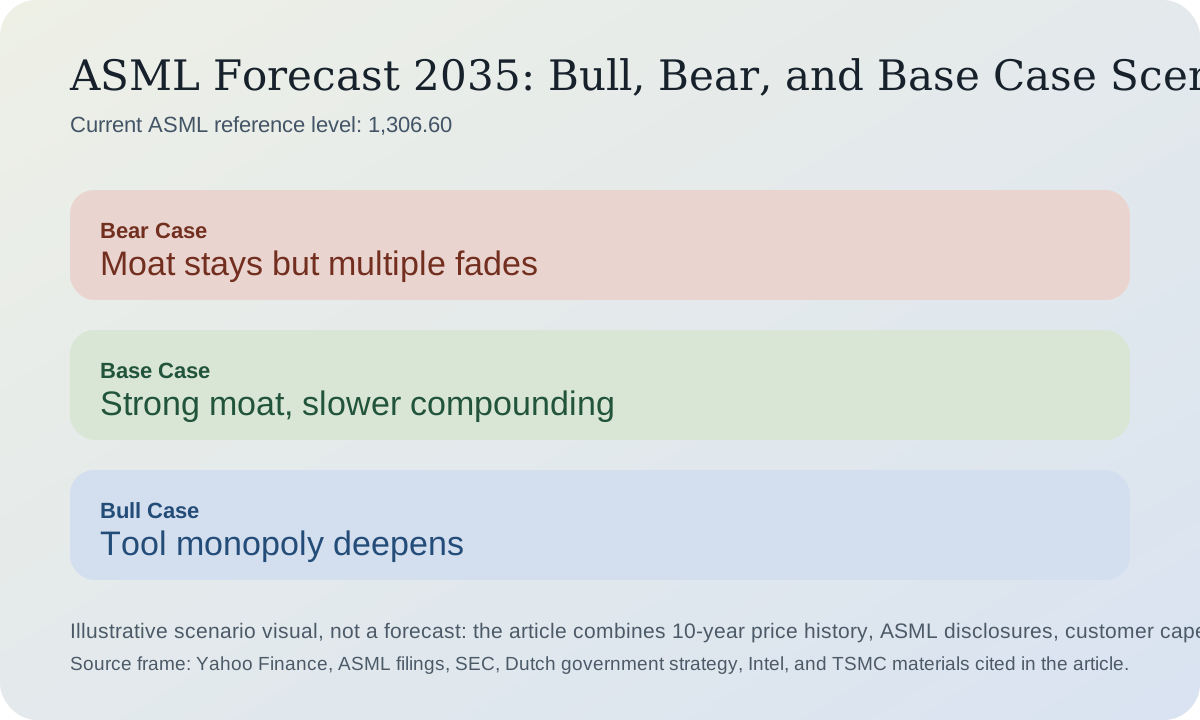
The long-range bull case is 3,000 to 3,800 by 2035. This would likely require AI-driven tool intensity to remain strong for years, High NA to deepen the moat, and customer funding to remain robust across several cycles.
Bearish scenario
The bear case is 1,300 to 1,700. That would imply a prolonged period of slower customer capex, tougher export constraints, and a lower market multiple on premium semiconductor infrastructure.
Base-case scenario
The base case is 2,200 to 2,900. That assumes moat durability, continued service growth, and periodic drawdowns that do not break the long-run thesis.
Risks to watch
Watch High NA adoption, export-control policy, foundry profitability, memory spending, and whether AI demand remains structural rather than front-loaded.
What could invalidate the forecast
The range would be too optimistic if export controls become more binding and customers defer leading-edge transitions more often than expected. It would be too conservative if lithography complexity rises fast enough to deepen ASML's pricing power beyond current roadmaps.
Conclusion
The most credible 2035 ASML view is constructive, but only inside a broad range. ASML can remain strategically indispensable while still putting investors through years of valuation digestion and cycle-driven volatility.
Disclaimer: This article is for research and informational purposes only. Long-range scenarios are conditional frameworks, not guarantees or individualized advice.
| Scenario | Range | Conditions | Probability |
|---|---|---|---|
| Bull | 3,000-3,800 | Durable AI capex, deep High NA adoption, and strong customer funding | 20% |
| Base | 2,200-2,900 | Strong moat with normal cycle volatility and slower stock compounding | 50% |
| Bear | 1,300-1,700 | Policy friction and longer spending pauses | 30% |
| Direction | Probability | Comment |
|---|---|---|
| Higher than today by 2035 | 60% | Nine years is enough time for an exceptional moat to matter despite cycle volatility. |
| Lower than today by 2035 | 15% | This likely requires a material policy and capex disappointment rather than normal cyclicality. |
| Sideways to moderate gains | 25% | Premium industrial compounders can digest gains for years even while the business improves. |
06. Investor Positioning
A long horizon changes how investors should think about ASML
| Investor type | Cautious approach | What to watch |
|---|---|---|
| Investor already in profit | Rebalance concentration and let the moat keep a role without becoming the whole portfolio. | How much performance depends on one premium multiple. |
| Investor currently at a loss | Check whether the thesis is long enough to justify holding through policy and capex cycles. | Short-term weakness does not automatically break the long-run case. |
| Investor with no position | Use staged entries instead of chasing a rare asset at any valuation. | Valuation matters more over a nine-year horizon than enthusiasm. |
| Trader | Do not confuse a decade scenario with a short-term setup. | The stock can be structurally attractive and still correct sharply over months. |
| Long-term investor | Dollar-cost averaging and periodic rebalancing remain the most defensible approach. | Total return and single-stock concentration. |
| Risk-hedging investor | Pair ASML exposure with explicit hedges if semiconductor-cycle risk is uncomfortable. | Export policy, customer capex, and broader tech sentiment. |
07. FAQ
Frequently asked questions about the ASML outlook
Can ASML still compound well after such a strong decade?
Yes, but probably at a slower pace. The moat can remain exceptional even if the stock no longer compounds like it did from a much lower base.
What matters most over a nine-year horizon?
The persistence of tool intensity, customer funding, export-policy limits, and whether High NA deepens the moat as expected.
Why not give one exact 2035 target?
Because a stock this cyclical and policy-sensitive can travel through multiple valuation regimes before 2035.
References
Sources
- Yahoo Finance chart API for ASML.AS, 10-year monthly history
- Yahoo Finance chart API for ASML.AS, recent daily closes
- ASML first-quarter 2026 results
- ASML annual report 2025
- ASML Investor Day 2024: 2030 opportunity and roadmap
- ASML long-term financial framework
- Dutch Semiconductor Vision 2035
- Dutch vision on generative AI
- Intel foundry update and 18A manufacturing roadmap
- TSMC fourth quarter 2025 conference call transcript and 2026 capex discussion
- ASML Form 20-F filed with the SEC
- Dutch AI Act supervision update