01. Quick Answer
The most likely 2027 outcome is range-bound to modestly higher, not a breakout or crash
With the index at 8,630.80 on 2026-05-15, a sensible 2027 forecast starts from the observation that the market is already below its February 2026 record but still well above the 2025 troughs (Yahoo Finance chart API for ^AXJO, one-month daily history; Yahoo Finance chart API for ^AXJO, one-year daily history). That usually argues for a range, not a dramatic call. The benchmark could grind higher if inflation cools and bank earnings hold up. It could just as easily move sideways if rates stay restrictive and resources lose momentum.
The key point is that 2027 is too close for structural wishful thinking. Near-term ASX performance will probably be decided by the RBA, domestic inflation, household resilience, and China-linked commodity pricing more than by decade-long policy aspirations (Reserve Bank of Australia, Statement by the Monetary Policy Board: Monetary Policy Decision, May 5, 2026; Australian Bureau of Statistics, Consumer Price Index, Australia, March 2026; ANZ, How China’s decarbonisation is reshaping Australia’s trade outlook).
| Takeaway | Why it matters in 2027 |
|---|---|
| Inflation is still the immediate swing factor | A cleaner disinflation path would help rates, valuations, and household confidence. |
| Banks still anchor the benchmark | Loan growth, margins, and asset quality will shape the index more than many investors admit. |
| Resources can rescue or hurt the tape quickly | The market remains sensitive to commodity sentiment and China demand. |
| Range thinking is more realistic than conviction thinking | The evidence does not justify a one-way call at this horizon. |
02. Historical Context
Near-term forecasting should be rooted in current conditions, not decade averages alone
The ASX 200's 10-year CAGR of 5.15% is useful context, but it can be misleading for a 2027 call. What matters more right now is that the benchmark has already shown investors both a record-high breakout and a fast pullback in 2026. The one-year range of 8,295.10 to 9,198.60 captures that tension (Yahoo Finance chart API for ^AXJO, one-year daily history).
The official factsheet also shows an index with a 3.43% indicated dividend yield and a projected P/E of 15.33 (S&P Dow Jones Indices, S&P/ASX 200 Index (AUD) Factsheet, as of April 30, 2026). That valuation profile is not distressed, but it is also not so expensive that mild growth disappointment automatically means collapse. It supports a base case of modest movement unless the macro data genuinely worsen.
| Indicator | Latest reading | Near-term meaning |
|---|---|---|
| ASX 200 level | 8,630.80 | Starting point for every 2027 scenario. |
| 52-week range | 8,295.10 to 9,198.60 | Shows the market has room in both directions without changing its longer-term trend. |
| Distance from record high | -6.22% | Suggests some air has already come out of the rally. |
| Indicated dividend yield | 3.43% | Can support buyer interest on pullbacks. |
| Data point | Latest signal | Why it matters |
|---|---|---|
| CPI | 4.6% annual CPI in March 2026 | Higher inflation keeps the RBA on alert and restrains multiples. |
| Trimmed mean | 3.3% | Underlying inflation remains above the comfort zone. |
| Unemployment | 4.3% in March 2026 | A still-firm labor market can support earnings but complicate disinflation. |
| Wages | 0.8% quarter-on-quarter in March 2026 | Wage pressure can support consumption yet squeeze margins and policy expectations. |
03. Main Drivers
Six catalysts are likely to decide the 2027 path
1. The cash-rate path. The RBA's May 2026 materials showed markets pricing more tightening by year-end (Reserve Bank of Australia, Statement on Monetary Policy, May 2026). If that path eases, the ASX can recover some confidence. If it hardens, upside narrows.
2. Headline and underlying inflation. The ABS inflation release turned more difficult in March 2026, driven partly by housing and transport (Australian Bureau of Statistics, Consumer Price Index, Australia, March 2026). A reversal would help the market. Persistence would not.
3. Bank margins and credit quality. Financials are 34.5% of the benchmark (S&P Dow Jones Indices, S&P/ASX 200 Index (AUD) Factsheet, as of April 30, 2026). The near-term ASX call is therefore inseparable from the banks.
4. Commodity prices and China demand. Westpac and ANZ both emphasize the importance of commodity dynamics and changing Chinese demand patterns (Westpac IQ, Commodities Update February 2026; ANZ, How China’s decarbonisation is reshaping Australia’s trade outlook).
5. Budget and fiscal follow-through. The 2026-27 Budget puts more weight on productivity, fuel resilience, and investment (Australian Government Budget 2026-27 overview). Near-term market effects are modest, but sector-level impacts can still matter.
6. Global risk appetite. Australia does not trade in isolation. A global de-risking move can pressure both banks and miners even if domestic data are merely mixed (BlackRock Australia, Outlook Q2 2026 and Quarterly Review; AMP, The investment outlook for 2026).
04. Institutional Forecasts and Analyst Views
Analyst views support cautious optimism, but not complacency
AMP expects a rough but ultimately acceptable ride for 2026 and notes that stronger profit growth in Australia is supportive, even as valuations remain only modestly attractive. AMP also expects Australian share returns to slow to around 8% in 2026 rather than repeat prior years. Fidelity Australia still sees opportunity, particularly where stock-specific fundamentals matter more than macro noise. Those views collectively support a modestly positive 2027 bias, but not a clean runaway rally.
Macro institutions make the same case in a different language. The IMF and OECD both describe growth that can support earnings, but the RBA and ABS data warn that inflation still limits how generous the valuation environment can become. That is why the evidence supports a base case centered on range-bound to moderately higher levels.
| Source | Read-through | 2027 implication |
|---|---|---|
| AMP | Reasonable returns remain possible, but valuations and macro risk cap enthusiasm. | Supports a modest upside bias, not a breakout assumption. |
| Fidelity Australia | Volatility should improve alpha opportunities across resources and selective financials. | Suggests dispersion, not uniform market strength. |
| IMF / OECD | Australia still looks resilient by developed-market standards. | Limits the probability of a deep bear outcome unless inflation worsens. |
05. Scenarios, Risks, and Invalidation
For 2027, scenario discipline matters more than storytelling
Bullish scenario
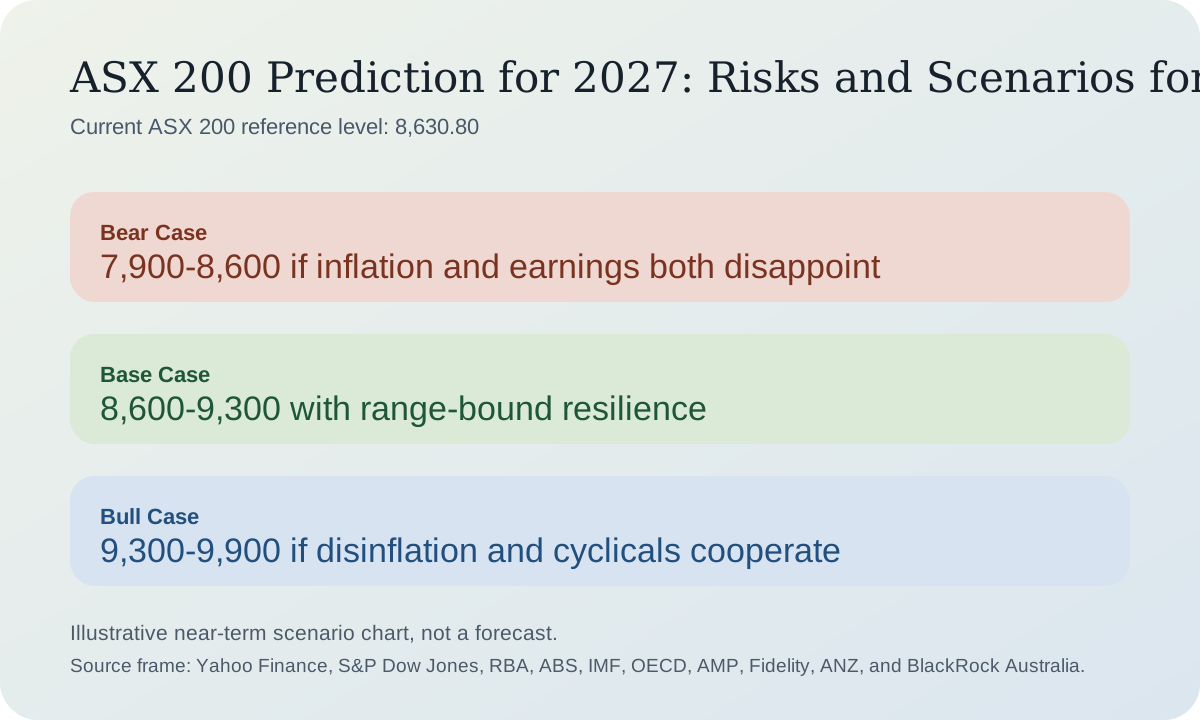
The bull case is 9,300 to 9,900 by 2027. It would likely require inflation to cool, the RBA to step back from further tightening, commodity prices to stay constructive, and banks to hold up better than feared.
Bearish scenario
The bear case is 7,900 to 8,600. That would fit a world where inflation stays sticky, household stress rises, miners lose earnings momentum, and the market starts pricing tighter financial conditions for longer.
Base-case scenario
The base case is 8,600 to 9,300. This assumes mixed macro data, resilient but unspectacular earnings, and enough dividend support to keep sell-offs from becoming persistent.
| Scenario | 2027 range | Conditions | Probability |
|---|---|---|---|
| Bull | 9,300-9,900 | Disinflation returns, rates settle, and cyclicals re-accelerate | 30% |
| Base | 8,600-9,300 | Mixed but survivable macro backdrop with modest earnings growth | 45% |
| Bear | 7,900-8,600 | Sticky inflation, slower credit, and weaker resource earnings | 25% |
| Direction | Probability | Comment |
|---|---|---|
| Higher | 40% | The market still has a credible path to modest gains if inflation improves. |
| Lower | 25% | A worse outcome most likely needs several macro negatives to align. |
| Sideways | 35% | Probably the single most realistic path if data remain noisy and rates stay elevated. |
Risks to watch
RBA guidance, trimmed mean inflation, Chinese industrial demand, bank provisioning trends, and any sign that wage growth is forcing a more restrictive policy stance.
What could invalidate the forecast
This range would be too cautious if inflation drops faster than expected and a broad valuation recovery follows. It would be too optimistic if the policy backdrop tightens further while commodity support fades.
Conclusion
The 2027 ASX call is best expressed as a range centered on resilience, not exuberance. Investors should expect choppiness and update their view as the inflation and rate story evolves.
Disclaimer: This article is for informational purposes only. The ranges and probabilities are editorial scenario estimates based on public information and are not personalized financial advice.
06. Investor Positioning
Different investor profiles need different levels of patience and risk control
| Investor type | Cautious approach | Why it fits the setup |
|---|---|---|
| Investor already in profit | Hold core positions but trim into sharp strength if the portfolio has become overly cyclical. | Near-term upside exists, but the macro path is still fragile. |
| Investor currently at a loss | Reassess the thesis versus inflation and rates before averaging down. | A weak position is easier to repair when the original reason for owning it still holds. |
| Investor with no position | Use staggered entries and avoid chasing short-lived relief rallies. | The index can move sideways for long periods when macro data are mixed. |
| Trader | Use stop-losses and focus on event risk around CPI, labor data, and RBA meetings. | The short-term tape is highly reactive to macro releases. |
| Long-term investor | Accumulate selectively, but recognize that 2027 may be a transition year rather than a breakout year. | Long-term compounding can still work even when the next 12 months are messy. |
| Risk-hedging investor | Blend ASX exposure with less cyclical global sleeves and watch currency and commodity sensitivity. | The benchmark remains vulnerable to both domestic and external shocks. |
07. FAQ
Frequently asked questions about the ASX 200 in 2027
Is 2027 mainly an RBA story?
Largely yes, but not only. Rates, inflation, bank earnings, and resource demand all interact, so policy cannot be analyzed in isolation.
Why is sideways action such a plausible outcome?
Because the ASX has real support from dividends and incumbent cash flow, but current inflation data make a major valuation expansion harder to justify.
What would make the 2027 outlook materially better?
A cleaner fall in trimmed mean inflation, more confidence that rates have peaked, and evidence that commodity demand remains durable.
References
Sources
- Yahoo Finance chart API for ^AXJO, one-month daily history
- Yahoo Finance chart API for ^AXJO, one-year daily history
- Yahoo Finance chart API for ^AXJO, 10-year monthly history
- S&P Dow Jones Indices, S&P/ASX 200 Index (AUD) Factsheet, as of April 30, 2026
- Reserve Bank of Australia, Statement by the Monetary Policy Board: Monetary Policy Decision, May 5, 2026
- Reserve Bank of Australia, Statement on Monetary Policy, May 2026
- Australian Bureau of Statistics, Consumer Price Index, Australia, March 2026
- Australian Bureau of Statistics, Labour Force, Australia, March 2026
- Australian Bureau of Statistics, Wage Price Index, Australia, March 2026
- IMF Executive Board Concludes 2025 Article IV Consultation with Australia, published February 15, 2026
- OECD Economic Surveys: Australia 2026
- AMP, The investment outlook for 2026
- AMP, 2026 predictions after 2025 success
- Fidelity Australia, A word on: Australian equities
- ANZ, How China’s decarbonisation is reshaping Australia’s trade outlook
- BlackRock Australia, Outlook Q2 2026 and Quarterly Review