01. Quick Answer
The 2035 ASX outlook is positive if Australia can convert its macro advantages into productivity
By 2035, the ASX 200 can plausibly be much higher than today without ever becoming a U.S.-style growth index. The most likely path is a slower, income-supported compounding profile built on banks, miners, infrastructure, and selective technology rather than one driven by perpetual multiple expansion. That matters because the market's own history, from 5,233.40 in May 2016 to 8,630.80 in May 2026, already argues against lazy extrapolation (Yahoo Finance chart API for ^AXJO, 10-year monthly history).
The long-run case is helped by several structural supports: an investable banking system, global relevance in iron ore, copper, gold, LNG, and critical minerals, and a government industrial agenda that is increasingly explicit (Future Made in Australia; critical minerals policy). But the evidence is mixed because productivity, housing affordability, energy costs, and China dependence remain binding constraints (OECD).
| Theme | 2035 implication |
|---|---|
| Dividend support | Australia can still deliver attractive total return even if price appreciation is only moderate. |
| Critical minerals and energy transition | Long-run commodity exposure can evolve rather than simply fade. |
| Productivity matters more than hype | Without stronger productivity, the index may rise but still underperform faster-growth peers. |
| Concentration is both strength and weakness | The same sector mix that supports yield can also cap diversification. |
02. Historical Context
The long-run baseline should start with how Australia has actually compounded
The official S&P factsheet puts the ASX 200 price return annualized at 5.13% over 10 years through April 30, 2026, while the Yahoo monthly series gives a nearly identical 5.15% through May 15, 2026 (S&P Dow Jones Indices, S&P/ASX 200 Index (AUD) Factsheet, as of April 30, 2026; Yahoo Finance chart API for ^AXJO, 10-year monthly history). That consistency is useful. It suggests a sensible 2035 forecast should begin with low-to-mid single-digit price compounding, then adjust for structural drivers rather than assuming the next decade will suddenly look like the Nasdaq.
The index's structure also matters for any long-run estimate. Financials represent 34.5% and materials 25.0% of the benchmark, while information technology is just 2.1% (S&P Dow Jones Indices, S&P/ASX 200 Index (AUD) Factsheet, as of April 30, 2026). In other words, the ASX still earns its future mostly through credit, housing, trade, resources, logistics, and dividends. Investors waiting for a giant domestic software weight to rescue the index may be waiting for the wrong story.
| Metric | Reading | Why it matters for 2035 |
|---|---|---|
| 10-year price CAGR | 5.15% | Provides a realistic starting point for long-term range building. |
| Top 10 constituent weight | 48.6% | Leadership concentration will continue to shape returns disproportionately. |
| Projected P/E | 15.33 | The market is not cheap enough to assume effortless rerating. |
| Indicated dividend yield | 3.43% | Total return potential is stronger than price-only charts imply. |
| Constraint | Current evidence | Why it matters |
|---|---|---|
| Productivity | OECD keeps flagging productivity and housing as core challenges. | Long-run earnings growth will disappoint if output per worker stays weak. |
| Inflation credibility | ABS CPI and RBA guidance show a less benign inflation regime. | Higher discount rates restrain valuation expansion. |
| China concentration | ANZ highlights how trade flows are being reshaped by decarbonisation. | Australia needs commodity relevance beyond legacy bulk exports. |
| Industrial depth | Future Made in Australia is supportive but execution still matters. | Policy headlines only matter if private investment follows. |
03. Main Drivers
The decade ahead will likely be decided by five structural drivers
1. Resource mix, not just resource volume. Australia's long-term equity case is no longer only about iron ore and coal. Copper, gold, lithium, rare earths, and processing capability matter more as the energy transition matures (Department of Industry, Science and Resources, Critical minerals; ANZ, How China’s decarbonisation is reshaping Australia’s trade outlook).
2. Banking durability. If the large banks remain highly profitable and capital disciplined, the index retains its income anchor. If mortgage stress or regulation compresses returns, the benchmark loses a key stabilizer (S&P Dow Jones Indices, S&P/ASX 200 Index (AUD) Factsheet, as of April 30, 2026; IMF Executive Board Concludes 2025 Article IV Consultation with Australia, published February 15, 2026).
3. Productivity and housing reform. The OECD is unusually clear that high living standards depend on better productivity growth and improved housing affordability. That is not abstract; it directly affects labor mobility, wages, margins, and consumption.
4. Inflation regime change. The return of higher inflation after what looked like a soft landing means the next decade may not enjoy the same valuation support from falling discount rates (Australian Bureau of Statistics, Consumer Price Index, Australia, March 2026; Reserve Bank of Australia, Statement on Monetary Policy, May 2026).
5. Selective technology and infrastructure adoption. Australia does not need a giant software weight to improve returns. It needs enough AI, automation, logistics, and data-center investment to raise productivity across incumbent sectors (National AI Plan; NEXTDC).
04. Institutional Forecasts and Analyst Views
Long-run institutional signals are constructive, but they point to discipline more than exuberance
AMP argues that the long underperformance of Australian shares relative to global peers may be getting long in the tooth, but also warns that valuations and macro risk can still make the path uneven. Fidelity Australia sees a more favorable medium-term backdrop for resources and practical AI adoption across incumbents. ANZ remains constructive on Australia's core fundamentals, including commodity support and a still-solid national balance sheet. Those are useful signals, yet none of them justifies a heroic 2035 target on its own.
The macro institutions add useful discipline. The OECD and IMF both point to growth that is good enough to support earnings but not so strong that investors can ignore policy, housing, or inflation risk. This is why the evidence supports an upward-sloping 2035 range, but not a speculative one.
| Institutional evidence | Direction | How it feeds the range |
|---|---|---|
| AMP | Constructive but bumpy | Supports a rising base case without assuming clean rerating. |
| Fidelity Australia | Resources and fundamentals gaining relevance | Supports the idea that leadership can rotate rather than simply stall. |
| OECD | Growth can improve if productivity reforms land | Supports upside only if structural reform becomes real. |
| IMF | Soft landing, but inflation and policy still matter | Explains why the discount-rate backdrop remains uncertain. |
05. Scenarios, Risks, and Invalidation
The 2035 range depends on whether Australia becomes more productive, not just more expensive
Bullish scenario
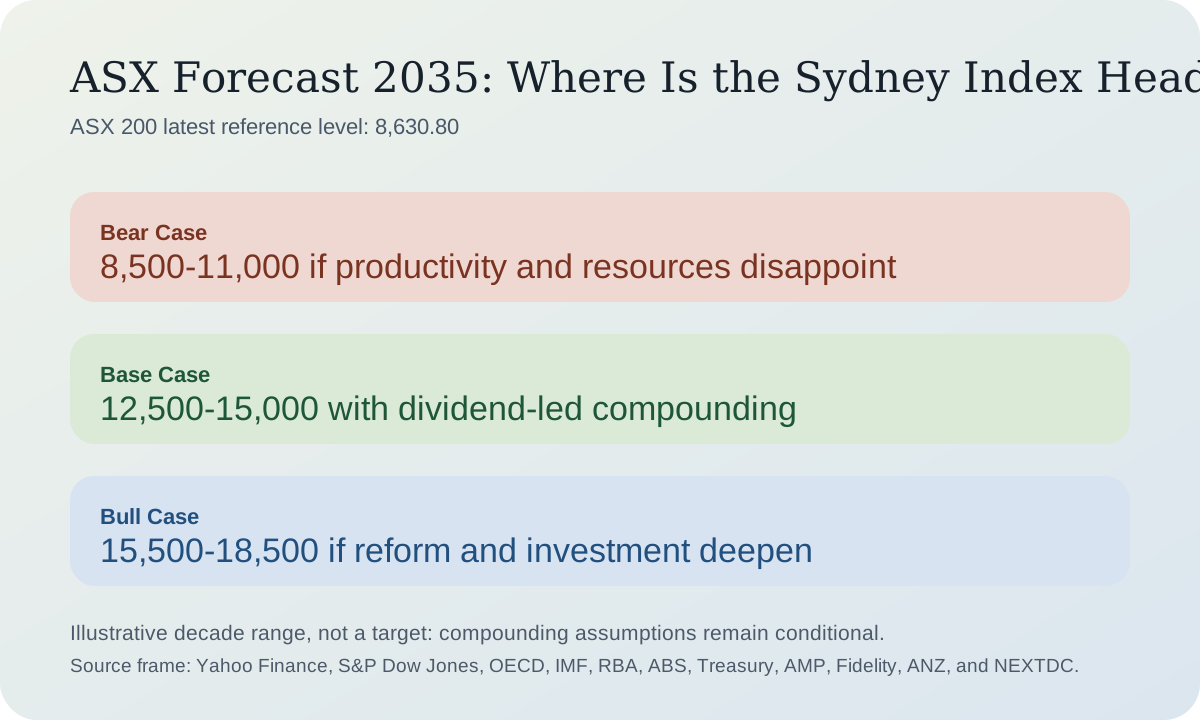
The bull case is 15,500 to 18,500 by 2035. This would require stronger productivity, credible industrial follow-through, continued bank profitability, resilient commodity demand, and enough AI and infrastructure adoption to raise economy-wide margins rather than just enrich a few niche companies.
Bearish scenario
The bear case is 8,500 to 11,000. That would likely happen if Australia remains overly dependent on a narrow set of old-economy earnings streams while productivity stalls, housing costs stay punitive, and China-linked resource demand loses momentum.
Base-case scenario
The base case is 12,500 to 15,000. This assumes price returns modestly above the last decade's pace, helped by dividends, selective policy execution, and enough earnings growth to offset a structurally higher rate environment.
| Scenario | 2035 range | Conditions | Probability |
|---|---|---|---|
| Bull | 15,500-18,500 | Productivity improves, critical minerals deepen, AI lifts margins, and banks remain robust | 25% |
| Base | 12,500-15,000 | Steady dividend-rich compounding with mixed but manageable macro conditions | 50% |
| Bear | 8,500-11,000 | Weak productivity, slower resource demand, housing drag, and ongoing inflation pressure | 25% |
| Path | Estimated probability | Comment |
|---|---|---|
| Rising | 55% | The benchmark still has credible structural support over a full decade. |
| Falling | 15% | A genuinely lower 2035 outcome likely requires multiple structural disappointments. |
| Sideways | 30% | Quite plausible if dividends do the heavy lifting but price rerating stays muted. |
Risks to watch
Watch productivity data, housing affordability, RBA credibility, resource investment quality, and whether government support actually crowds in private capital instead of merely subsidizing headlines.
What could invalidate the forecast
This framework would be too conservative if Australia develops a more meaningful technology and data-center complex than current sector weights imply. It would be too optimistic if policy support fails to raise productivity and the index remains trapped in aging sector leadership.
Conclusion
The most likely 2035 outcome is a higher ASX, but one that earns its way there through dividends, industrial relevance, and incremental reform. A realistic long-term outlook for Sydney's benchmark should emphasize quality of compounding over headline excitement.
Disclaimer: This article is for information only. The range estimates are editorial scenario frameworks based on public data and should not be treated as personal investment advice.
06. Investor Positioning
Different investor profiles need different levels of patience and risk control
| Investor type | Cautious approach | Why it fits the setup |
|---|---|---|
| Investor already in profit | Let winners run, but rebalance when one sector or one bank dominates gains. | A decade view still favors diversification because leadership can rotate. |
| Investor currently at a loss | Review whether the position was bought for income, value, or a rate-cut thesis before averaging. | Different entry theses fail for different reasons in a long horizon. |
| Investor with no position | Accumulate gradually and reinvest dividends instead of trying to time the perfect macro entry. | The 2035 case is about compounding, not a single tactical call. |
| Trader | Trade around macro events, but do not confuse short-term momentum with the structural 2035 thesis. | Long-horizon forecasts do not eliminate near-term volatility. |
| Long-term investor | Favor disciplined dollar-cost averaging and periodic rebalancing across domestic and global equity sleeves. | The ASX works best as part of a diversified long-duration portfolio. |
| Risk-hedging investor | Use the ASX as a dividend and hard-asset counterweight to growth-heavy global portfolios. | Its composition can balance tech concentration, but it still carries commodity and housing risk. |
07. FAQ
Frequently asked questions about the ASX 2035 forecast
Can the ASX 200 outperform global markets by 2035?
It can in specific cycles, especially if resources, banks, and dividends regain favor, but sustained outperformance still depends on productivity and sector broadening.
Why is productivity so central to a stock-market forecast?
Because over a decade, earnings growth is hard to sustain if labor, housing, and capital are all being used inefficiently.
Does the ASX need a bigger tech sector to do well?
Not necessarily. It needs enough technology and infrastructure investment to improve the profitability of the sectors it already has.
References
Sources
- Yahoo Finance chart API for ^AXJO, 10-year monthly history
- Yahoo Finance chart API for ^AXJO, one-month daily history
- S&P Dow Jones Indices, S&P/ASX 200 Index (AUD) Factsheet, as of April 30, 2026
- OECD Economic Surveys: Australia 2026
- OECD Australia Economic Snapshot
- IMF Executive Board Concludes 2025 Article IV Consultation with Australia, published February 15, 2026
- Australian Bureau of Statistics, Consumer Price Index, Australia, March 2026
- Reserve Bank of Australia, Statement on Monetary Policy, May 2026
- Australian Government Budget 2026-27 overview
- Australian Treasury, Future Made in Australia
- Department of Industry, Science and Resources, Critical minerals
- AMP, The outlook for Australian shares – is the long underperformance over?
- Fidelity Australia, A word on: Australian equities
- ANZ, The big themes of 2026
- NEXTDC, Record Contracted Growth and A$2.2bn Capital Plan to Scale AI-Ready Infrastructure