01. Quick Answer
Broadcom still has a constructive 2030 framework, but the next leg of value depends on whether AI and software remain mutually reinforcing rather than merely coexisting
The most defensible 2030 Broadcom view is constructive but disciplined. The company still combines AI networking, custom accelerators, enterprise connectivity, and a meaningful recurring software layer in a way few infrastructure names can match. By 2030, however, the market will likely care less about whether AVGO can post one more strong quarter and more about whether AI demand and software monetization are together creating a more durable, diversified earnings base. That is why the base case remains positive, but not limitless.
| Category | Evidence-based read | Implication |
|---|---|---|
| Historical data | AVGO moved from about $15.54 to about $439.79 over 10 years | Long-run upside is credible, but future ranges should reflect both AI strength and scale risk |
| Current market conditions | AI revenue and guidance remain very strong, while software integration remains strategically important | Forecasts should stay scenario-based, not simply euphoric |
| Institutional signals | Official reporting, Reuters, and S&P all point to strong execution with visible concentration and integration risk | Analysts remain constructive, though not blind to the downside |
| Most important watchpoints | AI chip growth, networking demand, VMware monetization, customer concentration, and software renewal quality | These variables will likely shape the stock range more than generic AI optimism |
02. Historical Context
Broadcom is still a semiconductor company first, but the modern thesis now depends on AI infrastructure and software monetization working together
AVGO moved from roughly $15.54 to about $439.79 over the last 10 years based on Yahoo Finance monthly data, implying a 10-year CAGR of about 39.69%. That is extraordinary for a company of Broadcom's size and already tells investors something important: this stock has not been driven by one isolated cycle. The long-run story combines custom silicon, networking, enterprise connectivity, recurring infrastructure software, disciplined acquisitions, and now a fast-rising AI buildout. The real forecasting challenge is no longer whether Broadcom can benefit from AI. It is whether the company can keep turning AI demand, custom accelerators, networking leadership, and VMware monetization into a durable earnings mix that supports its premium valuation.
| Metric | Latest official reading | Why it matters |
|---|---|---|
| Q1 FY26 revenue | `$19.3 billion, up 29% | Shows the company is still expanding rapidly even after the VMware deal |
| AI semiconductor revenue | `$8.4 billion, up 106% | AI is now a core growth engine, not a side business |
| Infrastructure software revenue | `$6.8 billion | VMware and recurring software matter because they smooth the mix and add durability |
| Q2 FY26 revenue guidance | `$22 billion | Shows management still sees strong near-term demand, especially tied to AI |
03. Main Drivers
Five forces are most likely to shape Broadcom stock over the next several years
1. AI custom silicon and networking are the biggest upside engines right now
Broadcom's own first-quarter release and Reuters reporting both show that custom AI accelerators and AI networking are now central to the thesis. As long as hyperscaler and large-model demand remains strong, AVGO has a powerful engine behind it.
2. VMware monetization is no longer background noise
Infrastructure software is already a large revenue contributor, and management has repeatedly argued that AI can increase the value of the VMware stack. If VMware becomes more predictable and more profitable under the new model, it strengthens the case for Broadcom as more than a chip cycle story.
3. Customer concentration and hyperscaler spending still matter
Broadcom can look uniquely positioned when a few massive customers are spending aggressively. The same structure becomes a risk if those customers pause, redesign, or move spending in-house faster than expected.
4. Execution risk rises when both AI and acquired software are this important at once
AVGO now depends on both cutting-edge hardware demand and enterprise software monetization. That mix is powerful, but it raises the burden of proof because disappointment in either side can pressure the multiple.
5. Competitive, regulatory, and partner frictions can still influence sentiment
Reports around VMware customer dissatisfaction and partner-program tension show that monetization discipline is not costless. Even if the financials look strong, sustained ecosystem friction can shape how investors think about the software side of the story.
04. Institutional Forecasts and Analyst Views
The market rewards Broadcom's AI leverage, but it is also asking harder questions about concentration and software execution
Official reporting, Reuters, S&P, and industry coverage all support that framing. AI semiconductor revenue is surging, the Q2 revenue guide was strong, and VMware remains strategically relevant. But the evidence is mixed enough on customer concentration, integration friction, and the sustainability of peak AI spending that a 2030 forecast should remain scenario-based rather than simply extending the last decade in a straight line.
| Source | Message | Interpretation |
|---|---|---|
| Broadcom official reporting | AI semis and total revenue both accelerated sharply in Q1 FY26 | Operational quality remains strong |
| Reuters | Management sees AI chip revenue exceeding $100 billion by 2027 | Supports a constructive but very execution-sensitive base case |
| S&P Global | AI networking, custom silicon, and VMware remain the three central pillars | Keeps both upside and integration risk visible |
| Industry reporting | VMware monetization is improving, but ecosystem friction remains real | Strengthens the need to judge AVGO as both a semiconductor and software story |
05. Bull, Bear, and Base Case
How the forecast range and probability table are built
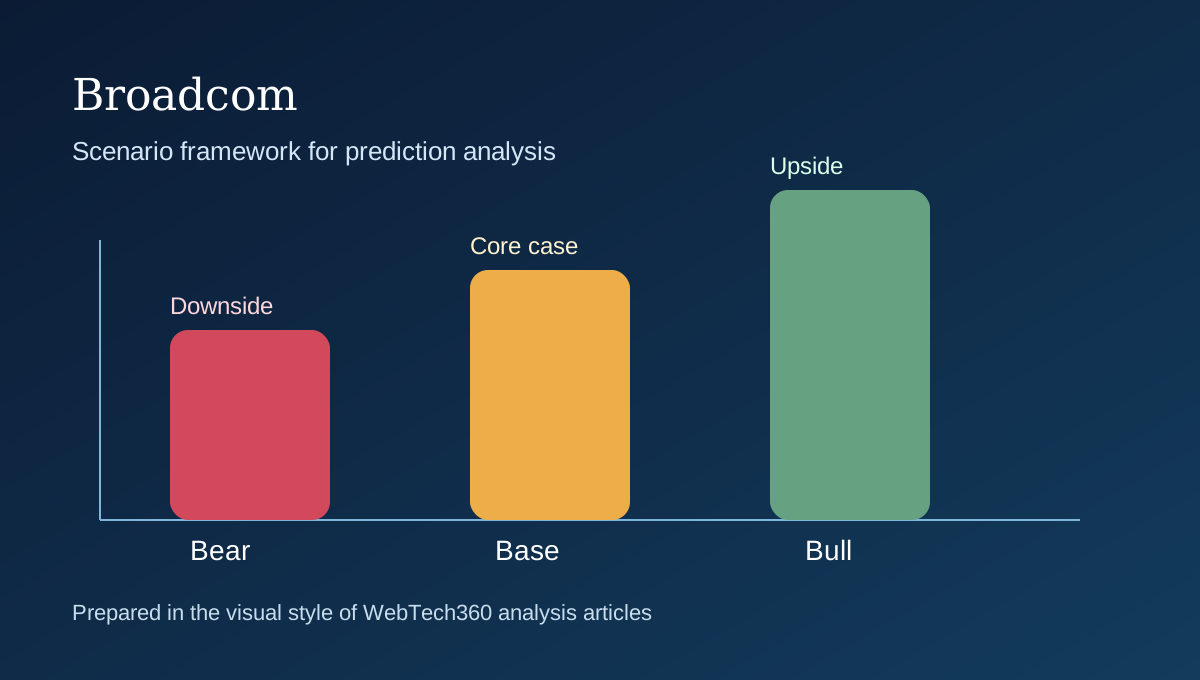
The ranges in this article are not institutional point targets. They are editorial scenario matrices built from current price, 10-year compounding history, AI semiconductor demand, networking exposure, software monetization, customer concentration, and the pace at which Broadcom turns AI and VMware into durable earnings quality.
| Scenario | 2030 range | Conditions | Probability |
|---|---|---|---|
| Bull | $780-$1050 | AI chips, networking, and software all compound strongly while Broadcom defends customer relationships and monetizes VMware cleanly | 30% |
| Base | $600-$780 | Broadcom compounds well, though concentration and valuation discipline keep upside more measured than the prior decade | 45% |
| Bear | $380-$600 | AI demand cools, software friction persists, or concentration risk becomes harder to ignore | 25% |
| Direction | Probability | Comment |
|---|---|---|
| Higher | 45% | Most plausible if AI and software keep improving the quality and durability of Broadcom's earnings mix |
| Lower | 20% | Would likely require a broader reset in hyperscaler demand, software monetization, or concentration assumptions |
| Sideways to moderate gains | 35% | Plausible because even elite AI infrastructure names can spend time digesting prior re-ratings |
| Investor type | Prudent approach | Main watchpoints |
|---|---|---|
| Investor already in profit | Hold a core stake, but trim if the position now assumes flawless AI demand and software integration | Position size, concentration, and premium valuation |
| Investor currently at a loss | Reassess whether the thesis is AI semis, networking, or software monetization before averaging down | Customer demand, VMware traction, and cash-flow quality |
| Investor with no position | Stage entries or wait for pullbacks tied to hyperscaler or software concerns instead of chasing peak AI enthusiasm | Valuation, guidance, and customer-spending visibility |
| Trader | Use stop-loss discipline and trade around earnings, AI order commentary, partner news, and software renewal updates | Volatility, options pricing, and event risk |
| Long-term investor | Dollar-cost average only if convinced Broadcom can remain both an AI infrastructure winner and a recurring-software cash generator | Mix quality, free cash flow, and execution depth |
| Risk-hedging investor | Rebalance if AVGO has become an oversized AI or semiconductor exposure relative to overall portfolio risk | Portfolio concentration and cyclical spending sensitivity |
Conclusion: Broadcom still looks like a credible long-term infrastructure compounder, but the 2030 upside case depends on whether AI and software together can keep broadening the business faster than concentration and integration risks can narrow it. Disclaimer: This article is for informational and research purposes only and does not constitute personalized financial advice.
06. FAQ
Frequently asked questions
Is Broadcom still mainly a chip story?
Semiconductors still drive much of the excitement, especially AI networking and custom silicon, but infrastructure software now matters too and changes the quality of the overall thesis.
What matters most for the next forecast revision?
AI revenue growth, networking demand, VMware monetization, customer concentration, and the quality of software renewals are the key inputs.
Is the biggest risk concentration or software integration?
Both matter. Concentration affects near-term revenue visibility, while software integration affects whether Broadcom can justify a more durable free-cash-flow multiple.
What would invalidate the bullish case?
Hyperscaler pauses, slower custom-silicon demand, VMware customer attrition, or weaker software economics would all weaken the bullish case.
Methodology and Invalidation
How to interpret this Broadcom framework and what would change it
Broadcom should not be analyzed like a standard cyclical chip company, but it also should not be treated as if AI demand automatically removes all execution risk. The business sits at the intersection of custom silicon, AI networking, enterprise connectivity, infrastructure software, recurring subscriptions, and acquisition-driven capital allocation. That mix is why single-point targets are often less useful than scenario ranges. Broadcom can look expensive on traditional semiconductor lenses and still look reasonable if AI and software improve the earnings mix. It can also look unstoppable right before a hyperscaler spending pause or VMware integration friction matters more.
These articles therefore anchor their ranges to three things: current price, 10-year growth history, and present operating evidence. Yahoo Finance chart data place AVGO around `$439.79` in mid-May 2026, versus roughly `$15.54` at the start of the 10-year comparison window. That implies a 10-year CAGR of about 39.69%. That is exceptional and should be treated as a reasonableness check, not as a base assumption. A company at Broadcom's current scale is unlikely to repeat that exact pace indefinitely unless AI infrastructure, custom accelerators, and software monetization all keep compounding together.
Primary documents matter most. Broadcom's first-quarter fiscal 2026 results showed revenue of `$19.3 billion`, AI semiconductor revenue of `$8.4 billion`, and infrastructure software revenue of `$6.8 billion`, with second-quarter revenue guidance of roughly `$22 billion`. The 2025 Form 10-K adds context around customer concentration, acquisition integration, recurring software economics, and geographic and product-line exposure. Those materials matter because they show that AVGO's current strength is real, but also explain why concentration and integration risk cannot be ignored.
External reporting explains what the market is debating now. Reuters emphasized that AI demand drove a better-than-expected outlook and that management sees AI chip revenue alone exceeding `$100 billion` by 2027. S&P Global focused on AI networking, custom silicon, and VMware as the three major pillars. CIO Dive highlighted the argument that AI can lift VMware growth, while TechRadar showed that some VMware customers still want to exit the platform. Available data suggests Broadcom is simultaneously benefiting from one of the strongest AI cycles in the market and one of the more controversial software integrations. That is exactly why scenario analysis is more useful than narrative certainty.
Investor positioning should therefore reflect horizon. A trader may care most about AI order flow, guidance, and hyperscaler commentary. A long-term allocator should care more about whether Broadcom can sustain a better earnings mix through AI chips, networking, and software. Someone already in profit may trim if position size now assumes flawless AI and VMware execution. Someone with no position may prefer staged entries after pullbacks rather than chasing strong AI prints. What would invalidate a constructive Broadcom view? A slowdown in hyperscaler spending, weaker custom-silicon visibility, customer pushback on VMware monetization, or thinner software renewal quality would all matter. What would invalidate a bearish Broadcom view? Continued strong AI growth, sustained networking demand, smoother VMware monetization, and evidence that software plus semis create more durable free cash flow would weaken it.
Inline evidence anchors the framework (Yahoo AVGO chart API; Broadcom Q1 FY26 results; Broadcom 2025 Form 10-K; Reuters on AI and VMware progress; S&P Global post-quarter snapshot; CIO Dive on VMware and AI). That combined evidence base is why the forecast ranges here are scenario tools rather than certainty theater.
References
Sources
- Yahoo Finance chart API, AVGO 10-year monthly history and current price
- Broadcom investor center
- Broadcom announces first quarter fiscal year 2026 financial results
- Broadcom financial reports hub
- Broadcom, Form 10-K for fiscal year ended November 2, 2025
- Broadcom to announce second quarter fiscal year 2026 financial results
- Reuters, Broadcom forecasts quarterly revenue above estimates on AI boom, March 4, 2026
- Reuters, Broadcom posts surging AI chip sales as VMware integration progresses, March 5, 2026
- Reuters, Broadcom sees over $100 billion in AI chip revenue by 2027, March 6, 2026
- S&P Global, Broadcom post-quarter snapshot, March 2026
- S&P Global, Broadcom preview on AI networking and VMware, March 2026
- CIO Dive, Broadcom expects AI to power VMware revenue growth, March 2026
- Tom's Hardware, Broadcom expands TPU-related Anthropic and Google supply commitments, April 2026
- TechRadar, VMware customers still trying to leave after acquisition, February 2026