01. Long-Term Setup
What matters most in an AXA 2035 forecast
A 2035 forecast for AXA should not be mistaken for a precision exercise. It is a framework for judging whether a large European insurer can keep converting underwriting discipline, scale, and capital management into compounding shareholder value over nearly a decade. The answer could be yes, but the path is highly conditional on catastrophe trends, regulation, pricing discipline, and whether AXA's next strategic cycle extends the quality of the current one (Unlock the Future; 1Q26 update).
| Topic | 2035 relevance |
|---|---|
| Capital return | Long-run total returns depend heavily on AXA preserving its payout discipline. |
| Insurance-cycle quality | A strong decade requires margins to survive softer pricing phases. |
| Balance-sheet resilience | Solvency is what allows AXA to stay offensive through stress. |
| Strategic continuity | The next plan after 2026 needs to look like an extension of a proven formula, not a reinvention. |
The 10-year market record gives AXA credibility as a long-range compounding candidate. A share-price move from EUR 17.81 to EUR 39.18 over the last decade is respectable, and that price history excludes the cash income component that many AXA investors care about most (Yahoo 10-year monthly chart). Yet it also shows the limits of complacency. A stock that can drop to EUR 13.80 under stress can still be cyclical even if the business model is stable.
| Anchor | Current evidence | Why it matters |
|---|---|---|
| Underlying earnings power | EUR 8.4 billion in FY 2025 | A large starting earnings base reduces the need for heroic growth assumptions. |
| Capital returns | EUR 2.32 dividend and up to EUR 1.25 billion annual buyback in 2026 | Supports long-run total return even if the multiple only modestly expands. |
| Solvency | 211%-224% recent public range | High solvency helps AXA navigate a tougher decade if claims volatility rises. |
| Business mix | P&C, Life, Health, commercial lines, and global reach | Diversification improves resilience versus a narrow mono-line insurer. |
The evidence suggests that AXA's appeal over a nine-year horizon is less about explosive growth and more about durability. Investors who understand that usually frame AXA correctly. Investors who expect it to trade like a high-multiple software company usually do not.
That framing also explains why a 2035 outlook must emphasize scenarios. By then, multiple underwriting cycles, several catastrophe seasons, and at least two strategic plans will have influenced results. Available data supports a broad range, not a slogan.
02. Core Drivers
The variables that can extend or weaken AXA's compounding story
1. Can AXA keep compounding underwriting quality?
If AXA can continue to show technical discipline in P&C and commercial lines even when pricing cools, the long-run thesis remains strong. If margins prove overly dependent on a favorable cycle, the market could eventually de-rate the stock.
2. Will life, health, and employee-benefits franchises deepen the moat?
Management repeatedly highlights employee benefits, individual health, and retail as clear growth opportunities. If those businesses scale with attractive economics, AXA's earnings mix becomes more valuable.
3. Can capital returns stay generous without starving growth?
AXA's attraction partly comes from a shareholder-friendly framework. The long-run test is whether that framework remains credible after capital shocks, cat losses, and changing solvency rules.
4. Will the industry backdrop remain supportive?
Swiss Re, Deloitte, and Aon all point to a world where insurers can still benefit from investment income and demand for protection, but where structural pressure from climate events, geopolitical fragmentation, and affordability constraints is rising (Swiss Re outlook; Deloitte 2026 insurance outlook).
5. Execution and technology may determine who deserves a premium
Over a decade, the difference between average and superior insurers often shows up in operating efficiency, claims handling, and risk selection. AXA's comments about automation and AI paying off should therefore be read as early indicators of process quality, not just digital theater (management comments on automation and AI).
03. Institutional Signals
How public targets and sector research shape the 2035 range
The strongest institutional input into a 2035 AXA forecast comes from the company's explicit medium-term targets and the sector's structural outlook. AXA's current plan aims for 6% to 8% underlying EPS CAGR from 2023 to 2026, a 14% to 16% underlying return on equity, and over EUR 21 billion of cumulative organic cash upstream over the plan period. Those numbers do not forecast 2035 directly, but they tell investors what kind of business AXA believes it is building (AXA's formal targets).
| Source | Message | 2035 reading |
|---|---|---|
| AXA strategic plan | Predictable earnings, cash, and capital | Supports the base-case assumption of continued disciplined compounding. |
| FY 2025 results | Record underlying results and strong solvency | Shows the model is currently delivering at a high level. |
| Q1 2026 indicators | Growth and solvency remain resilient | Suggests the plan is still on track late in the cycle. |
| Swiss Re and Deloitte | Insurance remains attractive but exposed to volatility | Implies higher-quality operators can still win, though not without drawdowns. |
| Analyst coverage | Broad bank coverage across Europe and the US | Means valuation can react quickly to changes in tone or reserve confidence. |
Analysts remain divided mainly on how much multiple expansion a mature insurer can earn, not on whether AXA is a serious franchise. That distinction matters. A 2035 bull case does not require AXA to become something radically new. It requires the market to trust that its existing strengths can survive a harder world.
That trust would likely be built through repetition rather than surprise: several more years of clean reserve commentary, continued solvency resilience, and evidence that commercial lines, health, and retail initiatives can all contribute without diluting returns. For a long-dated insurer call, steadiness is often more powerful than novelty.
04. Scenario Matrix
Bull, base, and bear cases for CS.PA into 2035
Bull case
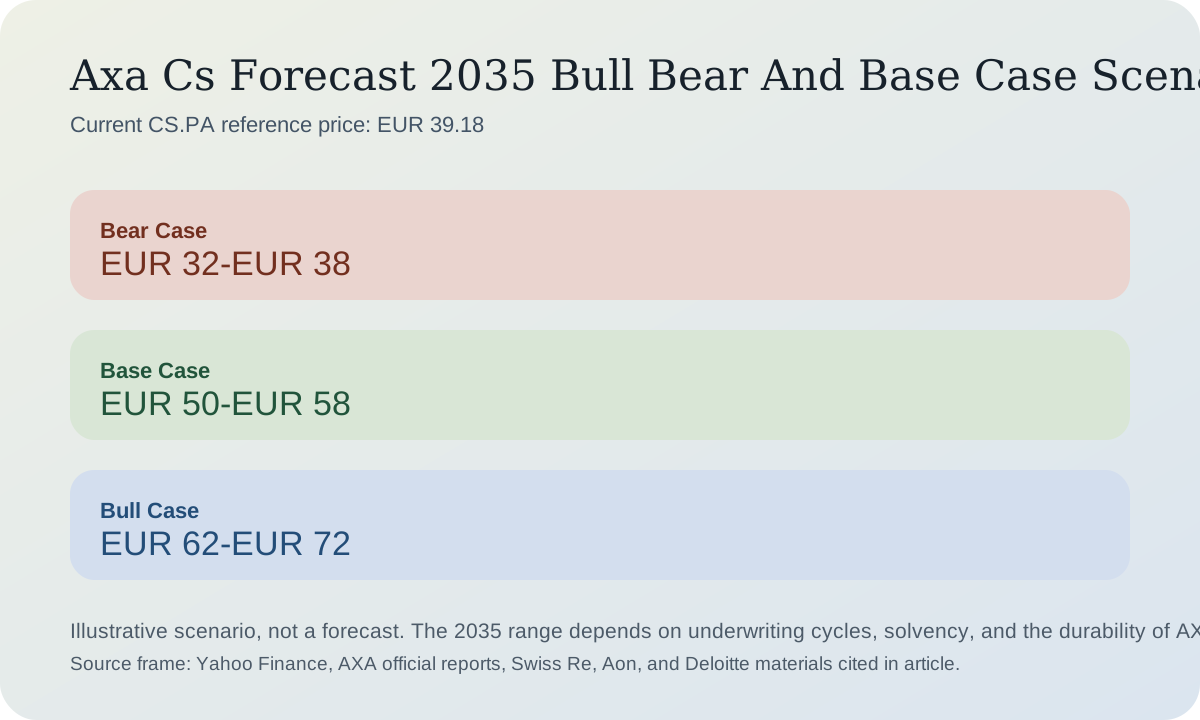
The bull case is EUR 62 to EUR 72 by 2035. That outcome would likely require multiple successful strategic cycles, continuing dividend growth, regular buybacks, and no lasting damage from catastrophe seasons or reserve problems. It also assumes that AXA earns at least some valuation premium for consistency.
Bear case
The bear case is EUR 32 to EUR 38. That range would fit a decade where growth disappoints, pricing softens too far, catastrophe losses stay elevated, or capital return has to become more defensive. This is not a collapse scenario. It is a grinding underperformance scenario.
Base case
The base case is EUR 50 to EUR 58. That assumes AXA remains a durable compounder, keeps capital returns meaningful, and benefits from moderate book-value growth without a spectacular rerating.
| Path | Editorial probability | Logic |
|---|---|---|
| Rising materially into 2035 | 43% | AXA starts from strength, but a long horizon invites more unknowns. |
| Broadly sideways to modestly higher | 32% | A realistic outcome if distributions do most of the work. |
| Meaningful downside | 25% | Requires a weaker combination of pricing, solvency, and cat-loss experience. |
| Investor type | Prudent stance | 2035-specific focus |
|---|---|---|
| Investor already in profit | Rebalance if overconcentrated, but do not ignore the power of reinvested income. | Whether AXA's next plan preserves discipline. |
| Investor currently at a loss | Separate short-term price weakness from long-run franchise deterioration. | Reserve language and payout sustainability. |
| Investor with no position | Phase in rather than chase, especially after strong runs. | Valuation against European peers and solvency trend. |
| Trader | Treat AXA as a financials trade around results and macro sentiment, not as a straight-line compounding chart. | Rates, cat events, and capital-market tone. |
| Long-term investor | Focus on total return and reinvestment rather than short-term multiple debates. | Book-value growth and distribution discipline. |
| Risk-hedging investor | Use only as part of diversified financial exposure, not as a pure hedge. | Insurance-cycle and recession sensitivity. |
How probability and range were set: the framework blends AXA's decade-long price behavior, current solvency and earnings power, management's public targets, and the observation that large insurers usually re-rate only gradually unless confidence breaks.
Risks to watch: reserve strengthening, cat losses, geopolitical claims complexity, regulatory capital shifts, and a less favorable investment-income backdrop.
What would invalidate the forecast: a transformative acquisition, an extreme solvency event, an abrupt end to the capital-return culture, or evidence that AXA's underwriting edge is much weaker than recent years imply.
Disclaimer: This article is for informational purposes only and does not constitute personalized investment advice. Long-term scenario ranges are conditional and not guaranteed.
The long-run AXA thesis is credible because it is boring in the right ways: earnings discipline, solvency, and distributions. That can produce strong returns, but only if investors stay realistic about what type of stock they own.
In a 2035 framework, that realism is a strength rather than a limitation.
05. FAQ
Frequently asked questions about AXA's long-term outlook
Could AXA realistically double by 2035?
It is possible in a strong total-return scenario, but it would likely require many years of disciplined execution and reinvested cash distributions rather than one dramatic rerating.
What matters more for a 2035 forecast: rates or underwriting?
Underwriting quality matters more over a full cycle, though rates still influence investment income and sentiment.
Is AXA safer than a bank stock?
It is a different type of risk. Insurers usually hinge more on claims, reserving, and solvency than on deposit confidence or credit funding.
Why not use a single 2035 target price?
Because too many variables can change over nine years. Scenario ranges are more honest and more useful.
06. Sources
Reference list
- Yahoo Finance chart API for CS.PA, 10-year monthly history
- Yahoo Finance chart API for CS.PA, recent daily closes
- AXA Full Year 2025 earnings release
- AXA 1Q26 activity indicators
- AXA 2025 Annual Report
- AXA 2024-2026 strategic plan and financial targets
- AXA strategic plan page
- AXA 2026 share buyback execution release
- AXA 2026 shareholders meeting and dividend approval
- AXA analysts coverage page
- AXA ratings page
- Swiss Re sigma 2/2025 on world insurance conditions
- Swiss Re sigma 5/2025 on insurance market outlook
- Aon Q1 2026 global insurance market overview
- Deloitte 2026 global insurance outlook
- AXA 2025 integrated report