01. Quick Answer
The most defensible 2030 BABA view is constructive, but only with a wide scenario range
The short answer is that Alibaba can plausibly be worth more by 2030, but available data suggest investors should work with a range, not a single heroic target. FY2026 results show a still-massive business with RMB1,023.67 billion in annual revenue and RMB520.82 billion of cash and other liquid investments. Alibaba's May 2026 AI update shows Cloud external revenue growth accelerating to 40% and 88VIP surpassing 62 million members. But the same results also show adjusted EBITA down 56% year over year and free cash flow turning negative. Add in soft China retail growth and ongoing IMF caution on domestic demand, and the case for a range becomes obvious.
| Point | Why it matters |
|---|---|
| Historical data still matters | BABA has compounded at 5.27% over 10 years, but with a drawdown of roughly 79.1%. |
| Current conditions are mixed | Cloud and AI are accelerating, but operating profit and free cash flow are under pressure from heavy reinvestment. |
| Public institutional views are thematic, not long-dated price targets | Goldman, UBS, J.P. Morgan, and IMF sources give a China-tech and macro framework, not a single verified BABA 2030 number. |
| Forecast ranges should separate bull, bear, and base cases | The evidence is mixed enough that probability-weighted ranges are more defensible than precise point forecasts. |
02. Historical Context
Alibaba's last decade shows both growth power and rerating risk
Yahoo Finance data show BABA trading at 132.59 on 2026-05-15, up from 79.53 on 2016-06-01. That equates to a 10-year price CAGR of 5.27%, but that simple number hides extraordinary volatility. Over the same period, the ADS traded between 63.58 and 304.69, with a maximum monthly drawdown of roughly 79.1%. That range is why any serious Alibaba forecast should use scenarios rather than a single destination price.
| Metric | Latest reading | Why it matters |
|---|---|---|
| Recent close | 132.59 | Every scenario in this article starts from the latest Yahoo Finance close on 2026-05-15. |
| 10-year starting point | 79.53 | Anchors long-run range work to an observable base rather than a cherry-picked low. |
| 10-year range | 63.58 to 304.69 | Shows how wide the historical outcome set has already been. |
| 10-year price CAGR | 5.27% | Provides a sober baseline for long-run scenario math. |
| Max monthly drawdown | 79.1% | Explains why risk control still matters even in a strong business-franchise thesis. |
| 52-week range | 103.71 to 192.67 | Frames current momentum against the latest market cycle. |
| Fact | Latest public evidence | Interpretation |
|---|---|---|
| FY2026 revenue | RMB1,023.67 billion | Scale remains very large even after portfolio streamlining. |
| March-quarter revenue | RMB243.38 billion | Core top-line growth is stabilizing, but not exploding. |
| Cloud Intelligence revenue | RMB41.63 billion in the March quarter, up 38% | Cloud is becoming more material to the thesis. |
| External cloud growth | 40% | Suggests real AI and enterprise demand, not only internal transfers. |
| 88VIP members | More than 62 million | Indicates premium user depth inside the retail ecosystem. |
| Cash and liquid investments | RMB520.82 billion | Supports strategic flexibility and shareholder-return capacity. |
| FY2026 free cash flow | RMB46.61 billion outflow | Shows how aggressive investment is compressing near-term cash generation. |
Historically, Alibaba's equity story has moved through three distinct regimes: the early post-IPO growth rerating, the 2020-2022 regulatory and sentiment reset, and the current attempt to rebuild the thesis around AI + Cloud, core commerce quality, and capital returns. The FY2025 Form 20-F is clear that management now sees e-commerce and AI + Cloud as the twin engines of long-term growth. That matters because the stock is no longer judged only on GMV scale or China retail dominance. Investors increasingly care about customer management revenue quality, cloud monetization, quick-commerce economics, and whether AI spending becomes a real second growth curve.
The most recent fundamentals both support and complicate the story. Alibaba's FY2026 results show full-year revenue of RMB1,023.67 billion and cash plus other liquid investments of RMB520.82 billion, which are large-company strengths. But the same results also show adjusted EBITA down 56% year over year and free cash flow swinging to an outflow of RMB46.61 billion, largely because of investment in quick commerce, user experience, and cloud infrastructure. That tension - between strategic investment and near-term profit compression - is the core analytical problem in every BABA outlook.
03. Main Drivers
Six forces will probably determine Alibaba's 2030 path
1. China retail conditions still matter because commerce remains the cash engine
NBS retail data show total retail sales up only 2.4% year over year in the first quarter of 2026, while online retail sales of goods and services rose 8.0%. That backdrop is not a consumer boom, but it does suggest digital retail is still growing faster than the broader base. For Alibaba, that matters because customer management revenue quality is more important than raw GMV spectacle.
2. AI + Cloud is no longer a side narrative
Alibaba's FY2025 20-F explicitly describes e-commerce and AI + Cloud as the two core businesses powering long-term growth. The May 2026 AI update shows external cloud revenue growth at 40%, AI-related product revenue accounting for 30% of Cloud's external revenue, and annualized AI-related product revenue above RMB35.8 billion.
3. Strategic spending is real, and it is expensive
Alibaba's Qwen App disclosure says the company plans to invest at least RMB380 billion over three years in AI and cloud infrastructure, foundational models and applications, and AI integration across existing businesses. That can create real value, but it also explains why near-term free cash flow is under pressure.
4. User depth and ecosystem integration remain a competitive advantage
FY2026 results show 88VIP membership above 62 million. Qwen ecosystem integration and Alibaba's broader Qwen announcements suggest management is trying to turn shopping, travel, maps, food delivery, and payments into an AI-native consumer layer rather than keeping them as disconnected apps.
5. Capital return still supports the floor, but not infinitely
Alibaba's October 2025 repurchase update said the company bought back 17 million ordinary shares during the September quarter for US$241 million and still had US$19.1 billion of authorization remaining through March 2027. The board also approved a regular annual dividend of about US$1.05 per ADS in May 2026. Those are meaningful supports, but they do not erase execution risk.
6. Macro and policy risk are still part of the multiple
The IMF and UBS both describe a Chinese economy that is more resilient than feared but still constrained by weak private demand and a long property adjustment. Alibaba does not trade in a vacuum from that macro backdrop.
| Driver | Current evidence | 2030 effect | Bias |
|---|---|---|---|
| China digital retail | Online retail still outgrows total retail | Supports commerce resilience | Constructive |
| Cloud and AI monetization | Cloud external revenue growth accelerated to 40% | Supports re-rating potential | Bullish |
| Strategic investment burden | Free cash flow turned negative in FY2026 | Limits near-term earnings power | Bearish |
| User depth and ecosystem | 88VIP surpassed 62 million | Supports pricing and engagement power | Constructive |
| China macro rebalancing | Demand is improving, but still uneven | Keeps the outcome set wide | Mixed |
04. Institutional Forecasts and Analyst Views
Public institutional research supports the BABA thesis indirectly rather than with a verified 2030 target
That distinction matters. Publicly available research from major banks and asset managers is more likely to talk about China tech, AI hyperscalers, cloud monetization, and consumer recovery than to publish a long-dated explicit BABA target. Goldman Sachs describes Chinese AI hyperscalers racing to build data-center and AI capacity, which helps explain why Alibaba Cloud and Qwen matter. UBS highlights semiconductor equipment, electronics components, and the wider China tech value chain as attractive. J.P. Morgan Asset Management says China's tech sector is a key profit-growth driver and that Chinese tech firms are well placed for future AI development. None of these are certified BABA 2030 targets. They are, however, credible institutional inputs for a probability-weighted scenario range.
| Source | Main public view | Why it matters for BABA |
|---|---|---|
| Goldman Sachs | Chinese AI providers and hyperscalers are scaling capex and commercialization | Supports the cloud and AI monetization thesis. |
| UBS | China growth can stabilize while tech remains a favored structural theme | Supports a constructive multiple backdrop if execution improves. |
| J.P. Morgan AM | China tech profit growth is improving and AI matters at the sector level | Supports viewing Alibaba as part of a broader earnings recovery story. |
| IMF | Consumption-led rebalancing is still incomplete | Supports keeping a meaningful bear and sideways case. |
05. Bull, Bear, and Base Cases
The 2030 range should reflect both AI upside and execution risk
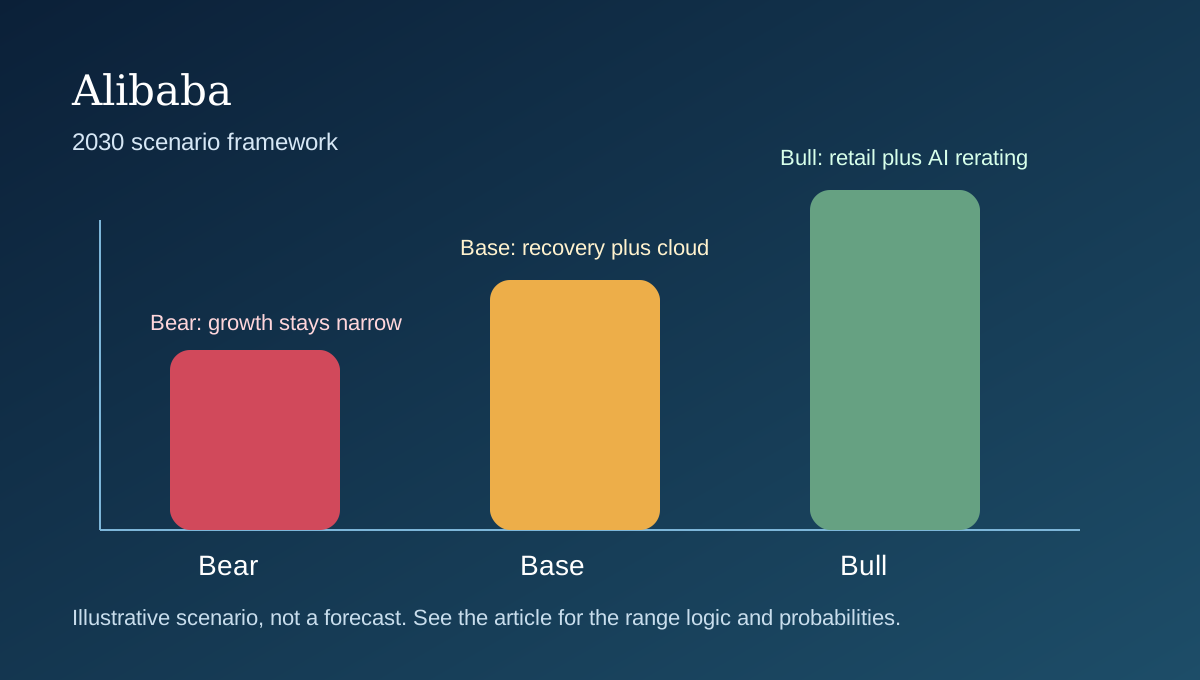
The scenario framework below starts with the current price, the 10-year range, the stock's drawdown history, and the current mix of commerce resilience plus AI reinvestment. These are editorial scenario estimates, not institutional targets.
Bullish scenario
The bull case is $250 to $340 by 2030. This requires a cleaner China retail backdrop, sustained high cloud growth, visible AI monetization, and a market willing to reward Alibaba as a credible AI + Cloud platform rather than a low-multiple China internet holdover.
Base-case scenario
The base case is $150 to $230. This assumes moderate core-commerce growth, improving but still lumpy cloud monetization, and better capital-allocation credibility over time without a full return to peak-era valuation multiples.
Bearish scenario
The bear case is $85 to $130. That would likely mean commerce remains competitive but low-growth, AI spending pressures margins for longer, and the market remains unwilling to re-rate the stock meaningfully.
| Scenario | Range | Core conditions | Probability |
|---|---|---|---|
| Bull | $250-$340 | Cloud and AI become a true second growth curve | 25% |
| Base | $150-$230 | Moderate growth with partial rerating | 50% |
| Bear | $85-$130 | Investment burden and weak multiple persist | 25% |
| Path | Estimated probability | Interpretation |
|---|---|---|
| Rising from current levels by 2030 | 55% | More likely than not if AI + Cloud keeps monetizing and core commerce stays resilient. |
| Falling below current levels by 2030 | 20% | Credible if spending stays heavy without enough commercial payoff. |
| Moving broadly sideways | 25% | Plausible because the stock can remain range-bound if the business improves only gradually. |
Risks to watch
The key variables are customer management revenue quality, cloud external growth, AI-related monetization, free-cash-flow inflection, and the broader China consumption backdrop.
What could invalidate this forecast
This framework would be too conservative if Alibaba proves that AI + Cloud deserves a meaningfully higher structural multiple. It would be too optimistic if commerce growth remains low quality or if cloud growth does not translate into durable profit expansion.
Conclusion
The cleanest 2030 BABA forecast is a range centered on moderate upside, not a guaranteed return to old highs and not a collapse narrative.
Disclaimer: This article is for research and informational purposes only. Forecast ranges and probabilities are conditional estimates, not personalized financial advice or guarantees.
06. Investor Positioning
Different readers should respond to the same Alibaba outlook in different ways
| Investor profile | Cautious approach | What to monitor |
|---|---|---|
| Investor already in profit | Hold a core position but consider trimming into sharp AI- or earnings-driven spikes if price outruns the pace of cloud and commerce monetization. | Watch cloud external growth, customer management revenue quality, and whether free cash flow improves after the current investment cycle. |
| Investor currently at a loss | Avoid averaging down mechanically. First decide whether your thesis is China retail recovery, AI + Cloud monetization, shareholder return, or simple multiple reversion. | Track cloud margins, quick-commerce economics, capital allocation, and whether China consumer demand is broadening. |
| Investor with no position | Scale in gradually or wait for pullbacks rather than chasing momentum after headline AI announcements. | Monitor valuation discipline, earnings revisions, and whether strategic spending is translating into better commercial outcomes. |
| Trader | Use stop-losses and treat BABA as a news- and sentiment-sensitive stock around earnings, China macro headlines, and U.S.-China policy developments. | Watch results releases, AI product updates, ADR sentiment, and gaps between GAAP and non-GAAP trends. |
| Long-term investor | Dollar-cost averaging is more defensible than hero timing, but only if you can tolerate regulatory, geopolitical, and rerating volatility. | Focus on the durability of the AI + Cloud second growth curve, capital returns, and the resilience of core commerce. |
| Risk-hedging investor | Rebalance or hedge if Alibaba exposure overlaps too heavily with China internet, EM tech, or ADR risk elsewhere in the portfolio. | Monitor macro policy, tariff and delisting narratives, FX sensitivity, and whether China-tech correlations are rising again. |
07. FAQ
Common questions investors ask about this Alibaba outlook
Can BABA return to its old peak by 2030?
It is possible, but it would likely require a much stronger AI + Cloud rerating and a more favorable China macro backdrop than the base case assumes.
Why does China retail still matter if cloud is growing faster?
Because commerce still funds much of the ecosystem and remains the largest revenue and engagement engine.
How was the 2030 range built?
It combines the current price, the 10-year trading history, FY2026 operating data, and public macro and institutional research into bull, base, and bear cases.
08. Sources
Primary and high-credibility references used in this article
- Yahoo Finance chart API for BABA, 10-year monthly history
- Yahoo Finance chart API for BABA, recent daily closes
- Alibaba Group Announces March Quarter 2026 and Fiscal Year 2026 Results
- Alibaba cloud revenue growth accelerates to 40% as AI strategy delivers
- Alibaba reports solid progress in AI + Cloud on the strength of its full-stack capabilities
- Alibaba's investments in AI and comprehensive consumption underpin solid September quarter 2025 results
- Alibaba Q1 results deliver strong growth in AI and quick commerce
- Alibaba Group 2025 annual report on Form 20-F filed with the SEC
- Alibaba Group announces filing of annual report on Form 20-F for fiscal year 2025
- Share repurchase update as of September 30, 2025
- Goldman Sachs on China's AI providers and data-center investment
- Goldman Sachs on China's economy forecast to grow faster than expected in 2026
- UBS China Outlook 2026-27: Resilience and Rebalancing
- UBS on Chinese equities and the next era of growth
- J.P. Morgan Asset Management global ex-US equities outlook
- J.P. Morgan Asset Management on emerging markets and Asia Pacific equities
- IMF Executive Board concludes 2025 Article IV consultation with China
- IMF commentary on how China can pivot to consumption-led growth
- China GDP preliminary accounting results for Q1 2026
- National Economy Got off to a Good Start in the First Quarter
- Total Retail Sales of Consumer Goods from January to March 2026
- Industrial Production Operation in March 2026
- Purchasing Managers' Index for April 2026
- Consumer Price Index in April 2026
- Industrial Producer Price Indexes in April 2026