01. Quick Answer
The 2030 BAYN outlook is no longer about whether Bayer has assets; it is about whether those assets can outrun litigation, debt, and execution drag
Bayer shares have recovered sharply from the late-2024 trough, but the stock is still far below its 2017 peak. That contrast is the core setup for any 2030 prediction. Available data suggests the market is willing to re-rate Bayer if three things happen together: Roundup uncertainty narrows materially, Pharma returns to sustainable growth, and Crop Science stops absorbing all of the restructuring burden. If those pieces line up, a 2030 base case in the low-to-mid €40s looks defensible. If they do not, the stock can stay trapped in a value-discount range despite solid operating assets.
| Point | Why it matters |
|---|---|
| Bayer remains a complex sum-of-parts story | Pharma, Crop Science, and Consumer Health each move on different cycles, so the stock rarely trades on one simple narrative. |
| Roundup still shapes the valuation discount | Even after operational progress, litigation still distorts free cash flow, leverage, and investor confidence. |
| 2030 upside depends on Pharma quality | Management's goal of mid-single-digit Pharma growth from 2027 and margin expansion toward 30% by 2030 is a key re-rating lever. |
| The evidence is mixed, not one-sided | Q1 2026 was strong, but long-term valuation still depends on outcomes that the market cannot yet fully underwrite. |
02. Historical Context
A decade of underperformance explains why even modest improvement could matter disproportionately by 2030
Yahoo Finance monthly data shows BAYN.DE at roughly €67.87 in May 2016, peaking near €89.06 in August 2017, collapsing to roughly €19.17 in November 2024, and rebounding to €37.84 by May 15, 2026. That translates to a negative 10-year price CAGR of about 5.7% despite Bayer owning real franchises in prescription drugs, crop technology, and consumer health. The disconnect tells investors something important: this is not a business-quality vacuum, it is a capital-markets trust problem layered on top of a legal overhang.
Q1 2026 reinforced that distinction. Group sales were €13.405 billion, EBITDA before special items rose 9% to €4.453 billion, and core EPS climbed to €2.71, helped by Crop Science and a soy licensing resolution. Yet the stock still trades at a deep discount because investors are asking whether one strong quarter can change the balance-sheet and litigation narrative in a durable way (Bayer Q1 2026; Reuters, May 12, 2026).
| Metric | Latest reading | Interpretation |
|---|---|---|
| Recent share price | €37.84 | Well above the 2024 trough, still far below the pre-Monsanto range |
| 10-year low / high | €19.17 / €89.06 | Shows how wide the litigation-driven valuation band has become |
| Q1 2026 EBITDA before special items | €4.453 billion | Above consensus, demonstrating that the operating engine can still surprise positively |
| Net financial debt at March 31, 2026 | €32.518 billion | Still too high to ignore in any long-range forecast |
| Observation | Forecast implication |
|---|---|
| Long-run share-price damage has already happened | The base case does not need heroic growth to justify upside from current levels. |
| Litigation repeatedly interrupted rerating attempts | Any bullish 2030 scenario must include visible legal de-risking, not just operating improvement. |
| Pharma is becoming strategically more important | Higher-quality Pharma growth can improve mix and reduce the market's focus on Crop Science cyclicality. |
| Balance-sheet repair remains slow | The stock can remain cheap for years if cash generation is redirected toward settlements and debt reduction. |
03. Main Drivers of Price Movement
Five variables will likely decide whether BAYN is a rerating story or another value trap into 2030
1. Roundup litigation is still the first filter for valuation
Reuters reported in February 2026 that Bayer's proposed $7.25 billion settlement was meant to support its Supreme Court strategy and reduce current and future legal risk. But Reuters also reported that law firms representing nearly 20,000 claimants sought to delay approval and said Bayer still faced around 65,000 unresolved claims. That means legal progress exists, but the evidence is mixed. For equity holders, the real question is not whether Bayer is trying to contain the problem. It is whether the market starts believing the problem is finite.
2. Free cash flow matters more than adjusted earnings
On March 4, 2026, Reuters said Bayer projected a 2026 free cash outflow of €1.5 billion to €2.5 billion because of roughly €5 billion in litigation payouts. That is why a simple EPS multiple can be misleading. A stock can look statistically cheap and still fail to rerate if cash is being redirected away from debt reduction, acquisitions, and shareholder returns.
3. Pharma needs to prove it can become the quality anchor
At Pharma Media Day 2026, Bayer said it expects Pharmaceuticals to return to mid-single-digit growth from 2027 onward and expand operating margin toward 30% by 2030. Nubeqa, Kerendia, asundexian, and newer specialty assets are central to that plan. If Pharma executes, the stock can start trading more like a discounted healthcare compounder and less like a conglomerate under siege.
4. Crop Science remains both an earnings engine and a volatility source
Q1 2026 benefited from the soy licensing resolution and strong seed traits performance, but Bayer still described the crop-protection environment as challenging. That combination matters. Crop Science can provide the earnings surprise that funds balance-sheet repair, but it can also add cyclicality and pricing pressure if the ag input market weakens again.
5. Strategic optionality is real, but not fully monetized
Bayer is still reshaping its portfolio. The planned acquisition of Perfuse Therapeutics for up to $2.45 billion expands the ophthalmology pipeline, while AI collaborations in antibody design and trial operations create long-duration productivity optionality. These moves help the long-term thesis, but they do not erase litigation or leverage by themselves.
04. Institutional Forecasts and Analyst Views
Published analyst views remain constructive on upside, but they are conditional rather than unconditional
There are very few credible public 2030 point targets for Bayer. That is normal for a company where legal outcomes, not just revenue growth, can radically change fair value. The better way to interpret institutional research is to extract the assumptions embedded in current analyst targets and management objectives.
| Source | Published view | Why it matters |
|---|---|---|
| JPMorgan, May 12, 2026 | Overweight, €50 target | Shows that at least one major U.S. bank sees meaningful upside even after the rebound. |
| UBS, February 2026 | Buy, €52 target; 36.2% forecast 12-month total return | UBS explicitly ties upside to litigation progress, peer-discount narrowing, and Pharma CAGR near 4% through 2030. |
| Reuters consensus context, March 2026 | Guidance midpoint was 3.3% below 2026 consensus | Reminds investors that sell-side optimism is still sensitive to execution misses. |
| Bayer Pharma Media Day 2026 | Mid-single-digit growth from 2027; margin toward 30% by 2030 | This is the operational backbone of the long-term bull and base cases. |
UBS also argued that Bayer traded at a 37% discount to European pharma peers on a 2026 P/E basis and raised its Nubeqa peak-sales estimate to $6 billion. That is useful because it shows what a rerating framework looks like in practice: better litigation visibility, better Pharma mix, and a less punitive conglomerate discount. Still, analysts remain divided on timing. Reuters noted that Bayer's 2026 profit outlook undershot consensus, which means the market is not ready to give management the benefit of the doubt on every forward number.
For 2030 specifically, the evidence suggests a range approach is more honest than a one-number target. The stock does not need to revisit its old highs to produce respectable returns from €37.84, but it does need some combination of legal closure, normalized cash generation, and Pharma-led quality improvement.
05. Scenario Analysis
A 2030 forecast range works better than a single target because too many variables remain event-driven
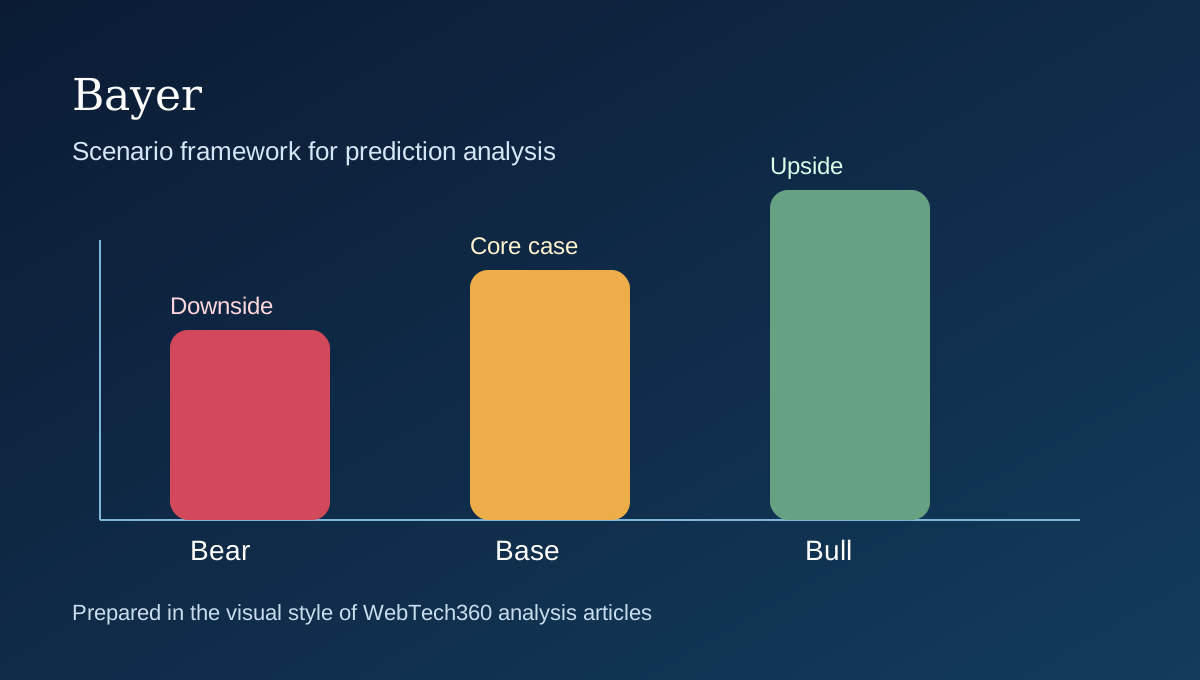
| Scenario | 2030 range | Conditions required |
|---|---|---|
| Bull | €55-€70 | Roundup liabilities become more finite, free cash flow normalizes, Pharma reaches its 2027-2030 growth and margin plan, and the market narrows the conglomerate discount. |
| Base | €40-€52 | Litigation remains expensive but increasingly manageable, Crop Science stays cyclical but profitable, and Pharma gradually improves mix without a breakout rerating. |
| Bear | €22-€34 | Settlement efforts stall, Supreme Court relief disappoints, cash outflows stay heavy, and operating progress is absorbed by debt and legal provisions. |
My base case is €40 to €52 by 2030. That is not an aggressive call. It simply assumes Bayer moves from crisis discount to stressed-normal discount over the next four years while Pharma and Consumer Health partially offset a still uneven Crop Science backdrop. The bull case requires more than earnings beats. It requires the market to believe that Bayer has moved from open-ended legal uncertainty toward quantifiable legal drag.
| Path | Probability | Rationale |
|---|---|---|
| Probability of rising | 45% | The stock starts from a depressed long-run base and still has re-rating optionality. |
| Probability of falling | 30% | Litigation, balance-sheet strain, and cyclicality can still overwhelm operational progress. |
| Probability of moving sideways | 25% | Bayer can produce decent operations yet still remain trapped in a legal discount band. |
These probabilities are illustrative, not predictive. They are derived from four variables: current price versus history, management's published operating objectives, the scale of litigation-related cash drag, and the degree of support visible in public analyst research. The methodology is not a quantitative model; it is a scenario-weighted judgment based on what is publicly verifiable today.
06. Investor Positioning, Risks, and Invalidation
Positioning in BAYN should stay cautious because the upside case is plausible but not clean
| Investor type | Cautious approach | Why |
|---|---|---|
| Investor already in profit | Hold core, trim into sharp rallies, and consider a hedge around litigation milestones | Bayer remains headline-sensitive, so protecting gains matters. |
| Investor currently at a loss | Re-underwrite the thesis before averaging down; avoid automatic capitulation or blind DCA | The stock can recover, but only if legal and cash-flow assumptions improve. |
| Investor with no position | Wait for pullbacks or build gradually in tranches | The rerating case exists, but event risk is still elevated. |
| Trader | Use stop-loss discipline and respect litigation and earnings dates | BAYN can move sharply on single headlines. |
| Long-term investor | Focus on free cash flow, debt, and Pharma execution more than quarterly price noise | The long thesis depends on business-quality improvement surviving legal costs. |
| Risk-hedging investor | Consider partial hedges, pair trades, or smaller sizing | This is not a low-volatility defensive healthcare name yet. |
Risks to watch: settlement pushback, an adverse Supreme Court outcome, slower-than-expected Pharma execution, persistent weakness in crop protection pricing, negative free cash flow lasting longer than expected, and debt that falls too slowly.
What could invalidate this forecast: a much cleaner legal resolution than the market currently expects would invalidate the conservative base case to the upside, while a sharp increase in unresolved claims or a renewed deterioration in balance-sheet flexibility would invalidate it to the downside. In other words, this forecast is less about demand destruction in Bayer's end markets and more about whether legal and financial drag finally becomes bounded.
Investment implication: BAYN looks more like a cautious rerating candidate than a straightforward growth stock. The setup may reward patience, but it still requires a high tolerance for litigation-driven volatility.
Disclaimer: This article is for informational purposes only, not personalized financial advice, and no single scenario should be treated as certain.
07. FAQ
Frequently asked questions about BAYN's 2030 outlook
Is BAYN cheap or just risky?
It is both. The stock screens cheap relative to parts of European pharma, but the discount exists for concrete reasons: Roundup uncertainty, debt, and uneven free cash flow.
What is the single most important catalyst for BAYN by 2030?
The single biggest catalyst is a credible narrowing of Roundup uncertainty. Without that, even strong Pharma execution may not translate into a full rerating.
How important is Pharma versus Crop Science?
Both matter, but Pharma is increasingly the quality anchor because it can support a higher multiple if growth and margins improve as management expects.
Could BAYN revisit pre-2018 levels by 2030?
It is possible, but current evidence does not support treating that as the base case. A move back toward the old €70-plus zone would likely require a much cleaner legal reset than is visible today.
References
Sources
- Yahoo Finance chart API, BAYN.DE 10-year monthly history and recent share price
- Bayer Quarterly Statement Q1 2026, earnings performance
- Bayer investor relations hub for Q1 2026 results and presentation materials
- Bayer Annual Report 2025
- Bayer Pharma Media Day 2026: portfolio, pipeline, and 2030 margin ambition
- Bayer strategy page covering core life-science priorities
- Bayer, Delivering on the promise of artificial intelligence
- Bayer Crop Science, GenAI for Good and E.L.Y. productivity program
- Reuters, March 4, 2026: Bayer's 2026 profit guidance and litigation-driven free cash outflow
- Reuters, February 17, 2026: Roundup settlement and Supreme Court strategy
- Reuters, February 25, 2026: pushback against the proposed Roundup settlement
- Reuters, May 12, 2026: Q1 operating profit beat driven by soy licensing resolution
- Reuters, April 7, 2026: Bayer says U.S. pharma tariffs do not change 2026 guidance
- Reuters, May 6, 2026: Bayer to acquire Perfuse Therapeutics for up to $2.45 billion
- dpa-AFX via Investing.com, May 12, 2026: JPMorgan keeps Bayer at Overweight with a €50 target