01. Quick Answer
The clearest 2027 Bitcoin framework is a catalyst map, not a one-line moonshot
BTC in 2027 will probably be judged by a shorter list of variables than a 2035 forecast: whether ETF access keeps broadening, whether the post-2025 deleveraging fully resets the market, whether macro liquidity turns easier, and whether BTC can reclaim the roughly $100,000 to $105,000 zone that Galaxy highlighted as important for restoring stronger momentum. That makes 2027 close enough for catalyst timing to matter, but still far enough away that a single quarter cannot settle the debate.
| Category | Evidence-based read | Implication |
|---|---|---|
| Historical data | BTC has repeatedly overreacted around cycle turning points | Short- and medium-term targets should allow for overshoot and undershoot |
| Current market conditions | Broader crypto remains in a repaired-but-not-fully-restored state | 2027 probably depends on whether the reset is complete |
| Institutional views | Galaxy, Bitwise, and Fidelity are constructive but explicit about near-term uncertainty | Momentum needs proof, not slogans |
| Base case | BTC likely trades above the 2026 price by 2027 if ETF and liquidity support persist | The debate is about magnitude and path, not survival |
02. Historical Context
Why 2027 should be framed as a momentum and reset question
The market backdrop going into 2027 is unusual. By 2025, Bitcoin had already reached new highs above $126,000 per Fidelity’s cycle analysis. Then came the 2025–2026 reset: Fidelity’s look-ahead report said Q4 2025 correction pressure was driven partly by long-term-holder profit-taking, and Galaxy described a drawdown nearing 40% in early 2026. That matters because 2027 is unlikely to be priced from a euphoric clean slate. It will be priced from the memory of a boom, a deleveraging, and a market asking whether the next leg is accumulation or exhaustion.
| Metric | Latest reading | Why it matters |
|---|---|---|
| Recent BTC close | ~$76,864 | Shows that BTC is entering the 2027 setup from below the prior high, not above it |
| Recent support zone | Fidelity described support resetting near $85,000 in late 2025; Galaxy flagged lower levels near the $70k-$80k area during stress | Helps define the downside floor debate |
| Institutional access | Bitwise expects wider access through platforms like Morgan Stanley, Wells Fargo, and Merrill Lynch | 2027 upside needs fresh buyer channels |
| Volatility regime | Galaxy says longer-term BTC volatility has structurally decreased | Could make 2027 less manic than 2021-style markets |
| Catalyst | Constructive signal | Negative signal |
|---|---|---|
| Price structure | BTC reclaims and holds above $100k-$105k | Repeated rejection below that band |
| ETF flows | Steady net inflows and broader platform rollout | Flat demand or recurrent outflow clusters |
| Macro liquidity | Easier rates and better risk appetite | Sticky inflation and stronger dollar |
| Treasury demand | More public-company adopters beyond the current leaders | Treasury adoption stalls or becomes politically toxic |
03. Main Drivers
The 2027 path probably turns on four practical drivers
1. Whether ETF adoption keeps broadening after the early wave
Bitwise’s late-2025 outlook argued that 2026 would be the first year most institutional investors could access crypto ETFs through mainstream channels. If that thesis proves right, 2027 is when distribution should begin showing up in the price data more clearly.
2. Whether the deleveraging reset actually cleared the deck
Fidelity described the October 10, 2025 shakeout as a psychological and structural overhang, while Galaxy noted broader crypto was already deep in a bear market when it published its 2026 predictions. If leverage has mostly been flushed, 2027 could benefit from a healthier base. If not, another washout is possible.
3. Whether BTC can convert policy legitimacy into real holdings
The White House strategic reserve order and Strategy’s continued purchases are directionally supportive. But 2027 depends on whether those signals attract lasting private capital rather than just headlines and tactical speculation.
4. Whether macro conditions cooperate
Galaxy explicitly warned that AI capex deployment, monetary policy, and the U.S. midterm backdrop all add uncertainty. BTC can outperform in improving liquidity regimes, but it is not immune when markets become broadly risk-off.
04. Institutional Forecasts and Analyst Views
Published analyst targets imply upside is still possible by 2027, but timing risk remains high
Galaxy’s clearest public call is the boldest: BTC will hit $250,000 by year-end 2027. At the same time, Galaxy admitted 2026 was too chaotic to predict cleanly and said the options market was pricing very wide near-term ranges. Bitwise did not publish a specific 2027 target in the cited 2026 outlook, but it did argue Bitcoin could break the historical four-year cycle and set new all-time highs as institutional demand accelerates. Fidelity’s work is compatible with that view because it points toward a more stable, liquid market that may no longer require a classic blow-off top to keep advancing.
| Source | Published view | 2027 implication | Main caveat |
|---|---|---|---|
| Galaxy Research | $250k by year-end 2027 | High-end bull anchor for this horizon | Near-term downside risk remains explicit in the same note |
| Bitwise | BTC breaks the four-year cycle and sets new highs | Supports a constructive path into 2027 | No single published 2027 target in the cited report |
| Fidelity Digital Assets | Cycle behavior looks more mature and less explosive | Supports higher highs with potentially shallower cycle extremes | Still dependent on macro and demand durability |
The right takeaway is not that $250,000 is inevitable. It is that a wide 2027 range remains credible because the market is balancing structural demand progress against still-unresolved macro and leverage risk.
05. Bull, Bear, and Base Case
A 2027 range should balance momentum recovery with the possibility that the post-2025 reset lingers
| Scenario | 2027 range | Conditions | Probability |
|---|---|---|---|
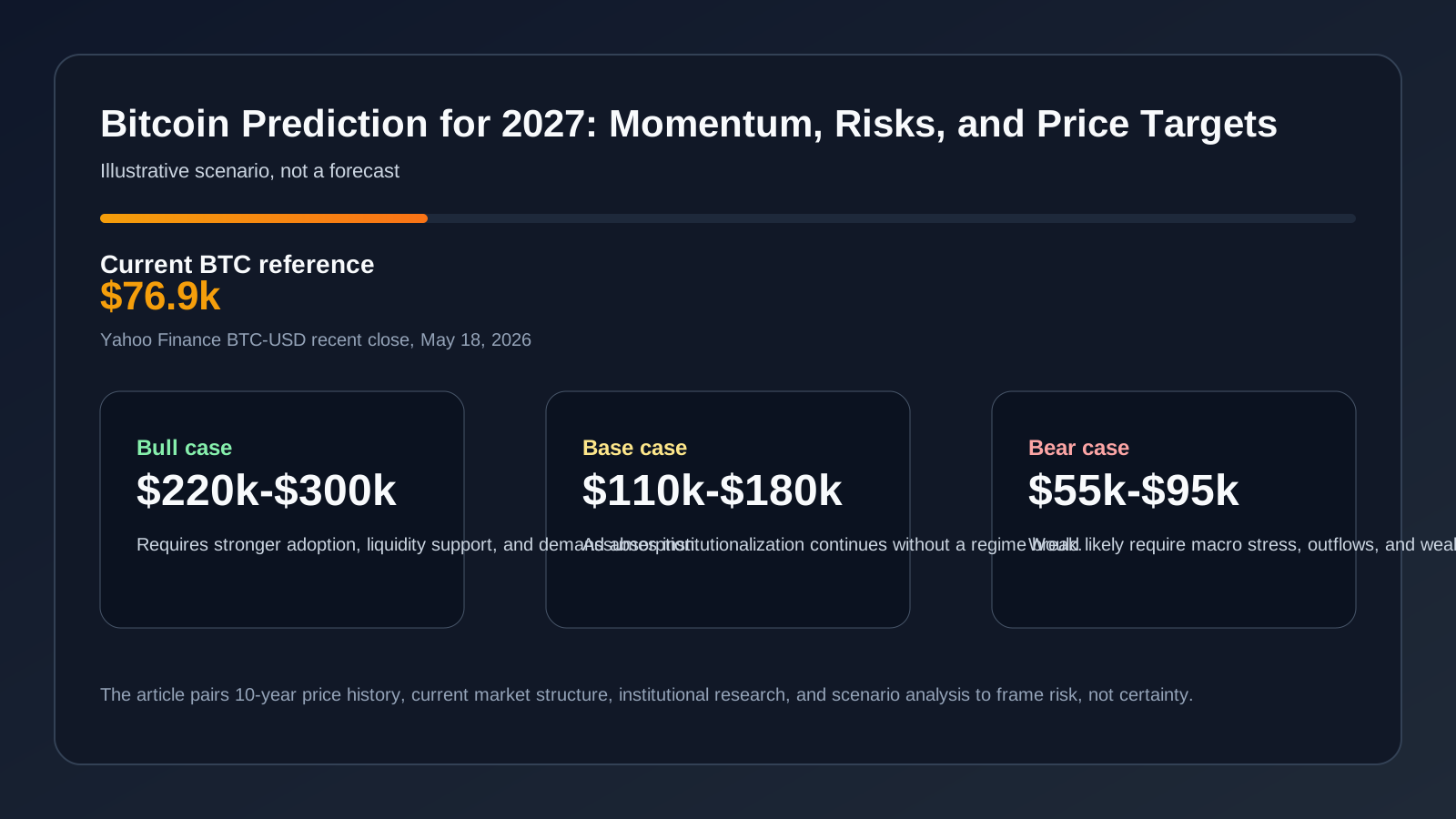
| Bull | $220k-$300k | ETF demand broadens, BTC cleanly reclaims prior highs, liquidity improves, and the leverage reset proves complete | 25% |
| Base | $110k-$180k | BTC recovers meaningfully and posts new highs, but with intermittent macro and policy setbacks | 45% |
| Bear | $55k-$95k | Macro remains restrictive, inflows disappoint, and BTC fails to hold recovered momentum zones | 30% |
| Direction | Probability | Comment |
|---|---|---|
| Higher by 2027 | 50% | The evidence still favors higher prices over a two-year horizon if broad adoption continues |
| Lower | 25% | Downside remains credible because BTC is still sensitive to macro stress and leverage reflexes |
| Sideways | 25% | Plausible if BTC spends more time repairing than trending |
| Investor type | Prudent approach | Main watchpoints |
|---|---|---|
| Investor already in profit | Hold a core allocation but trim into euphoric breakouts if position size becomes too large | Momentum quality and realized gains |
| Investor currently at a loss | Avoid revenge-positioning; decide whether the horizon is still 2027 or shorter | Liquidity needs and thesis clarity |
| Investor with no position | Stage entries or wait for confirmed trend strength rather than chase every BTC rally | ETF inflows and reclaim of major resistance |
| Trader | Use stop-loss rules and watch volatility skew, funding, and macro calendar risk | CME and options positioning |
| Long-term investor | Dollar-cost averaging is usually cleaner than overfitting one price target | Adoption breadth and policy risk |
| Risk-hedging investor | Keep BTC exposure sized so a 30% drawdown would not force a bad decision | Correlation spikes and cash buffer |
What would invalidate the 2027 constructive case? Failure to reclaim key resistance, persistent outflows, sticky rates, or another leverage accident large enough to damage institutional confidence. What would invalidate the bearish case? A cleaner-than-expected breakout above prior highs with fresh platform-driven demand would weaken it quickly.
06. FAQ
Frequently asked questions
Can BTC really reach $250,000 by 2027?
Galaxy says yes under a bullish scenario, but that outcome depends heavily on renewed momentum, broad inflows, and a more supportive macro backdrop.
What is the most important 2027 watchpoint?
The strongest near-term watchpoint is whether BTC can reclaim and hold above the roughly $100,000 to $105,000 zone Galaxy highlighted.
Is 2027 more about price momentum or adoption?
Both matter, but for this horizon momentum probably reflects whether adoption is translating into real buying rather than just narrative support.
Could BTC still spend 2027 mostly sideways?
Yes. If the post-2025 reset proves longer and macro conditions stay mixed, a choppy range is entirely plausible.
Methodology and Invalidation
How to interpret this Bitcoin 2027 framework and what would change it
The forecast ranges in this article are scenario bands, not promises. They combine live price data from Yahoo Finance, 10-year context, post-ETF market structure, public-company treasury activity, adoption research, regulated derivatives activity, and institutional commentary from firms such as ARK, Fidelity, Bitwise, Galaxy, and CME. That mix is helpful because bitcoin does not respond to a single variable. It reacts to liquidity, regulation, leverage, adoption, macro sentiment, and the behavior of long-term holders at the same time.
Probability tables in this article are editorial estimates rather than mathematical certainties. They are derived by asking which path currently has the strongest evidence: renewed accumulation and broader institutionalization, prolonged consolidation after the 2025–2026 reset, or a deeper repricing caused by macro stress and forced selling. Where the evidence is mixed, the range stays wide on purpose. False precision is usually a sign that the analyst is hiding uncertainty rather than measuring it honestly.
The most important discipline is to state what would invalidate the working view. The most important invalidators would be weak ETF demand, repeated failure to reclaim critical resistance, or renewed macro stress that keeps BTC trapped in a repair regime. Investors who are already in profit, investors sitting on losses, traders, hedgers, and long-term allocators do not need the same playbook, so the positioning table separates horizon and risk tolerance instead of pretending one answer fits everyone. Disclaimer: This article is for informational and research purposes only and does not constitute personalized financial advice.
References
Sources
- Yahoo Finance BTC-USD chart API, 10-year monthly price history
- Yahoo Finance BTC-USD chart API, recent daily closes
- U.S. SEC, statement on the approval of spot Bitcoin exchange-traded products, January 10, 2024
- ARK Invest, Bitcoin 2030 price-target methodology, April 24, 2025
- Fidelity Digital Assets, Is Bitcoin’s Four-Year Cycle Over?, February 24, 2026
- Fidelity Digital Assets, 2026 Look Ahead report
- Strategy, first-quarter 2026 results and bitcoin treasury update, May 5, 2026
- Chainalysis, 2025 Global Crypto Adoption Index
- CME Group, Crypto Catch-Up Q4 2025
- The White House, Strategic Bitcoin Reserve executive order, March 6, 2025
- Cambridge Centre for Alternative Finance, Bitcoin electricity consumption methodology
- Bitwise, 10 Crypto Predictions for 2026
- Galaxy Research, 26 crypto, bitcoin, DeFi, stablecoin, and AI predictions for 2026
- Bitcoin.org, Bitcoin Core validation and the 21 million supply rule