01. Quick Answer
BNB still has a credible path higher into 2030, but the path depends more on ecosystem durability than on exchange-token nostalgia
BNB is trading near $640 as of May 18, 2026 based on Yahoo Finance recent data. The same public monthly series started in December 2017 near $8.636 and has ranged from roughly $5.079 to $1,089 since then, which is a reminder that BNB has already compounded dramatically and can still swing hard in both directions (Yahoo 10-year chart API).
The base case for 2030 is constructive rather than euphoric. Available data suggests BNB still benefits from three structural supports: a deflationary token model through scheduled burns (35th burn disclosure and BNB token-model documentation), continued relevance inside the BNB Chain ecosystem (2026 roadmap), and persistent exchange/network utility rather than pure speculation. The evidence is mixed, however, on whether that is enough for a clean move to new highs without a broader crypto bull cycle and lower regulatory friction.
| Category | Evidence-based read | Implication |
|---|---|---|
| Historical data | BNB rose from roughly $8.64 at the start of its public history to above $600, with an all-time high near $1,089. | Long-term upside is real, but so are violent repricings. |
| Current market conditions | Recent daily closes have been roughly $615 to $678 over the last month. | Momentum is stable, not explosive, which argues for scenarios rather than certainties. |
| Institutional coverage | Mainstream bank coverage of BNB is thin compared with BTC or ETH. | Analysts need to rely more on primary ecosystem data and less on sell-side targets. |
| Working 2030 view | BNB can plausibly be worth more in 2030 if utility, burns, and activity persist. | The token behaves more like a high-beta ecosystem equity than a reserve asset. |
| Metric | Latest reading | Why it matters |
|---|---|---|
| Recent BNB price | $640 | A forecast range needs a current anchor, not an old cycle low. |
| Recent 1-month range | $615 to $678 | Shows whether momentum is expanding or cooling in the very near term. |
| Listed monthly history | 2017-12-01 to 2026-05-18 | BNB does not have a full 10-year public market history because it launched in 2017. |
| Long-run range | $5.079 to $1,089 | Useful for distinguishing a normal correction from a structural breakdown. |
| Price-only CAGR | 65.9% | Strong historical compounding warns against both easy extrapolation and easy dismissal. |
| Editorial base range | $900-$1,600 | A scenario band is more honest than one heroic point target. |
02. Historical Context
BNB's history argues for humility: the token can compound fast, but it can also spend years repricing narrative excess
BNB's listed price history is shorter than a full decade because the token launched in 2017. Even so, the available monthly record is long enough to show multiple regimes. The early move into 2021 reflected both exchange growth and the rapid adoption of BNB Smart Chain during the DeFi boom. The subsequent resets in 2022 and 2023 showed that BNB is not insulated from broader crypto deleveraging or from entity-specific concerns tied to Binance (DOJ plea announcement and SEC complaint announcement).
What matters for 2030 is that BNB did not disappear after those shocks. The token remained embedded in fee payments, staking, launches, and ecosystem incentives described in the official token model (BNB token model). That survival matters because many exchange-linked tokens lose relevance after a cycle breaks. BNB did not. It retained enough utility and user familiarity to stay among the largest crypto assets by market value (CoinMarketCap BNB listing), although market capitalization rankings alone are not a valuation thesis.
| Date anchor | Approximate monthly close | What changed |
|---|---|---|
| December 2017 | $8.636 | Public trading history begins near the first big crypto cycle. |
| December 2020 | $37.38 | DeFi and exchange-token usage broadened as crypto liquidity surged. |
| May 2021 peak month | $354 | BNB became one of the biggest cycle winners as BSC usage exploded. |
| December 2022 | $246 | The post-FTX environment reset valuations and put exchange-linked assets under pressure. |
| December 2024 | $701 | BNB recovered with stronger market breadth and steady chain usage. |
| May 2026 | $640 | The token remains far above early-cycle levels but below its all-time high near $1,089. |
Available data also suggests BNB's behavior changed over time. Early phases were dominated by exchange growth and speculative rotation. More recent pricing appears to be influenced by a broader mix of chain activity, stablecoin use, validator economics, and confidence in Binance's operating perimeter. That makes 2030 forecasting harder than simply extending a 2021-style cycle chart forward.
03. Main Drivers
Five variables will probably decide whether BNB is merely resilient or structurally stronger by 2030
1. Deflationary token economics still matter
The quarterly auto-burn mechanism remains one of BNB's clearest valuation supports. The 35th burn update says 1,579,207.72 BNB were removed, following 1,371,703.67 BNB in the 34th burn. The official token model describes BNB as a utility and gas token used across the ecosystem, with the burn schedule designed to reduce supply over time until 100 million BNB remain (official documentation). If network usage stays healthy, fewer units chasing a stable or rising utility base is a real tailwind.
2. Ecosystem breadth matters more than exchange branding
The strongest long-run BNB argument is no longer just 'Binance is big.' It is that BNB Chain still wants to compete across payments, consumer apps, DeFi, AI agents, and real-world assets. The 2026 roadmap emphasizes sub-second latency, gasless UX, AI-native tooling, and storage/computing layers rather than a static smart-contract chain. That matters because long-term token value usually follows retained utility, not brand memory alone.
3. Stablecoins and transaction throughput create economic gravity
BNB Chain's appeal has often been transactional efficiency rather than ideological purity. BscScan statistics and DeFiLlama research point to an ecosystem where stablecoin flows, DEX activity, and consumer-style transfers remain central. If BNB Chain continues to be a low-cost venue for activity that users actually repeat, BNB has a better chance of keeping a monetary premium over time.
4. Competition is a permanent valuation cap
No serious BNB forecast should ignore competition from Ethereum, Solana, Base, and other high-throughput networks. A token can retain utility and still underperform if developer mindshare, liquidity quality, or stablecoin issuance shifts elsewhere. The evidence is mixed here: BNB Chain remains relevant, but it no longer enjoys the same 'cheap Ethereum alternative' novelty that powered earlier adoption.
5. Regulation remains the variable that can overpower fundamentals
BNB is unusually exposed to regulatory spillover because the token's identity is still tightly associated with Binance. The DOJ settlement and SEC enforcement case announcement do not automatically define BNB's value, but they shape counterparty trust, exchange access, listing treatment, and institutional comfort. That overhang is one reason analysts should use wider probability bands than they would for more neutral infrastructure assets.
04. Institutional Forecasts and Analyst Views
Direct bank price targets for BNB are scarce, so the best evidence comes from ecosystem and market-structure research
Unlike bitcoin or gold, BNB does not have a deep bench of sell-side 2030 target notes from major banks. That absence is itself informative. It suggests investors should lean harder on primary evidence such as official supply mechanics, network activity, and independent market-structure research. Binance Research frames 2025 as a year of stronger user activity and execution across major crypto verticals, while the April 2026 monthly report shows how rapidly sentiment can change with macro liquidity and policy headlines.
| Source | What it contributes | How it should influence a forecast |
|---|---|---|
| BNB Chain roadmap 2026 | Execution priorities around lower latency, gasless UX, AI and storage layers. | Supports a utility-driven upside case if roadmap execution translates into sustained usage. |
| Official burn disclosures | Visible supply reduction and continued commitment to the auto-burn framework. | Supports valuation discipline, but cannot offset ecosystem decline on its own. |
| Binance Research | Context on market structure, DeFi, and sector rotation within crypto. | Helpful for current conditions, but not a substitute for independent valuation. |
| DeFiLlama research | Stablecoin and on-chain liquidity context for BNB Chain. | Useful for judging whether usage is sticky or mostly cyclical. |
| U.S. DOJ and SEC documents | Formal statement of regulatory risk tied to Binance and related entities. | These are the main reasons a discount to the cleanest bull narrative is justified. |
In practical terms, the evidence base supports a range forecast rather than a point estimate. Analysts remain divided because the same facts can be read in two ways. Bulls see a large token with ongoing burns, strong distribution, and an ecosystem that still processes real user activity. Bears see a mature token whose future depends too much on one corporate orbit and whose market-share upside may be capped.
05. Scenario Analysis
Three 2030 scenarios are more useful than one headline target
| Scenario | 2030 range | What has to happen | Why it is plausible |
|---|---|---|---|
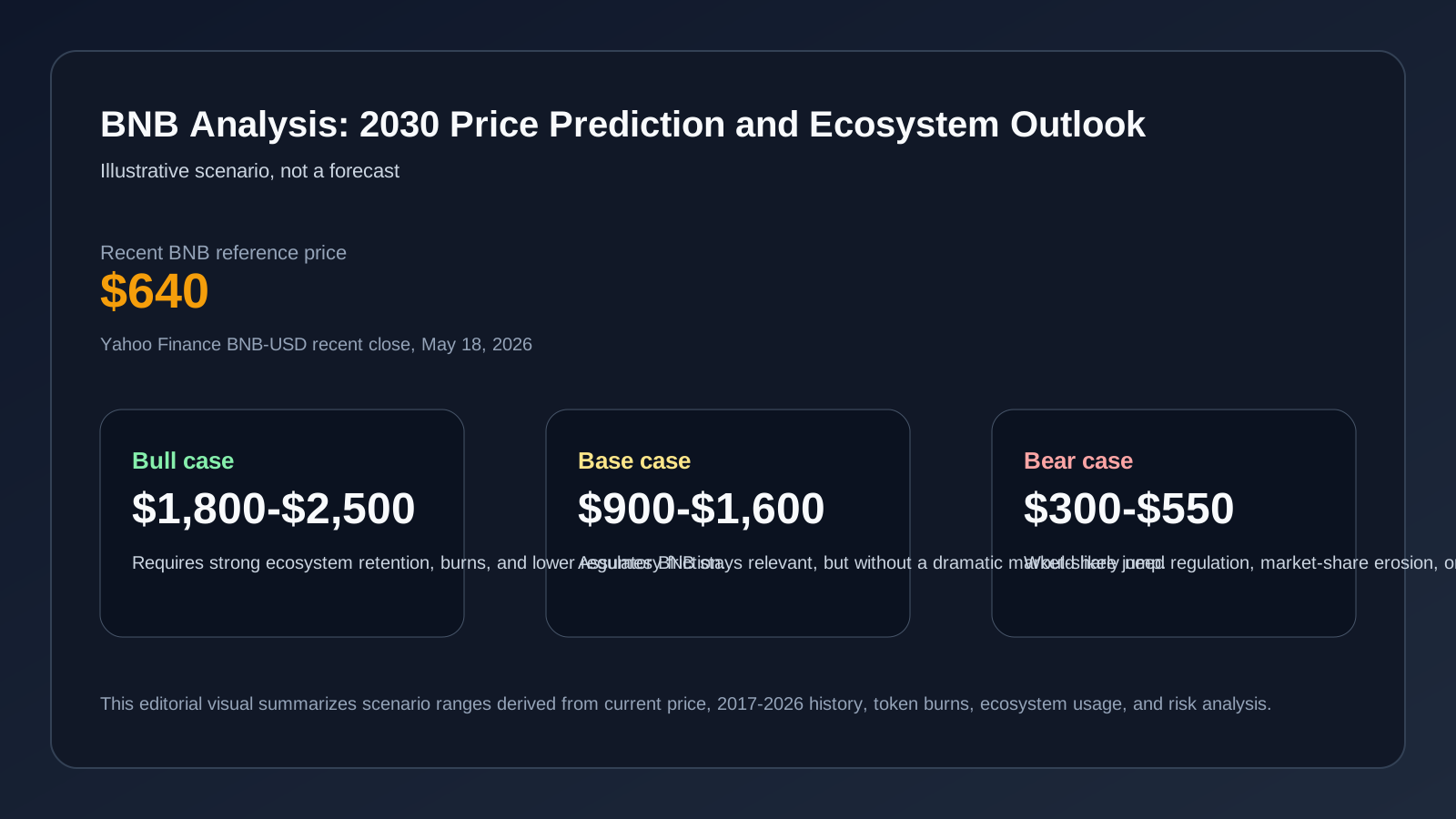
| Bull case | $1,800-$2,500 | BNB Chain keeps meaningful share in payments, DeFi, and consumer apps; burns continue; regulatory overhang fades; crypto beta stays constructive. | BNB already has brand recognition, supply reduction, and deep exchange integration. |
| Base case | $900-$1,600 | Ecosystem remains relevant but not dominant; activity and burns offset dilution from competition; Binance risk does not disappear but does not spiral. | This is the middle path if BNB stays useful without becoming the default chain for everything. |
| Bear case | $300-$550 | Competition keeps taking premium flows, regulation bites harder, and BNB becomes more of a legacy exchange token than a growth ecosystem asset. | The token's dependence on Binance-linked sentiment creates a real downside channel. |
| Path | Editorial probability | Why the estimate looks reasonable |
|---|---|---|
| Probability of rising | 45% | Reasonable if burns, utility, and overall crypto adoption continue without a major legal shock. |
| Probability of falling | 30% | Material because BNB still carries entity risk and high-beta behavior. |
| Probability of moving sideways | 25% | Possible if BNB remains relevant but fails to reclaim a stronger growth narrative. |
| Investor profile | Cautious positioning approach | What to monitor next |
|---|---|---|
| Investor already in profit | Consider holding a core position while trimming into strength if BNB has become too large a share of the portfolio. | Watch whether chain activity and burns still justify the premium valuation. |
| Investor currently at a loss | Avoid revenge buying. Re-underwrite the thesis first, then average only if the ecosystem trend still looks durable. | Regulatory developments, market-share trends, and any loss of utility inside the BNB ecosystem. |
| Investor with no position | Prefer staged entries or a wait-for-pullback plan over chasing breakouts in a volatile token. | Monthly closes, network activity, and whether upside is driven by fundamentals or only beta. |
| Trader | Trade trend and liquidity, not ideology. Use stop-losses and be ready for high weekend gap risk. | Momentum, volume, BTC direction, and news tied to Binance or global crypto regulation. |
| Long-term investor | Treat BNB as a high-risk satellite allocation rather than a portfolio core unless the thesis is continuously revalidated. | Token burns, ecosystem retention, validator economics, and competitive positioning versus Ethereum and Solana. |
| Reader seeking a hedge | BNB is usually not a hedge in the classic sense. If the goal is protection, position size and diversification matter more than conviction. | Correlation with broader crypto drawdowns and how BNB behaves when exchange risk dominates. |
06. Risks to Watch
The biggest risk is not one bad headline; it is a gradual loss of ecosystem relevance
Short-term price damage can come from regulation, but long-term underperformance usually comes from weaker usage. If wallets, stablecoins, DEX flows, and new applications migrate elsewhere, the burn narrative becomes less powerful because the utility base stops compounding. That is why transaction data and ecosystem execution matter as much as legal news.
Another risk is that BNB's profile makes it highly reflexive. When sentiment is good, exchange reach, liquidity, and utility all reinforce one another. When sentiment breaks, the same linkages can accelerate downside. That is why it is important to distinguish a correction from a bear market or a crash. A correction is a normal 10% to 20% reset after strong upside. A bear market is a deeper, trend-defining decline often linked to macro or competitive deterioration. A crash usually requires a confidence shock or liquidity accident.
Investors should also watch whether future product development creates genuine demand or just narrative demand. AI, storage, DePIN, and RWA initiatives can all sound valuable, but they must convert into repeat usage, fees, and reasons to hold or spend BNB. If they do not, price may eventually reconnect with a lower utility multiple.
07. Methodology and Invalidation
How the range was built and what would invalidate it
This article uses live Yahoo Finance pricing, BNB's 2017-2026 trading history, official quarterly burn disclosures, the BNB Chain roadmap, network-statistics context, and public research from Binance Research and DeFiLlama research. The goal is not to pretend precision. It is to combine historical data, current market conditions, ecosystem activity, and known risk factors into conditional scenario ranges.
The probability table is an editorial estimate, not a machine-generated certainty. It weighs whether current evidence favors adoption and scarcity, a long consolidation, or a deeper repricing caused by regulation, market-share loss, or a broad crypto bear market. Wide ranges are intentional because BNB is still a high-volatility asset.
This 2030 outlook would be invalidated if BNB Chain materially loses transaction relevance for multiple years, if the burn framework is weakened, or if regulatory constraints materially impair Binance's ability to support ecosystem liquidity and access. Disclaimer: This article is for information and research purposes only and does not constitute personalized financial advice.
08. FAQ
Common investor questions about BNB's 2030 outlook
Can BNB realistically make a new all-time high before 2030?
Yes, but it is not guaranteed. A new high is plausible if crypto market breadth improves and BNB Chain keeps enough real activity to justify a premium token valuation.
Why is the base case below the most aggressive crypto forecasts?
Because direct institutional coverage of BNB is limited and regulation still matters. A cautious base case should reflect both upside potential and entity-linked risk.
Does the burn mechanism alone make BNB bullish?
No. Burns help, but only if the ecosystem keeps generating demand for the token. Supply reduction cannot permanently mask falling utility.
What would make the bear case wrong?
Sustained growth in transactions, stablecoins, user retention, and new applications, plus lower regulatory friction, would weaken the bear case materially.
References
Sources
- Yahoo Finance BNB-USD 10-year monthly chart API
- Yahoo Finance BNB-USD recent daily chart API
- BNB Chain tech roadmap 2026
- BNB Chain 35th quarterly BNB burn
- BNB Chain 34th quarterly BNB burn
- BNB Chain token model and BNB utilities
- BscScan charts and network statistics
- Binance Research full-year 2025 and themes for 2026
- Binance Research April 2026 monthly market insights
- Binance Research, DeFi on BNB Chain
- DeFiLlama research on stablecoins on BNB Chain
- U.S. DOJ plea announcement involving Binance
- U.S. SEC complaint announcement involving Binance and BAM entities