01. Quick Answer
A 2035 Brent forecast should be treated as a regime map, not as a precise point estimate
Public institutions rarely publish a clean Brent point target for 2035, so any serious long-term forecast must extend from today's physical market, the official 2027 baselines in the EIA global oil page and IMF WEO database, and the demand-and-investment debate laid out by the OPEC World Oil Outlook and the World Bank Commodity Markets Outlook. Brent near $110.99/bbl on May 18, 2026 proves oil is still strategically priced, but the ten-year path from $16/bbl to $137/bbl proves that long-horizon oil analysis needs scenarios, not certainty.
| Category | Evidence-based read | Implication |
|---|---|---|
| Historical data | Brent has already moved through a $16/bbl to $137/bbl ten-year corridor Yahoo Finance | Long-term forecasts need wide bands. |
| Current market conditions | Spot prices still include conflict and shipping risk according to Reuters market report | The current quote is informative but not a durable 2035 anchor. |
| Institutional gap | Near-term official forecasts sit much lower than current spot, while OPEC's long-run demand view remains constructive EIA global oil page; OPEC World Oil Outlook | The evidence is divided, which supports scenario work. |
| Most important watchpoints | Demand in Asia, non-OPEC growth, OPEC discipline, and transition policy should matter more than any single quarterly print. | A 2035 call lives or dies on structural assumptions. |
02. Historical Context
2035 forecasting starts with a sober reading of what Brent has already done
Oil markets punish linear thinking. The past decade included oversupply, a once-in-a-century demand shock, war-driven scarcity, and then renewed disruption. That is why any 2035 Brent view should begin by recognizing regime changes rather than pretending that CAGR-style extrapolation works for a geopolitical commodity. The Yahoo Finance price history, the OPEC Annual Statistical Bulletin, and the latest official macro documents show a market that keeps resetting around different constraints.
| Metric | Latest read | Why it matters |
|---|---|---|
| Current Brent reference | $110.99/bbl | The latest spot level is still high enough to validate oil's strategic relevance. |
| Official 2027 baseline | $76/b from EIA and about $75.97 from IMF assumptions | Long-run bulls must explain why prices would remain well above the 2027 baseline for another eight years. |
| OPEC long-run demand thesis | Demand still rising into the 2030s in OPEC's outlook | That thesis supports the idea that oil does not simply collapse because energy transition headlines exist. |
| World Bank tail-risk framing | Escalation scenarios can lift prices sharply above baseline | The long-run range must include conflict and underinvestment risk. |
| Marker | Level | Interpretation |
|---|---|---|
| 2020 dislocation | $16/bbl | Oil can trade at crisis prices when demand collapses and storage becomes binding Yahoo Finance. |
| 2022 scarcity shock | $137/bbl | Oil can also trade at severe scarcity prices when war and sanctions disrupt flows Yahoo Finance. |
| 2024 normalization band | $70s to low $80s | This range matters because it resembles a more balanced market, not a crisis market Yahoo Finance. |
| Late-2025 softness | $60.85/b December 2025 close | The market was still willing to price oversupply before 2026 disruptions returned. |
| 2026 risk repricing | $110.99/bbl | The current rebound is a useful reminder that spare-capacity math is always political as well as geological Reuters supply report. |
03. Main Drivers
The 2035 call depends on five structural arguments
1. Will demand still rise through the 2030s?
OPEC says yes in the OPEC World Oil Outlook, arguing that emerging-market mobility, petrochemicals, and aviation remain supportive. Skeptics point to efficiency, electrification, and slower population growth. A 2035 forecast has to choose how much of OPEC's demand slope it accepts.
2. How much spare capacity survives the transition?
Years of mixed policy signals can depress long-cycle investment even if short-cycle output still grows. OPEC's investment requirement language in the OPEC WOO release matters because decline rates do not pause just because transition rhetoric is loud.
3. Can non-OPEC supply keep capping prices?
The base and bear cases get stronger if North and South American supply remains flexible. That is one reason official baselines from the EIA global oil page do not extrapolate current triple-digit spot conditions indefinitely.
4. How geopolitically fragmented does the system become?
Brent's strategic premium rises when shipping lanes, sanctions, and producer alignment all become less predictable. The World Bank release and IEA Oil Market Report both highlight how conflict spillovers still matter even in a more diversified supply system.
5. Does AI and industrial electrification increase or reduce oil intensity?
Available data suggests the direct AI-to-oil link is limited, but the indirect effects through industrial buildout, logistics, and power-system backup are real enough to watch. The IEA Energy and AI and Goldman Sachs AI power demand note are relevant here, even if they mostly focus on electricity.
04. Institutional Forecasts and Analyst Views
There is no credible public consensus point target for 2035, which is exactly why scenario discipline matters
The farther the horizon, the weaker the case for pretending any institution can pin down Brent to the dollar. What the public record does show is a tension between official medium-term normalization and long-run structural tightness. The EIA global oil page and IMF WEO database lean toward lower medium-term averages, while the OPEC World Oil Outlook argues oil demand remains durable and investment needs remain large. The World Bank Commodity Markets Outlook adds that conflict can keep oil materially above baseline for longer than models assume.
| Source | Message | Interpretation |
|---|---|---|
| EIA | Public baseline implies lower prices than today's spot by 2027 | Useful anchor for base and bear cases. |
| IMF | Oil assumptions stay near the mid-$70s by 2027 | The IMF baseline does not support a permanent triple-digit assumption without extra catalysts. |
| OPEC | Long-run demand still rises and cumulative investment needs remain large | Supports a structurally higher floor than a simple demand-collapse thesis. |
| World Bank | Escalation can keep Brent materially above baseline | Confirms that tail-risk pricing deserves explicit probability weight. |
| IEA and S&P Global | Both emphasize balance uncertainty, spare capacity, and demand sensitivity rather than certainty IEA Oil Market Report; S&P Global Commodity Insights | That uncertainty widens the 2035 cone of outcomes. |
05. Bull, Bear, and Base Case
Bull, bear, and base case pathways to 2035
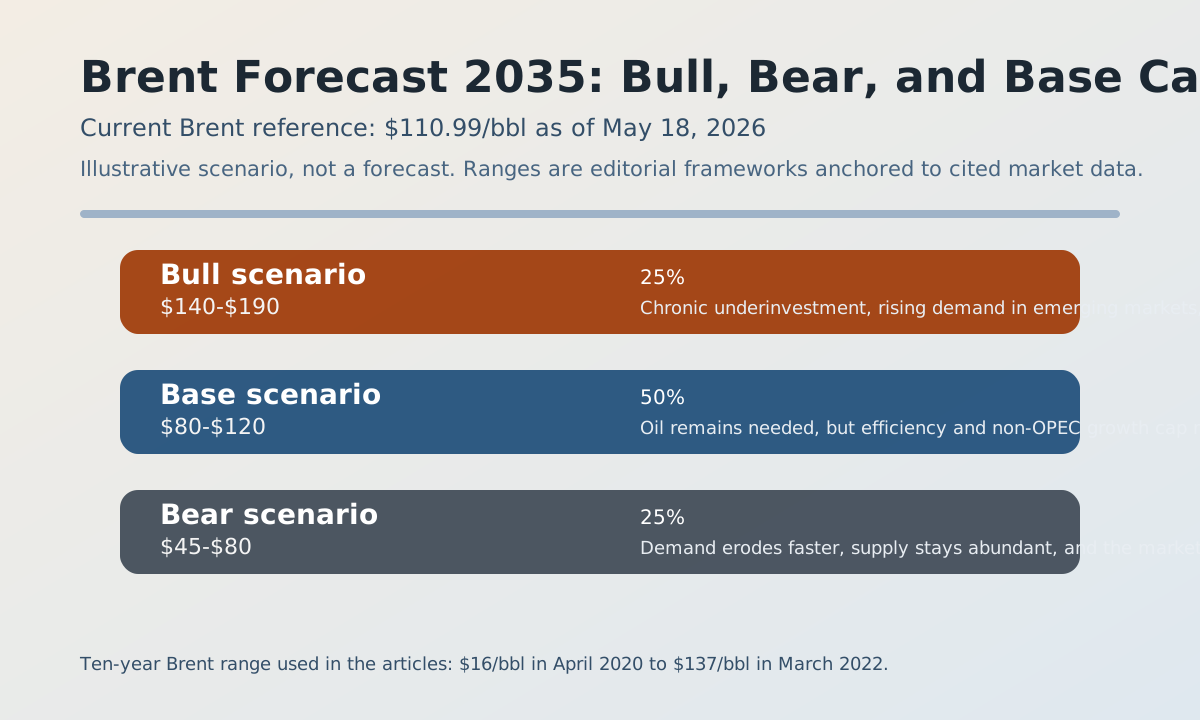
The base case stretches today's official medium-term assumptions into a later-decade market that is tighter than 2015-2019 but looser than crisis peaks. The bull and bear cases then test what happens if structural underinvestment or structural demand destruction dominates. Because the horizon is so long, the probabilities should be read as broad regime weights rather than precise odds.
| Scenario | Price range | Conditions | Probability |
|---|---|---|---|
| Bull | $140-$190 | Chronic underinvestment, rising demand in emerging markets, and persistent supply insecurity | 25% |
| Base | $80-$120 | Oil remains needed, but efficiency and non-OPEC growth cap runaway upside | 50% |
| Bear | $45-$80 | Demand erodes faster, supply stays abundant, and the market reprices transition risk | 25% |
| Direction | Probability | Comment |
|---|---|---|
| Higher | 30% | A higher path is credible if demand remains durable and supply investment stays politically constrained. |
| Lower | 25% | A lower path needs both weaker oil intensity and enough supply flexibility to prevent repeated scarcity episodes. |
| Wide middle band | 45% | The most likely outcome is still a broad mid-range rather than an extreme. |
Bullish scenario. Brent in the $140-$190 zone by 2035 requires a world where oil demand in emerging markets stays resilient, natural decline rates bite, and geopolitics prevents spare capacity from functioning as a clean buffer. OPEC's investment and demand framing in the OPEC World Oil Outlook is the main public source that makes this pathway intellectually defensible.
Bearish scenario. Brent in the $45-$80 zone requires much faster efficiency gains, more credible electrification, softer petrochemical and freight growth, and enough low-cost supply to stop every rally. This is not impossible, but it depends heavily on structural substitution that is not yet fully visible in current official demand data.
Base case. The $80-$120 range assumes oil remains strategically needed and sometimes stressed, but not permanently in crisis. It also assumes that producers still respond to price signals often enough to prevent every shock from becoming a supercycle.
06. Positioning, Risks, and Conclusion
Positioning for a 2035 Brent view requires patience and humility
| Investor type | Prudent approach | Main watchpoints |
|---|---|---|
| Investor already in profit | Rebalance and protect gains into sharp spikes. A 2035 thesis is too uncertain to justify permanent maximum exposure. | Long-cycle capex, OPEC policy, and macro slowdown risk. |
| Investor currently at a loss | Review whether the loss comes from timing or from a broken thesis. Long-run oil positions need balance-sheet and policy discipline. | Inventory trends and producer response. |
| Investor with no position | Use staged entries or broader energy exposure rather than trying to pick one exact oil cycle turn. | Term structure and credit conditions. |
| Trader | Keep the time horizon short and respect event risk. A 2035 narrative does not rescue a badly timed short-term trade. | Ceasefire headlines and OPEC meetings. |
| Long-term investor | Favor diversified energy exposure, hedge concentration risk, and update assumptions when demand and investment data change. | Decline rates and demand elasticity. |
| Risk-hedging investor | Treat Brent as a macro hedge, not as a simple growth asset. Position size should reflect that oil can mean revert violently. | Inflation beta and geopolitical stress. |
Risks to watch
Risks to watch include transition-policy surprises, an unexpectedly durable EV and efficiency wave, producer overinvestment after a high-price period, sanctions relief, and weaker emerging-market growth. On the upside, a lack of new long-cycle investment or repeated security disruptions could keep the floor higher than consensus expects.
Conclusion
A 2035 Brent forecast is inherently probabilistic. The strongest conclusion from today's evidence is not that oil must be very high or very low, but that the middle of the 2030s is still likely to price strategic scarcity risk more often than the old glut-era consensus did. That supports a scenario framework centered on $80-$120, with real room for both upside and downside if structural assumptions change. Disclaimer: This article is for informational and research purposes only and does not constitute personalized financial advice.
07. FAQ
Frequently asked questions
Can anyone credibly forecast Brent for 2035?
Only as scenarios. The public data does not justify a precise point target that far out.
Why is the base case not lower if the IMF and EIA show mid-$70s assumptions for 2027?
Because a 2035 view also has to weigh long-run decline rates, investment needs, and the possibility that producers defend a higher equilibrium range, as argued in the OPEC World Oil Outlook.
What would make the 2035 bear case more likely?
Faster electrification, softer industrial demand, and a more durable return of low-cost supply would all help.
What would invalidate the 2035 base case?
A persistent demand breakdown or, on the other side, a genuine oil supercycle driven by chronic underinvestment would both invalidate the middle-range case.
Methodology and Invalidation
How to interpret this framework and what would invalidate it
This article extends from public medium-term anchors rather than pretending the sources themselves publish exact 2035 Brent targets. The base inputs are today's price from Yahoo Finance, official medium-term oil assumptions from the EIA global oil page and IMF WEO database, escalation framing from the World Bank Commodity Markets Outlook, physical-balance commentary from the IEA Oil Market Report, and long-run demand and investment language from the OPEC World Oil Outlook.
The probability table is intentionally broad because long-run oil outcomes depend on policy, conflict, and technology adoption that are impossible to pin down with precision. The probabilities therefore represent relative plausibility, not actuarial odds.
What would invalidate the framework? A major shift in oil intensity, a policy regime that suddenly unleashes abundant low-cost supply, or a much faster energy substitution path would all reduce the upper-range credibility. Conversely, persistent underinvestment and repeated disruptions would push the middle of the distribution higher.
References
Sources
- Yahoo Finance, Brent Crude Oil Futures quote page and historical chart
- U.S. EIA, Short-Term Energy Outlook global oil section
- IMF, World Economic Outlook database, April 2026
- IMF, World Economic Outlook April 2026
- World Bank, Commodity Markets Outlook, April 2026
- World Bank, Commodity Markets Outlook release, April 28, 2026
- IEA, Oil Market Report, May 2026
- OPEC, Annual Statistical Bulletin
- OPEC, World Oil Outlook 2025
- OPEC, World Oil Outlook release note
- IEA, Energy and AI
- S&P Global Commodity Insights, 2026 oil market outlook