01. Quick Answer
Brent can still be above pre-2022 norms by 2030, but the most defensible outlook is a wide range rather than a heroic single target
Brent is trading near $110.99/bbl as of May 18, 2026, far above the $16/bbl panic low from April 2020 and still below the $137/bbl spike seen in March 2022 according to Yahoo Finance. That history alone argues against a one-number forecast. The more credible 2030 approach is to combine current spot conditions, near-term official forecasts from EIA global oil page and the IMF WEO database, structural demand assumptions from the OPEC World Oil Outlook, and balance-sheet stress described by the World Bank Commodity Markets Outlook. On that basis, Brent still has a plausible base case in the $85-$115 range by 2030, with upside if underinvestment and geopolitical risk remain synchronized.
| Category | Evidence-based read | Implication |
|---|---|---|
| Historical data | Brent has swung from $16/bbl in April 2020 to $137/bbl in March 2022 | Long-run ranges matter more than straight-line extrapolation. |
| Current market conditions | Spot Brent near $110.99/bbl reflects active disruption risk and a tighter prompt market Reuters market report | The current price is informative, but it is not automatically a steady-state level. |
| Institutional signals | EIA global oil page and the IMF WEO database both show lower medium-term averages than current spot | Official forecasters still expect some normalization once shocks fade. |
| Most important watchpoints | OPEC spare capacity, non-OPEC supply, demand elasticity, and shipping disruption remain central according to IEA Oil Market Report and OPEC World Oil Outlook | These variables should drive the 2030 range more than narrative alone. |
02. Historical Context
The last decade shows why Brent forecasts need regimes, not slogans
Oil has repeatedly moved through distinct regimes: a shale-and-glut period, a pandemic collapse, a war shock, a disinflationary normalization, and the current disruption-heavy rebound. The Yahoo Finance ten-year series captures that arc, while the OPEC Annual Statistical Bulletin and OPEC World Oil Outlook show why demand did not disappear even as efficiency improved. That makes 2030 less about whether oil vanishes and more about whether supply flexibility can catch up with structural and political risk.
| Metric | Latest read | Why it matters |
|---|---|---|
| Current Brent reference | $110.99/bbl on May 18, 2026 | Spot is elevated enough to warrant caution around chasing, but also high enough to validate that the market still prices geopolitical risk. |
| EIA near-term view | EIA expects Brent to fall below $90/b in 4Q26 and average $76/b in 2027 per EIA global oil page | Official base cases remain well below today's shock-influenced spot price. |
| World Bank stress case | The World Bank Commodity Markets Outlook says escalation could keep Brent around $95-$115 in 2026 | Upside still requires disruption or deeper underinvestment, not just trend growth. |
| Long-run demand view | OPEC expects global oil demand to keep rising toward the 2030s in the OPEC World Oil Outlook | That view helps explain why a collapse scenario is not the default case. |
| Marker | Level | Interpretation |
|---|---|---|
| Pandemic trough | $16/bbl | Extreme demand destruction and storage stress pushed Brent into a regime that was never likely to persist once mobility recovered Yahoo Finance. |
| War shock peak | $137/bbl | The 2022 spike shows how quickly sanctions, war, and spare-capacity fear can reprice oil when inventories are thin Yahoo Finance. |
| Late 2024 reset | $72.94/b close in November 2024 | That period illustrated how softer demand and adequate supply can still drag Brent back toward a more comfortable range Yahoo Finance. |
| End-2025 level | $60.85/b close in December 2025 | Before the 2026 spike, the market had already been leaning toward oversupply risk, which matters for any long-run mean reversion argument Yahoo Finance. |
| Current 2026 rebound | $110.99/bbl | The latest move reintroduced conflict premium and shipping risk, which is why scenario work matters more than static valuation language Reuters supply report. |
03. Main Drivers
Five drivers matter most for Brent's 2030 macro outlook
1. OPEC spare capacity and cohesion
The prompt price can stay high when OPEC production discipline is credible and when market participants doubt how fast spare barrels can return. The latest Reuters survey and the OPEC World Oil Outlook both suggest that spare capacity is still strategically important, not irrelevant.
2. Non-OPEC supply growth
Base-case oil forecasts soften if U.S., Brazil, Guyana, and Canada keep adding barrels efficiently. That is a core reason the EIA global oil page still sees softer prices in 2027 even after the 2026 shock.
3. Demand resilience versus substitution
The evidence is mixed. The OPEC World Oil Outlook is still structurally constructive on demand, but the IMF WEO database and World Bank Commodity Markets Outlook both assume slower global growth than the pre-pandemic norm. That keeps long-run demand positive in some scenarios and flatter in others.
4. Fiscal and geopolitical risk
The market is not pricing only refinery margins or shipping costs. It is also pricing sovereign risk, sanctions risk, and the probability that governments intervene in strategic flows. The World Bank release and IEA Oil Market Report both underline how sensitive oil still is to conflict spillovers.
5. Underinvestment and decline rates
OPEC argues in the OPEC WOO release that trillions of dollars of cumulative investment are still needed to prevent a supply crunch. If capital remains cautious because of transition policy uncertainty, the marginal barrel can stay expensive even if headline demand growth cools.
04. Institutional Forecasts and Analyst Views
Official and institutional views still point to normalization, but not to a world where oil becomes strategically irrelevant
Near-term official forecasts are noticeably below spot. The EIA global oil page expects Brent below $90/b in late 2026 and roughly $76/b in 2027. The IMF WEO database uses an oil assumption near $75.97 in 2027. The World Bank Commodity Markets Outlook is more explicit about tail risk, noting that escalation can keep Brent materially higher. That spread is useful because it shows analysts remain divided on whether current tightness is temporary or the start of a new structural band.
| Source | Message | Interpretation |
|---|---|---|
| EIA | Brent below $90/b in 4Q26 and about $76/b average in 2027 | The official U.S. baseline assumes some disruptions ease and supply growth reasserts itself. |
| IMF | World Economic Outlook database uses an oil assumption around $75.97 in 2027 | The IMF baseline leans toward normalization rather than a permanently triple-digit oil market. |
| World Bank | Baseline 2026 energy forecasts eased, but escalation could keep Brent around $95-$115 | The World Bank is constructive on tail-risk pricing and explicitly scenario-based. |
| IEA | The IEA Oil Market Report frames 2026 as a market where disruptions, weaker macro data, and price-sensitive demand all coexist | That is consistent with a wide medium-term range rather than certainty. |
| Reuters and Barclays | Barclays raised its 2026 Brent forecast to $100/b in a report covered by Reuters on Barclays | Private-sector analysts can shift quickly when disruption risk rises, which is why long-run forecasts should remain conditional. |
05. Bull, Bear, and Base Case
How the 2030 range is built
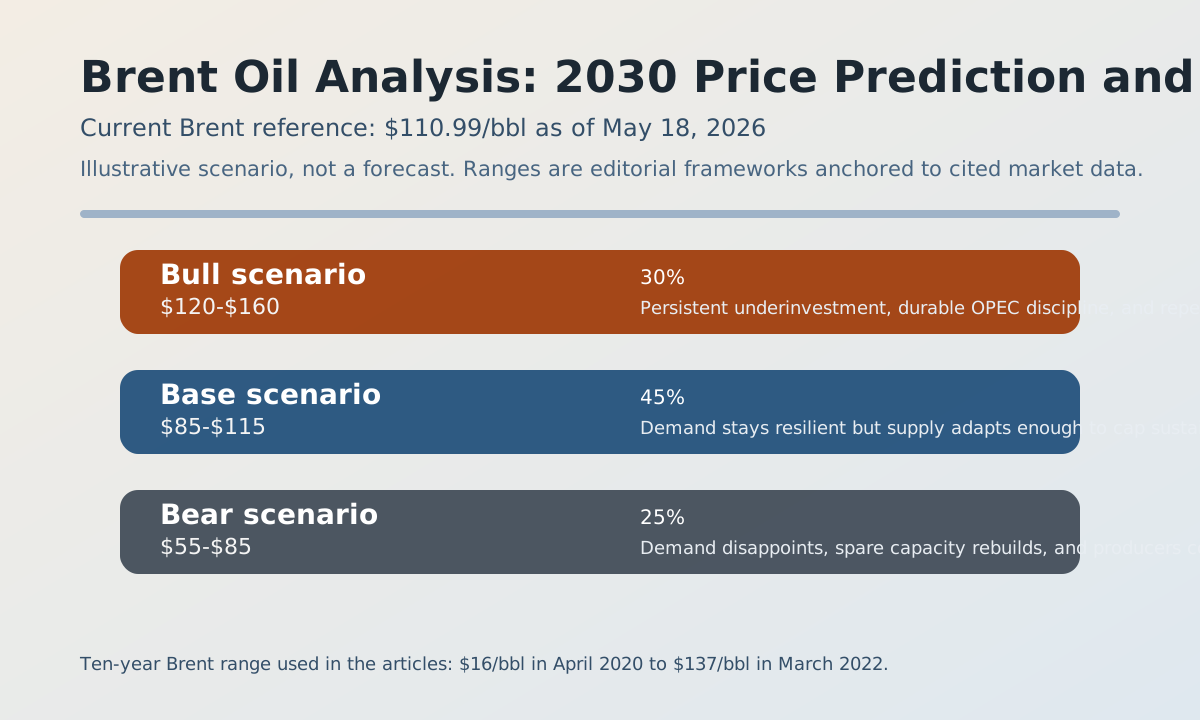
The range here is editorial, not an institutional point target. It starts from today's elevated price, then asks whether the market by 2030 is more likely to look like the oversupplied late-2025 tape or the disruption-heavy 2026 tape. The probabilities also incorporate how often Brent historically mean reverts after shocks while still rewarding periods of structural underinvestment.
| Scenario | Price range | Conditions | Probability |
|---|---|---|---|
| Bull | $120-$160 | Persistent underinvestment, durable OPEC discipline, and repeated disruption premium | 30% |
| Base | $85-$115 | Demand stays resilient but supply adapts enough to cap sustained spikes | 45% |
| Bear | $55-$85 | Demand disappoints, spare capacity rebuilds, and producers compete for market share | 25% |
| Direction | Probability | Comment |
|---|---|---|
| Higher | 35% | A higher path becomes more likely if underinvestment persists and OPEC keeps spare capacity strategically tight. |
| Lower | 25% | A lower path likely needs slower demand, faster non-OPEC supply, and fewer geopolitical interruptions at the same time. |
| Sideways to elevated | 40% | The most defensible outcome is a broad but still elevated range relative to the pre-2022 average. |
Bullish scenario. Brent can spend meaningful time above $120 if global inventories stay lean, conflict risk keeps insurance and freight costs high, and producers fail to outspend decline rates. That is the scenario most aligned with the stress language in the World Bank Commodity Markets Outlook and with OPEC's repeated investment argument in the OPEC WOO release.
Bearish scenario. Brent can move back into the $55-$85 range if the current disruption premium fades, if non-OPEC growth stays healthy, and if weaker macro conditions make demand more price elastic. That logic is broadly consistent with the normalization bias in the EIA global oil page and IMF WEO database.
Base case. The $85-$115 band assumes the market never fully forgets the supply shocks of the 2020s, but also assumes it does not live in a permanent emergency. In other words, prices stay above the old glut era without needing a nonstop crisis.
06. Positioning, Risks, and Conclusion
Different investors should respond differently to the same Brent outlook
| Investor type | Prudent approach | Main watchpoints |
|---|---|---|
| Investor already in profit | Hold a core position or hedge selectively, but consider trimming into policy-driven spikes instead of assuming every disruption becomes a lasting regime. | Prompt spreads, ceasefire headlines, and OPEC language. |
| Investor currently at a loss | Separate thesis quality from entry timing. Avoid averaging aggressively at triple-digit prices unless the underinvestment thesis has clearly strengthened. | Inventory data and non-OPEC supply growth. |
| Investor with no position | Wait for pullbacks or build exposure gradually. Brent is too cyclical to reward impatient entries after a sudden geopolitical repricing. | Volatility term structure and macro data. |
| Trader | Use stop-loss discipline and be explicit about whether the trade is a disruption trade or a fundamental balance trade. | Shipping risk, sanctions, and EIA weekly inventory data. |
| Long-term investor | Focus on diversified energy exposure, rebalance position size, and stress-test assumptions against both $75 and $125 oil. | Capital discipline and policy shifts. |
| Risk-hedging investor | Use Brent more as a hedge against inflation or geopolitical stress than as a single-direction bet, and avoid chasing after vertical moves. | Cross-asset correlation and inflation expectations. |
Risks to watch
The main risks are obvious but not trivial: OPEC policy error, unexpectedly strong non-OPEC supply, a sharper-than-expected global slowdown, faster electrification, sanctions changes, and the possibility that the 2026 spike proves temporary. Available data suggests each one can move Brent by much more than standard equity-style valuation changes.
Conclusion
Brent's 2030 outlook is still constructive in the sense that the market probably does not return to a structurally cheap-oil world unless both demand and geopolitics soften together. But the evidence from EIA global oil page, World Bank Commodity Markets Outlook, IEA Oil Market Report, and OPEC World Oil Outlook also argues against pretending triple-digit oil is guaranteed. The most rigorous stance is scenario-based, risk-aware, and humble about how much of today's price is conflict premium versus durable scarcity. Disclaimer: This article is for informational and research purposes only and does not constitute personalized financial advice.
07. FAQ
Frequently asked questions
What is a realistic Brent price prediction for 2030?
The evidence is mixed, but a cautious editorial base case is about $85-$115 because it sits between the normalization bias in EIA global oil page and the tighter long-run supply logic in OPEC World Oil Outlook.
Why not just use the current spot price as the 2030 forecast?
Because today's Brent price includes a live geopolitical premium. Both the EIA global oil page and World Bank Commodity Markets Outlook show that medium-term averages can diverge sharply from current spot when disruption fades or intensifies.
What would make the bull case stronger?
Persistent underinvestment, repeated shipping disruptions, and demand that remains resilient despite higher prices would all strengthen it.
What would invalidate this constructive 2030 view?
A combination of weaker demand, faster non-OPEC supply growth, restored producer competition, and lower geopolitical stress would all make the high-range view materially less credible.
Methodology and Invalidation
How to interpret this framework and what would invalidate it
This framework combines the latest Brent reference from Yahoo Finance, official medium-term views from the EIA global oil page and IMF WEO database, downside and escalation cases from the World Bank Commodity Markets Outlook, physical market commentary from the IEA Oil Market Report, and long-run demand and investment signals from the OPEC World Oil Outlook. It does not assume any institution has a precise 2030 point forecast because the public record mostly does not support that level of precision.
The forecast range is built by asking which regime is most likely by 2030: a tighter market with chronic supply insecurity, a rebalanced market with adequate new supply, or a weaker market where demand disappoints. The probabilities are therefore judgmental, but they are anchored to observed ten-year volatility and to the degree of divergence between current spot and official 2027 assumptions.
What would invalidate the framework? A faster-than-expected collapse in oil intensity, a decisive return of low-cost spare supply, or a geopolitical thaw large enough to remove the disruption premium would all push the range lower. On the other hand, more durable underinvestment or renewed conflict around critical shipping routes would move the range higher. Investors should update the view when those variables change rather than defend a fixed target.
References
Sources
- Yahoo Finance, Brent Crude Oil Futures quote page and historical chart
- U.S. EIA, Short-Term Energy Outlook global oil section
- U.S. EIA, Short-Term Energy Outlook home page
- World Bank, Commodity Markets Outlook, April 2026
- World Bank, Commodity Markets Outlook release, April 28, 2026
- IMF, World Economic Outlook database, April 2026
- IMF, World Economic Outlook April 2026
- IEA, Oil Market Report, May 2026
- OPEC, Annual Statistical Bulletin
- OPEC, World Oil Outlook 2025
- OPEC, World Oil Outlook release note
- Reuters via TradingView, Barclays raises 2026 Brent forecast
- Reuters via Investing.com, oil rises on Middle East supply fears