01. Quick Answer
The CAC 40 in 2027 is likely to be decided by specific catalysts rather than by a broad new bull market narrative
The 2027 question is much narrower than the 2030 or 2035 debate. Investors are not asking whether the CAC 40 contains strong companies. They are asking whether Paris equities can regain momentum after a record high, a soft first quarter for French GDP, and continued fragility in luxury sentiment (INSEE; Reuters on LVMH January 2026).
| Catalyst | Why it matters |
|---|---|
| Luxury stabilization | LVMH, Hermès, Kering, and related names still anchor broad sentiment toward the French market. |
| ECB and rates | A higher-for-longer path can compress European multiples quickly. |
| Defense and industrial resilience | Airbus, Safran, Thales, and Schneider can offset consumer-facing weakness if order books stay firm. |
| Fiscal headlines | French budget and deficit discussions remain relevant to the index multiple. |
02. Historical Context
The benchmark enters 2027 after a record zone and a softer macro pulse, which makes catalyst analysis essential
Recent history shows why 2027 should be treated as a catalyst-driven call. The benchmark reached a 10-year high of 8,580.75 in January 2026 and then pulled back toward 7,952.55 by mid-May (Yahoo Finance). Meanwhile, INSEE's first estimate showed the French economy stalled in Q1 2026 as exports fell sharply and investment softened (INSEE GDP release). That combination makes 2027 less about a fresh discovery of quality and more about whether enough positive catalysts arrive to restart momentum.
| Metric | Latest reading | 2027 implication |
|---|---|---|
| Recent close | 7,952.55 | The starting point matters because 2027 upside is smaller if much good news is already priced. |
| Q1 2026 GDP | 0.0% q/q | Domestic growth is too soft to provide easy cyclical support. |
| April 2026 CPI | 2.2% y/y | Inflation and rates remain valuation variables. |
| Euronext YTD to March 31 | -4.08% | The market already entered 2026 with a less forgiving tone. |
The evidence is mixed because the index still contains strong structural winners, but the macro backdrop is no longer straightforward. That is why the 2027 discussion has to be built around explicit catalysts: luxury earnings, ECB decisions, energy prices, defense orders, and whether French confidence indicators stabilize from depressed spring 2026 levels.
One useful discipline is to separate signal from noise. A single weak macro print may not matter if the largest constituents keep guiding confidently. But a cluster of weaker earnings, softer confidence, and firmer rates would matter a great deal because that would suggest the market's January 2026 optimism arrived too early.
03. Main Drivers
Five forces are most likely to shape the CAC 40 over the next 12 to 18 months
1. Luxury earnings are the clearest near-term swing factor
Reuters-linked market reporting has repeatedly shown that weak luxury prints can drag Paris lower because investors still use French equities as a proxy for global premium consumption (Reuters on LVMH Q1 2026).
2. ECB communication can change the multiple faster than domestic data
Reuters coverage of ECB officials in May 2026 highlighted the risk of another hike if the inflation outlook does not improve (Reuters on ECB hike risk). For 2027, rate expectations may matter more than a single GDP print.
3. Defense and aerospace can still surprise positively
Banque de France business surveys showed defense and aerospace demand helping parts of French industry. If that support persists, it can keep the index more balanced than headline luxury angst suggests.
4. Energy shock risk remains a headline variable
Reuters' broader European equities reporting tied weaker French shares to oil-driven inflation worries and geopolitical stress. That matters because higher energy prices can help some names while hurting the overall rate and consumer backdrop (Reuters on European shares).
5. AI-linked industrial demand is becoming a real support story
Schneider's AI and data-center demand signals show that parts of the index have a real capex-driven growth tailwind that can help offset softer consumer names (Reuters on Schneider's results).
04. Institutional Forecasts and Analyst Views
Near-term market structure and official macro projections matter more than thin public point targets
There are fewer credible public 2027 point targets for the CAC 40 than for individual stocks, so the best institutional framework combines official macro projections and current market structure. Banque de France still expects positive baseline growth, but INSEE's latest data and ECB uncertainty make the near-term range wide enough that analysts remain divided on whether the January 2026 high was a temporary overshoot or an early step toward another leg up (Banque de France; INSEE dashboard).
| Input | Signal | Why it matters |
|---|---|---|
| Banque de France baseline | Growth remains positive in the central case | Supports a constructive base case if rates do not tighten too much. |
| INSEE dashboard | Confidence weakened sharply in April 2026 | Explains why upside still needs visible catalysts. |
| Reuters market coverage | Luxury and rates keep moving Paris | Reinforces the importance of sector-specific catalysts. |
| Euronext index structure | Top ten names dominate | A narrow set of earnings seasons can change the whole benchmark's tone. |
Available data suggests the base case for 2027 is a range rather than a directional certainty. A mild rebound is plausible, but it depends heavily on whether softness in luxury and confidence data proves cyclical rather than structural.
For practical forecasting, investors should watch four signals together: luxury revenue prints, ECB communication, French confidence indicators, and the tone of industrial order books. If three of those four improve, the market can look very different by 2027. If they deteriorate together, the downside case strengthens materially.
05. Scenarios, Risks, and Invalidation
A 2027 CAC view is best framed with explicit bull, bear, and base-case triggers
Bullish scenario
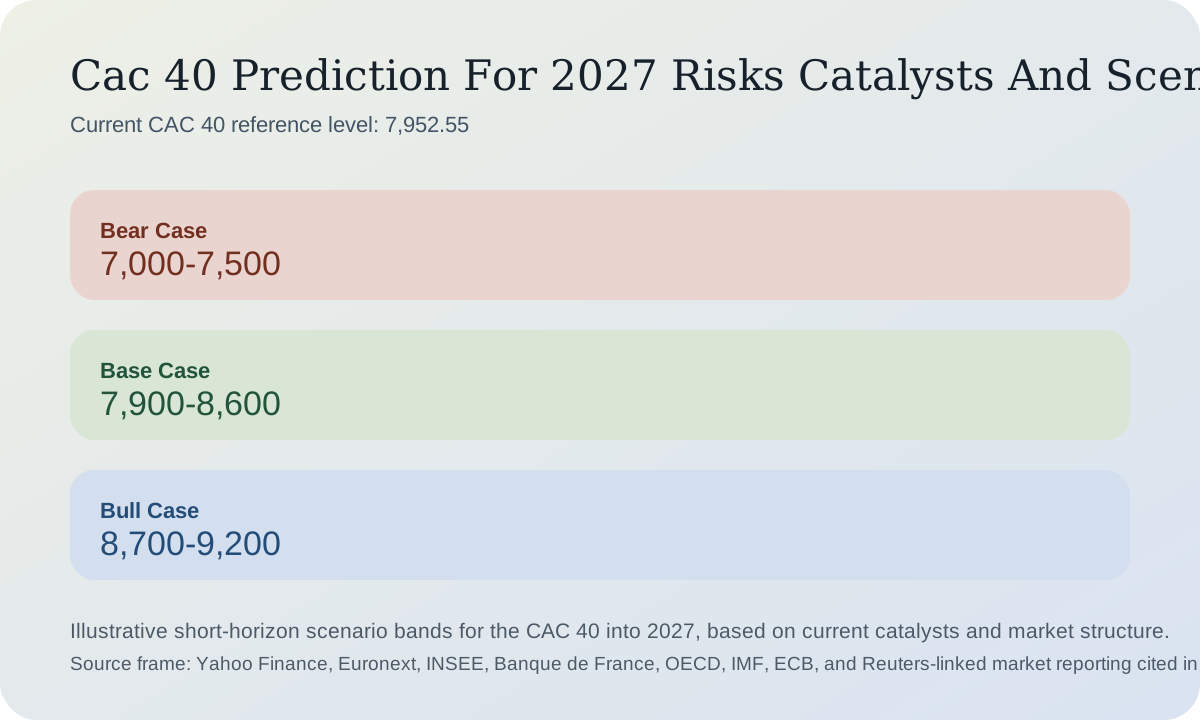
The bull range is 8,700 to 9,200 by 2027. That would likely require a stabilizing luxury cycle, a more benign ECB path, continued defense and industrial strength, and no fresh energy shock.
Bearish scenario
The bear range is 7,000 to 7,500. This scenario depends on luxury demand staying weak, rate pressure persisting, and French or euro-area growth continuing to underwhelm.
Base-case scenario
The base case is 7,900 to 8,600. That range assumes the CAC roughly digests 2026 volatility and ends up modestly higher if the macro and sector mix becomes less adversarial.
| Scenario | Range | Catalysts | Probability |
|---|---|---|---|
| Bull | 8,700-9,200 | Luxury recovery, stable ECB, and industrial resilience. | 25% |
| Base | 7,900-8,600 | Mixed but manageable macro conditions and sector rotation. | 50% |
| Bear | 7,000-7,500 | Luxury weakness and tighter financial conditions persist. | 25% |
| Path | Estimated probability | Reasoning |
|---|---|---|
| Rising by 2027 | 45% | There is still enough sector quality to support a rebound if catalysts cooperate. |
| Falling by 2027 | 25% | A lower path is plausible if rates and luxury both disappoint. |
| Moving sideways | 30% | The index may need time to digest the 2026 record zone and macro uncertainty. |
Risks to watch
Luxury earnings, ECB rhetoric, oil prices, confidence indicators, and French fiscal headlines should dominate the 2027 setup.
What could invalidate the forecast
The base range would be too low if a luxury rebound and industrial capex wave arrive together. It would be too high if the ECB stays restrictive into weak growth and Chinese luxury demand remains sluggish.
Conclusion
The near-term CAC outlook is balanced rather than emphatic. There are enough global-quality constituents to support upside, but not enough macro clarity to justify certainty.
That is why patience matters more than conviction slogans. A 2027 French-market view should be updated as the catalysts arrive, not defended as a fixed ideology.
Investors who stay flexible will probably navigate the range better than investors who anchor on the record high or on the latest weak data point. The benchmark still has enough quality to recover, but it also has enough concentration that disappointment can travel quickly.
Disclaimer: This 2027 framework is for informational purposes only and does not constitute personal investment advice.
06. Investor Positioning
Different investor types should handle a near-term French index call differently
| Investor type | Prudent approach | Key monitor |
|---|---|---|
| Investor already in profit | Hold core positions but trim if concentration in luxury or industrial winners has become excessive. | Luxury earnings and ECB decisions. |
| Investor currently at a loss | Reassess based on macro and sector drivers rather than emotion. | Whether weakness is temporary or part of a longer rerating lower. |
| Investor with no position | Scale in or wait for pullbacks rather than chase rebounds. | Entry discipline matters in a catalyst-driven range. |
| Trader | Use stop-losses and respect event risk. | ECB, CPI, oil, and major earnings. |
| Long-term investor | A staged approach still makes more sense than trying to call the exact 2027 level. | Total return and sector balance. |
| Risk-hedging investor | Pair any CAC exposure with explicit hedges if macro protection is the goal. | Energy and rate shocks. |
07. FAQ
Frequently asked questions about a CAC 40 prediction for 2027
What is the biggest risk to the CAC 40 in 2027?
The cleanest answer is a combination of weak luxury demand and a restrictive ECB path, because those two forces can weigh on both earnings sentiment and valuation.
Can the CAC 40 rise even if French GDP remains weak?
Yes. Many constituents are global franchises, so the index can rise on global sector strength even if domestic French growth is mediocre.
Why is the sideways scenario still meaningful?
Because high-quality European indices often consolidate after record highs when fundamentals are decent but not decisively better than what investors already expected.
References
Sources
- Yahoo Finance chart API for ^FCHI, 10-year monthly history
- Yahoo Finance chart API for ^FCHI, recent daily closes
- Euronext CAC 40 factsheet, March 31, 2026
- INSEE economic dashboard for France
- INSEE Q1 2026 GDP release
- Banque de France macroeconomic projections page
- Banque de France March 2026 macroeconomic projections
- OECD Economic Outlook landing page
- OECD Economic Outlook Volume 2025 Issue 2
- IMF 2025 Article IV consultation for France
- ECB April 2026 economic outlook and monetary policy speech
- Reuters factbox on France's 2026 budget
- Reuters on LVMH and luxury recovery doubts
- Reuters on ECB June hike risk
- Reuters on Schneider and data-center demand