01. Historical Context
How AXA's last decade shapes a 2030 CS forecast
AXA is one of those insurers that can look deceptively simple from a distance. It is a French-listed global insurance group with a well-known brand, a large dividend, and a long history. But a serious 2030 forecast for CS.PA depends on much more than brand familiarity. Investors have to judge whether AXA can keep compounding underwriting quality, preserve a strong Solvency II buffer, sustain buybacks and dividend growth, and navigate a world where catastrophe losses, regulation, and technology all matter at the same time (2024-2026 strategy; FY 2025 earnings).
| Point | Why it matters |
|---|---|
| AXA is more than a French domestic insurer | Its global P&C, life, health, and commercial lines mix broadens the earnings base. |
| Balance-sheet quality remains central | A strong solvency ratio supports both resilience and shareholder distributions. |
| 2030 should be expressed as a range | Insurance-cycle conditions and catastrophe costs make single-point forecasts weak. |
| Capital return is part of the story, not the whole story | A dividend-rich insurer can still rerate lower if underwriting quality slips. |
Historical context supports a constructive but disciplined long-term view. CS.PA rose from about EUR 17.81 in May 2016 to EUR 39.18 in May 2026, which implies a price-only CAGR of about 8.21%. The path was not smooth. The stock fell to roughly EUR 13.80 in September 2020 during pandemic stress and later climbed to a 10-year high of EUR 42.68 in June 2025 before easing back in 2026 (10-year Yahoo Finance history; recent daily pricing).
| Metric | Latest public reading | Why it matters for 2030 |
|---|---|---|
| CS.PA close | EUR 39.18 | The current valuation still reflects a profitable but cyclical insurer rather than a pure growth stock. |
| FY 2025 gross written premiums and other revenues | EUR 116 billion, up 6% | Confirms top-line momentum across businesses. |
| FY 2025 underlying earnings | EUR 8.4 billion, up 6% | Supports the case that AXA is still expanding earnings rather than only harvesting capital. |
| Solvency II ratio | 224% at Dec. 31, 2025; 211% at Mar. 31, 2026 | Keeps AXA in a strong zone even after the grandfathering step-down. |
| 2026 dividend and annual buyback framework | EUR 2.32 dividend and up to EUR 1.25 billion buyback | Capital return remains a key part of valuation support. |
That history matters because AXA is not being priced like a speculative transformation story. The market usually values it as a high-quality compounder within insurance, with a heavy emphasis on capital return, reserve discipline, and underwriting credibility. The upside case into 2030 therefore depends less on dreamlike multiple expansion and more on whether AXA can keep doing difficult things well for a long time.
Available data suggests the company is entering that period from a position of strength. FY 2025 showed record underlying results, while the first quarter of 2026 kept revenue growth and solvency broadly on track with management's medium-term ambitions (1Q26 activity indicators).
The main question is not whether AXA is strong today. It is whether the current combination of underwriting conditions, investment income, and capital management can remain durable enough to justify a higher share-price range by 2030.
02. Key Drivers
What will move AXA shares over the long term
1. Underwriting discipline remains the first driver
AXA's long-term equity outcome still starts with insurance basics. If pricing stays rational and claims inflation remains manageable, AXA can protect margins and compound capital. If the cycle weakens, the stock may still deliver income but with much less rerating potential.
2. Solvency and capital return shape the equity multiple
The 2024-2026 strategic plan explicitly ties AXA's shareholder appeal to a 75% payout framework made up of a 60% dividend payout ratio and roughly 15% of underlying earnings via annual share buybacks, subject to conditions (capital management policy; 2026 buyback execution). That is important because insurers with credible capital return often hold investor attention even in modest-growth periods.
3. Commercial lines and health are where quality really shows
Management keeps emphasizing scaled commercial lines, employee benefits, and individual health as strategic priorities. Those are attractive areas, but they also demand technical excellence. If AXA keeps winning there, 2030 valuation can improve. If not, the market may treat it as a mature cash machine rather than a compounding franchise.
4. The insurance backdrop is supportive, but not static
Swiss Re and Aon both describe an environment where insurers still benefit from stronger investment income and generally solid capacity, but where catastrophe risk, geopolitics, and market fragmentation remain real constraints (Swiss Re sigma 2/2025; Aon Q1 2026 overview). AXA can benefit from that balance, but it cannot escape it.
5. Technology and operations matter more than they used to
AXA's own disclosures increasingly point to automation and AI as contributors to efficiency. Over a four-year horizon, that matters less as a buzzword and more as an operating lever that can lower cost ratios, improve claims triage, and sharpen underwriting consistency (FY 2025 management commentary; AXA AI usage disclosure).
03. Institutional View
What company targets and industry research imply for 2030
Institutional forecasting for AXA is best framed as a combination of company targets and industry conditions rather than a single external target price. AXA itself is guiding 2026 underlying earnings per share growth toward the upper end of the 6% to 8% plan target range, while its strategic plan aims for underlying return on equity of 14% to 16% and more than EUR 21 billion of cumulative organic cash upstream over 2024 to 2026 (latest guidance; strategic targets).
| Input | Current signal | Forecast implication |
|---|---|---|
| Company EPS growth framework | Upper end of 6-8% plan range for 2026 | Supports a constructive long-term base case if execution remains steady. |
| Solvency buffer | 211%-224% recent range | Leaves room for resilience and capital return. |
| Swiss Re insurance outlook | Sector profitability still aided by investment income | Supports earnings durability, but not immunity from shocks. |
| Aon market view | Buyer-friendly conditions in many lines, with hidden complexity | Suggests growth is possible but margins still need discipline. |
| Sell-side coverage breadth | Broad analyst coverage across major banks | AXA is widely watched, so surprises can rerate the stock quickly. |
Available data suggests the evidence is mixed only on magnitude, not on direction. The company appears fundamentally sound, but by 2030 the real debate is how much of that quality is already embedded in the share price. A modest rerating plus continuing distributions can still produce a good shareholder outcome. A dramatic rerating would require several more years of visible underwriting excellence, clean catastrophe absorption, and continued evidence that AXA deserves a premium to slower peers.
That is why this article uses scenario ranges rather than a single endpoint. Insurance is too balance-sheet-driven, too cyclical, and too exposed to exogenous shocks for point precision to be honest.
04. Scenarios
Bull, bear, and base cases for CS.PA into 2030
Bullish scenario
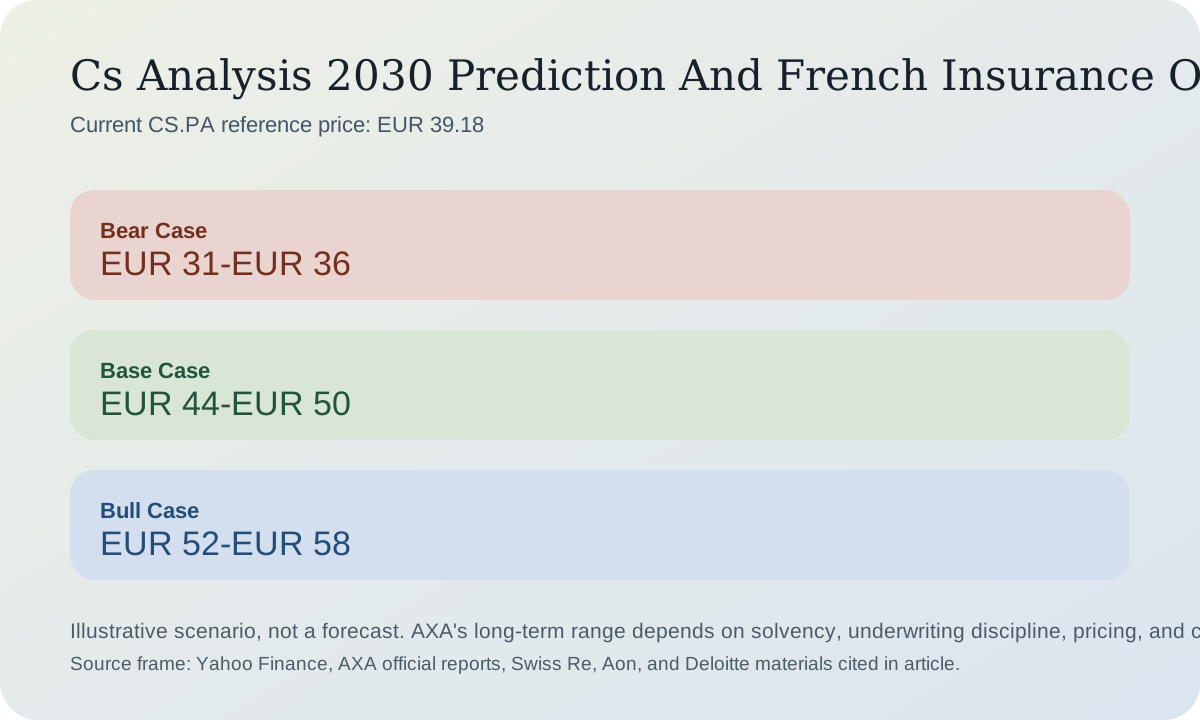
The bull case points to roughly EUR 52 to EUR 58 by 2030. That would likely require AXA to keep delivering at or near the top end of its earnings-growth framework, maintain a very strong solvency profile, and prove that capital returns can coexist with disciplined investment in higher-quality commercial and health franchises. It would also likely require catastrophe experience to stay painful but manageable rather than systemically destructive.
Bearish scenario
The bear case points to roughly EUR 31 to EUR 36. That would fit a world where claims inflation, reserve strengthening, catastrophe volatility, weaker pricing, or regulatory pressure reduce confidence in AXA's ability to compound book value while maintaining its payout profile. This scenario does not require a crisis. It only requires several years of ordinary disappointment.
Base-case scenario
The base case is EUR 44 to EUR 50. That assumes AXA remains a high-quality insurer with dependable earnings and a generous distribution policy, but without the kind of acceleration needed for a far richer valuation. In other words, the stock would continue to behave like a disciplined compounder rather than a market darling.
| Path | Editorial probability | Reasoning |
|---|---|---|
| Rising meaningfully by 2030 | 45% | Supported by AXA's earnings, solvency, and payout framework, but still dependent on insurance-cycle quality. |
| Moving broadly sideways | 30% | A plausible outcome if dividend and buybacks offset only modest growth or valuation compression. |
| Falling meaningfully | 25% | Possible if losses, regulation, or pricing conditions weaken the thesis for longer than expected. |
| Investor type | Prudent approach | What to watch |
|---|---|---|
| Investor already in profit | Hold core exposure, trim only if position size has become excessive. | Solvency, payout guidance, and reserve commentary. |
| Investor currently at a loss | Avoid emotional exits; reassess whether the original thesis depended on capital returns or growth. | Combined-ratio tone and capital generation. |
| Investor with no position | Wait for either a pullback or fresh evidence that AXA can keep compounding above market expectations. | Q2 and FY updates, plus strategic-plan credibility. |
| Trader | Respect support and resistance; do not over-romanticize a dividend stock as a low-volatility trade. | Results days, rate moves, and cat-loss headlines. |
| Long-term investor | Dollar-cost averaging can make sense if expectations stay realistic and diversification is preserved. | Execution versus 2027-2029 targets once announced. |
| Risk-hedging investor | Use AXA more as a quality financial allocation than as a direct hedge. | Macro credit conditions and equity-risk sentiment. |
How this forecast range was built: the range combines AXA's current share price, its 10-year share trajectory, official earnings and solvency disclosures, the existing payout framework, and a judgment about how much rerating a mature insurer can realistically earn without heroic assumptions.
Risks to watch: reserve adequacy, catastrophe severity, pricing normalization, regulatory capital changes, weaker investment income, and the possibility that AXA's next strategic plan fails to convince investors that quality growth can continue beyond 2026.
What would invalidate this forecast: a major acquisition, a severe balance-sheet shock, a structural change in European insurance regulation, or a sustained deterioration in underwriting quality that makes current profitability look cyclical rather than repeatable.
Disclaimer: This article is for informational and research purposes only. Scenario ranges are editorial judgments based on public sources, not guarantees or personal investment advice.
On balance, CS looks more like a disciplined long-term compounder than a speculative breakout story. That can still be attractive. It just means investors should expect the path to be driven by fundamentals and distributions, not hype.
05. FAQ
Frequently asked questions about AXA and a 2030 forecast
Is AXA mainly a dividend stock or a growth stock?
It is primarily a high-yield, quality financial stock with moderate growth potential rather than a pure growth name.
Why does solvency matter so much for AXA?
Because solvency supports confidence in capital returns, claims-paying ability, and resilience during stress periods.
What is the biggest swing factor for a 2030 CS forecast?
The combination of underwriting quality and catastrophe absorption is probably the most important long-term swing factor.
Can AXA outperform if rates fall?
It can, but the evidence is mixed. Lower rates may pressure future investment income, while better asset values and equity sentiment could help the shares.
06. Sources
Reference list
- Yahoo Finance chart API for CS.PA, 10-year monthly history
- Yahoo Finance chart API for CS.PA, recent daily closes
- AXA Full Year 2025 earnings release
- AXA 1Q26 activity indicators
- AXA 2025 Annual Report
- AXA 2024-2026 strategic plan and financial targets
- AXA strategic plan page
- AXA 2026 share buyback execution release
- AXA 2026 shareholders meeting and dividend approval
- AXA analysts coverage page
- AXA ratings page
- Swiss Re sigma 2/2025 on world insurance conditions
- Swiss Re sigma 5/2025 on insurance market outlook
- Aon Q1 2026 global insurance market overview
- Deloitte 2026 global insurance outlook