01. Quick Answer
Ethereum's 2027 path looks tradable, but it is still conditional on relative-strength repair and cleaner value capture
A sensible 2027 ETH forecast has to balance two truths. First, Ethereum remains one of the most institutionally accessible digital assets after Bitcoin, with ETFs, staking narratives, and deeper derivatives participation (SEC) (CME Group). Second, ETH entered 2026 trading far below its 2025 highs, which implies the market is still debating whether Ethereum's usage growth will translate into better token performance (Yahoo Finance) (Grayscale).
| Category | Evidence-based read | Implication |
|---|---|---|
| Historical data | ETH has repeatedly rallied hard after deep drawdowns, but the rebounds were not smooth | Momentum trades should respect volatility rather than ignore it |
| Current market conditions | Recent closes slid from roughly $2,369 on May 10, 2026 to roughly $2,120 on May 18, 2026 (Yahoo Finance) | Near-term tape still looks fragile |
| Institutional signals | CoinShares recorded meaningful March 2026 ETH inflows, while BlackRock and CME show access and trading infrastructure remain active (CoinShares) (BlackRock) (CME Group) | There is still a real demand stack if sentiment improves |
| Working base case | ETH can plausibly trade above current levels by 2027 without requiring a euphoric replay of the last cycle | A range remains more credible than a single target |
02. Historical Context
The 2027 question is whether ETH is rebuilding leadership or just stabilizing after losing momentum
Medium-horizon forecasts should start with market structure rather than with mythology. CME and Glassnode described a maturing ETH market in which options, futures, and ETFs are now meaningful parts of the ownership and risk-transfer stack (CME Group and Glassnode). That is supportive because it broadens participation. It is also why 2027 can be volatile: mature markets can reprice quickly when flows, hedges, or relative-value views shift.
| Metric | Latest reading | Why it matters |
|---|---|---|
| Recent ETH close | ~$2,120.16 | Current anchor for 2027 price-target work |
| Recent 1-month slide | ~$2,369 to ~$2,120 in recent daily closes | Shows momentum weakened into mid-May 2026 |
| Weekly flow signal | $315M of Ethereum inflows in CoinShares' March 16, 2026 report | Demonstrates that institutional interest can return quickly |
| Market depth | CME crypto volumes and Ether derivatives participation rose sharply in 2025 | Improves liquidity but can magnify relative-value swings |
| Reference point | Approximate level | Read-through for 2027 |
|---|---|---|
| Late-2018 trough | ~$85 | Shows how oversold ETH can become in structural washouts |
| 2021 cycle high | ~$4.6k monthly-close area | Important memory level for longer-term bulls |
| 2025 peak | ~$4.8k in available Yahoo history | Key reference for whether ETH can reclaim prior leadership |
| Mid-2026 reset | ~$2.1k | Suggests the market is still asking for proof, not stories |
03. Main Drivers
Five drivers will likely decide whether 2027 is a recovery year, a sideways year, or another disappointment
1. ETF and ETP flows have to stay supportive
Ethereum attracted meaningful inflows in CoinShares' March 16, 2026 data, which suggests allocators still respond when valuations reset (CoinShares). For 2027, that matters more than social sentiment because ETH now depends heavily on institutional demand channels.
2. ETH/BTC relative strength needs to stabilize
Grayscale noted that the ETH/BTC ratio had fallen back toward levels last seen in mid-2020 (Grayscale). A 2027 recovery case is stronger if ETH can stop losing ground on a relative basis, not just bounce in dollar terms.
3. Staking has to remain investable and operationally clean
The yield and security case for ETH is better than it was pre-Merge, especially with staking increasingly normalized (Ethereum.org) (Ethereum Foundation). Any regulatory attack on staking would be a material risk to 2027 targets.
4. Rollups need to grow without fully cannibalizing the token case
Ethereum.org's scaling roadmap makes clear that rollups are central to the plan (Ethereum.org). The 2027 question is whether the market sees that as a moat-building transition or as evidence that base-layer economics are structurally weaker.
5. Macro liquidity still matters a lot
ETH is not insulated from rates, risk appetite, or broader liquidity conditions. A slow-growth but easing macro environment would probably help. A persistent risk-off regime could keep upside capped even if Ethereum's fundamentals improve.
04. Institutional Forecasts and Analyst Views
Analyst views support a scenario range, not overconfidence
VanEck's long-run framework is too long-dated to be a direct 2027 target, but it still matters because it shows what the high-end strategic case is trying to price (VanEck). Fidelity's thesis matters for the opposite reason: it highlights the pillars of demand without pretending every phase will look bullish (Fidelity).
Nearer-term, CoinShares' inflow data and BlackRock's ETF wrapper show there is a live institutional channel for ETH (CoinShares) (BlackRock). But Grayscale's fee-capture concerns remain a real brake on valuation enthusiasm (Grayscale). That is why the evidence is mixed and why the scenario band should stay moderate.
| Source | Published view or signal | What it suggests | Limit |
|---|---|---|---|
| VanEck | Long-run 2030 valuation framework | ETH still has credible upside if market share and cash flow build | Not a dedicated 2027 call |
| Fidelity Digital Assets | Constructive multi-role thesis | ETH can matter as money, yield, and utility | No explicit 2027 price target |
| CoinShares | $315M of weekly inflows in mid-March 2026 | Allocators can re-engage quickly after weakness | One data point, not a full trend |
| Grayscale | Constructive on network role, cautious on token value capture | Upside depends on resolving the monetization debate | Does not specify exact 2027 price levels |
For 2027, the most defensible view is not a moonshot. It is a recovery framework that allows for upside if flows improve and relative strength repairs, but still respects structural valuation debates.
05. Bull, Bear, and Base Case
A 2027 scenario matrix is more useful than pretending the path is obvious
| Scenario | 2027 range | Conditions | Probability |
|---|---|---|---|
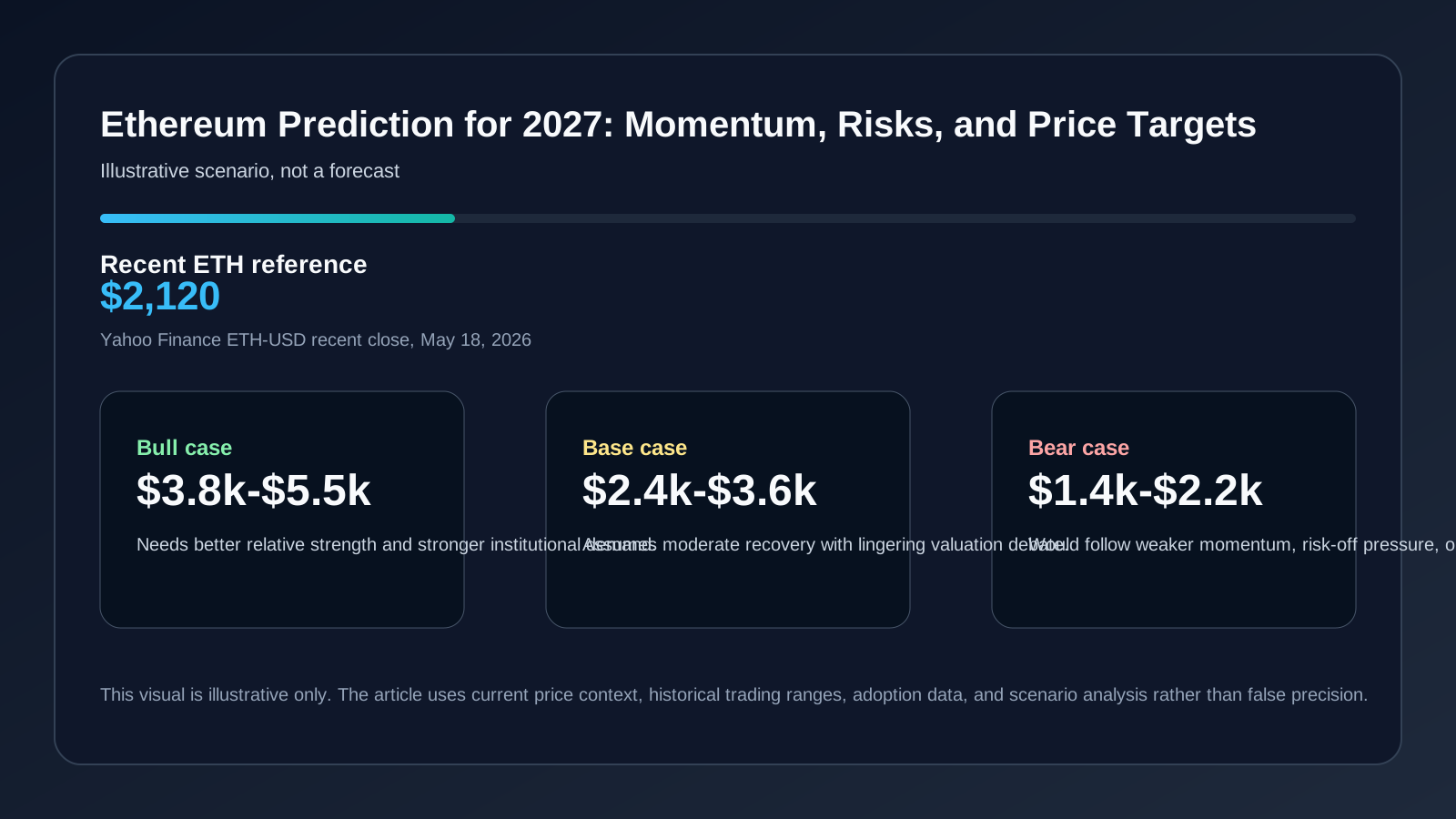
| Bull | $3.8k-$5.5k | ETF demand broadens, ETH/BTC improves, staking stays investable, and crypto beta returns | 25% |
| Base | $2.4k-$3.6k | Ethereum remains relevant and recovers moderately, but fee-capture concerns limit rerating | 45% |
| Bear | $1.4k-$2.2k | Risk appetite stays weak, relative strength deteriorates further, or staking and rollup concerns intensify | 30% |
| Direction | Probability | Comment |
|---|---|---|
| Higher by 2027 | 42% | A recovery is plausible, but not yet something the tape has fully earned |
| Lower | 26% | A weaker path would likely come from structural underperformance or macro stress |
| Sideways | 32% | Reasonable if ETH remains important but not leadership-grade |
| Investor type | Prudent approach | Main watchpoints |
|---|---|---|
| Investor already in profit | Trim or rebalance if the position rebounded sharply from a low cost basis | Relative strength and support levels |
| Investor currently at a loss | Avoid averaging mechanically; reassess whether the original thesis still depends on Ethereum's role rather than just price nostalgia | Portfolio size and holding period |
| Investor with no position | Wait for momentum confirmation or scale in gradually on weakness | Flow persistence and ETH/BTC stability |
| Trader | Use stop-loss orders and avoid oversized positions into major macro or protocol events | Options positioning, ETF flows, and key chart levels |
| Long-term investor | Build slowly only if you still believe Ethereum remains the premier programmable settlement layer | Tokenization traction and fee trends |
| Risk-hedging investor | Treat ETH as cyclical exposure, not as a pure hedge asset | Correlation spikes during stress |
What could invalidate the constructive 2027 case? Another sharp deterioration in ETH relative strength, a staking-related policy shock, or clear evidence that institutional wrappers are not translating into durable demand would all weaken it. What could invalidate the cautious stance? Stronger-than-expected ETF and tokenization adoption could push ETH back toward prior highs faster than this framework assumes.
06. FAQ
Frequently asked questions
Can ETH reach its old highs again by 2027?
Yes, it can, but that is not guaranteed. The path depends on flows, relative strength, and whether Ethereum's economic model looks cleaner to investors.
Why is your 2027 base case below the old peak?
Because a medium-horizon base case should respect current weakness and structural debate rather than assuming instant peak-cycle multiples.
What matters most for 2027 traders?
ETH/BTC trend, ETF and ETP flows, staking headlines, and macro liquidity conditions.
Is sideways action a real possibility?
Yes. Ethereum can remain strategically important while price churns if investors stay unconvinced on value capture.
Methodology and Invalidation
How to interpret this Ethereum 2027 framework and what would change it
The forecast ranges in this article are scenario bands, not promises. They combine live ETH price data, official Ethereum documentation, and institutional or market-structure research from major asset managers, exchanges, research desks, and financial firms, plus editorial judgment about market structure. That mix matters because ether is not driven by one variable. It reacts to fee generation, staking, tokenization demand, rollup economics, derivatives positioning, regulation, and macro risk at the same time.
Probability tables in this article are editorial estimates rather than mathematical certainties. They are derived by weighing whether the evidence currently favors stronger usage and institutionalization, a mixed middle path with slower monetization, or a weaker path marked by fee compression, risk-off conditions, or renewed competition. Where the evidence is mixed, the range stays intentionally wide. False precision is usually a sign that the analyst is hiding uncertainty rather than measuring it honestly.
The clearest invalidators would be evidence that ETF access is not converting into sticky demand, that staking becomes a policy target, or that Ethereum loses leadership in high-value use cases faster than expected. The most important discipline is to state what would invalidate the working view. Investors who are already in profit, investors sitting on losses, traders, hedgers, and long-term allocators do not need the same playbook, so the positioning table separates horizon and risk tolerance instead of pretending one answer fits everyone. Disclaimer: This article is for informational and research purposes only and does not constitute personalized financial advice.
References
Sources
- Yahoo Finance ETH-USD chart API, available weekly price history
- Yahoo Finance ETH-USD chart API, recent daily closes
- Fidelity Digital Assets, Ethereum Investment Thesis
- U.S. SEC, references to the Spot Ether ETP Approval Order and related approvals
- BlackRock, iShares Ethereum Trust ETF overview
- CME Group and Glassnode, Ethereum: Insights and Market Trends H1 2025
- CME Group, record 2025 derivatives activity including ether futures growth
- CoinShares, Digital asset fund flows, March 16, 2026
- Ethereum.org, Scaling Ethereum
- Ethereum.org, The Merge
- Ethereum Foundation, Treasury Staking Initiative, February 24, 2026
- Grayscale Research, Ethereum: The OG Smart Contract Blockchain
- VanEck, ETH 2030 Price Target and Optimal Portfolio Allocations
- Franklin Templeton, Revolution-Not Evolution: Detangling tokenization of RWAs