01. Quick Answer
A 2035 Euro Stoxx 50 estimate is a structural scenario exercise, not a short-term trade call
A 2035 Euro Stoxx 50 forecast is not really a call on next quarter's GDP. It is a call on whether Europe can sustain profit growth, capital spending, and strategic autonomy for another decade. The index has already nearly doubled from its approximate 2,864.74 level ten years ago to 5,827.76 today (Yahoo Finance), but extrapolating that path another decade requires more than rate cuts.
By 2035, the decisive questions will be whether Europe keeps building on semiconductors, industrial automation, defense, energy transition, and enterprise software, or whether it slips back into a low-growth, low-productivity regime. Current macro projections from the ECB and OECD are only near-term, but they provide a starting point: modest growth, gradually stabilizing inflation, and no immediate evidence of collapse (ECB; OECD).
| Point | Why it matters |
|---|---|
| 2035 is a structural question | This horizon depends on productivity, industrial policy, demographics, and capital-market depth more than on one rate cycle. |
| The benchmark already has world-class franchises | ASML, SAP, Siemens, Allianz, Schneider, Airbus-style industrial ecosystems, and healthcare names provide real quality anchors. |
| A long-run rerating is possible but not guaranteed | Europe still trades with credibility and growth questions that can reappear quickly. |
| Range discipline matters more over nine years | The further the horizon, the more sensitive outcomes become to small changes in earnings growth and valuations. |
02. Historical Context
The benchmark's long-run path is better than Europe's reputation, but the next decade needs new drivers
The structural starting point is better than Europe's reputation suggests. STOXX methodology ensures the index remains tied to the eurozone's largest liquid companies (STOXX guide), while ETF factsheets show the index is not dominated by one sector the way some U.S. benchmarks are dominated by mega-cap technology (BlackRock fact sheet). Instead, the benchmark mixes semiconductors, software, luxury, capital goods, banks, insurers, pharma, and energy.
That matters because long-term equity returns come from two engines: earnings compounding and valuation change. The first engine depends on sector profitability and reinvestment. The second depends on whether investors begin to believe that Europe deserves a narrower discount to the U.S. or broader global peers. Analysts remain divided on that second point, which is exactly why 2035 should be framed in scenarios.
| Variable | Why it matters | 2035 question |
|---|---|---|
| Nominal GDP growth | Supports revenue growth and leverage over fixed costs | Can the euro area sustain trend growth above its low-2010s norm? |
| Productivity | Supports margins and justifies higher multiples | Will AI and automation lift output per worker materially? |
| Capital spending | Feeds industrial, software, and infrastructure leaders | Does Europe invest enough in defense, grids, chips, and factories? |
| Capital markets | Shapes valuation and funding depth | Can European equities attract more persistent global inflows? |
Available data suggests the long-run bull case is more credible than it was five or ten years ago, but the evidence is still mixed. Stronger fiscal policy in Germany and a broader industrial policy conversation help, yet demographics and political fragmentation still cap enthusiasm.
03. Main Drivers
Five structural forces will matter most for a 2035 forecast
1. Earnings breadth is the make-or-break variable
J.P. Morgan and UBS both argue that eurozone earnings expectations have improved, but they also imply that the story still needs broader participation across sectors (J.P. Morgan market outlook; UBS secular growth note).
2. Strategic industries could matter more by 2035
Semiconductors, industrial software, defense, electrification, and grid investment are likely to matter more than they did in the pre-2020 regime. That is supportive for several core constituents.
3. Energy vulnerability remains the key long-run discount
If Europe cannot lower energy volatility, investors may keep applying a lower multiple to many exporters and manufacturers. The ECB bulletin's discussion of war-driven energy inflation is a reminder that this risk is current, not theoretical.
4. Capital inflows can amplify or cap the move
J.P. Morgan Asset Management notes that flows into European equities turned positive in early 2025 and remained strong into 2026. Sustained inflows would matter more over a 2035 horizon than over a one-year horizon (J.P. Morgan Asset Management).
5. AI and automation may be Europe's best productivity lever
Europe does not need to become the Nasdaq to benefit from AI. It needs AI to raise productivity in design, software, engineering, manufacturing, logistics, and enterprise operations. That is far more relevant to the Euro Stoxx 50 than social-media-style monetization.
04. Institutional Forecasts and Analyst Views
Public strategist views help frame the long-run range even without precise 2035 targets
No mainstream institution can responsibly publish a precise 2035 Euro Stoxx 50 target with high confidence, so the better approach is to translate public strategist views into long-run scenario ranges. Constructive houses such as UBS and J.P. Morgan imply that Europe could enjoy better earnings and valuation support than it did in the 2010s. More selective houses like BlackRock imply the upside exists, but only if earnings delivery narrows the credibility gap (UBS add to Europe; J.P. Morgan; BlackRock).
| Source | Current public stance | 2035 read-through |
|---|---|---|
| UBS | Europe and the eurozone are attractive on valuation and cyclical recovery | Supports a higher long-run range if earnings keep broadening. |
| J.P. Morgan | Eurozone risk-reward improving, fiscal support matters | Supports a structural re-rating thesis if Europe avoids renewed stagnation. |
| BlackRock | Neutral overall Europe, selective sector preference | Suggests upside is real but conditional, not automatic. |
| State Street | Constructive on equities but alert to macro shocks | Warns that long horizons still need downside planning. |
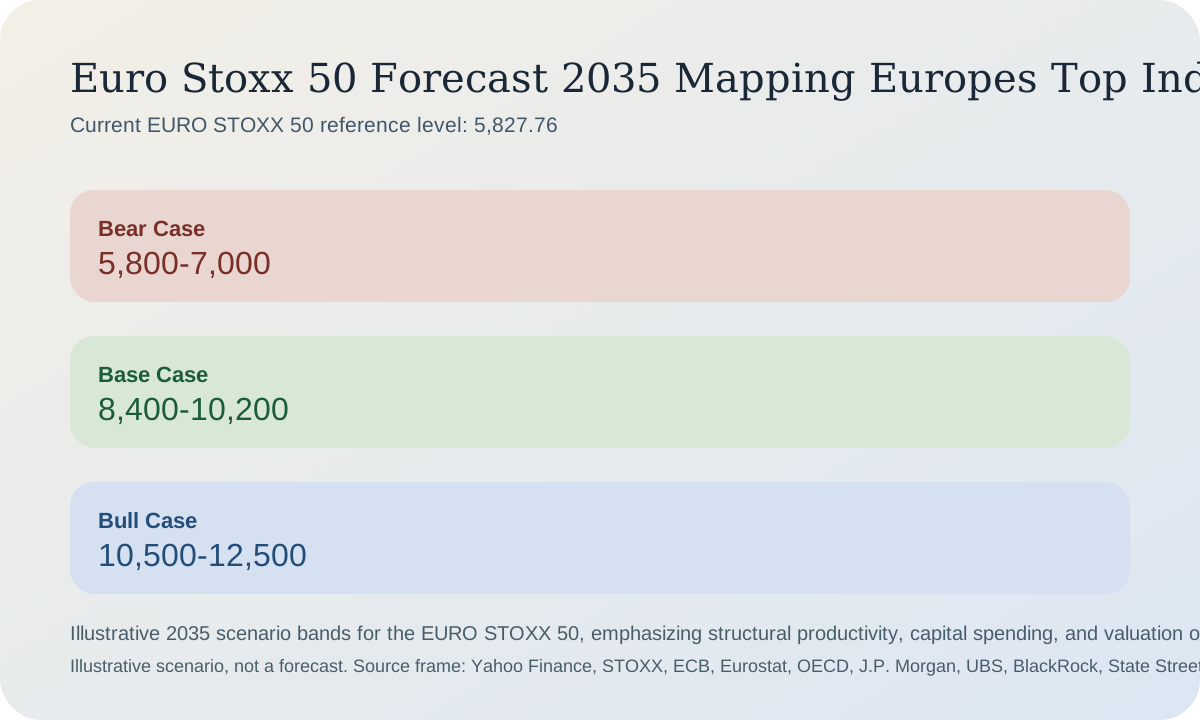
For this 2035 estimate, the range is built from three pillars: the live 2026 level, the 10-year CAGR as a disciplined baseline, and a judgment about whether Europe's strategic sectors can improve long-run profit growth. That produces a base case around 8,400 to 10,200 by 2035, with clearly wider tails than a five-year forecast.
05. Bull, Bear, and Base Cases
Long-horizon scenario analysis works best when the assumptions are explicit
Bullish scenario
The bull case is 10,500 to 12,500 by 2035. It needs sustained productivity gains, successful AI and automation diffusion, stronger energy security, and a persistent narrowing of Europe's valuation discount.
Bearish scenario
The bear case is 5,800 to 7,000 by 2035. That would likely require repeated energy shocks, weak capital spending, disappointing productivity, and a return to structural underperformance versus U.S. equities.
Base-case scenario
The base case is 8,400 to 10,200 by 2035. This assumes Europe compounds more steadily than the pessimists think, but without entering a U.S.-style growth boom.
| Scenario | 2035 range | Requirements | Interpretation |
|---|---|---|---|
| Bull | 10,500-12,500 | Productivity gains, AI diffusion, stronger capex, and better energy resilience. | Europe's discount narrows meaningfully. |
| Base | 8,400-10,200 | Moderate GDP growth, selective earnings leadership, and a manageable energy backdrop. | A durable but not spectacular long-run climb. |
| Bear | 5,800-7,000 | Stagnation, poor productivity, and renewed geopolitical or energy stress. | The index struggles to re-rate structurally. |
| Outcome | Estimated probability | Reasoning |
|---|---|---|
| Higher by 2035 | 55% | Time favors compounding, and the index contains high-quality franchises. |
| Lower than today | 15% | A negative long-run outcome is possible, but it would require persistent structural failure. |
| Sideways to modestly higher | 30% | This fits a world where Europe improves slowly but never fully rerates. |
The evidence is mixed enough that extreme conviction would be misplaced. The further out the horizon, the more prudent it is to treat probability as a range-building tool rather than a claim of precision.
06. Investment Implications
Long-term positioning still needs caution and realistic return assumptions
| Investor type | Prudent approach | Key watchpoints |
|---|---|---|
| Investor already in profit | Rebalance gradually and avoid assuming the next decade will mirror the last ten years. | Valuation discipline and sector concentration. |
| Investor currently at a loss | Separate a bad entry point from a potentially valid long-run thesis. | Whether strategic sectors keep gaining share. |
| Investor with no position | Build slowly rather than chase headline optimism. | Macro entry points and currency considerations. |
| Trader | Treat 2035 stories as context, not as timing tools. | Near-term macro remains dominant for tactical moves. |
| Long-term investor | Use dollar-cost averaging and review total-return expectations realistically. | Dividends, earnings breadth, and Europe-specific risk premia. |
| Risk-hedging investor | Pair exposure with a plan for energy, FX, or geopolitical hedges if needed. | Oil, gas, euro, and volatility. |
Risks to watch: demographic drag, productivity disappointment, poor capital-market depth, policy fragmentation, and fresh energy dependence.
What could invalidate the forecast: a genuine productivity boom could make even the bull case too low, while repeated crises and weak corporate investment could make the base case too generous.
Conclusion: mapping Europe's top index to 2035 leads to a constructive but cautious answer. The Euro Stoxx 50 does not need perfection to rise, but it does need enough productivity and earnings breadth to prove the region is more than a periodic value trade.
Disclaimer: This article is for research and educational purposes only and should not be taken as a guarantee of future market performance.
07. FAQ
Frequently asked questions about the Euro Stoxx 50 forecast for 2035
Is the 2035 outlook mainly about rates?
No. Rates matter, but a nine-year horizon is mainly about productivity, profits, energy resilience, and capital allocation.
Why is the range so wide?
Because small changes in long-run earnings growth and valuation assumptions create large differences by 2035.
What would make Europe outperform expectations?
A stronger-than-expected mix of AI adoption, industrial capex, grid investment, and strategic-sector profitability.
References
Sources
- Yahoo Finance chart API for ^STOXX50E, 10-year monthly history
- Yahoo Finance chart API for ^STOXX50E, recent daily closes
- STOXX index details page for the EURO STOXX 50
- STOXX Index Guide, April 2026
- iShares Core EURO STOXX 50 UCITS ETF fact sheet, March 2026
- State Street SPDR EURO STOXX 50 ETF benchmark page
- Eurostat flash GDP estimate for Q1 2026
- Eurostat euro area inflation release for April 2026
- ECB staff macroeconomic projections for the euro area, March 2026
- ECB Economic Bulletin Issue 3, 2026
- OECD Economic Outlook, euro area chapter
- Reuters market coverage on European shares and inflation worries, via Investing.com
- J.P. Morgan 2026 Market Outlook
- J.P. Morgan European Stocks Outlook
- J.P. Morgan Asset Management on Europe
- UBS on adding to European equities
- BlackRock 2026 Investment Outlook