01. Quick Answer
The 2035 FTSE 100 outlook depends less on domestic UK hype and more on whether global value, dividends, and commodity-sensitive earnings stay relevant
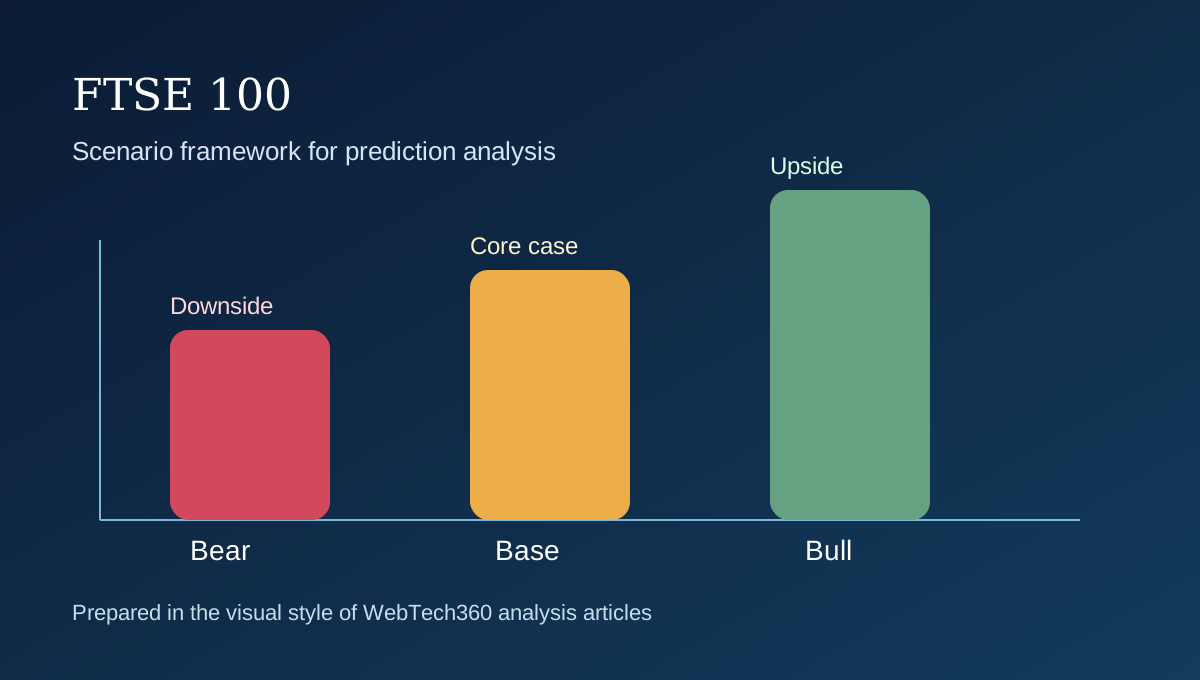
The long-range UKX debate is not whether the FTSE 100 can behave like the Nasdaq. It probably cannot. The real question is whether dividends, global earnings, and selective rerating can compound into respectable long-term returns from today’s level near 10,287. Available data suggests a 2035 base case of 13,000 to 16,000 is reasonable if UK equities remain cheap but structurally investable.
| Point | Why it matters |
|---|---|
| Long-term compounding is plausible even without a tech boom | The FTSE 100 is usually driven by composition and macro mix, not by a simple domestic growth narrative. |
| Yield and buybacks matter more than narrative excitement | Current UK inflation, Bank of England policy, and energy-price uncertainty still shape the near-term range. |
| The index can rerate if global allocators revalue UK value exposure | Sterling and overseas earnings translation can materially alter the path even if local UK growth is only mediocre. |
| A 2035 range should stay broad because macro regime changes dominate | The most defensible forecast uses probability ranges rather than certainty language. |
02. Historical Context
The FTSE 100 has compounded more slowly than US indexes, but its total-return case is stronger than its headline price chart suggests
UKX sits near 10,287 in mid-May 2026 based on Yahoo Finance chart data, versus roughly 6,504 ten years earlier. That implies a 10-year price CAGR of about 4.69%. On a headline basis, that trails major US indexes by a wide margin. But the FTSE 100 is a different animal: it is heavy in banks, energy, mining, healthcare, staples, and globally exposed multinationals, and its dividend profile matters much more than in a tech-heavy benchmark. London Stock Exchange data also show a trailing dividend yield above 3%, which means total return has historically been better than price-only charts imply.
The composition matters for forecasting. The FTSE 100 is not a clean domestic UK growth index. It is a market-cap-weighted basket of global earners listed in London. That is why a weak pound often helps reported earnings, while rising oil or metals prices can lift the index even when local UK activity is soft. Reuters coverage in February and April 2026 showed exactly that pattern, with energy and banking stocks frequently shaping index direction more than purely domestic sectors. Investors therefore need to separate UK macro from UKX earnings sensitivity rather than treating them as identical.
| Metric | Latest reading | Why it matters |
|---|---|---|
| UKX / FTSE 100 level | 10,287.18 | Live anchor for all scenario ranges in this article set |
| 52-week range | 8,585.01 to 10,910.55 | Shows how far the index has already rerated inside one year |
| Dividend yield | 3.12% | Income is a meaningful part of FTSE 100 investor returns |
| Constituent count | 100 | Large-cap blue-chip focus limits small-cap domestic sensitivity |
| Feature | FTSE 100 implication | Forecast effect |
|---|---|---|
| High weight in energy, mining, and financials | Commodity and rate cycles matter heavily | Upside can accelerate in reflation, but drawdowns can be sharp in global slowdowns |
| Large overseas revenue mix | Sterling translation matters | A weaker GBP can support earnings even when local growth disappoints |
| Higher yield profile | Income attracts defensive allocators | Can limit downside, but usually does not create tech-style multiple expansion |
| Lower direct AI exposure | Less enthusiasm premium than US mega-cap tech | The AI story is more operational and indirect than narrative-driven |
03. Main Drivers
Five structural drivers should dominate the FTSE 100 outlook over the next several years
1. Bank of England policy and UK inflation
The Bank of England's April 2026 Monetary Policy Report kept Bank Rate at 3.75% and highlighted the uncertain energy-price shock created by conflict in the Middle East. ONS data for March 2026 showed CPI at 3.3%. For UKX, this matters through banks, consumer confidence, financing conditions, and equity discount rates. Easing would help cyclicals and valuation. Sticky inflation would keep pressure on domestic rate-sensitive segments.
2. Sterling translation and overseas earnings
The FTSE 100 earns a large portion of revenue abroad. That means the pound is not just a currency story but an earnings story. When GBP weakens, overseas revenue translated back into sterling looks better. When sterling strengthens, the opposite can happen. That is one reason UKX can lag on days when the domestic macro mood improves but the pound rallies too quickly.
3. Commodity prices and geopolitics
Reuters market coverage in April 2026 repeatedly tied FTSE 100 moves to oil, miners, and geopolitics. Energy-price shocks tied to the Middle East can support index heavyweights even while hurting the broader UK consumer. This creates a paradoxical index structure: a negative macro shock for the UK economy can still support parts of UKX in the short run.
4. UK valuation discount and income appeal
Many global allocators still view UK equities as persistently cheap relative to US peers. That discount can remain in place for years, but it also means the FTSE 100 does not need heroic assumptions to deliver acceptable returns. Dividend yield, buybacks, and mean re-rating can matter more than breakneck earnings growth.
5. Global growth, not just domestic UK growth
OECD's United Kingdom snapshot projects GDP growth of about 1.2% in 2026 and 1.3% in 2027. That is not a boom. Yet UKX can still perform if global trade, energy, banks, and healthcare earnings remain supportive. Available data suggests investors should treat UKX as a hybrid between a UK macro trade and a global value-income portfolio.
04. Institutional Forecasts and Analyst Views
Official macro data are clearer than long-range sell-side point targets, so the framework has to stay scenario-based
There are fewer credible long-dated institutional point forecasts for the FTSE 100 than for single stocks or commodities. That is normal. Index outlooks beyond one year usually depend more on macro regimes than on company-specific modeling precision. The best evidence base therefore combines official market facts, central-bank guidance, macro forecasts, and recent Reuters market reporting.
| Source | What it says | Implication for UKX |
|---|---|---|
| FTSE Russell / LSEG | Index characteristics, yield, 52-week range, sector composition context | Supports the view that UKX is a yield- and global-earnings driven benchmark |
| Bank of England | Rates held at 3.75%, inflation still above target, energy shock uncertainty elevated | Creates a mixed but tradable backdrop for banks, defensives, and cyclicals |
| ONS | CPI 3.3% in March 2026; latest GDP release shows subdued growth | Domestic growth is not strong enough on its own to justify aggressive multiple expansion |
| OECD | UK growth expected around 1.2% in 2026 and 1.3% in 2027 | Base-case outlook favors moderate compounding rather than a runaway bull market |
| Reuters market coverage | Energy, banks, inflation, and BoE expectations are repeatedly driving the tape | Reinforces that UKX remains a macro-sensitive value-income index |
05. Scenarios
Bull, bear, and base-case scenarios for UKX
| Scenario | 2035 range | Conditions | Probability |
|---|---|---|---|
| Bull | 16,000-19,000 | UK equities rerate from a persistent valuation discount, dividends stay healthy, and global cyclical earnings remain durable | 25% |
| Base | 13,000-16,000 | Moderate compounding, steady income, and modest valuation support offset the absence of US-style growth leadership | 50% |
| Bear | 9,500-13,000 | Commodity support fades, GBP strengthens, and the UK market remains structurally cheap for legitimate reasons | 25% |
| Direction | Probability | Comment |
|---|---|---|
| Higher | 45% | Long horizons favor income plus gradual rerating, especially from a market that already trades below flashier peers |
| Lower | 20% | Requires long-running structural stagnation with weak commodities and little valuation relief |
| Sideways to moderate gains | 35% | Still plausible because the index may compound respectably without ever becoming a market darling |
06. Investor Positioning
How different investors might respond
| Investor type | Prudent stance | Why |
|---|---|---|
| Investor already in profit | Hold core, trim into spikes, rebalance if UK cyclicals run too far | FTSE rallies are often led by energy, miners, and banks, which can reverse quickly with sterling or commodity moves |
| Investor currently at a loss | Avoid panic selling, reassess thesis versus income and valuation, add only if macro setup improves | UKX is more value- and income-heavy than growth-heavy, so recovery paths can be slower but steadier |
| Investor with no position | Wait for pullbacks or use staggered entries | Buying after commodity-led spikes can be inefficient if global growth cools or GBP strengthens |
| Trader | Use stop-losses and watch oil, copper, GBP, and Bank of England rate signals | Short-term FTSE moves often reflect macro cross-currents more than purely domestic UK data |
| Long-term investor | Focus on dividends, valuation discount, and overseas earnings mix; consider dollar-cost averaging | FTSE 100 total return can improve materially when yield and mean re-rating combine |
| Hedging-focused investor | Use UKX as a diversified value and dividend sleeve, not a pure growth engine | The index can hedge expensive US growth exposure, but it is not a clean recession hedge because it remains cyclical |
07. Risks to Watch
What could change the outlook quickly
The greatest long-range risk is not one recession but a decade of mediocre nominal growth combined with stronger sterling and weaker commodity support. Another risk is opportunity cost: UKX can produce acceptable returns yet still lag faster-growth markets enough to discourage capital inflows. The evidence therefore supports a constructive but not euphoric long-term stance.
| Possible invalidation | Why it matters |
|---|---|
| BoE easing arrives faster than expected without reigniting inflation | Would likely improve valuation support and weaken some bearish assumptions |
| Sterling weakens materially while global growth holds up | Could boost overseas-earnings translation and favor UK multinationals |
| Commodity prices fall sharply | Would pressure energy and mining heavyweights and weaken a major UKX support pillar |
| UK inflation remains high and rates stay restrictive for longer | Would hurt domestic cyclicals and keep a lid on rerating hopes |
| Global risk appetite rotates from expensive US growth into value and income markets | Would support a broader rerating in UK equities that the bear case would miss |
08. Conclusion
Bottom line
By 2035, the FTSE 100 can plausibly be much higher than today without ever resembling a US growth index. The best long-run case for UKX is steady compounding from income, overseas earnings, and periodic rerating rather than perpetual multiple expansion.
FAQ
Frequently asked questions
Is the FTSE 100 really a good proxy for the UK economy?
Only partially. Many FTSE 100 companies earn a large share of revenue overseas, so the index often reflects global commodity, dollar, and rate conditions as much as domestic UK growth.
Why does sterling matter so much for UKX?
A weaker pound can flatter overseas earnings translated back into sterling, which often supports large multinational constituents. A stronger pound can do the opposite.
Why are energy and banks so important to the FTSE 100 outlook?
Because they are major index weights and can materially shape dividends, earnings revisions, and investor sentiment. That makes oil prices, rates, and credit conditions unusually important.
How were the forecast ranges built?
The ranges combine the current UKX level, the 10-year CAGR of roughly 4.69%, recent record-high behavior, valuation and income characteristics, and scenario analysis around rates, sterling, commodities, and earnings mix. They are editorial ranges, not institutional price targets.
Methodology and Invalidation
How these UKX ranges were built and what would invalidate them
These scenario ranges are editorial frameworks, not promises or institutional targets. They start with the live UKX level near 10,287 in mid-May 2026, then layer on the index's roughly 4.69% 10-year price CAGR, its above-3% dividend yield, and the reality that FTSE 100 earnings are heavily shaped by commodities, banks, healthcare, and overseas revenue translation. A mechanical projection of the last decade would undershoot potential upside in a reflationary, commodity-supportive world and could overstate downside if valuation support and income attract capital back into UK equities. That is why a scenario matrix is more useful than a single number.
There is also a definitional issue that matters for readers. A correction usually means a decline of around 10% from a recent high. A bear market usually implies around 20% down. A crash is sharper, faster, and often tied to stress or forced liquidation. The FTSE 100 can experience all three, but its path often looks different from the Nasdaq because the sector mix is different. Energy or banks may cushion a domestic slowdown, while a stronger pound or weaker oil price may cap upside even when the UK data improve.
These forecasts also use present macro evidence rather than narrative alone. The Bank of England still sees inflation and energy-price uncertainty as key risks. ONS inflation data show CPI above target. OECD expects only modest UK growth. Reuters reporting shows traders still reacting primarily to oil, banks, BoE expectations, and geopolitics. That evidence suggests a moderate base case is more defensible than either euphoric UK renaissance rhetoric or an automatic assumption that the UK market must structurally underperform forever.
What would invalidate the constructive case? A stronger and sustained pound, weaker commodities, materially lower bank profitability, or a deeper global slowdown would all matter. What would invalidate the bearish case? Continued foreign-earnings resilience, policy easing, persistent commodity support, and a broader rerating of cheap dividend markets would weaken it. Investors should treat the scenario tables as conditional tools that need updating as UK inflation, rates, sterling, and global commodity conditions evolve.
Disclaimer: This material is for research and editorial purposes only, does not constitute investment advice, and should not be treated as a recommendation to buy, sell, or hold any index fund, ETF, future, or related security.
References
Sources
- Yahoo Finance chart API, FTSE 100 10-year monthly history and current level
- London Stock Exchange, FTSE 100 overview and index characteristics
- FTSE Russell factsheet for UKX / FTSE 100
- Bank of England, Monetary Policy Report, April 2026
- Bank of England, April 2026 monetary policy summary and minutes
- Office for National Statistics, UK consumer price inflation, March 2026
- Office for National Statistics, GDP monthly estimate, latest release
- OECD, United Kingdom economic snapshot
- OECD Interim Economic Outlook, March 2026
- Reuters via TradingView, FTSE 100 touches record high, February 4, 2026
- Reuters via Investing.com, FTSE 100 marks third-straight week of gains, February 13, 2026
- Reuters via Investing.com, FTSE 100 falls as crude rises, April 23, 2026
- Reuters via Investing.com, UK inflation rises to 3.3%, April 22, 2026
- Reuters via MarketScreener, FTSE 100 edges higher as energy and banking stocks power gains, April 27, 2026
- Reuters via Investing.com, London stocks slip as investors parse earnings, April 29, 2026