01. Quick Answer
The most reasonable FTSE MIB 2030 forecast is constructive, but it still depends on whether Italy keeps converting a bank-led rerating into broader earnings durability
The FTSE MIB closed at 49,116.47 on 2026-05-15, up from 16,198 at the start of its 10-year Yahoo Finance monthly series on 2016-06-01, for a price-only CAGR of about 11.73% (Yahoo Finance 10-year history; recent daily closes). A credible 2030 outlook therefore starts with two competing truths. Italy's flagship index has already climbed far enough that easy valuation catch-up is behind it, but the market still carries profitable banks, regulated utilities, defense exposure, and selected global industrial leaders that can support further upside.
Public macro institutions remain measured rather than euphoric. The OECD Italy 2026 survey expects GDP growth to stay around 0.6% in 2026 and 0.7% in 2027, while the IMF 2025 Article IV says the economy has become more resilient but still faces high debt and weak medium-term productivity. That combination argues for a 2030 range, not a heroic single target.
| Point | Why it matters |
|---|---|
| The FTSE MIB is no longer a pure deep-value story | A strong 10-year recovery means further gains need earnings support, not just multiple repair. |
| Banks still dominate the debate | UniCredit and Intesa have been central to the rerating, so rate paths and capital distribution remain critical. |
| Utilities and defense create a second engine | Enel, Leonardo, and Prysmian give the index exposure to energy transition, security spending, and grid investment. |
| 2030 should be modeled as scenarios | Available data suggests Italy offers upside, but sovereign risk and cyclical manufacturing weakness still matter. |
02. Historical Context
The FTSE MIB has already delivered a full-cycle recovery, which raises the bar for what 2030 needs to look like
The historical setup matters because the Italian index is no longer climbing from crisis-era levels. The FTSE MIB closed at 49,116.47 on 2026-05-15, up from 16,198 at the start of its 10-year Yahoo Finance monthly series on 2016-06-01, for a price-only CAGR of about 11.73% (Yahoo Finance 10-year history; recent daily closes). The 10-year climb captures the end of the euro-area sovereign stress hangover, the post-COVID recovery, and the unusually powerful earnings rebound in Italian banks as euro rates rose.
Borsa Italiana's monthly market statistics and performance pages show that the MIB's composition still leans heavily toward financials, utilities, industrials, and consumer names, with banks and Enel among the dominant drivers (Borsa monthly statistics; Borsa performance page). That matters because index-level results can diverge sharply from Italy's headline GDP if a few large sectors are doing most of the work.
Historical returns also warn against simply extending the last decade. A market that compounded from a depressed base can still rise further, but forward returns usually moderate once sentiment normalizes. For 2030, the realistic debate is whether Italy can shift from a bank-led recovery to a broader market story that includes grids, defense, premium manufacturing, and selected AI-sensitive infrastructure.
| Metric | Latest reading | Why it matters |
|---|---|---|
| Current index level | 49,116.47 | Every forecast range in this set is anchored to the latest available close rather than an older peak. |
| 52-week range | 38,605.00 to 50,050.00 | Shows that the MIB has already rerated materially and is no longer a deeply depressed market. |
| 10-year start point | 16,198 | Provides a disciplined baseline for long-run compounding and avoids narrative-only projections. |
| Editorial base range | 58,000-66,000 | A scenario range is more defensible than a single-number target in a macro-sensitive index. |
| Feature | Implication | Forecast effect |
|---|---|---|
| Heavy financial weight | Banks and insurers remain central to earnings and sentiment | ECB policy and sovereign spreads matter more here than in tech-heavy benchmarks. |
| National champions in utilities, defense, and industrials | Enel, Leonardo, Prysmian, Ferrari, and Stellantis create sector diversification | The index can benefit from defense, grid capex, or premium manufacturing even if domestic demand is uneven. |
| Italy-specific risk premium | Public debt and politics still influence foreign allocations | Valuation can rerate both up and down faster than fundamentals alone would suggest. |
| Strong 10-year recovery | Price compounded about 11.73% annually over the last decade | Forward returns are unlikely to simply repeat that pace without continued earnings and rerating support. |
03. Main Drivers
Five structural drivers are most likely to shape the Italian benchmark into 2030
1. Bank profitability and capital return. Italy's largest banks remain essential. UniCredit and Intesa Sanpaolo continue to frame the market around fee resilience, buybacks, and dividend capacity. If earnings normalize gently rather than collapse as rates fall, the MIB can keep its core support.
2. Sovereign spreads and policy credibility. The IMF still highlights very high public debt, while the OECD argues that reforms and budget discipline remain central to medium-term stability. The index's valuation multiple can expand or compress depending on whether foreign investors treat Italy as improving policy risk or as a spread-sensitive trade.
3. Utilities, grids, and electrification. Enel and Prysmian give the index direct exposure to network capex, data-center power demand, and transmission investment. Those are slower stories than bank rerating, but they are potentially longer-lived.
4. Defense and industrial policy. Leonardo's 2026 industrial plan update points to higher orders, cash generation, and stronger defense-electronics ambitions. In a Europe that is spending more on security, that is a real structural tailwind.
5. Cyclical manufacturing risk. The evidence is mixed because Italy also carries exposure to autos and global industrial demand. Stellantis remains a reminder that tariffs, model transitions, and weak volume can offset the good news elsewhere.
04. Institutional Forecasts and Analyst Views
Official macro projections are modest, so a bullish 2030 outcome needs help from sector mix and execution rather than domestic growth alone
The institutional evidence base is more useful than long-range sell-side point targets. Banca d'Italia still sees subdued but positive growth, the European Commission says Italy should keep expanding but not rapidly, and the OECD and IMF both stress debt, demographics, and productivity limits. That is not a recipe for a runaway domestic boom.
What keeps the medium-term case alive is the composition of the index rather than the macro headline alone. Analysts remain divided because the evidence is mixed: banks may be past peak net interest income, but utilities, defense, and selected industrial names may be earlier in their capital-expenditure cycle. That is why the most defensible 2030 estimate is a range centered moderately above current levels, not a certainty call.
| Source | What it says | Implication for FTSE MIB |
|---|---|---|
| IMF | Italy is more resilient than in past cycles but still constrained by high debt and low productivity growth | Supports a constructive but not euphoric long-run market view. |
| OECD | Growth remains positive yet modest, with reform execution still important | Suggests earnings durability matters more than macro acceleration. |
| Banca d'Italia | Baseline activity remains positive, but external demand and uncertainty cap momentum | Keeps the base case above crisis levels but below extreme bull assumptions. |
| Company plans | UniCredit, Intesa, Leonardo, Enel, and Prysmian all provide identifiable strategic drivers | Index-level upside can continue even without a strong national GDP boom. |
05. Scenarios, Risks, and Invalidation
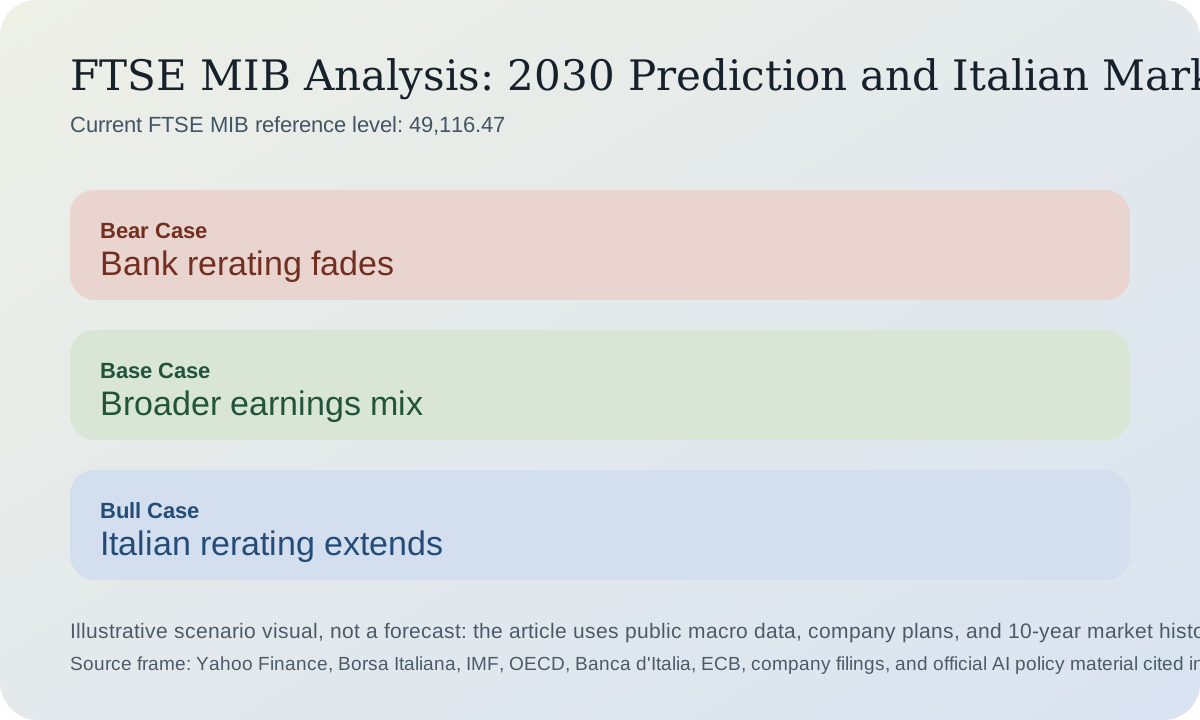
Bull, base, and bear cases imply a 2030 range, and the probabilities depend on what happens to banks after the rerating phase
Bullish scenario
The bull case for 2030 is roughly 68,000 to 76,000. This scenario depends on banks keeping high capital return, Leonardo and defense names compounding, utilities benefiting from grid investment, and Italy preserving enough fiscal credibility to keep foreign flows supportive.
Bearish scenario
The bear case is 42,000 to 48,000. That path would likely need a deeper European slowdown, faster bank earnings normalization, wider sovereign spreads, and renewed industrial weakness that drags cyclicals and sentiment lower.
Base-case scenario
The base case is 58,000 to 66,000. That assumes modest GDP growth, lower but still healthy bank profitability, ongoing utility and defense support, and no major policy accident.
Risks to watch
The most important variables are the euro-rate path, BTP-Bund spreads, capital return from banks, EU industrial policy execution, and whether Italy's manufacturing softness broadens into something more persistent.
What could invalidate the forecast
This framework would be too optimistic if lower rates cut bank earnings harder than expected while public-finance anxiety widens spreads. It would be too conservative if Italy's utilities, defense, and AI-adjacent industrial names broaden leadership more quickly than the market expects.
Conclusion
The 2030 FTSE MIB outlook is constructive, but not effortless. Italy has already earned a major rerating, so the next leg depends on whether profits become more diversified than the bank story that led the rebound.
Disclaimer: This article is for research and informational purposes only. Scenario ranges are editorial judgments based on public information, not guarantees or personal investment advice.
| Scenario | Range | Key conditions | Probability |
|---|---|---|---|
| Bull | 68,000-76,000 | Banks stay generous, utilities and defense compound, spreads remain contained | 25% |
| Base | 58,000-66,000 | Moderate growth, orderly rate cuts, and broader but still uneven sector leadership | 50% |
| Bear | 42,000-48,000 | Bank profits reset sharply and sovereign risk premium returns | 25% |
| Path | Estimated probability | Why |
|---|---|---|
| Rising from current levels by 2030 | 55% | The index still has multiple cash-generative large caps and a valuation profile that is not extreme. |
| Falling below current levels by 2030 | 20% | A lower 2030 level likely requires both macro stress and a bank-led earnings reset. |
| Moving broadly sideways | 25% | This is plausible if bank weakness and utility-defense strength mostly offset each other. |
06. Investor Positioning
Different investor profiles should approach the FTSE MIB differently into 2030
| Investor type | Cautious approach | What to watch |
|---|---|---|
| Investor already in profit | Hold core exposure but trim if bank concentration has become too large after the rerating. | Net interest income trends, buyback updates, and sovereign spread behavior. |
| Investor currently at a loss | Separate timing error from thesis failure before averaging down. | Whether weakness is cyclical or tied to a renewed Italy risk premium. |
| Investor with no position | Wait for pullbacks or build exposure in stages rather than chasing strength. | ECB signals, valuations, and whether gains remain narrow. |
| Trader | Use stop-losses and trade around ECB, bank earnings, and geopolitical catalysts. | Short-term moves in UniCredit, Intesa, Enel, and Leonardo. |
| Long-term investor | Dollar-cost averaging is more defensible than all-in forecasts. | Total return, including dividends and buybacks, not just index price. |
| Risk-hedging investor | Use dedicated hedges and rebalance rather than assuming Italian equities are defensive. | BTP-Bund spreads, euro-area growth, and energy shocks. |
07. FAQ
Frequently asked questions about the FTSE MIB outlook
Is the FTSE MIB still cheap after its rally?
Cheaper than many US benchmarks on composition and sector mix, yes, but not obviously distressed anymore. That is why earnings durability matters more than simple mean reversion.
Why do banks matter so much for the index?
Because the FTSE MIB still carries a heavy financial footprint. Changes in rates, capital return, and sovereign spreads can therefore move the whole benchmark.
What is the biggest upside catalyst into 2030?
A broader leadership mix. If banks stay resilient while utilities, defense, and industrial infrastructure also compound, the market can rise without relying on one story.
References
Sources
- Yahoo Finance chart API for FTSEMIB.MI, 10-year monthly history
- Yahoo Finance chart API for FTSEMIB.MI, recent daily closes
- Borsa Italiana FTSE MIB performance page
- Borsa Italiana monthly market report, March 2026
- IMF 2025 Article IV consultation for Italy
- OECD Economic Surveys: Italy 2026
- European Commission Spring 2026 forecast for Italy
- Banca d'Italia Economic Bulletin 2/2026
- ECB monetary policy decisions, April 2026
- ISTAT consumer prices, April 2026
- UniCredit first quarter 2026 results
- Intesa Sanpaolo first quarter 2026 results
- Leonardo industrial plan update, March 12 2026
- Enel 2026-2028 strategic plan
- Prysmian first quarter 2026 results
- STMicroelectronics first quarter 2026 results
- Stellantis 2025 second-half preliminary results
- AgID Italian artificial intelligence strategy 2024-2026
- IT4LIA AI Factory official page