01. Quick Answer
The most likely 2027 FTSE MIB path is mildly higher, but the index may need to earn those gains through resilience rather than excitement
The FTSE MIB closed at 49,116.47 on 2026-05-15, up from 16,198 at the start of its 10-year Yahoo Finance monthly series on 2016-06-01, for a price-only CAGR of about 11.73% (Yahoo Finance 10-year history; recent daily closes). For a 2027 forecast, that history matters mainly because it raises the hurdle for the next year or two. A lot of obvious cheapness is gone.
The near-term setup is mixed. The ECB is easing more carefully than markets once hoped, ISTAT still shows inflation data worth monitoring, and official Italian macro forecasts remain positive but subdued. Available data suggests 2027 is more likely to be a year of digestion and selective upside than a second straight easy rerating year.
| Point | Why it matters |
|---|---|
| The rate path matters more in 2027 than in 2035 | Near-term index performance still runs heavily through bank earnings and discount-rate changes. |
| A narrower range is more credible | One to two years is too short for sweeping structural claims and too long for pure trading noise. |
| Autos and manufacturing can still drag | Stellantis and broader industrial activity remain key downside channels if European demand weakens. |
| Defense and utilities are stabilizers | Leonardo, Enel, and Prysmian can offset part of the cyclicality elsewhere in the index. |
02. Historical Context
The Milan benchmark is now operating from strength, which makes 2027 more about consolidation risk than rescue-level upside
Near-term forecasting is hard precisely because the MIB has been strong. The FTSE MIB closed at 49,116.47 on 2026-05-15, up from 16,198 at the start of its 10-year Yahoo Finance monthly series on 2016-06-01, for a price-only CAGR of about 11.73% (Yahoo Finance 10-year history; recent daily closes). The index is trading much closer to its 52-week high than to its low, which means investors are now asking how much of the bank and valuation story has already been priced.
Borsa Italiana and company filings suggest Milan's large-cap leadership still sits with banks, utilities, industrial infrastructure, and premium cyclicals. That can be a healthy mix, but it also creates a market that reacts quickly to central-bank messaging and shifts in European growth expectations. In other words, the MIB can remain fundamentally solid while still producing a flat or choppy 2027 outcome.
That is why a 2027 call should not be built around long-term ideology. It should be built around a small number of observable variables: ECB easing, BTP-Bund spreads, capital return from the banks, energy costs, and whether the cyclical parts of the Italian market stop deteriorating.
| Metric | Latest reading | Why it matters |
|---|---|---|
| Current index level | 49,116.47 | Every forecast range in this set is anchored to the latest available close rather than an older peak. |
| 52-week range | 38,605.00 to 50,050.00 | Shows that the MIB has already rerated materially and is no longer a deeply depressed market. |
| 10-year start point | 16,198 | Provides a disciplined baseline for long-run compounding and avoids narrative-only projections. |
| Editorial base range | 50,500-55,500 | A scenario range is more defensible than a single-number target in a macro-sensitive index. |
| Feature | Implication | Forecast effect |
|---|---|---|
| Heavy financial weight | Banks and insurers remain central to earnings and sentiment | ECB policy and sovereign spreads matter more here than in tech-heavy benchmarks. |
| National champions in utilities, defense, and industrials | Enel, Leonardo, Prysmian, Ferrari, and Stellantis create sector diversification | The index can benefit from defense, grid capex, or premium manufacturing even if domestic demand is uneven. |
| Italy-specific risk premium | Public debt and politics still influence foreign allocations | Valuation can rerate both up and down faster than fundamentals alone would suggest. |
| Strong 10-year recovery | Price compounded about 11.73% annually over the last decade | Forward returns are unlikely to simply repeat that pace without continued earnings and rerating support. |
03. Main Drivers
Five near-term forces should dominate the Milan tape into 2027
1. ECB cuts versus bank earnings normalization. Lower rates can support multiples and macro sentiment, but they can also reduce net interest income. That trade-off is central for the MIB because of its bank weight.
2. Sovereign-spread behavior. The FTSE MIB often behaves better when BTP-Bund spreads stay quiet. If markets begin to reprice Italy's fiscal risk more aggressively, the benchmark can feel that quickly even without a recession.
3. Utilities and regulated investment. Enel and Prysmian still give the index a steadier base than a pure cyclical market would have. That matters if growth disappoints but investment in power infrastructure keeps moving.
4. Defense and aerospace order books. Leonardo remains a meaningful offset if security spending persists. It is one of the cleaner reasons Milan can still outperform other value-heavy markets in a slower economy.
5. Auto and export sensitivity. Stellantis is still a reminder that tariffs, weak volumes, and model transitions can pressure a market that is not purely domestic.
04. Institutional Forecasts and Analyst Views
The institutional backdrop suggests 2027 should be framed as resilience versus slowdown, not as a one-way trend
The official sources are not calling for a dramatic Italian acceleration. The OECD, European Commission, and Banca d'Italia all point to growth, but not a boom. That means any 2027 upside likely has to come from stable spreads, acceptable bank earnings, and better relative performance from non-bank large caps.
The evidence is mixed, which is exactly why scenario analysis is more credible than certainty language. If ECB easing helps confidence without crushing bank profitability, Milan can still edge higher. If easing arrives into broader cyclical weakness, 2027 can end up mostly sideways or lower despite apparently supportive policy.
| Source | Signal | Implication |
|---|---|---|
| ECB | Policy is easing, but cautiously | Supports valuation, yet reduces a key earnings tailwind for banks. |
| OECD and Commission | Italy should keep growing, but slowly | Favors moderate upside rather than a runaway bull case. |
| Bank results | Capital return remains strong for now | Helps support the floor as long as credit quality stays contained. |
| Industrial filings | Utilities, defense, and infrastructure remain active | Provides non-bank support if manufacturing stays soft. |
05. Scenarios, Risks, and Invalidation
The 2027 path is likely to be narrower and more tactical than long-range forecasts
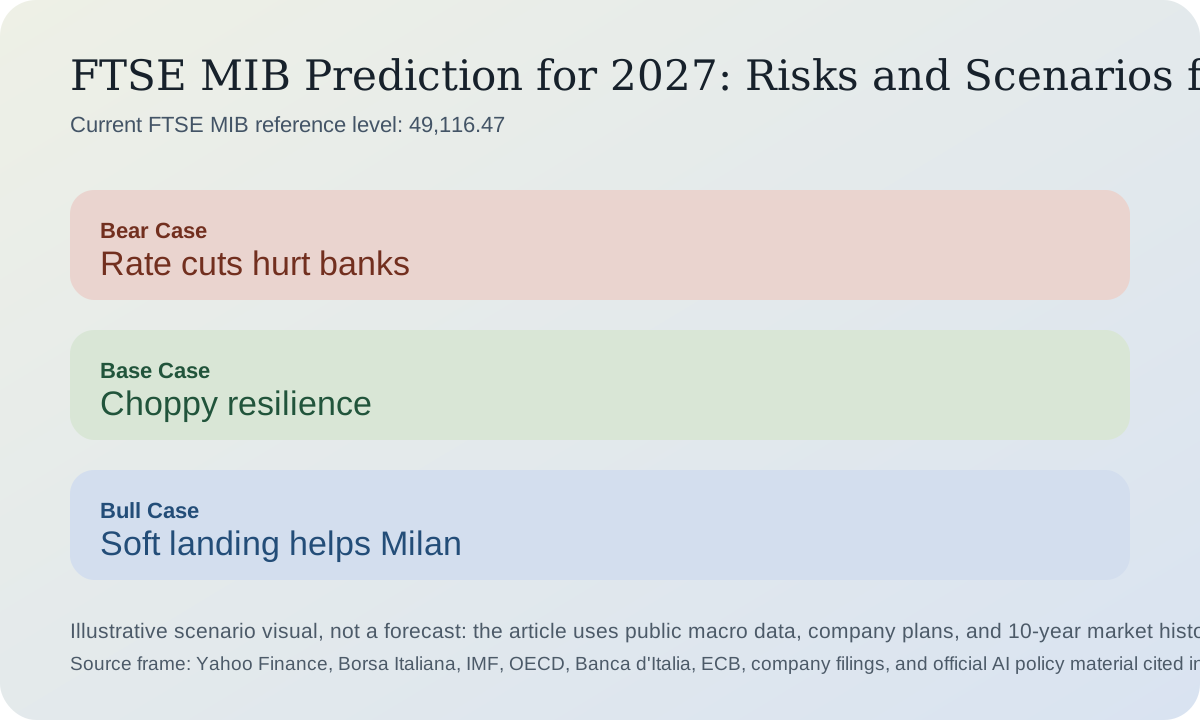
Bullish scenario
The bull case for 2027 is 56,500 to 60,000. This requires orderly ECB easing, stable sovereign spreads, and enough earnings support from banks, utilities, and defense to justify another leg higher.
Bearish scenario
The bear case is 41,000 to 47,000. This likely needs wider spreads, a sharper-than-expected bank earnings reset, and more visible industrial or auto weakness.
Base-case scenario
The base case is 50,500 to 55,500. That implies modest upside from current levels, but with more volatility and less rerating fuel than the past cycle.
Risks to watch
Watch ECB communication, Italian budget credibility, credit costs at major banks, euro-area growth indicators, and whether Stellantis or other cyclicals signal a deeper demand problem.
What could invalidate the forecast
This forecast would be too cautious if rates fall without a meaningful hit to bank earnings and if utilities plus defense keep broadening leadership. It would be too optimistic if spreads widen materially or if the market decides the bank peak has passed.
Conclusion
The most reasonable 2027 FTSE MIB forecast is constructive but tactical. Milan still has support, yet it no longer looks like a market where investors should assume upside comes easily.
Disclaimer: This article is for informational research only. It is not a recommendation to buy, sell, or hedge any specific security or index exposure.
| Scenario | Range | Key conditions | Probability |
|---|---|---|---|
| Bull | 56,500-60,000 | Soft landing, spread stability, resilient bank capital return | 25% |
| Base | 50,500-55,500 | Moderate gains with choppy sector rotation | 45% |
| Bear | 41,000-47,000 | Bank rerating fades and macro stress returns | 30% |
| Path | Estimated probability | Why |
|---|---|---|
| Higher into 2027 | 45% | The market still has resilient large-cap cash generators, even if the pace slows. |
| Lower into 2027 | 30% | Near-term downside is real because the index is already rerated and bank sensitivity remains high. |
| Broadly sideways | 25% | A mature value market can digest gains while fundamentals remain mixed. |
06. Investor Positioning
Near-term positioning should be disciplined, not heroic
| Investor type | Cautious approach | What to watch |
|---|---|---|
| Investor already in profit | Use trailing stops or light trimming if your position is heavily bank-led. | How much of your gain depends on peak-rate bank profitability. |
| Investor currently at a loss | Avoid reflex averaging unless the core thesis is intact. | If the loss came from spread stress, watch whether that stress is fading or worsening. |
| Investor with no position | Wait for pullbacks or build exposure in layers. | Do not chase new highs without a risk plan. |
| Trader | Trade around ECB, bank earnings, and budget headlines with defined stops. | Short-term catalysts dominate this horizon. |
| Long-term investor | Use 2027 weakness as an accumulation window only if you accept policy-sensitive volatility. | Focus on sector balance and total return. |
| Risk-hedging investor | Consider hedges rather than assuming near-term diversification alone is enough. | Rates, spreads, and geopolitical energy risk. |
07. FAQ
Frequently asked questions about the FTSE MIB outlook
Why is 2027 harder to forecast than 2035 in some ways?
Because the short-run path can be dominated by ECB timing, spreads, and bank earnings noise rather than long-term structural themes.
What is the key 2027 downside risk?
A combination of spread widening and a faster-than-expected normalization in bank profitability.
What could surprise to the upside?
If rate cuts help valuations while banks remain more resilient than feared and utilities-defense leadership broadens.
References
Sources
- Yahoo Finance chart API for FTSEMIB.MI, 10-year monthly history
- Yahoo Finance chart API for FTSEMIB.MI, recent daily closes
- Borsa Italiana FTSE MIB performance page
- Borsa Italiana monthly market report, March 2026
- IMF 2025 Article IV consultation for Italy
- OECD Economic Surveys: Italy 2026
- European Commission Spring 2026 forecast for Italy
- Banca d'Italia Economic Bulletin 2/2026
- ECB monetary policy decisions, April 2026
- ISTAT consumer prices, April 2026
- UniCredit first quarter 2026 results
- Intesa Sanpaolo first quarter 2026 results
- Leonardo industrial plan update, March 12 2026
- Enel 2026-2028 strategic plan
- Prysmian first quarter 2026 results
- STMicroelectronics first quarter 2026 results
- Stellantis 2025 second-half preliminary results
- AgID Italian artificial intelligence strategy 2024-2026
- IT4LIA AI Factory official page