01. Quick Answer
A responsible 2035 gold forecast starts by admitting that direct long-dated institutional targets are scarce
Gold futures (GC=F on Yahoo Finance) were trading around $4,545.2/oz on 2026-05-18. The same 10-year monthly series started near $1,318.4/oz on 2016-06-01 and most recently showed $4,545.2/oz, with a 10-year range of roughly $1,150.0 to $4,713.9 and a price-only CAGR near 15.51% (10-year monthly data).
Few major institutions publish a clean 2035 target for gold. That is not a weakness in the analysis; it is a sign that serious forecasters know how unstable the inputs become over nine years. The best method is to use current prices, long-run compounding bands, reserve trends, fiscal trajectories, and current institutional medium-term views as boundary markers (J.P. Morgan; World Gold Council; IMF COFER).
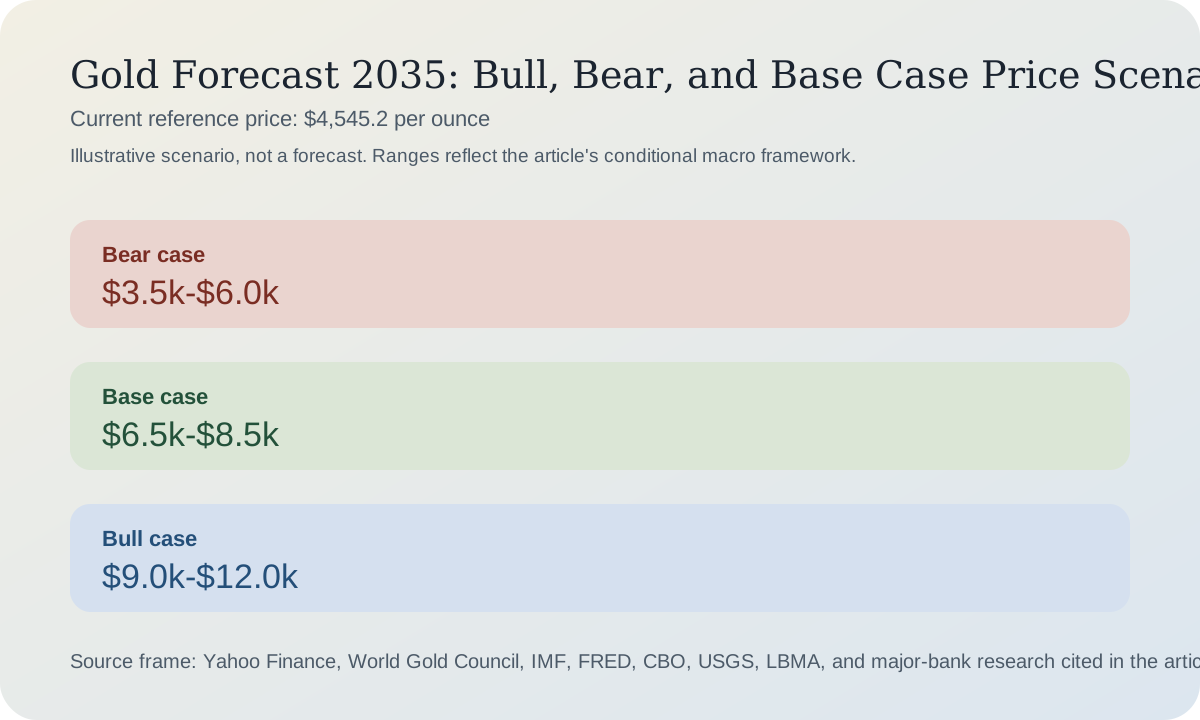
On that basis, a cautious base case sits around $6,500 to $8,500 by 2035. A bear case below that range remains plausible if real yields stay structurally higher and gold loses part of its safe-haven premium. A bull case above $9,000 requires a more radical reserve and macro regime break than the market has yet fully priced.
| Point | Why it matters |
|---|---|
| Historical data | The last 10 years already contain a move from roughly $1,318 to above $4,500, so 2035 assumptions must distinguish between repeatable compounding and one-off repricing. |
| Institutional anchors | Banks and WGC offer useful medium-term markers, but direct 2035 point forecasts are limited and should be treated cautiously. |
| Scenario discipline | A long-dated base case should be built from transparent annual return assumptions, not from sensational terminal numbers. |
| Risk management | The longer the horizon, the more the forecast depends on which macro regime becomes dominant rather than on a single year's price momentum. |
02. Historical Context
Long-dated forecasts become more credible when they are built from return bands instead of from headlines
The simplest reason to be careful with 2035 forecasts is arithmetic. From today's level near $4,545.2, a move to $6,500 by 2035 requires only moderate annual compounding. A move to $12,000 requires something much more extreme. The question is not whether gold can spike there in a crisis. The question is whether a high terminal value can be defended as a durable, multi-year equilibrium.
The long-run backdrop remains supportive in some respects. The IMF still shows a gradual decline in the dollar's reserve share, the CBO still sees debt ratios moving higher, and central banks continue to describe gold as a strategic reserve asset (IMF COFER; CBO debt outlook; WGC survey).
But the longer the horizon, the easier it is to hide weak assumptions behind exciting numbers. That is why the right 2035 process is to define what annualized return assumptions are embedded in each scenario and ask whether the macro evidence can really support them.
| Metric | Latest reading | Why it matters |
|---|---|---|
| Current gold price | $4,545.2/oz | Every long-range forecast needs a current anchor rather than an outdated cycle low. |
| 52-week range | $3,207.5 to $5,586.2 | Shows how much of the safe-haven and reserve-diversification story is already in the price. |
| 10-year monthly range | $1,150.0 to $4,713.9 | Useful for separating a normal correction from a genuine regime break. |
| 10-year price CAGR | 15.51% | A high recent compounding rate is a warning against naive straight-line extrapolation. |
| 10-year real yield | 2.00% on 2026-05-14 | Real yields remain one of the cleanest cyclical headwinds or tailwinds for a non-yielding asset. |
| Editorial base range | $6.5k-$8.5k | Scenario ranges are more defensible than a single number for a macro asset. |
| 2035 range | Approx. annualized path | Interpretation |
|---|---|---|
| $3,500-$6,000 | About -2.8% to +3.1% | Bearish or low-compounding world with stronger real-yield discipline. |
| $6,500-$8,500 | About +4.1% to +7.2% | Moderately constructive long-run base case. |
| $9,000-$12,000 | About +7.9% to +11.4% | Requires an unusually supportive combination of reserve, debt, and macro stress forces. |
03. Main Drivers
The 2035 range depends on whether five structural debates resolve in gold's favor
1. Will reserve diversification keep broadening?
If the dollar's reserve share keeps drifting lower and more of that displaced capital moves into gold, a long-horizon bullish case becomes easier to defend. If diversification stalls, very high 2035 targets become harder to justify.
2. Can central-bank buying remain strategically high for years?
WGC's 2025 survey still showed unusually strong official enthusiasm. The 2035 question is whether this remains a multi-cycle trend or eventually normalizes toward older averages.
3. Does mine and recycling supply stay only modestly responsive?
Supply does not need to collapse for gold to rise. It only needs to remain less dynamic than strategic demand. WGC and USGS data suggest that is plausible, but not guaranteed.
4. Do debt and fiscal dominance concerns intensify or stabilize?
The anti-fiat gold thesis gets stronger if fiscal repair remains politically difficult and sovereign balance sheets keep deteriorating. It weakens if markets regain lasting confidence in real returns from paper assets.
5. Does technology change gold's role?
AI and electrification can affect gold both ways: more industrial demand at the margin, but potentially stronger productivity and real-yield pressure if growth accelerates. That makes 2035 inherently more path-dependent than a shorter forecast horizon (WGC technology data; IMF on AI productivity).
04. Institutional Forecasts and Analyst Views
The farther out the horizon, the more important it becomes to convert current institutional views into scenario boundaries
The most credible institutional inputs remain medium-term rather than 2035-specific. J.P. Morgan Global Research still anchors the constructive case with a 2026-2027 path above current history, while J.P. Morgan Private Bank discusses a $6,000-$6,300 bullish framework. LBMA analysts are less euphoric, but still broadly consistent with gold remaining expensive by historical standards.
World Gold Council work is helpful because it frames price behavior through macro scenarios. Its 2026 research explicitly allows for both 15%-30% upside in a deeper risk-off environment and 5%-20% downside in a reflationary, higher-rate world (WGC Outlook 2026). Those same scenario families can be extended to 2035 more honestly than a single terminal number can.
In practice, the best way to use these forecasts is to treat them as early-waypoint markers. If gold cannot sustain a high-price regime through the next two to three years, the most aggressive 2035 targets become much less credible. If it can, the upper half of the long-run range becomes easier to defend.
| Source | Published view | Why it matters |
|---|---|---|
| J.P. Morgan Global Research | $5,055 average in Q4 2026 and roughly $5,400 by end-2027 | Official bank research remains constructive despite already-elevated prices. |
| J.P. Morgan scenario analysis | $6,000 if just 0.5% of foreign U.S. asset holdings diversify into gold | Useful as a stress-test for how powerful reserve shifts could become. |
| J.P. Morgan Private Bank | $6,000-$6,300 medium-term outlook | Adds a multi-asset allocation perspective rather than a pure commodities call. |
| LBMA 2026 survey | $4,269 average, with analyst ranges stretching roughly $3,700-$5,175 | Shows consensus still sees a high-price regime but not a one-way market. |
| World Gold Council 2026 outlook | +5%-15% in a softer-growth case; +15%-30% in a deeper risk-off case | WGC frames gold best through scenarios instead of point targets. |
| Goldman Sachs via Reuters | $5,400 by end-2026 | One of the stronger major-bank upside calls tied to ETF and central-bank demand. |
| BofA via Reuters | $5,000 in 2026 | Useful bullish reference, but still below the more aggressive extreme-bull narratives. |
| Deutsche Bank via Reuters | $6,000 bull-case discussion for 2026 | Illustrates how upside scenarios widen when reserve diversification is assumed to accelerate. |
05. Bull, Bear, and Base Case
The 2035 debate is mostly a debate about long-run compounding regimes
Bullish scenario
The bull case is $9,000 to $12,000 by 2035. That range assumes persistent reserve diversification, recurring fiscal anxiety, lower trend real yields, strong portfolio demand, and only modest supply elasticity. It is plausible, but it is not the default case.
Base-case scenario
The base case is $6,500 to $8,500. This assumes gold stays in a premium valuation regime and compounds at a mid-single-digit to high-single-digit nominal pace from an already-elevated base.
Bearish scenario
The bear case is $3,500 to $6,000. In that world, the reserve shift cools, real yields stay firmer than gold bulls expect, and private investors prefer other inflation or growth assets for large parts of the cycle.
Risks to watch
The key long-run risks are policy credibility, real-yield persistence, ETF ownership fatigue, substitution in technology uses, and a stronger global appetite for paper assets if growth and productivity surprise to the upside.
What could invalidate the forecast
The base case would be invalidated downward if official buying normalizes and real returns on cash and bonds remain more attractive than the market now expects. It would be invalidated upward if reserve diversification and fiscal stress both intensify while private allocations to gold remain structurally underweight.
Conclusion
For 2035, the most useful forecast is not a sensational number. It is a scenario grid that makes the return assumptions visible. Analysts remain divided on the path, but available data suggests gold deserves a higher long-run range than it did before 2020, while the evidence is mixed on whether that range should already extend far beyond $10,000.
| Scenario | Illustrative range | What has to happen | Probability |
|---|---|---|---|
| Bull | $9,000-$12,000 | Reserve diversification, fiscal strain, and lower real yields remain mutually reinforcing. | 20% |
| Base | $6,500-$8,500 | Gold compounds from a higher structural floor without a full macro crisis regime. | 50% |
| Bear | $3,500-$6,000 | High real yields, better fiat credibility, and softer investor demand cap long-run upside. | 30% |
| Path | Estimated probability | Comment |
|---|---|---|
| Probability of rising | 50% | A higher 2035 price remains the single most likely outcome if strategic demand persists. |
| Probability of falling | 20% | A lower terminal path would likely need a durable change in rates, confidence, and reserve behavior. |
| Probability of moving sideways | 30% | Extended sideways movement is plausible because gold can remain expensive without compounding rapidly. |
06. Investor Implications
Long-dated gold forecasts should change sizing and expectations more than they change conviction
A 2035 forecast is best used to set expectations, portfolio weights, and rebalancing rules. It is not a timing signal. Investors who are already in profit may care more about maintaining diversification than about squeezing out the last bit of upside. Investors without a position should care more about entry discipline and scenario resilience than about catching every breakout.
| Investor type | Cautious approach | What to watch |
|---|---|---|
| Investor already in profit | Hold a core allocation if the hedge thesis still fits, but trim or rebalance if gold has become oversized. | ETF flows, real yields, and whether gold keeps failing at resistance after macro shocks. |
| Investor currently at a loss | Separate a broken thesis from a bad entry. Average in only if the time horizon is long and the macro case is intact. | Reserve diversification, official buying, and whether corrections remain orderly rather than structural. |
| Investor with no position | Prefer staged entries, wait-for-pullback plans, or dollar-cost averaging over panic buying after spikes. | The relationship between rates, the dollar, and follow-through demand after geopolitical headlines. |
| Trader | Respect volatility, use stop-losses, and trade the macro tape rather than a single long-term narrative. | TIPS yields, the U.S. dollar, ETF flow data, and momentum around prior highs. |
| Long-term investor | Think in terms of portfolio role, rebalance bands, and scenario probabilities instead of one heroic target. | Debt trends, reserve allocations, and whether gold still diversifies stock-and-bond risk. |
| Reader seeking a hedge | Use gold as one hedge among several and avoid assuming it will respond perfectly to every inflation or recession scare. | Correlation with equities and bonds during stress, not just headline inflation. |
Disclaimer: This 2035 outlook is a scenario analysis for research purposes only. It should not be interpreted as a guaranteed terminal price or a recommendation to buy or sell any instrument.
07. FAQ
Frequently asked questions about a 2035 gold forecast
Why is the 2035 base case a range instead of a single number?
Because the uncertainty around rates, reserve allocations, geopolitics, and supply behavior is too large for a precise point estimate to be credible.
Are there many official 2035 targets from big banks?
No. Most large institutions publish shorter-horizon views, which is why the long-range analysis here uses those views as waypoints rather than pretending they are direct 2035 forecasts.
What would make a $10,000-plus target credible?
A stronger reserve-diversification trend, persistent fiscal stress, lower real yields, and broader private allocation to gold over several years.
References
Sources
- Yahoo Finance GC=F recent daily chart
- Yahoo Finance GC=F 10-year monthly chart
- World Gold Council, Gold Demand Trends Q4 and Full Year 2025
- World Gold Council, Full-Year 2025 central banks
- World Gold Council, Full-Year 2025 supply
- World Gold Council, Gold Demand Trends Q1 2026
- World Gold Council, Q1 2026 outlook
- World Gold Council, Q1 2026 technology demand
- World Gold Council, Gold Outlook 2026
- World Gold Council, Why Gold in 2026? A cross-asset perspective
- World Gold Council, Gold Mid-Year Outlook 2025
- World Gold Council, Central Bank Gold Reserves Survey 2025
- IMF COFER Q4 2025 data brief
- FRED 10-year TIPS real yield series
- Congressional Budget Office, Long-Term Budget Outlook
- USGS Mineral Commodity Summaries 2026
- J.P. Morgan Global Research, gold price outlook
- J.P. Morgan Private Bank, Is it a golden era for gold?
- LBMA 2026 precious metals forecast survey
- LBMA 2026 analyst forecasts for gold
- IMF article on AI and productivity preparedness
- IMF topic page on artificial intelligence