01. Historical Context
Gold's 2030 outlook starts with the fact that its market structure has already changed
Gold's current regime is different from most of the 2013-2019 period. Official-sector buying is stronger, reserve diversification is more explicit, ETF ownership has broadened, and debt concerns are harder to dismiss. Even so, the lesson from every major commodity and macro cycle still applies: structural truths do not eliminate cyclical reversals. They only change the probability distribution.
That distinction matters because a 2030 article can easily become misleading if it simply extrapolates the latest rally. A structural forecast has to identify what could keep the floor higher even through multi-quarter drawdowns, and what could prevent the extreme bull case from ever fully materializing.
| Metric | Latest reference point | Why it matters |
|---|---|---|
| USD reserve share | 56.77% in Q4 2025 | Reserve diversification remains gradual but visible |
| Central-bank demand | 863t in 2025 | Strategic buying remains far above pre-2022 norms |
| Q1 2026 CB demand | 244t | Official demand did not vanish at higher prices |
| Debt outlook | 107% of GDP by 2029 in CBO projections | Supports the long-run anti-fiat and reserve-diversification case |
02. The 5 Structural Forces
Five forces could push XAU toward $8,000, or stop it well short of that level
Force 1: reserve diversification away from the dollar
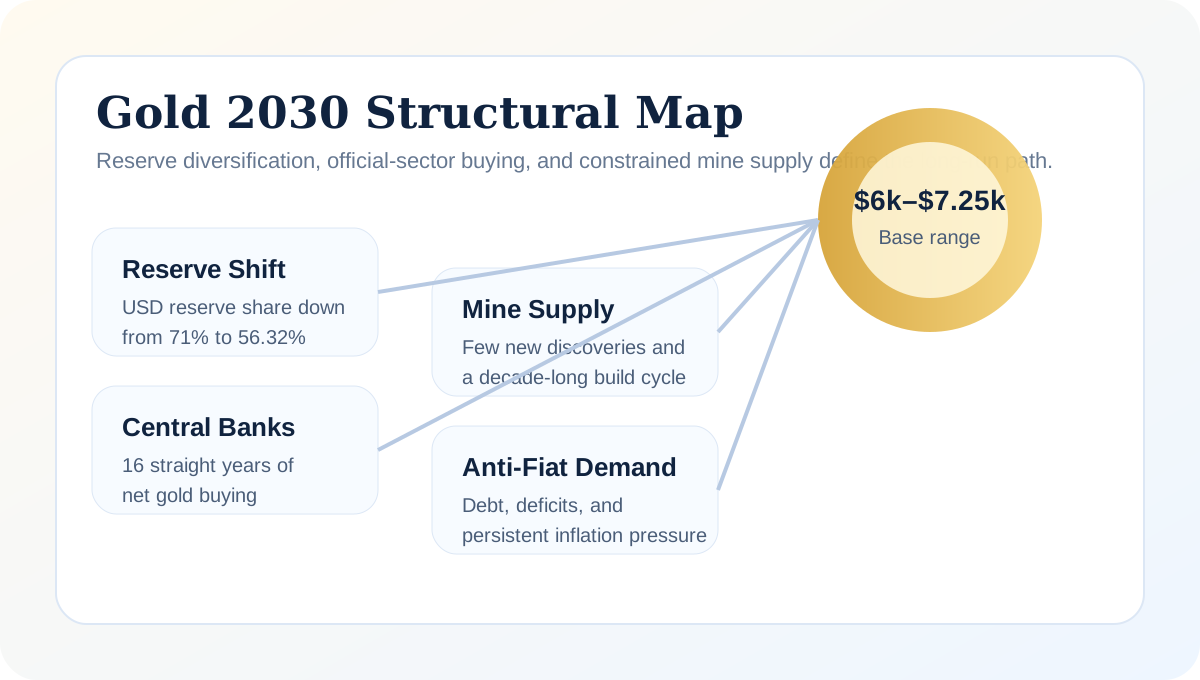
The IMF's Q4 2025 COFER data brief showed the U.S. dollar at 56.77% of allocated reserves. That remains dominant, but the direction is important. WGC's 2025 central-bank survey found 73% of respondents expected the dollar's share of global reserves to be moderately or significantly lower over five years. That does not imply dollar collapse. It does imply persistent marginal reallocation, and gold is one of the obvious beneficiaries.
Force 2: central-bank gold buying remains historically elevated
WGC's 2025 demand data showed central banks bought 863 tonnes, below the prior three 1,000-tonne years but still far above the post-2010 average. The survey also found 95% of respondents expected global official gold reserves to increase over the next 12 months and 43% expected their own institution to buy more. A strategic floor of this magnitude did not exist in earlier cycles.
Force 3: mine supply and recycling are not infinitely elastic
Record prices can lift recycling and improve mining margins, but gold supply still responds slowly. WGC's 2025 and Q1 2026 data show higher recycling and modest mine growth, not a supply surge. That matters because long-horizon upside scenarios require only that demand outpace supply gradually, not that supply collapse.
In practical terms, this means gold does not need a shortage narrative like some industrial metals. It only needs supply to remain less dynamic than demand from central banks, ETFs, bars and coins, and reserve reallocators over time.
Force 4: fiscal pressure and debt sustainability concerns
CBO projects debt held by the public to exceed the prior historical peak by 2029 and continue rising thereafter. This is not a daily trading catalyst, but it is a powerful structural narrative. Gold does not need a debt crisis tomorrow; it only needs investors and reserve managers to believe fiat credibility is being diluted over time.
Force 5: broader investor adoption beyond traditional gold buyers
WGC's ETF data, J.P. Morgan's demand analysis, and WGC's 2026 outlook all point to a broader ownership pool. Chinese insurance, Asian ETF participation, and renewed Western fund flows matter because gold is no longer being bought only by a narrow inflation-hedge constituency.
Broader ownership cuts both ways. It can push gold into a larger, more durable market. It can also make pricing more sensitive to shifts in investor taste, especially when gold has already appreciated substantially. That is why the ownership-broadening story is bullish structurally but not automatically bullish tactically.
| Force | Bullish evidence | What could weaken it |
|---|---|---|
| Reserve diversification | Dollar share trending lower over time | Renewed confidence in U.S. assets and institutions |
| Central-bank demand | Still very high in 2025 and firm in Q1 2026 | Greater price sensitivity or liquidity needs |
| Supply constraints | Mine growth remains modest | Faster recycling and unexpected production growth |
| Fiscal pressure | Debt keeps climbing in CBO projections | Credible fiscal consolidation |
| Investor adoption | ETFs and global investment demand broadened materially | Persistently high real yields and crowded positioning |
Viewed together, these forces suggest gold's 2030 debate is less about whether one catalyst appears and more about whether several slow-moving trends reinforce one another. That is why long-horizon gold analysis should look more like a macro mosaic than a single-event prediction.
03. Institutional Forecasts and Analyst Views
Most institutional evidence supports a structurally higher floor, not an automatic $8,000 target
J.P. Morgan's official gold outlook sees prices moving toward $5,000 by the end of 2026 and around $5,400 by late 2027, with a longer-term $6,000 scenario if more foreign U.S. assets diversify into gold. WGC's frameworks remain constructive but scenario-based. The LBMA 2026 survey shows analysts broadly clustered in the mid-$4,000s for 2026, with meaningful upside ranges but also lower-end cases below $4,000. In other words, institutional evidence supports a higher structural regime. It does not prove that $8,000 is base case.
That is the key analytical guardrail. The structural case is strong enough that aggressive upside cannot be dismissed. But a 2030 framework still has to weigh the possibility that gold compounds from a higher base at a more moderate pace rather than sprinting continuously.
04. 2030 Scenarios
Bull, base, and bear case for 2030
| Scenario | Illustrative 2030 range | Required conditions | Probability |
|---|---|---|---|
| Extreme bull | $8,000-$9,500 | Reserve diversification accelerates, official buying stays high, real yields fall, and investors seek protection from fiscal erosion | 20% |
| Base | $5,500-$7,000 | Most structural supports persist, but without a dramatic acceleration | 50% |
| Bear | $3,800-$5,200 | Real yields stay higher, ETF participation cools, and official buying moderates materially | 30% |
| Direction into 2030 | Probability | Comment |
|---|---|---|
| Higher than current structural range | 55% | The structural case still looks stronger than it did a decade ago |
| Lower | 20% | Would likely require both cyclical and structural disappointment |
| Sideways but volatile | 25% | Possible if official buying supports the floor but investor demand cools |
The reason $8,000 belongs in the discussion is not because it is the default. It belongs because the structural preconditions are at least imaginable. The reason it should not be the base case is that several of those forces could soften before 2030, especially rates and investor positioning.
Investors should also remember that gold can arrive at a higher 2030 price through multiple paths. One path is an orderly grind higher. Another is a sequence of sharp rallies and deep corrections. The same terminal number can imply very different risk experiences for real portfolios.
05. Investor Implications
How different investors can use a 2030 framework responsibly
| Investor type | Prudent approach | Main indicators |
|---|---|---|
| Investor already in profit | Hold core, trim excess, and rebalance rather than assume extreme bull case | CB demand, ETF flows, TIPS yields |
| Investor currently at a loss | Average only if time horizon and thesis are genuinely long term | Whether structural drivers are still intact |
| Investor with no position | Stage entries or wait for pullbacks; avoid chasing the most extreme targets | Macro tone and valuation discipline |
| Trader | Trade the macro tape, not just the structural narrative | Dollar, rates, volatility, positioning |
| Long-term investor | Use rebalancing or dollar-cost averaging, not all-or-nothing calls | Reserve diversification and debt trends |
| Hedge-focused investor | Use gold as one risk-management tool, with sizing discipline | Inflationary shock behavior and stock-bond correlation |
What could invalidate the 2030 bullish framework? A durable rise in real yields, a meaningful cooling in central-bank buying, credible fiscal repair in major economies, or broad evidence that reserve managers stop diversifying at the margin. Those are not impossible outcomes. They are simply less supported by current evidence than the constructive base case.
On the other hand, what could strengthen the extreme bull case would be a faster shift in reserve preferences, broader institutional adoption outside the traditional gold buyer base, and a market conclusion that sovereign debt trajectories are politically impossible to stabilize. Those would be the conditions under which $8,000 stops sounding sensational and starts sounding scenario-consistent.
Conclusion: the structural case for gold into 2030 is real, but the extreme target of $8,000 should be treated as an aggressive upside scenario, not a default expectation. The more defensible view is that gold's floor has likely moved higher for structural reasons, while the exact upside depends on whether those same forces intensify or fade.
Disclaimer: This article is for information and research only and does not constitute financial advice or a recommendation to trade any instrument.
06. FAQ
Frequently asked questions
Is $8,000 gold realistic by 2030?
It is realistic as an extreme bull case if several structural drivers stay aligned. It is not the base case from the current evidence.
What is the strongest long-term support for gold?
Persistent central-bank buying combined with fiscal and reserve-diversification concerns is the strongest support.
What is the main long-term downside risk?
A combination of higher real yields, cooling investor demand, and less aggressive official-sector accumulation.
Why use scenarios instead of one target?
Because 2030 depends on variables that can shift materially over several years, including rates, geopolitics, debt dynamics, and reserve policy.
References
Sources
- IMF Data Brief, COFER Q4 2025
- IMF blog on reserve-share valuation effects
- World Gold Council, Central Bank Gold Reserves Survey 2025
- World Gold Council, Full-Year 2025 central-bank demand
- World Gold Council, Q1 2026 outlook
- World Gold Council, Q1 2026 investment demand
- World Gold Council, Gold Outlook 2026
- J.P. Morgan Global Research, gold prices outlook
- LBMA, 2026 Precious Metals Forecast Survey at a glance
- LBMA, 2026 analyst forecasts
- Congressional Budget Office, The Long-Term Budget Outlook: 2025 to 2055
- FRED, 10-year TIPS real yield