01. Quick Answer
AI is more likely to affect Bitcoin indirectly than to create a simple one-way price boom
The cleanest answer is nuanced. Artificial intelligence could help Bitcoin through stronger digital-asset infrastructure, broader onchain activity, and potentially easier global liquidity if the AI boom keeps capital spending and risk appetite elevated. But AI can also compete with Bitcoin for power infrastructure, intensify market volatility through faster trading systems, and channel new payment activity toward stablecoins rather than BTC itself. The evidence is mixed, which is why AI should be treated as a force multiplier, not as a standalone Bitcoin valuation model.
| Category | Evidence-based read | Implication |
|---|---|---|
| Historical data | BTC has often traded as a macro-sensitive, liquidity-responsive asset | AI’s macro impact may matter more than AI headlines alone |
| Current market conditions | AI is already affecting miner economics and onchain product design | Some effects are real now, not hypothetical |
| Adoption channel | AI-agent payment rails are growing, but mostly around stablecoins and cheaper chains | BTC may benefit indirectly, not always directly |
| Volatility channel | AI can deepen both automation and herding in markets | BTC volatility may change in shape, not vanish |
02. Historical Context
The right AI question is not “Will AI make BTC go up?” but “Through which channels?”
Bitcoin’s recent history already contains two relevant clues. First, Fidelity’s 2026 outlook described BTC as closely tied to liquidity and broader capital-market conditions. Second, the same report devoted a section to the “Bitcoin Treasury Company Landscape and the AI Impact,” arguing that AI data-center demand may reshape mining economics by competing for energy infrastructure and creating alternative revenue opportunities for miners. That means AI is not just a buzzword around BTC. It is already interacting with the network’s industrial base.
| Metric | Latest reading | Why it matters |
|---|---|---|
| Recent BTC close | ~$76,864 | Baseline for judging whether AI changes BTC’s long-run path meaningfully |
| Miner crossover point | Fidelity cited roughly $60-$70 per petahash per day | Suggests AI hosting can outcompete mining economics in some cases |
| AI-agent rails | Base markets 127 million agent transactions and $40M+ payment volume | Shows machine-driven onchain activity is becoming measurable |
| AI-driven payments narrative | Galaxy expects AI-driven payments to show up onchain in 2026 | Supports adoption experimentation, though not necessarily on Bitcoin itself |
| Channel | Bullish path | Bearish path |
|---|---|---|
| Macro and liquidity | AI spending sustains risk appetite and capital formation | AI capex disappoints and drags broader risk assets lower |
| Mining and energy | AI hosting makes miners financially stronger and less cyclical | AI competes away power capacity and compresses mining economics |
| Onchain commerce | AI agents increase demand for programmable digital payments and value transfer | Most of that activity settles on stablecoin or alt-L1 rails, leaving BTC only a partial beneficiary |
03. Main Drivers
The AI impact on Bitcoin is real, but it is not one-dimensional
1. AI may influence BTC through macro sentiment and liquidity
Galaxy explicitly said BTC’s near-term outlook still depends partly on the rate of AI capex deployment. That sounds indirect, but it matters. If the AI buildout keeps lifting equity markets, credit availability, and broader risk appetite, BTC often benefits. If AI capex becomes a bubble unwinding, BTC can suffer alongside other risk assets.
2. AI can reshape miner economics and hash-rate behavior
Fidelity’s 2026 report argued miners now have a credible second revenue stream through AI hosting and cloud contracts. It also suggested 2026 could bring hash-rate flattening if major miners slow pure-Bitcoin expansion in favor of AI-hosting economics. That can be bullish if it makes miners more resilient, but bearish if energy competition becomes intense enough to disrupt network investment or selling behavior.
3. AI agents may boost digital-asset adoption, but not always BTC adoption
Base and Coinbase are openly building infrastructure for AI agents to hold wallets, make micropayments, and transact over web-native payment protocols. That is an important adoption signal for digital assets broadly. The caution is obvious: most of those rails currently emphasize stablecoins and low-cost chains, not Bitcoin mainnet. BTC may still benefit as the reserve collateral or savings asset in the ecosystem, but the transmission is indirect.
4. AI can change volatility, not just price direction
The BIS has warned more broadly that AI can amplify herding and procyclicality in markets. In BTC, that can mean faster reactions, denser liquidity in calm periods, and sharper air pockets when automated positioning all leans the same way. CME’s new volatility benchmarks and futures fit that evolution: volatility itself is becoming a more mature, tradable object.
5. AI may reinforce the long-run “digital collateral” narrative
If an AI-heavy economy needs machine-native settlement, auditable collateral, and globally transferable value stores, BTC could benefit as the simplest scarce digital reserve asset. The evidence is still mixed, but the conceptual case is stronger today than it was a few years ago.
04. Institutional Forecasts and Analyst Views
No serious source says AI alone determines Bitcoin’s future, but several show it is now part of the equation
Fidelity provides the strongest direct bridge by linking AI to miner economics and hash-rate behavior. Galaxy broadens the picture by tying AI capex deployment and AI-driven payments to broader crypto outcomes. Base and Coinbase show that agentic commerce is already being productized onchain. The key limitation is that these sources do not prove BTC will capture all the economic value created by AI-driven digital finance. In many cases, the evidence suggests BTC may capture some value through reserve demand, brand trust, and collateral roles while faster payment layers capture transactional throughput.
| Dimension | Potential upside | Potential downside |
|---|---|---|
| Price | Stronger risk appetite, more institutional interest in digital scarcity, healthier miners | AI-capex unwind and higher competition for infrastructure |
| Adoption | BTC becomes a reserve or collateral asset in an AI-native financial stack | Stablecoins and other chains capture most usage growth |
| Volatility | Deeper liquidity, more hedging tools, wider institutional participation | Algorithmic herding and faster reflexive selloffs |
05. Bull, Bear, and Base Case
AI probably acts as an amplifier, so the base case should stay moderate
| Scenario | 2030 range | Conditions | Probability |
|---|---|---|---|
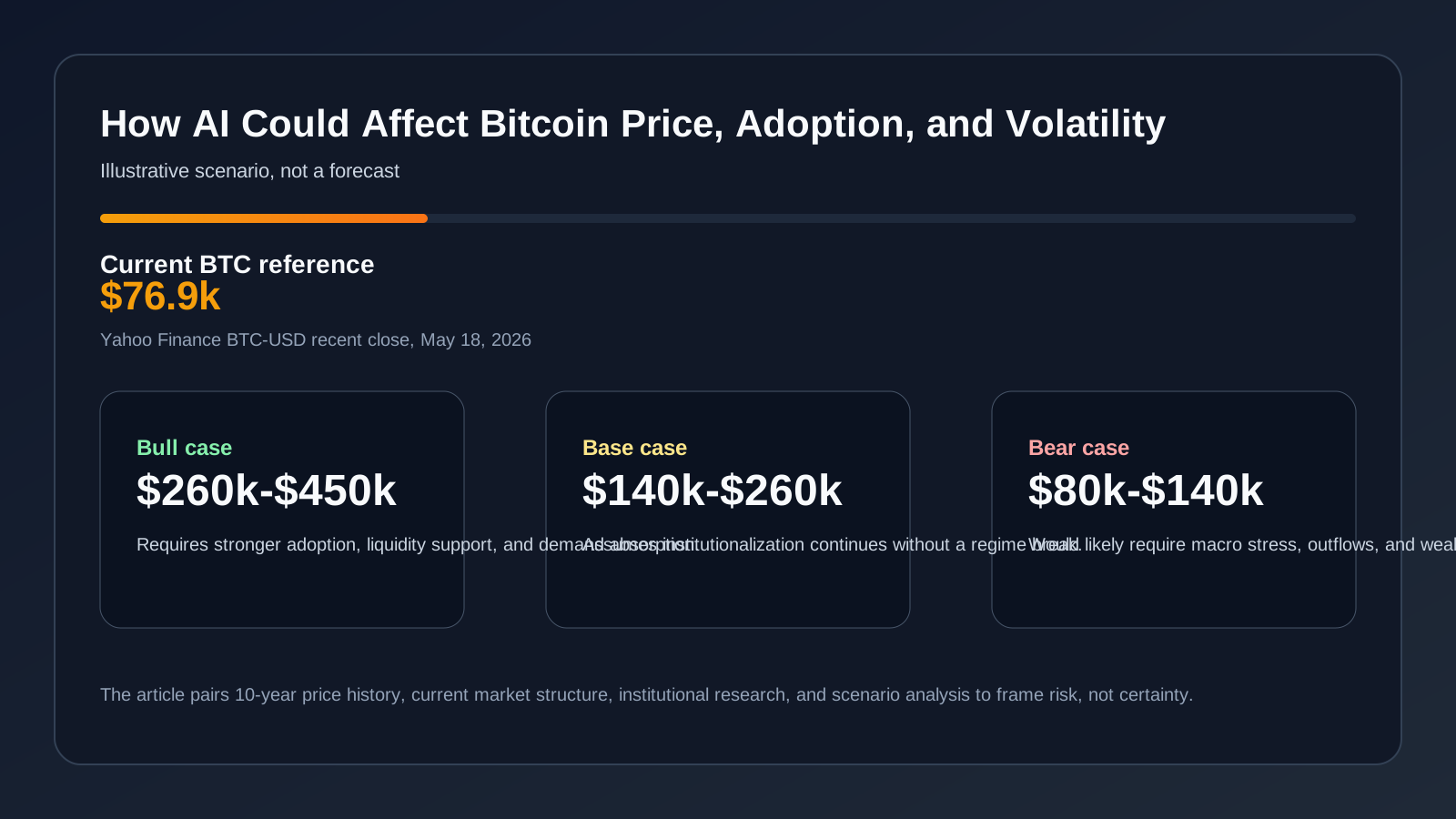
| Bull | $260k-$450k | AI spending remains constructive, miners become financially stronger, and BTC benefits from reserve-style adoption in an AI-native digital economy | 25% |
| Base | $140k-$260k | AI is modestly supportive through macro liquidity and infrastructure maturation, but most transactional growth accrues elsewhere | 50% |
| Bear | $80k-$140k | AI competes for power, fails to support broad risk appetite, and drives more volatility than durable BTC demand | 25% |
| Direction | Probability | Comment |
|---|---|---|
| Higher | 46% | AI is more likely to be net supportive than net destructive, but the effect is indirect |
| Lower | 22% | Downside rises if AI crowds out energy access or broad risk appetite weakens |
| Sideways to moderate gains | 32% | Plausible if AI changes market plumbing more than BTC valuation |
| Investor type | Prudent approach | Main watchpoints |
|---|---|---|
| Investor already in profit | Do not overstate AI as a guaranteed BTC catalyst; keep position sizing disciplined | Miner economics and macro correlation |
| Investor currently at a loss | Separate the long-run BTC thesis from short-run AI narratives that may not monetize directly | Flow quality and time horizon |
| Investor with no position | Wait for evidence that AI-related adoption benefits BTC itself, not just crypto broadly | Treasury demand and reserve narrative |
| Trader | Trade AI-related headlines cautiously because they can affect BTC through sentiment first and fundamentals later | Volatility skew and event reaction |
| Long-term investor | Use dollar-cost averaging if you view BTC as digital collateral in an AI-heavy world, but keep expectations realistic | Energy competition and policy |
| Risk-hedging investor | Hedge the possibility that AI helps other digital assets more than BTC | Relative performance within crypto |
What would invalidate the constructive AI-on-BTC thesis? Clear evidence that AI payment growth bypasses Bitcoin almost entirely, that power competition damages mining economics more than it helps, or that AI-led market turbulence overwhelms the adoption case. What would invalidate the cautious view? More reserve-style BTC usage by institutions and stronger signs that miners can monetize AI without weakening the network.
06. FAQ
Frequently asked questions
Will AI definitely raise Bitcoin’s price?
No. AI could help, hurt, or mostly bypass BTC depending on which channels dominate: macro liquidity, mining economics, or payment-rail adoption.
Why do miners matter so much in the AI discussion?
Because miners control energy-intensive infrastructure. If AI hosting becomes more profitable than mining, capital allocation decisions can change quickly.
Are AI agents likely to use Bitcoin directly?
Some may, but the current evidence suggests many agentic payment systems are being built first around stablecoins and cheaper execution rails.
Could AI reduce Bitcoin volatility?
It could deepen liquidity in some settings, but AI can also amplify herding and short-term market reflexes, so the effect is not one-way.
Methodology and Invalidation
How to interpret this AI-and-Bitcoin framework and what would change it
The forecast ranges in this article are scenario bands, not promises. They combine live price data from Yahoo Finance, 10-year context, post-ETF market structure, public-company treasury activity, adoption research, regulated derivatives activity, and institutional commentary from firms such as ARK, Fidelity, Bitwise, Galaxy, and CME. That mix is helpful because bitcoin does not respond to a single variable. It reacts to liquidity, regulation, leverage, adoption, macro sentiment, and the behavior of long-term holders at the same time.
Probability tables in this article are editorial estimates rather than mathematical certainties. They are derived by asking which path currently has the strongest evidence: renewed accumulation and broader institutionalization, prolonged consolidation after the 2025–2026 reset, or a deeper repricing caused by macro stress and forced selling. Where the evidence is mixed, the range stays wide on purpose. False precision is usually a sign that the analyst is hiding uncertainty rather than measuring it honestly.
The most important discipline is to state what would invalidate the working view. The supportive case would be weakened by evidence that AI’s main financial rails bypass BTC, that power competition structurally hurts miners, or that AI-led market shocks increase volatility without deepening long-run demand. Investors who are already in profit, investors sitting on losses, traders, hedgers, and long-term allocators do not need the same playbook, so the positioning table separates horizon and risk tolerance instead of pretending one answer fits everyone. Disclaimer: This article is for informational and research purposes only and does not constitute personalized financial advice.
References
Sources
- Yahoo Finance BTC-USD chart API, 10-year monthly price history
- Yahoo Finance BTC-USD chart API, recent daily closes
- U.S. SEC, statement on the approval of spot Bitcoin exchange-traded products, January 10, 2024
- ARK Invest, Bitcoin 2030 price-target methodology, April 24, 2025
- Fidelity Digital Assets, Is Bitcoin’s Four-Year Cycle Over?, February 24, 2026
- Fidelity Digital Assets, 2026 Look Ahead report
- Strategy, first-quarter 2026 results and bitcoin treasury update, May 5, 2026
- Chainalysis, 2025 Global Crypto Adoption Index
- CME Group, Crypto Catch-Up Q4 2025
- The White House, Strategic Bitcoin Reserve executive order, March 6, 2025
- Cambridge Centre for Alternative Finance, Bitcoin electricity consumption methodology
- Bitwise, 10 Crypto Predictions for 2026
- Galaxy Research, 26 crypto, bitcoin, DeFi, stablecoin, and AI predictions for 2026
- Bitcoin.org, Bitcoin Core validation and the 21 million supply rule
- Base, agentic economy and onchain payments overview
- Coinbase, Payments MCP for wallets, onramps, and AI-agent payments
- BIS, Annual Economic Report chapter on artificial intelligence and the economy