01. Quick Answer
AI could help Ethereum most if it turns the chain into infrastructure for autonomous payments, coordination, and tokenized financial workflows
AI and Ethereum intersect in three different ways. First, AI can raise demand for digital coordination, tokenized assets, and programmable payments. Second, AI agents themselves may need transparent data, onchain wallets, and smart-contract execution, which Ethereum.org already documents in early use cases (Ethereum.org). Third, AI can make markets faster, more reflexive, and more volatile by improving automation, signal processing, and speculation. So the question is not whether AI is good or bad for ETH. It is which channel dominates.
| Category | Evidence-based read | Implication |
|---|---|---|
| Macro backdrop | McKinsey estimated generative AI could add $2.6 trillion to $4.4 trillion annually across analyzed use cases (McKinsey) | Large AI adoption could reshape payment, software, and financial rails |
| Ethereum relevance | Ethereum.org already highlights AI agents using onchain wallets, market analysis, and autonomous interactions (Ethereum.org) | Ethereum is at least directionally exposed to the AI-agent economy |
| Financial-rails angle | Visa's agentic-commerce work and Franklin's tokenization work both point to more programmable settlement needs (Visa) (Franklin Templeton) | That could support Ethereum-linked infrastructure demand |
| Risk angle | AI can also increase market speed, copycat issuance, and speculative churn | Adoption upside does not remove volatility risk |
02. Historical Context
The AI question for Ethereum is less about science fiction and more about who owns the future transaction layer
Ethereum already has the technical and market-history context to be part of the AI conversation. It is a programmable settlement layer with staking, smart contracts, and a roadmap built around cheaper execution through rollups (Ethereum.org) (Ethereum.org). If AI agents become economically meaningful, they will need places to hold assets, execute rules, and coordinate with other systems. That does not guarantee Ethereum wins, but it gives ETH real optionality.
| Metric | Latest reading | Why it matters |
|---|---|---|
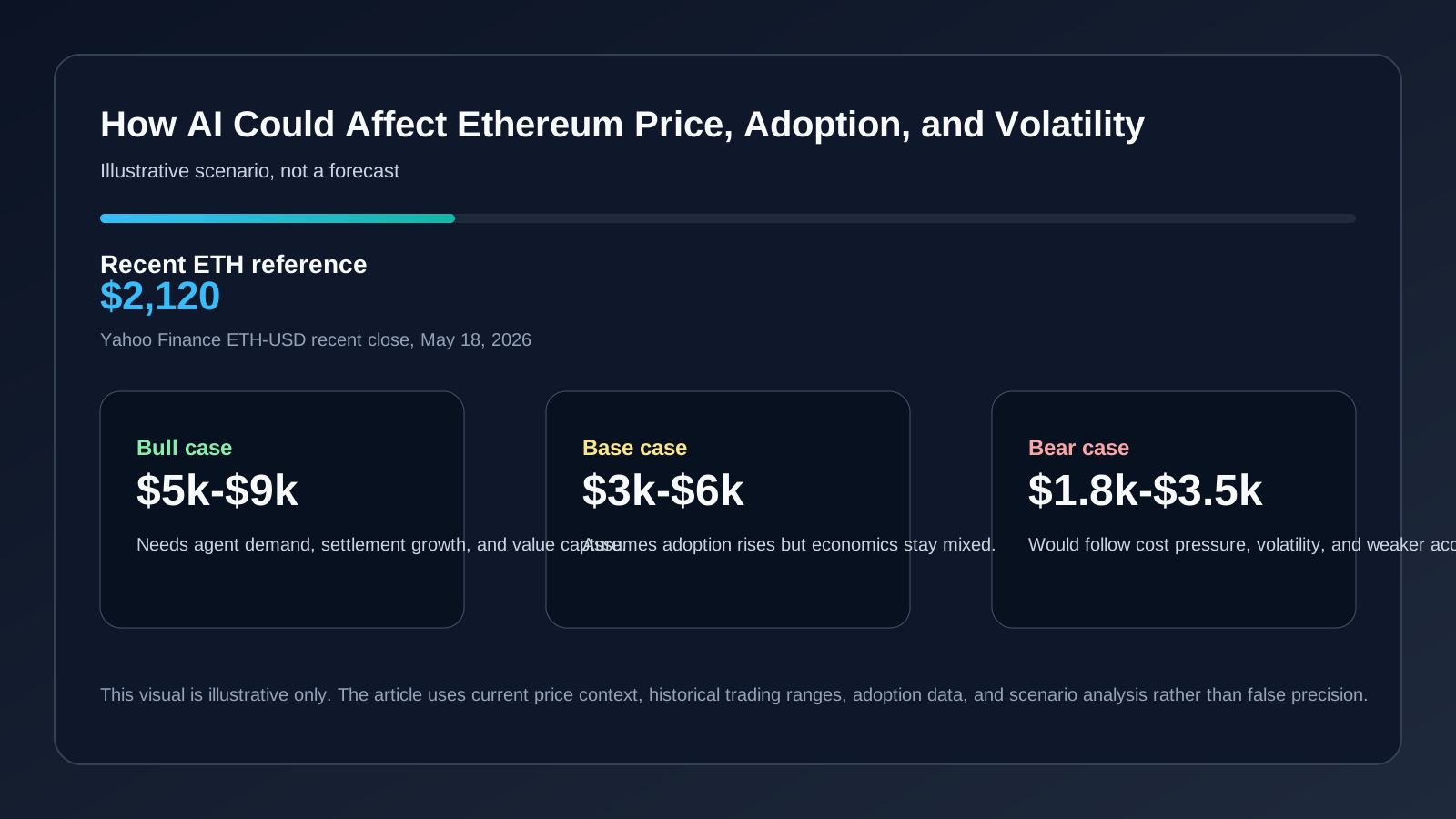
| Recent ETH close | ~$2,120.16 | Current base for AI-linked scenario analysis |
| AI agent experimentation | Ethereum.org lists agent-controlled wallets and onchain AI-agent examples | Shows the concept is already moving beyond theory |
| Tokenization trend | Traditional firms are pushing tokenized products and onchain settlement pilots | AI could accelerate demand for programmable asset rails |
| Market structure | Spot ETFs and derivatives make ETH an accessible AI-adjacent trade for institutions | Adoption narratives can translate into capital flows more easily |
| Channel | Bullish interpretation | Bearish interpretation |
|---|---|---|
| Autonomous agents | More wallets, transactions, and smart-contract activity | Cheap alternative chains may capture the busiest traffic |
| Tokenized finance | AI increases demand for programmable, 24/7 settlement rails | Institutions may prefer permissioned or multi-chain rails |
| Market automation | Better analytics improve capital allocation and liquidity | Faster trading can amplify volatility and crowding |
| Infrastructure competition | Ethereum's moat deepens if security matters most | Value capture weakens if AI-driven activity prefers cheaper execution layers |
03. Main Drivers
Five ways AI could affect Ethereum price, adoption, and volatility
1. AI could increase demand for programmable payments and settlement
Visa's work on agentic commerce suggests AI-mediated transactions will need trusted payment credentials, tokens, and APIs (Visa). If commerce becomes more software-driven, public programmable rails may become more relevant, which is directionally supportive for Ethereum-linked ecosystems.
2. AI agents are already being framed as onchain actors
Ethereum.org's AI agents page describes agents with onchain wallets, trading and market-analysis functions, and autonomous economic interactions (Ethereum.org). If this category grows materially, ETH could benefit from more demand for execution, collateral, and settlement.
3. AI could accelerate tokenization and operational automation in finance
McKinsey's productivity work and Franklin Templeton's tokenization work point toward a world where more financial and enterprise workflows become automated and digitally native (McKinsey) (Franklin Templeton). Ethereum does not need to own all of that activity to benefit; it only needs to remain one of the preferred trust layers.
4. AI can also intensify competition and commoditize execution
Ethereum's own roadmap assumes much cheaper execution through rollups (Ethereum.org). If AI explodes transaction counts, users and agents may care even more about cost, which could favor whichever layer offers the lowest-friction execution rather than the highest-fee chain.
5. AI will probably raise market speed and volatility
Deeper derivatives markets already exist for ETH (CME Group) (CME Group and Glassnode). AI-enhanced trading, faster signal extraction, and automated agents could make rotations into and out of ETH more violent, even if long-run adoption improves.
04. Institutional Forecasts and Analyst Views
No credible source can precisely price AI's impact on ETH, so scenario logic matters more than exact numbers
McKinsey provides the macro backdrop by showing that AI's potential economic impact is large enough to reshape software, operations, customer service, and R&D (McKinsey). Ethereum.org provides the narrower crypto backdrop by showing that AI-agent experimentation on Ethereum already exists (Ethereum.org).
The missing link is still monetization. Grayscale's Ethereum analysis is helpful because it reminds investors that ecosystem relevance and token performance are not identical (Grayscale). AI could raise Ethereum usage and still leave investors arguing over where the profits accrue. That is why the evidence is mixed and why scenario bands should stay wide.
| Question | Bullish answer | Bearish answer | Why it matters |
|---|---|---|---|
| Will AI agents use public chains? | Yes, for transparency and composability | Only selectively, with most value offchain | Decides transaction and wallet demand |
| Will tokenization scale? | Yes, boosting settlement demand | Growth stays niche or multi-chain | Affects institutional relevance |
| Will value accrue to ETH? | Security, staking, and settlement reinforce token demand | Execution gets cheaper while value migrates elsewhere | Determines price sensitivity to adoption |
| Will volatility rise? | Yes, but alongside better liquidity | Yes, with reflexive crowding and faster liquidations | Shapes trader risk, not just long-run upside |
The practical conclusion is that AI is more likely to act as a force multiplier on existing Ethereum debates than as a clean one-way catalyst. It can help adoption and still make the trading path rougher.
05. Bull, Bear, and Base Case
A scenario matrix is the most honest way to frame AI's effect on ETH
| Scenario | Price zone | Conditions | Probability |
|---|---|---|---|
| AI-accelerated bull | $5k-$9k | AI agents, tokenization, and programmable payments materially expand Ethereum-linked demand and ETH still captures enough value | 24% |
| Mixed base case | $3k-$6k | AI helps adoption, but value capture is diluted across layers and volatility remains high | 51% |
| AI-risk-heavy bear | $1.8k-$3.5k | AI increases competition, speculation, and cost pressure faster than it increases durable ETH demand | 25% |
| Direction | Probability | Comment |
|---|---|---|
| Higher over the medium term | 44% | AI creates real optionality for Ethereum if agent and settlement use cases stick |
| Lower | 20% | A weaker path would likely follow poor value capture or stronger competitive pressure |
| Sideways with volatility | 36% | Plausible if AI raises attention and trading activity without resolving economics |
| Investor type | Prudent approach | Main watchpoints |
|---|---|---|
| Investor already in profit | Hold but rebalance if AI hype drives sharp repricing without better fundamentals | Fee trends and narrative excess |
| Investor currently at a loss | Avoid using AI as a fresh excuse for a weak thesis; look for evidence of real adoption | Network usage quality and token demand |
| Investor with no position | Wait for either stronger adoption proof or better entry levels | AI-agent traction and market breadth |
| Trader | Respect volatility and avoid headline chasing around every AI-token or agent narrative | Momentum, derivatives, and sentiment |
| Long-term investor | Accumulate slowly only if you believe AI will increase demand for open, programmable settlement | Tokenization, agent wallets, and staking economics |
| Risk-hedging investor | Treat AI-linked ETH exposure as speculative growth infrastructure, not as a hedge | Cross-asset beta and liquidity conditions |
What would invalidate the constructive AI case? If most valuable AI-commerce and agent workflows stay offchain or move to cheaper rails with little ETH dependence, then the bullish read weakens materially. What would invalidate the cautious case? Clear growth in agent-controlled wallets, more tokenized assets settling on Ethereum-linked rails, and stronger evidence that this demand benefits ETH itself.
06. FAQ
Frequently asked questions
Why would AI matter for Ethereum at all?
Because AI can increase demand for automated payments, tokenized assets, transparent data, and smart-contract execution.
Does Ethereum already have AI-agent activity?
Yes. Ethereum.org already documents early examples of AI agents with onchain wallets and market-oriented use cases (Ethereum.org).
Could AI increase ETH volatility even if adoption improves?
Yes. Faster trading, automated signals, and narrative crowding can amplify volatility even in a healthier long-run adoption environment.
Is AI automatically bullish for ETH price?
No. AI can help usage while still leaving the value-capture question unresolved.
Methodology and Invalidation
How to interpret this AI-and-Ethereum framework and what would change it
The forecast ranges in this article are scenario bands, not promises. They combine live ETH price data, official Ethereum documentation, and institutional or market-structure research from major asset managers, exchanges, research desks, and financial firms, plus editorial judgment about market structure. That mix matters because ether is not driven by one variable. It reacts to fee generation, staking, tokenization demand, rollup economics, derivatives positioning, regulation, and macro risk at the same time.
Probability tables in this article are editorial estimates rather than mathematical certainties. They are derived by weighing whether the evidence currently favors stronger usage and institutionalization, a mixed middle path with slower monetization, or a weaker path marked by fee compression, risk-off conditions, or renewed competition. Where the evidence is mixed, the range stays intentionally wide. False precision is usually a sign that the analyst is hiding uncertainty rather than measuring it honestly.
The biggest invalidators would be proof that AI-related economic activity prefers non-Ethereum rails, or that the incremental activity boosts usage statistics without creating meaningful ETH demand. The most important discipline is to state what would invalidate the working view. Investors who are already in profit, investors sitting on losses, traders, hedgers, and long-term allocators do not need the same playbook, so the positioning table separates horizon and risk tolerance instead of pretending one answer fits everyone. Disclaimer: This article is for informational and research purposes only and does not constitute personalized financial advice.
References
Sources
- Yahoo Finance ETH-USD chart API, recent daily closes
- BlackRock, iShares Ethereum Trust ETF overview
- CME Group and Glassnode, Ethereum: Insights and Market Trends H1 2025
- CME Group, record 2025 derivatives activity including ether futures growth
- Ethereum.org, Scaling Ethereum
- Ethereum.org, Ethereum roadmap
- Grayscale Research, Ethereum: The OG Smart Contract Blockchain
- Franklin Templeton, Revolution-Not Evolution: Detangling tokenization of RWAs
- Franklin Templeton, Benji platform overview
- Ethereum.org, AI agents on Ethereum
- McKinsey, The economic potential of generative AI: The next productivity frontier
- Visa, Earning consumer trust in the age of agentic commerce