01. AI Setup
What Airbus has already disclosed about AI
Artificial intelligence is unlikely to change Airbus in the same way it could change a software company. But it could change Airbus profoundly in the way that matters for a complex aerospace manufacturer: better design workflows, smarter production systems, improved maintenance and operations data, faster engineering support, and more integrated digital services across the aircraft lifecycle. For Airbus, AI's value is likely to be industrial before it is narrative.
| AI angle | Why it matters |
|---|---|
| Design and engineering | AI can shorten cycles and improve information handling in complex product environments. |
| Manufacturing operations | Digital and AI tools can reduce friction in industrial planning and quality control. |
| Services and fleet data | AI can enhance value around the installed base through predictive and digital offerings. |
| Valuation impact is indirect | AI matters most if it improves execution and cash generation, not if it creates flashy headlines. |
Airbus has already been public about its digital and AI ambitions. Its digital-transformation and DDMS materials emphasize smart manufacturing, Industry 4.0, and end-to-end digital methods for design, manufacturing, and services (Airbus digital transformation page; DDMS program). In the 2025 board report, Airbus also disclosed broad internal AI adoption, noting over 272,000 users of the Gemini AI app and nearly 66,000 employees trained in the ethical use of generative AI (2025 board report).
| Evidence | What Airbus disclosed | Interpretation |
|---|---|---|
| Digital transformation strategy | Advanced digital technologies across design, production, and operations | Shows AI is embedded in a wider industrial-digitization push. |
| DDMS program | Digital-first approach to design, manufacturing, and operations | Suggests AI can influence the full product lifecycle, not just office productivity. |
| Skywise subsidiary launch | Merged digital solutions and Navblue into a dedicated entity | Signals strategic intent around data and digital-services monetization. |
| Board-report AI metrics | Large user scale and training base | Implies AI adoption is already material inside the organization. |
The important point is that Airbus' AI story already looks practical rather than speculative. That matters because aerospace value creation usually comes through better execution, fewer delays, stronger maintenance analytics, and more efficient engineering collaboration, not through consumer-facing AI hype.
In other words, AI's value to Airbus is likely to show up in programme execution, manufacturing learning curves, and lifecycle services before it shows up in a radically different market multiple.
That is a subtle but important distinction for investors. If they wait for AI to transform Airbus into something visibly tech-like, they may miss the quieter way value usually gets created in advanced manufacturing: fewer bottlenecks, faster information flow, and better coordination across complex systems.
02. Use Cases
Where AI could matter most inside Airbus
1. Engineering and design acceleration
Large aerospace programmes generate huge amounts of data, documentation, and engineering iteration. AI tools can help teams organize information faster and improve collaboration across design and certification workflows.
2. Smart manufacturing and industrial planning
Airbus explicitly links digital transformation to Industry 4.0 and smarter production methods. If AI helps reduce defects, improve scheduling, or detect bottlenecks earlier, the financial impact can be meaningful over time.
3. Services and fleet analytics
The Skywise ecosystem and the 2026 Skywise subsidiary launch point to a future where Airbus creates more value through data-rich operational services across fleet, flight, and technical workflows (Skywise subsidiary launch; Skywise story).
4. Internal productivity and knowledge handling
In a company with huge engineering, industrial, and support organizations, even modest productivity gains can matter. Airbus' board-report training and adoption figures suggest it is already trying to scale this benefit responsibly.
5. AI may improve quality of execution, not just cost
For Airbus, fewer surprises in planning, procurement, and maintenance support may matter as much as direct cost savings. AI that reduces industrial friction can strengthen the whole investment case.
03. Market Implications
How AI could influence Airbus' operating quality and valuation
Institutional research in aerospace is still cautious about assigning direct valuation premiums to AI. That is reasonable. But Airbus' own digital disclosures suggest AI should be viewed as an enabler of industrial quality, services growth, and operational resilience rather than as a separate speculative story (services-market outlook; board report AI adoption).
| Area | Potential benefit | Constraint |
|---|---|---|
| Engineering and documentation | Faster iteration and stronger knowledge retrieval | Aerospace validation and safety requirements remain strict. |
| Manufacturing | Better planning, quality control, and bottleneck detection | Industrial systems are complex and benefits may take time to surface. |
| Services and operations | More valuable digital products around aircraft lifecycle data | Customers still need interoperable and trusted tools. |
| Employee productivity | Less friction in communication and workflow support | Benefits may be real but hard for outsiders to quantify. |
| Valuation | Higher-quality earnings if execution improves | The market may not assign much extra premium unless results become visible. |
The evidence is mixed on how much AI should change Airbus' valuation multiple. It is clearer on how much AI could change Airbus' operating quality. For a complex industrial system, that distinction is enough to matter. If AI helps Airbus move aircraft, parts, data, and engineering decisions through the system more effectively, the cumulative effect over a decade can be substantial.
Still, investors should resist the temptation to treat AI as a magic aerospace-growth lever. The more realistic view is that it can make Airbus a better-run manufacturer and services provider, not a fundamentally different kind of company.
That realism is useful because it sets the right hurdle. Airbus does not need AI to create a new category. It needs AI to help existing categories work better, whether through planning, engineering support, maintenance analytics, or customer-facing digital tools around the installed base.
04. Scenarios
Bull, base, and bear cases for AI at Airbus
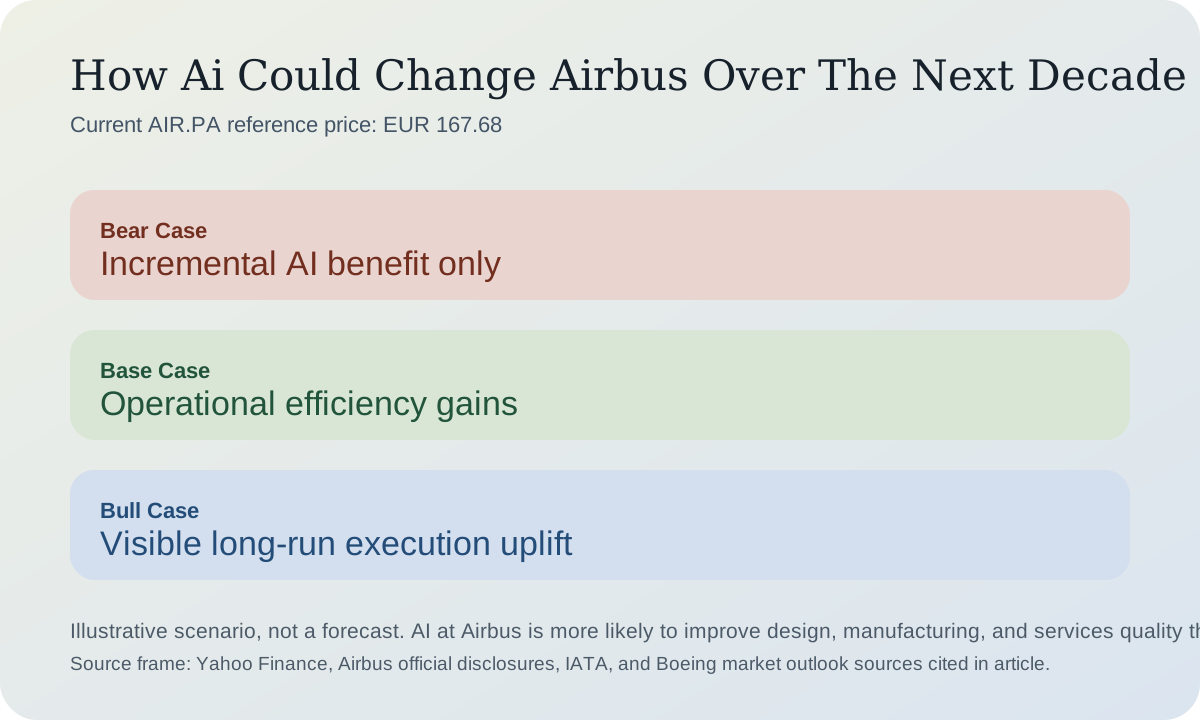
AI bull scenario
The bullish AI scenario is that Airbus becomes materially better at industrial planning, engineering collaboration, digital services, and lifecycle support, with those gains gradually supporting higher margins, fewer bottlenecks, and a stronger quality reputation.
AI bear scenario
The bearish AI scenario is not failure so much as under-delivery. Airbus invests heavily in digital tools and training, but the measurable financial benefit remains difficult for investors to see. Costs show up sooner than the productivity gains.
AI base case
The base case is that AI quietly improves execution and services over time without becoming the dominant reason to own the shares. That is often how real value is created inside industrial leaders.
| Path | Probability | Interpretation |
|---|---|---|
| AI helps Airbus outperform on execution quality | 43% | Plausible because Airbus already has material digital infrastructure and internal AI adoption. |
| AI improves operations but leaves valuation mostly unchanged | 37% | A realistic middle outcome for a mature aerospace manufacturer. |
| AI remains mostly incremental or disappointing | 20% | Possible if benefits stay too diffuse or too slow to measure. |
| Investor type | Prudent approach | AI-specific watchpoint |
|---|---|---|
| Investor already in profit | Treat AI as an enhancer of industrial quality, not the sole reason to hold. | Evidence of execution improvement in public disclosures. |
| Investor currently at a loss | Do not assume AI alone will repair a weak entry point. | Operational proof rather than AI branding. |
| Investor with no position | Wait for evidence that digital transformation is visible in services or industrial quality. | Cash generation and workflow benefits. |
| Trader | Do not overtrade AI headlines in an aerospace stock. | Results-day commentary on execution and digital services. |
| Long-term investor | View AI as a compounding aid that can strengthen Airbus over time. | Adoption, monetization, and quality-of-execution signals. |
| Risk-hedging investor | AI does not turn Airbus into a hedge or a software proxy. | Keep sizing tied to aerospace fundamentals. |
How this framework was built: it relies on Airbus' official digital-transformation and AI disclosures, its Skywise strategy, and the observation that industrial AI usually matters through execution quality before it matters through equity storytelling.
Risks to watch: slow monetization, uneven adoption, governance and safety constraints, high implementation costs, and the possibility that digital benefits remain real but hard for investors to measure.
What would invalidate this forecast: a much more aggressive external digital-services monetization strategy than Airbus currently signals, or alternatively a serious execution setback that forces digital priorities lower on the agenda.
Disclaimer: This article is for informational purposes only and does not constitute investment advice. The AI scenarios discussed here are judgment calls based on public disclosures, not company guidance.
Over the next decade, AI could matter a great deal to Airbus without ever becoming flashy. For a complex aerospace manufacturer, that may actually be the most credible bullish interpretation.
The strongest AI thesis for Airbus is therefore not disruption but disciplined augmentation. If the company keeps integrating AI into controlled industrial workflows and can point to clearer efficiency or services gains over time, investors may gradually view Airbus as a higher-quality operator even if they never view it as a technology story.
05. FAQ
Frequently asked questions about AI and Airbus
Will AI turn Airbus into a technology company?
No. The more plausible outcome is that AI makes Airbus a more efficient, better-coordinated, and more data-rich aerospace manufacturer and services provider.
Where can AI help Airbus the most?
Engineering workflows, manufacturing planning, fleet data services, and internal productivity appear to be among the clearest use cases.
What is the main risk to the AI thesis?
The main risk is that AI improves internal processes but does not become visible enough in financial or industrial outcomes to change investor perception.
Why focus on services and Skywise in an AI article?
Because AI is likely to matter most where Airbus can combine installed-base data, digital workflows, and operational relevance for customers.
06. Sources
Reference list
- Yahoo Finance chart API for AIR.PA, 10-year monthly history
- Yahoo Finance chart API for AIR.PA, recent daily closes
- Airbus Full-Year 2025 results release
- Airbus First Quarter 2026 results release
- Airbus annual reports page
- Airbus 2025 Report of the Board of Directors
- Airbus financial results page
- Airbus 2025 deliveries and backlog release
- Airbus Global Market Forecast 2025
- Airbus services-market outlook 2026
- IATA 2026 airline profitability outlook
- IATA global outlook for air transport, December 2025
- Boeing Commercial Market Outlook 2025-2044
- Airbus digital transformation page
- Airbus DDMS program
- Airbus Skywise subsidiary launch
- Airbus Skywise digital story