01. Quick Answer
AI could reshape Apple stock mainly by changing retention, upgrade behavior, and ecosystem monetization rather than by turning Apple into a hyperscale AI utility
Apple’s AI impact on the stock is likely to be indirect but still substantial. Official Apple materials already show Apple Intelligence moving into system-level workflows, language translation, visual search, developer access, and on-device foundation models. If those features deepen customer loyalty, stimulate upgrades, and strengthen Services attachment, the equity impact could be meaningful even without a massive standalone AI revenue disclosure. If the features remain mostly defensive or parity-driven, then AI may improve product quality without fundamentally changing the stock’s long-run growth rate.
| Category | Evidence-based read | Implication |
|---|---|---|
| Historical data | Apple has repeatedly turned ecosystem scale into margin resilience | Supports premium valuation if ecosystem control holds |
| Current market conditions | Results remain strong, but AI and legal questions are still unresolved | Forecasts should remain scenario-based |
| Institutional signals | S&P and Reuters both show strong execution with visible debate on constraints and regulation | Analysts remain constructive but not unanimous |
| Most important watchpoints | Services growth, gross margin, China, AI traction, App Store outcomes | These variables will likely shape the stock range more than headlines alone |
02. Historical Context
Apple’s long-run valuation rests on ecosystem durability more than any single device cycle
Apple has repeatedly shown that skeptics can underestimate how much value sits in installed-base economics rather than in headline unit volume alone. The company’s 2025 Form 10-K and most recent quarterly materials still show a business anchored by the iPhone but increasingly stabilized by Services, capital return, and a premium customer base that monetizes repeatedly over time. That is why an Apple forecast cannot stop at “how many iPhones will sell next quarter.” It has to assess whether the ecosystem remains sticky enough to keep gross margins strong, support share repurchases, and defend pricing power even when hardware categories mature.
| Metric | Latest read | Why it matters |
|---|---|---|
| Revenue trend | Q2 FY26 revenue of $111.2 billion | Confirms the business can still produce double-digit top-line growth at scale |
| Services strength | Roughly $31 billion in Q2 FY26 per S&P Global | Supports margin quality and lowers dependence on one-off hardware demand |
| Capital return | New $100 billion buyback authorization | Still a major support for per-share earnings compounding |
| China signal | Q2 Greater China revenue of $20.5 billion; Reuters also cited early-2026 shipment strength | China remains both a growth lever and a strategic risk |
03. Main Drivers
Five drivers matter most for Apple’s medium- and long-run stock outlook
1. iPhone mix still matters more than headline unit obsession
Reuters noted that Apple’s Q2 results were helped by stronger mix and pricing even though supply constraints limited iPhone upside. That distinction matters. Apple does not need unit hypergrowth every year if higher-end mix, ecosystem engagement, and attached services continue lifting economics.
2. Services is now central to valuation quality
Services revenue at roughly $31 billion in Q2 FY26 reinforces the view that Apple is not only a hardware company. If the segment keeps compounding, investors may tolerate slower hardware growth. If regulation compresses App Store or payments economics, the multiple debate becomes harder.
3. AI execution matters, but Apple’s monetization path will likely look different from hyperscalers
Apple’s official platform materials show Apple Intelligence moving deeper into the software stack and into developer tools. The question is whether those features become a compelling upgrade and retention engine rather than just a parity response to rivals.
4. China remains both opportunity and concentration risk
China smartphone sales data and stronger Greater China revenue show Apple can still outperform there, yet investors should not confuse a good quarter with a solved strategic issue. Domestic competition, geopolitics, supply chain concentration, and pricing politics all remain live variables.
5. Regulation is no longer a background issue
The Epic litigation and wider scrutiny of App Store practices matter because Apple’s most valuable qualities now include control, distribution, and monetization inside a tightly governed ecosystem. If those economics are forced more open, valuation support could become less durable.
04. Institutional Forecasts and Analyst Views
The market sees resilience, but it is still debating what deserves the next leg of valuation
This is why analysts remain divided. The evidence is strong that Apple is integrating AI into the product stack. The evidence is mixed on whether that integration deserves the same valuation excitement the market assigns to cloud or enterprise-AI monetizers. A sober AI article on Apple therefore has to distinguish product relevance from direct revenue capture.
| Source | Message | Interpretation |
|---|---|---|
| Apple official reporting | Revenue and EPS growth remained strong, with a fresh billion buyback authorization | Operational execution remains solid |
| S&P Global | Results exceeded consensus with strong Services, margin expansion, and better-than-expected Q3 guidance | Supports the base-to-bull case |
| Reuters | Demand and China trends were encouraging, but supply constraints and Siri/AI expectations remain important | Keeps near-term optimism from becoming certainty |
| Regulatory backdrop | Epic and App Store scrutiny remain live risks | Services quality still deserves a risk haircut |
05. Bull, Bear, and Base Case
How the forecast range and probability table are built
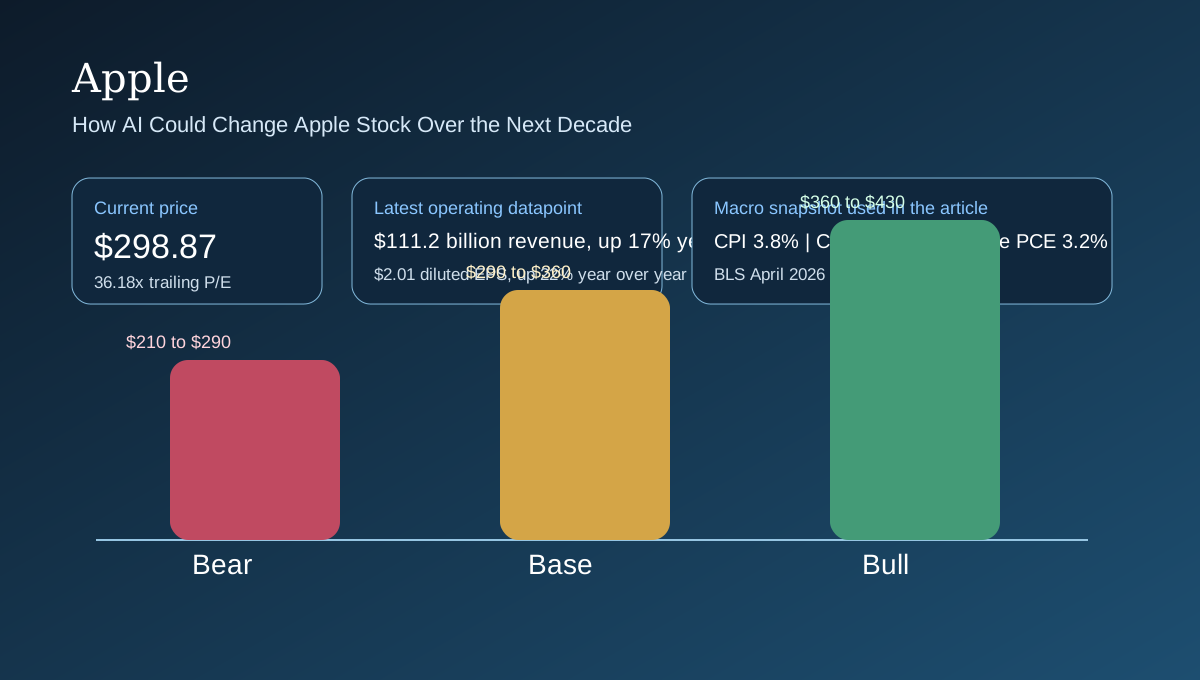
The range in this article is not a point target. It is an editorial scenario matrix based on revenue durability, margin quality, buyback support, legal risk, AI monetization, and multiple sensitivity. In practical terms, the probability weightings below ask a simple question: what combination of earnings growth and narrative credibility is the market likely to assign to Apple over the relevant horizon?
| Scenario | Likely effect | Conditions | Probability |
|---|---|---|---|
| Bull | AI strengthens upgrade rates and ecosystem retention | Apple Intelligence becomes useful, trusted, and meaningfully sticky | 30% |
| Base | AI helps quality more than valuation | Features improve user experience without creating a major new revenue line | 45% |
| Bear | AI impact stays marginal to the equity thesis | Apple trails rivals in perceived capability and monetization | 25% |
| Directional outcome | Probability | Comment |
|---|---|---|
| AI lifts long-run stock quality | 50% | Most plausible if AI enhances retention, pricing, and developer engagement |
| AI has limited net effect | 25% | Possible if Apple mostly reaches parity rather than differentiation |
| AI becomes a competitive weakness | 25% | Would require a more visible capability or ecosystem gap to emerge |
| Investor type | Prudent approach | Main watchpoints |
|---|---|---|
| Investor already in profit | Hold a core position, but trim if valuation starts implying flawless AI and regulatory execution | Services margins and legal outcomes |
| Investor currently at a loss | Separate timing pain from thesis quality and avoid averaging up without a clearer margin of safety | Installed-base monetization and China |
| Investor with no position | Wait for pullbacks or stage entries rather than chase narrative-driven rallies | WWDC follow-through and Q3 guidance |
| Trader | Use stop-loss discipline and focus on product-cycle, court, and earnings catalysts | Supply-chain headlines and options pricing |
| Long-term investor | Dollar-cost average only if convinced Services and capital returns can offset slower category growth | Regulation, AI adoption, and buyback pace |
| Risk-hedging investor | Rebalance oversized Apple exposure rather than assume brand strength removes concentration risk | Portfolio concentration and macro drawdowns |
Conclusion: over the next decade, AI could change Apple stock most meaningfully by altering the quality and monetization of the ecosystem rather than by creating a hyperscale-cloud narrative, which makes execution and user adoption more important than buzz alone. Disclaimer: This article is for informational and research purposes only and does not constitute personalized financial advice.
06. FAQ
Frequently asked questions
Is Apple still a growth stock?
Available data suggests Apple is still capable of growth, but the mix increasingly matters. Services quality, buybacks, and ecosystem monetization are now as important as raw hardware volume.
What matters most for the next forecast revision?
Services resilience, AI traction at WWDC and beyond, China demand, and the legal shape of the App Store model are the most important inputs.
Is the risk more about competition or regulation?
Both matter. Competition shapes growth ceilings, while regulation can affect the quality and durability of Apple’s margin structure.
What would invalidate the optimistic case?
A weaker Services profile, underwhelming AI uptake, or a more severe App Store economic reset would all weaken the optimistic case materially.
Methodology and Invalidation
How to interpret this Apple framework and what would change it
Apple stock should not be analyzed like a pure hardware cyclical or like a pure software platform. The business now sits at the intersection of premium devices, a very large installed base, recurring Services monetization, ecosystem lock-in, capital returns, and a still-evolving artificial intelligence strategy. That mix is why the same headline can mean different things to different investors. A stronger iPhone cycle may support near-term earnings without proving that Apple has solved its long-run AI positioning. A strong Services quarter may lift margin quality without removing legal or policy risk around the App Store. A fresh buyback authorization may support per-share metrics without necessarily changing the topline growth ceiling.
The range-based framework in these articles therefore combines official company reporting, regulatory developments, and external market interpretation. Apple’s Q2 fiscal 2026 release showed revenue of $111.2 billion and diluted EPS of $2.01, while Apple’s most recent annual and quarterly SEC filings remain the primary source for segment exposures, risk factors, and cash deployment. Inline evidence also matters. S&P Global’s post-quarter snapshot noted Services revenue of roughly $31 billion, record gross margin, and a 2.5 billion active-device installed base, while Reuters highlighted both strong China demand and iPhone supply constraints. Those details matter because they show why the bull case and bear case can coexist. The franchise is still powerful, but that power does not eliminate execution risk.
Apple’s AI path needs to be read carefully rather than emotionally. Official Apple materials show that Apple Intelligence is moving deeper into the software stack, with on-device foundation models, developer access, Live Translation, and workflow integrations already highlighted in September 2025 platform releases, while WWDC26 was explicitly framed as a showcase for additional AI advancements. That confirms strategic intent. It does not yet confirm that Apple will capture AI economics on the same scale as companies whose revenue models are already cloud- or enterprise-AI centric. Available data suggests Apple’s AI upside depends more on ecosystem enhancement, upgrade stimulation, and privacy-centric differentiation than on building a standalone hyperscale AI revenue line.
Investor positioning also depends on horizon. A trader may focus on channel data, product cycle expectations, gross margin guidance, and headline risk around courts or regulation. A long-term allocator should care more about ecosystem durability, Services mix, capital intensity, competitive AI positioning, and whether regulatory pressure changes App Store economics in a material way. An investor already in profit may rationally trim if the multiple is pricing near-perfect execution. An investor with no position may rationally wait for a pullback if product enthusiasm is outrunning earnings durability. These are not contradictory actions. They reflect different time horizons and different required margins of safety.
What would invalidate a constructive Apple outlook? The most important invalidators would be evidence that ecosystem monetization is weakening, Services margins are being structurally impaired by regulation, Apple Intelligence fails to improve device demand or developer relevance, or China becomes a more persistent headwind to both sales and supply. What would invalidate a more bearish Apple view? Clear evidence of sustained Services resilience, strong upgrade cycles, margin defense despite legal pressure, and more credible AI adoption at scale would all weaken it. The discipline investors should demand is straightforward: every Apple thesis should explain what evidence would force the range higher or lower rather than treating the brand as automatically bullish or automatically untouchable.
Inline evidence anchors that discipline. Apple’s own quarter, SEC filings, and platform releases establish the factual baseline (Apple Q2 2026 results; Apple 2025 Form 10-K). External coverage then helps frame what the market is debating right now: better-than-expected China demand, supply constraints, App Store litigation, and the pace of AI monetization (S&P Global post-quarter snapshot; Reuters on results; Reuters on App Store litigation). That is the basis for the probability ranges used here.
References
Sources
- Apple, fiscal Q2 2026 results press release
- Apple, FY26 Q2 consolidated financial statements
- Apple, Form 10-Q for quarter ended March 28, 2026
- Apple, Form 10-K for fiscal year ended September 27, 2025
- Apple, new software platforms and Apple Intelligence features, September 15, 2025
- Apple, WWDC26 announcement, March 23, 2026
- S&P Global, Apple post-quarter snapshot, May 14, 2026
- Reuters, Apple sales beat expectations powered by Mac but iPhone hits supply constraints, April 30, 2026
- Reuters, Apple China smartphone sales jump 23% to start 2026, March 19, 2026
- Reuters, Supreme Court declines to pause Apple App Store order, May 6, 2026