01. Quick Answer
AI could reshape Berkshire more indirectly than many tech leaders, but it can still improve underwriting, operations, and capital allocation support across the conglomerate
AI's impact on Berkshire is not likely to come from one flagship consumer product. It is more likely to show up gradually across insurance analytics, freight routing, utility optimization, manufacturing efficiency, maintenance systems, fraud detection, and capital-allocation support tools. Over the next decade, AI could change Berkshire through many practical channels at once: lower operating costs, better underwriting decisions, stronger utility and railroad efficiency, and better productivity in acquired businesses. It could also change the conglomerate by making technology adoption across decentralized subsidiaries a more important differentiator than it used to be.
| Category | Evidence-based read | Implication |
|---|---|---|
| Historical data | BRK.B moved from about $144.79 to about $484.06 over 10 years | Long-run upside is credible, but future ranges should reflect Berkshire's size and value orientation |
| Current market conditions | Operating earnings are healthy and the balance sheet is exceptionally strong, but cash deployment remains the big open question | Forecasts should stay scenario-based, not based on automatic premium assumptions |
| Institutional signals | Official reporting and Reuters both show resilience, but also a growing focus on Greg Abel's capital-allocation era | Analysts remain constructive, though not complacent |
| Most important watchpoints | Cash deployment, buybacks, insurance quality, subsidiary earnings, and leadership continuity | These variables will likely shape the stock range more than short-term market noise |
02. Historical Context
Berkshire is still a value compounder first, but the modern thesis now includes succession, cash deployment, and capital flexibility
BRK.B moved from roughly $144.79 to about $484.06 over the last 10 years based on Yahoo Finance monthly data, implying a 10-year CAGR of about 12.83%. That is lower than many mega-cap growth names, but strong for a capital-heavy conglomerate built around insurance, railroads, utilities, manufacturing, services, retail, and a large equity portfolio. The forecasting challenge is different here than for a software or semiconductor stock. Berkshire is less about one breakthrough and more about the rate at which capital gets redeployed, the durability of operating subsidiaries, and whether post-Buffett leadership can sustain the company's unusually disciplined compounding culture.
| Metric | Latest official reading | Why it matters |
|---|---|---|
| Q1 2026 operating earnings | `$12.7 billion | Shows the underlying operating engine still matters more than short-term market gains or losses |
| Cash and Treasuries | About `$397.4 billion | Cash deployment remains one of the most important long-run valuation variables |
| Book value mindset | Capital discipline remains central even after Buffett's CEO transition to Greg Abel | Valuation still depends on Berkshire's ability to compound capital better than average, not just to hold it |
| Buybacks | Repurchases resumed in early 2026 | Signals management still sees value and has capital-return flexibility |
03. Main Drivers
Five forces are most likely to shape Berkshire stock over the next several years
1. Cash deployment is now one of the biggest valuation variables
Reuters, Fortune, and AP all highlighted Berkshire's roughly `$397 billion` cash and Treasury pile in Q1 2026. That balance protects the company and gives it optionality, but it also raises a recurring question: can management find enough attractive uses for that capital to keep compounding at a premium rate?
2. Insurance float and underwriting discipline still form the core economic engine
Berkshire's insurance operations remain foundational because they provide float, underwriting earnings, and flexibility that can feed the rest of the conglomerate. Investors should not reduce Berkshire to just Apple and cash.
3. Succession matters more than it used to, but the evidence so far is mixed rather than alarming
Greg Abel is now fully in the CEO seat, and Reuters reporting around the 2026 annual meeting made clear that investors are trying to assess both continuity and independence. Berkshire's culture is durable, but capital allocation and deal-making under Abel will increasingly shape the multiple.
4. The operating subsidiaries still matter through the economic cycle
Railroad, utilities, manufacturing, and service businesses make Berkshire more economically exposed than some investors assume. The defensive reputation is deserved, but not absolute. A slowdown can still affect earnings quality in the operating businesses even when the balance sheet looks fortress-like.
5. Buybacks, equity portfolio positioning, and acquisition appetite all affect per-share compounding
When Berkshire cannot find large deals, buybacks become more relevant. When the equity portfolio changes, investors update their read on management's opportunity set. Neither variable is the whole story, but both influence how efficiently Berkshire converts financial strength into per-share value growth.
04. Institutional Forecasts and Analyst Views
The market still respects Berkshire's defensive quality, but it increasingly wants evidence that huge liquidity can still compound well
That is why the long-run AI article on Berkshire has to stay balanced. The evidence is mixed because Berkshire is not an obvious AI monetizer in the way a hyperscaler is. But available data suggests AI can still improve the quality of underwriting and operations across a very broad group of businesses. The most credible upside comes from cumulative efficiency and decision-quality gains rather than one spectacular standalone AI revenue line.
| Source | Message | Interpretation |
|---|---|---|
| Berkshire official reporting | Operating earnings remained solid and cash kept growing | Operational and balance-sheet quality remain strong |
| Reuters | Greg Abel's first CEO era begins with a huge cash pile and major expectations around capital allocation | Supports a constructive but discipline-dependent base case |
| AP and Fortune | The company remains financially strong, but investors are focused on what it can still buy or build at scale | Keeps upside and opportunity-cost risk visible |
| Annual report and shareholder letter | The culture still prioritizes patience, liquidity, and per-share compounding over headline activity | Strengthens the defensive quality of the thesis |
05. Bull, Bear, and Base Case
How the forecast range and probability table are built
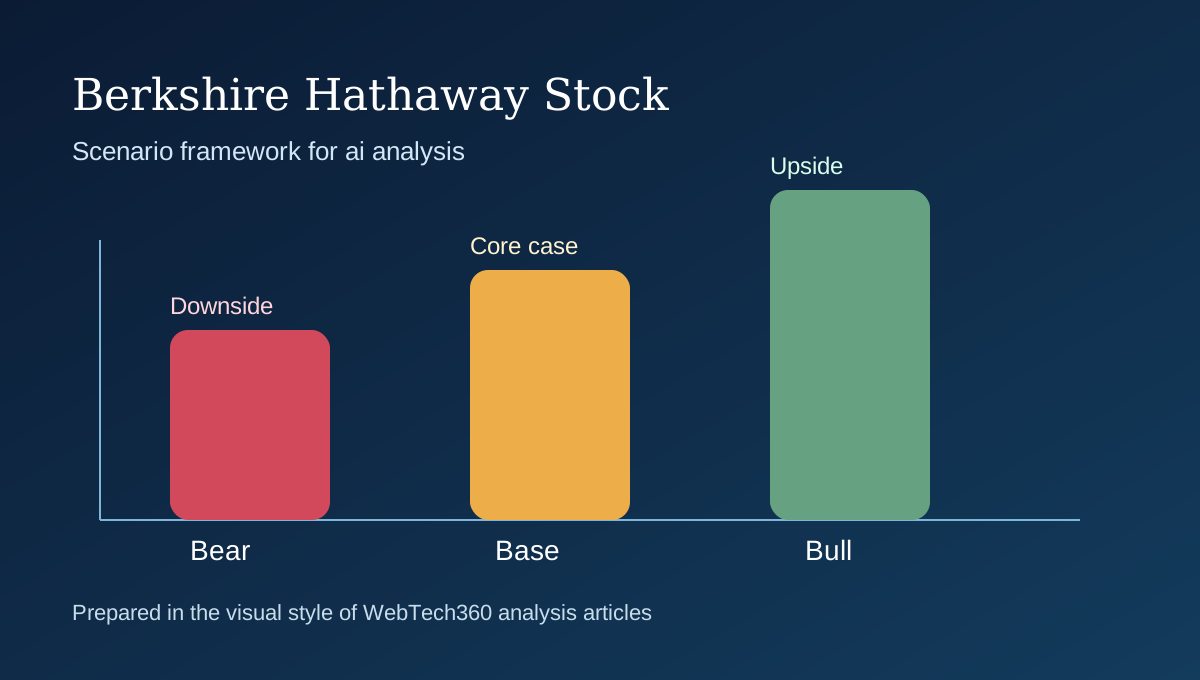
The ranges in this article are not institutional point targets. They are editorial scenario matrices built from current price, 10-year compounding history, insurance and operating-business durability, the pace of capital deployment, buyback flexibility, and the extent to which the Abel era preserves Berkshire's allocation discipline.
| Scenario | Likely effect | Conditions | Probability |
|---|---|---|---|
| Bull | AI deepens Berkshire's operational moat and improves decentralized productivity steadily | Insurance, rail, utility, and industrial operations all gain meaningful efficiency without cultural disruption | 35% |
| Base | AI helps quality, but mainly through gradual efficiency gains | Benefits are real, though dispersed across many subsidiaries and slow to re-rate the stock dramatically | 45% |
| Bear | AI remains strategically useful but financially incremental | Adoption is uneven and the gains remain too diffuse to change the valuation much | 20% |
| Directional outcome | Probability | Comment |
|---|---|---|
| AI lifts long-run stock quality | 55% | Most plausible if incremental improvements across many subsidiaries accumulate into better returns on capital |
| AI has a mixed net effect | 25% | Possible if adoption benefits remain real but too diffuse to change per-share compounding meaningfully |
| AI becomes largely irrelevant to the thesis | 20% | Would apply if decentralized adoption stays too slow or uneven to matter economically |
| Investor type | Prudent approach | Main watchpoints |
|---|---|---|
| Investor already in profit | Hold a core stake, but trim if Berkshire has become too large a defensive anchor relative to the rest of the portfolio | Position size, buybacks, and opportunity cost versus other sectors |
| Investor currently at a loss | Reassess whether the thesis is balance-sheet defense, insurance quality, or long-run capital allocation before averaging down | Cash deployment and subsidiary earnings quality |
| Investor with no position | Stage entries or wait for broad-market pullbacks rather than chase a defensive name near optimism peaks | Valuation, buyback cadence, and macro stress points |
| Trader | Use stop-loss discipline and trade around major earnings, annual-meeting commentary, buybacks, and acquisition headlines | Volatility, event risk, and relative performance vs. the index |
| Long-term investor | Dollar-cost average only if convinced Berkshire can keep compounding per-share intrinsic value in the post-Buffett era | Capital allocation, insurance float, and operating-business resilience |
| Risk-hedging investor | Rebalance if Berkshire has become an oversized proxy for caution while missing better long-run opportunities elsewhere | Portfolio concentration and macro positioning |
Conclusion: over the next decade, AI could change Berkshire more through cumulative operational gains than through obvious headline products, but the stock's payoff still depends on whether those gains become meaningful enough at scale to improve per-share compounding. Disclaimer: This article is for informational and research purposes only and does not constitute personalized financial advice.
06. FAQ
Frequently asked questions
Is Berkshire still mainly a Buffett stock?
Buffett's legacy still shapes the culture, but the live investment question is increasingly about whether Greg Abel can preserve Berkshire's allocation discipline at this scale.
What matters most for the next forecast revision?
Cash deployment, buybacks, insurance results, operating-subsidiary earnings, and any large acquisition or portfolio changes matter most.
Is the biggest risk underinvestment or recession?
Both matter. Underinvestment can create opportunity cost, while recession can pressure operating businesses even if the balance sheet remains very strong.
What would invalidate the bullish case?
Persistently idle cash, weaker operating results, poor capital deployment, or evidence that the post-Buffett era is less disciplined than expected would all weaken the bullish case.
Methodology and Invalidation
How to interpret this Berkshire framework and what would change it
Berkshire Hathaway should not be analyzed like a single-sector stock, and it should not be treated as a simple holding company either. The company combines insurance float, capital allocation, equity investments, regulated utilities, transportation, industrial operations, and a very large cash balance. That mix means point forecasts are often less useful than scenario ranges. A range-based framework is more honest because Berkshire's future returns will depend less on one dramatic catalyst and more on the interaction between capital deployment, operating resilience, buybacks, and leadership continuity.
These articles therefore anchor their ranges to three things: current price, 10-year growth history, and current operating evidence. Yahoo Finance chart data place BRK.B around `$484.06` in mid-May 2026, versus roughly `$144.79` at the start of the 10-year comparison window. That implies a 10-year CAGR of about 12.83%. For a company of Berkshire's size and maturity, that is a strong long-run result. But it is not a forecast by itself. Berkshire's next decade is unlikely to replicate the exact same pace unless management continues finding good capital allocation opportunities despite the company's enormous scale and cash balances.
Primary documents matter most. Berkshire's 2025 annual report and 10-K describe the operating earnings power of insurance, BNSF, utilities, manufacturing, and services, while also making clear how much of shareholder value still depends on disciplined capital allocation. The Q1 2026 earnings release then showed that operating earnings rose and the cash pile moved close to `$400 billion`. Those facts matter because they support both the bull and bear cases at once: Berkshire is incredibly liquid and resilient, but it also faces the challenge of putting so much capital to work at attractive rates.
External reporting helps explain what the market is debating now. Reuters and AP focused on Greg Abel's first annual meeting and the post-Buffett transition, while Fortune and Axios emphasized the enormous cash reserve. Reuters also reported that Berkshire resumed buybacks in early 2026. Available data suggests the company remains exceptionally strong, but that future per-share compounding depends increasingly on how post-Buffett leadership balances defense, patience, and opportunism. That is why the ranges in these articles are intentionally scenario-based rather than built around one heroic acquisition or one single valuation multiple.
Investor positioning should therefore reflect horizon. A trader may care most about buybacks, quarterly operating earnings, and any major portfolio or acquisition moves. A long-term allocator should care more about whether Berkshire can keep compounding per-share intrinsic value through cycles, even if headline growth looks modest. Someone already in profit may trim if BRK.B has become a very large portfolio weight relative to more cyclical or higher-growth exposures. Someone with no position may prefer staged entries during broader market pullbacks rather than waiting for a transformational deal. What would invalidate a constructive Berkshire view? Persistently unproductive cash, weaker operating subsidiaries, lower insurance quality, or a succession era that proves less disciplined than expected would all matter. What would invalidate a bearish Berkshire view? Continued buybacks, strong operating earnings, disciplined capital deployment, and evidence that Abel can preserve the allocation culture would weaken it.
Inline evidence anchors the framework (Yahoo BRK.B chart API; Berkshire 2025 annual report; Berkshire Q1 2026 earnings release; Reuters on the first Abel annual meeting; Reuters on resumed buybacks; AP on Abel and Berkshire's investing posture). That combined evidence base is why the forecast ranges here are tools for disciplined thinking rather than certainty theater.
References
Sources
- Yahoo Finance chart API, BRK.B 10-year monthly history and current price
- Berkshire Hathaway 2025 annual report
- Berkshire Hathaway, Form 10-K for fiscal year ended December 31, 2025
- Berkshire Hathaway, first quarter 2026 earnings release
- Berkshire Hathaway, 2026 shareholder letter
- Business Wire / Nasdaq notice on 2026 first-quarter earnings release and annual meeting
- Reuters, Greg Abel to lay out thinking for a post-Buffett world, February 26, 2026
- Reuters, shareholders head to Greg Abel's first annual meeting, May 2, 2026
- Reuters via Investing, Berkshire posts 18% jump in Q1 profit as cash pile nears $400 billion, May 2, 2026
- Reuters, Berkshire resumes buybacks and discloses Greg Abel compensation, March 13, 2026
- AP, Greg Abel promises Berkshire won't retreat from investing, February 28, 2026
- Fortune, Berkshire cash pile reaches roughly $397 billion, May 2, 2026
- Axios, Greg Abel inherits Berkshire's giant cash pile and growth challenge, May 2, 2026
- Berkshire Hathaway corporate site