01. Quick Answer
The most likely AI outcome is that LVMH becomes more precise and productive before it becomes visibly different
The central AI question for LVMH is not whether generative AI can replace craftsmanship. It cannot. The real question is whether AI can improve the economics around craftsmanship: clienteling, demand forecasting, vineyard analysis, retail conversion, media efficiency, personalization, and internal productivity. LVMH's own innovation materials strongly suggest that this is exactly how the group is thinking about AI (VivaTech 2025; LVMH startups and tech partners).
| Theme | Why it matters |
|---|---|
| AI is an operating story first | The near-term payoff is more likely to be productivity, targeting, and conversion than a dramatic new product line. |
| Luxury still requires a human layer | The highest-end experience depends on craftsmanship, service, and emotion, which means AI will mostly augment rather than replace. |
| LVMH already has a practical AI pipeline | Official innovation materials show real pilots across maisons rather than only generic tech talk. |
| The payoff likely compounds slowly | Available data suggests the biggest benefits appear over years, not quarters. |
02. Current Context
LVMH already has the scale, data, and luxury positioning to make AI relevant
LVMH enters the AI decade from a stronger starting point than many consumer companies. It already has one of the world's richest datasets on high-end retail, selective distribution, customer journeys, and creative campaign performance. It also has the scale to test technology across dozens of maisons without forcing a single operating model on all of them. That matters because the group's decentralized structure makes AI deployment harder, but also makes successful local pilots more valuable.
| Area | Current evidence | Why it matters |
|---|---|---|
| Vineyards and supply | Moët & Chandon showcased AI to analyze nearly 16,000 grape batches in less than three weeks | Agricultural and quality-control use cases can create real process gains. |
| Client experience | LVMH repeatedly frames AI around customer experience and omnichannel journeys | Luxury conversion and retention can improve even if the product remains handcrafted. |
| Creative and marketing workflows | VivaTech materials highlight GenAI and data use in desirability and communication | Better targeting and media efficiency matter in a brand-intensive group. |
| Startup ecosystem | LVMH continues to partner with startups through innovation awards and pilots | External partnerships can accelerate experimentation and commercialization. |
The evidence is mixed on timing, which is normal. AI can generate impressive demonstrations before it produces visible index-card financial effects. That is why the LVMH AI story should be framed as a decade-long productivity and desirability thesis rather than a one-year revenue event.
There is also a strategic asymmetry here. If AI works well, it can make a luxury empire more precise without changing what customers love about it. If it works poorly, the biggest cost may be slow adoption rather than fundamental brand damage. That asymmetry is one reason the long-run AI optionality still deserves attention.
03. Main Drivers
Five ways AI could reshape LVMH over the next decade
1. AI could deepen clienteling and personalization
LVMH officially highlights personalized customer experiences and fluid omnichannel journeys as central innovation themes. In luxury, even small improvements in client conversion or retention can have large economic value because ticket sizes and lifetime values are high (LVMH x VivaTech 2025).
2. Demand forecasting and merchandising can become smarter
AI may help reduce inventory mistakes, localize product mix, and improve demand anticipation across geographies. That matters in luxury because scarcity and selectivity are strategic, not accidental.
3. Creative support and marketing optimization can improve brand efficiency
LVMH has consistently presented data and AI as part of brand desirability efforts. The benefit is not replacing creative directors. It is helping teams test, target, and amplify creative output more intelligently.
4. Supply-chain and agricultural use cases can improve quality control
Official examples such as AI in vineyard analysis show that luxury AI is not limited to chatbots or ad targeting. It can also help upstream sourcing, agriculture, and production decisions (VivaTech example).
5. Governance and brand protection remain essential
Luxury brands cannot afford clumsy AI deployment that harms exclusivity, privacy, or customer trust. That is why LVMH's human-centered framing matters. AI is useful only if it reinforces desirability rather than diluting it.
04. Institutional Forecasts and Analyst Views
Public AI evidence supports a measured productivity thesis rather than hype
Institutional forecasting on AI and luxury remains more qualitative than numeric, and that is appropriate. The strongest public evidence comes from LVMH's own innovation agenda and the broader luxury industry's need to become more selective and efficient. Bain and McKinsey both describe a tougher luxury environment, which actually strengthens the case for technologies that improve precision and client economics (Bain; McKinsey 2026).
| Function | Potential upside | Main constraint |
|---|---|---|
| Clienteling and CRM | Higher conversion and retention from better personalization | Luxury clients may resist anything that feels too automated. |
| Marketing and media | Better targeting and campaign efficiency | Brand equity can be damaged if automation becomes too obvious or generic. |
| Forecasting and merchandising | Better assortment and inventory precision | Complexity across maisons and geographies slows clean rollout. |
| Operations and sourcing | Faster analysis, higher quality control, better upstream insight | Data quality and local execution still matter. |
Analysts remain divided mainly on the pace of payoff. The evidence does not support a claim that AI will reinvent LVMH overnight. It does support a claim that AI can make an already strong luxury machine more efficient and more targeted over the next decade.
In practice, investors should think of AI here as a compounding tool. Better targeting, cleaner assortment decisions, sharper vineyard analytics, and improved marketing efficiency are not glamorous on their own, but together they can materially influence long-run margins and returns on investment.
05. AI Scenarios, Risks, and Invalidation
Bull, base, and bear AI cases should be tied to real business outcomes
Bullish AI scenario
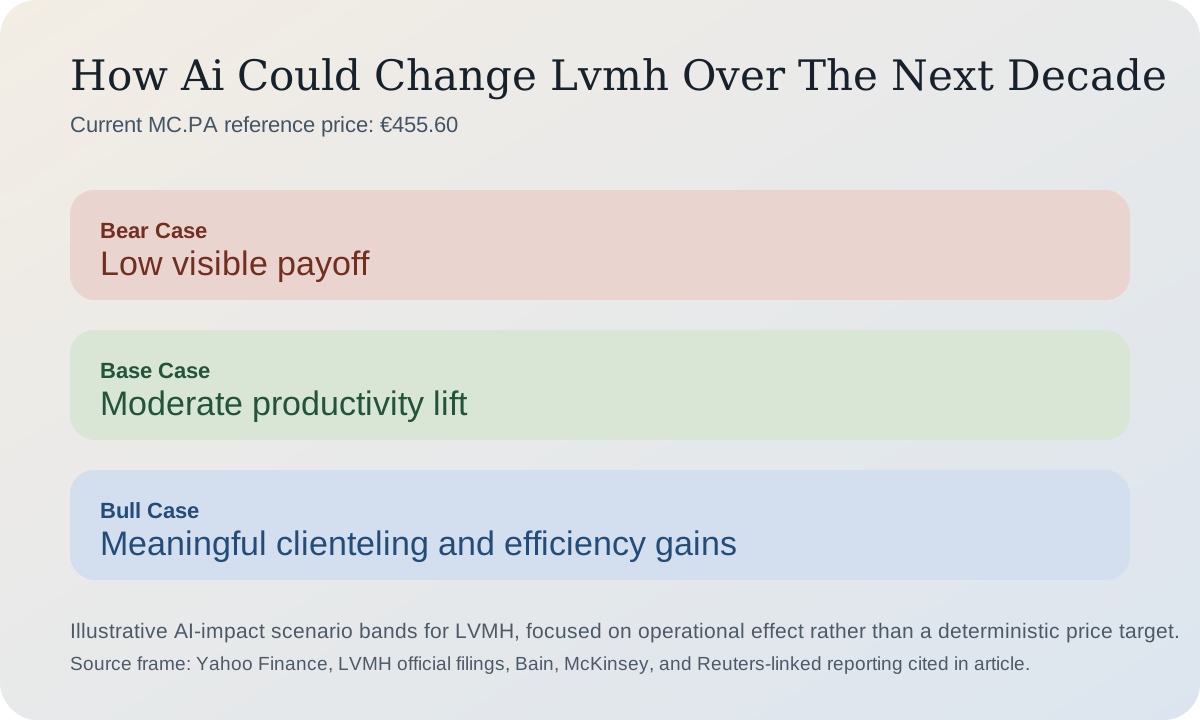
The bullish AI case is that LVMH becomes materially better at personalization, conversion, planning, and supply-side quality control while preserving the human aura of luxury. In equity terms, that could support a stronger premium multiple and faster per-share compounding than the market currently expects.
Base-case AI scenario
The base case is more moderate. AI gradually improves marketing efficiency, merchandising precision, and selected operational workflows, helping margins and execution without fundamentally rewriting the luxury model.
Bearish AI scenario
The bearish AI case is not that the company does nothing. It is that deployment remains fragmented, the economic payoff stays hard to see, or the human nature of luxury limits the most obvious automation gains.
| Scenario | Business effect | Equity implication | Probability |
|---|---|---|---|
| Bull | Visible gains in conversion, targeting, and operational precision | Supports a stronger premium and better long-run margins | 25% |
| Base | Gradual, measurable productivity benefits | Helpful but not revolutionary for valuation | 55% |
| Bear | Slow adoption or low visible payoff | Little incremental valuation uplift beyond current expectations | 20% |
| Path | Estimated probability | Comment |
|---|---|---|
| AI improves LVMH meaningfully | 50% | The group has the scale and data to execute, but luxury monetization will be gradual. |
| AI disappoints relative to expectations | 20% | Execution, culture, and trust constraints are real. |
| AI helps only incrementally | 30% | That is often the realistic path in high-touch premium sectors. |
Risks to watch
Watch whether AI use cases translate into visible gains in marketing efficiency, retail productivity, or customer retention, and whether LVMH can scale these without diluting brand intimacy.
What could invalidate the AI outlook
The optimistic view would be too strong if AI initiatives remain mostly demonstrative and fail to show operational value. It would be too cautious if LVMH starts pointing to measurable improvements in clienteling, merchandising, or operating productivity tied directly to AI-enabled systems.
Conclusion
AI could change LVMH materially over the next decade, but mostly by improving how a luxury empire operates rather than by changing what luxury fundamentally is. That may sound less dramatic, but for long-term investors it could still be economically meaningful.
The practical question is therefore not whether AI headlines sound impressive. It is whether AI quietly improves the economics of serving clients, managing inventory, and protecting brand desirability better than before.
Disclaimer: This article is for informational research only. Any long-run valuation implications from AI remain conditional and uncertain.
06. Investor Positioning
Investors should treat AI as optional upside, not as a substitute for valuation discipline
| Investor type | Prudent approach | What to track |
|---|---|---|
| Investor already in profit | Do not pay any price for the AI narrative alone. | Look for evidence of real operating gains, not just innovation theater. |
| Investor currently at a loss | Avoid using AI as a post-hoc justification for prior entries. | Check whether the core luxury thesis still stands without AI hype. |
| Investor with no position | Treat AI as optional upside, not the whole investment case. | Valuation and sector recovery still matter more. |
| Trader | Trade around AI headlines carefully. | Technology headlines can move sentiment more than fundamentals in the short run. |
| Long-term investor | View AI as a margin and desirability enhancer that compounds slowly. | Customer experience, productivity, and brand protection. |
| Risk-hedging investor | Do not confuse AI optionality with downside protection. | Separate secular upside from portfolio hedging. |
07. FAQ
Frequently asked questions about AI and LVMH
Will AI make LVMH a technology company?
No. The more realistic outcome is that AI makes LVMH a more efficient, more targeted, and more data-driven luxury company.
What are the clearest AI use cases for LVMH?
Clienteling, marketing efficiency, demand forecasting, vineyard analysis, merchandising, and internal workflows appear to be among the clearest current use cases.
What is the biggest risk to the AI thesis?
The biggest risk is that luxury's human and brand-sensitive nature limits how much automation can translate into visible financial payoff.
References
Sources
- Yahoo Finance chart API for MC.PA, 10-year monthly history
- Yahoo Finance chart API for MC.PA, recent daily closes
- LVMH 2025 full-year results press release
- LVMH Q1 2026 revenue press release
- LVMH key documents page, including 2025 annual report
- LVMH 2025 dividend announcement
- Reuters on LVMH shares diving after 2025 results
- Reuters on LVMH fourth-quarter sales and China improvement
- Reuters on LVMH shares after Q1 2026 and Middle East disruption
- Reuters analysis on luxury-stock volatility in 2026
- Bain & Company / Altagamma 2025 luxury market study
- McKinsey State of Fashion 2026
- LVMH at VivaTech 2025
- LVMH x VivaTech 2025
- LVMH Dream Garden at VivaTech 2024
- LVMH startups and tech partners