01. Quick Answer
AI could change Mitsubishi UFJ less through hype and more through the operating system of the bank itself
MUFG is not an AI stock in the way a semiconductor or software platform is. But that does not mean AI is irrelevant. In a bank with this scale, even modest improvements in service productivity, risk processes, sales quality, and document workflows can become financially material over a decade (MUFG AI Policy; MUFG Report 2025).
The official record already points in that direction. MUFG says it aims to become an AI-native organization, has established an AI policy centered on governance and human-centric use, and disclosed that AI strategies have progressed ahead of the initial medium-term plan (MUFG Report 2025 integrated report; strategy page). The bank also deepened its relationship with Sakana AI and linked AI and cloud capabilities to its retail and digital ambitions (Sakana AI investment release; FY2026 highlights).
| Point | Why it matters |
|---|---|
| The AI story is operational first | Productivity and control improvements likely matter before any dramatic new revenue stream. |
| Governance is central | MUFG's own AI policy emphasizes safety, transparency, accountability, and literacy. |
| AI supports, not replaces, the banking thesis | Returns still depend on rates, capital returns, and execution. |
| The upside is cumulative | Many small gains across a huge institution can add up over time. |
02. Historical Context
MUFG's AI opportunity sits on top of a bank already trying to improve ROE and customer reach
AI matters more when it lands inside a business already in transition. MUFG is not starting from a static base. It is already trying to lift ROE, expand digital touchpoints, grow customer referrals, and build a broader Asia x Digital footprint (MUFG strategy page and medium-term business plan; MUFG Report 2025 integrated report). That makes AI more than a side project.
The integrated report says MUFG aims to transform into an AI-native company, while the latest full-year highlights say AI initiatives are progressing ahead of the original medium-term plan and that the Google alliance in retail is built around advanced AI and cloud technologies (MUFG Financial Highlights under Japanese GAAP for the fiscal year ended March 31, 2026). The evidence suggests AI is being treated as infrastructure for the business, not just as marketing language.
| Metric | Reading | AI relevance |
|---|---|---|
| Current ADR price | 18.84 | AI optimism is entering an already rerated bank story. |
| ROE | 11.3% | AI matters most if it helps sustain or improve returns. |
| FY2026 ROE target | Approx. 12% | Provides a measurable framework for judging AI productivity help. |
| AI strategic posture | AI-native organization goal | Shows management is framing AI as a broad operating capability. |
| Area | Mechanism | Potential effect |
|---|---|---|
| Employee productivity | Copilot-style workflow support and internal automation | Can lower cost-to-serve and improve speed. |
| Sales and customer analytics | Data-driven targeting, referrals, and advice | Can raise revenue quality and cross-sell efficiency. |
| Risk and fraud controls | Better detection and screening | Can reduce losses and response costs. |
| Document and process operations | Automation of legacy workflows and review tasks | Can improve operating leverage over time. |
03. Main Drivers
Five AI channels could materially reshape MUFG over the next decade
1. AI-native operating model. MUFG Report 2025 explicitly frames the bank's ambition to become an AI-native organization. That matters because it implies AI will be pushed across workflows rather than limited to a single team.
2. Governance-led deployment. MUFG's AI Policy stresses human-centric use, reliability, fairness, privacy, information security, transparency, accountability, and AI literacy. In banking, good governance is part of the AI investment case, not a side issue.
3. Retail and digital customer experience. The latest highlights connect the Google retail alliance to advanced AI and cloud technologies and to creating more seamless digital financial experiences (MUFG Financial Highlights under Japanese GAAP for the fiscal year ended March 31, 2026). If executed well, that can improve customer acquisition and retention economics.
4. Frontier partnerships and model innovation. MUFG's additional investment in Sakana AI shows the bank wants direct exposure to advanced AI model development and implementation, not just vendor consumption.
5. Fraud, security, and control pressure. The same FY2026 highlights that celebrate AI progress also list information-security threats posed by advances in AI as a key risk (MUFG Financial Highlights under Japanese GAAP for the fiscal year ended March 31, 2026). That duality matters: AI can create both efficiency upside and new control costs.
04. Institutional Forecasts and Analyst Views
The AI case is strongest when framed as productivity and customer-value enhancement
There are few credible public analyst models that isolate an AI valuation premium for MUFG. The better approach is to use official disclosures to understand where AI could move economics. MUFG Report 2025 says AI initiatives are already ahead of the original plan and ties them to work-style reform, data-driven sales, and stronger AI and data infrastructure. The Sakana AI release says MUFG sees AI as part of data-driven management, productivity improvement, and customer-value creation.
That evidence supports a long-run positive view, but not an immediate hype premium. Analysts remain divided because the evidence is mixed on timing. Large banks often realize AI gains gradually, first in internal process quality and only later in reported efficiency ratios or revenue quality.
| Source | What it shows | Implication |
|---|---|---|
| MUFG AI Policy | Formal governance framework for AI use | Reduces the odds of careless deployment. |
| MUFG Report 2025 | AI-native ambition and progress ahead of plan | Signals broad internal adoption intent. |
| FY2026 highlights | Retail alliance and AI progress embedded in strategy | Connects AI to customer economics and productivity. |
| Sakana AI investment | Direct relationship with advanced AI R&D capability | Gives MUFG a deeper optionality layer than generic software procurement. |
05. Scenarios, Risks, and Invalidation
AI matters most if it changes economics, not just narratives
Bullish scenario
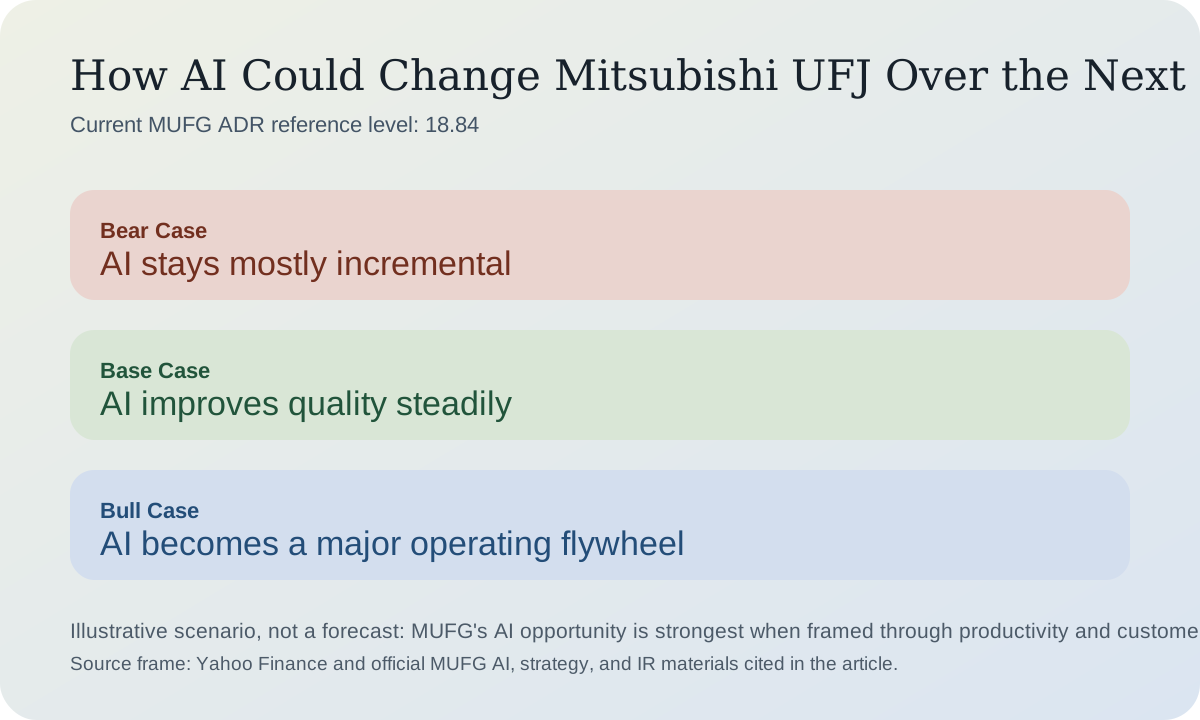
The AI upside case is roughly $30 to $40 by the mid-2030s. That requires AI to materially improve productivity, fraud control, customer acquisition efficiency, and sales quality while staying inside manageable governance boundaries.
Bearish scenario
The limited-impact case is $17 to $24. That would likely happen if AI remains useful but too diffuse to change valuation much, or if governance and security costs absorb much of the benefit.
Base-case scenario
The base case is $24 to $32. It assumes AI gradually improves operating leverage and customer value but does not transform MUFG into a pure growth multiple story.
The methodology behind these ranges is deliberately conservative. Banks rarely monetize new technology in a straight line, and the institutions that win are usually those that combine productivity gains with risk discipline.
Risks to watch
Watch whether AI projects become measurable in productivity, cost-to-serve, fraud outcomes, or customer conversion rather than staying mostly conceptual.
What could invalidate the forecast
This framework would be too optimistic if AI raises governance and cyber risk faster than it lifts efficiency. It would be too cautious if MUFG turns AI into a genuine productivity flywheel across sales, operations, and controls.
Conclusion
AI could materially change Mitsubishi UFJ over the next decade, but probably through steady operating leverage and better customer economics rather than through a sudden tech-stock rerating. For investors, that may actually be the healthier version of the thesis.
Disclaimer: This article is for research and informational purposes only. AI-related scenarios are conditional estimates based on public disclosures and cited sources, not guarantees of future stock performance.
| Scenario | Range | Conditions | Probability |
|---|---|---|---|
| AI upside | $30-$40 | Productivity, sales quality, and control gains become measurable | 25% |
| Base | $24-$32 | AI lifts quality gradually without a hype-style rerating | 50% |
| Limited impact | $17-$24 | Benefits stay real but financially incremental | 25% |
| Outcome | Probability | Comment |
|---|---|---|
| AI materially improves earnings quality | 45% | The scale of MUFG makes many small productivity gains potentially meaningful. |
| AI effect is mixed but positive | 35% | Likely if the improvements remain visible internally but only partly visible to the market. |
| AI stays mostly incremental | 20% | Possible if governance and control needs absorb much of the economic upside. |
06. Investor Positioning
Position sizing should reflect starting point, time horizon, and macro tolerance
Investors should treat MUFG's AI story as a long-duration quality and productivity thesis, not as a short-term headline trade.
| Investor type | Prudent approach | Why |
|---|---|---|
| Investor already in profit | Hold the core, but trim if Japanese bank exposure has become oversized after MUFG's long rerating. | That preserves gains while leaving room for BOJ upside if margins keep widening. |
| Investor currently at a loss | Re-check whether the original thesis was about dividends, rates, or broad value re-rating before averaging down. | Losses in bank stocks often come from wrong catalysts rather than wrong franchises. |
| Investor with no position | Build exposure in stages or wait for pullbacks instead of chasing strong sentiment. | Japanese bank stocks can reprice sharply around BOJ meetings, FX moves, and credit headlines. |
| Trader | Use stop-losses, focus on BOJ dates, JGB volatility, and earnings guidance, and avoid treating dividends as a short-term shield. | Near-term price action is still macro-driven. |
| Long-term investor | Favor dollar-cost averaging, periodic rebalancing, and disciplined review of ROE, CET1, and payout quality. | The long case depends on multi-year profitability, not one quarter of excitement. |
| Risk-hedging investor | Consider hedging market beta or rebalancing against cyclical financial exposure. | MUFG can be a hedge against rising Japanese rates, but not against every global risk shock. |
07. FAQ
Frequently asked questions about AI and Mitsubishi UFJ
Is MUFG really an AI stock?
Not in the narrow sense. But AI can still matter materially by improving productivity, controls, and customer economics across a huge banking platform.
Why does the AI policy matter for investors?
Because in banking, governance quality can determine whether AI becomes an asset or a source of operational and reputational risk.
What is the most important AI metric to watch?
Watch whether AI starts showing up in better operating leverage, higher sales productivity, and stronger risk outcomes rather than only in strategy slides.
References
Sources
- Yahoo Finance chart API for MUFG, 10-year monthly history
- Yahoo Finance chart API for MUFG, recent daily closes
- MUFG Financial Highlights under Japanese GAAP for the fiscal year ended March 31, 2026
- MUFG Report 2025 integrated report
- MUFG strategy page and medium-term business plan
- MUFG AI Policy
- MUFG additional investment in Sakana AI
- MUFG investor relations homepage