01. Quick Answer
AI could matter a lot to Nestle, but mostly by improving execution in a very large physical business
The right AI question for Nestle is not whether it can become an AI winner in the same way a chipmaker can. It is whether AI can make a global food company faster, more adaptive, and more efficient in product development, marketing, procurement, manufacturing, and supply chain planning.
There is already evidence that the answer may be yes. Nestle said in October 2025 that its next-generation SAP-based digital core upgrade will enable AI and automation at scale across supply chain, procurement, order fulfillment, and investment prioritization (Nestle digital core upgrade). The implication for investors is gradual productivity rather than science-fiction disruption.
| Point | Why it matters |
|---|---|
| AI is an execution story for Nestle | The likely value is better forecasting, content creation, procurement, and operations rather than a new standalone revenue line. |
| Marketing and supply chain may benefit first | Those functions already show clear evidence of AI deployment in Nestle's own disclosures. |
| The upside is real but probably incremental | AI could improve margins and agility, yet it may not fully change a mature staples valuation on its own. |
| There are still adoption and governance risks | Bad data, weak execution, or overpromising could make AI investment less valuable than bulls expect. |
02. Historical Context
Nestle is already using AI in ways that fit a global food company, which makes this a present-tense productivity story rather than a distant concept
The company's own materials show that AI is not a theoretical future project. Nestle said in 2025 that it launched an AI-driven service using digital twins to create product visuals for e-commerce and brand assets faster and at lower cost, and that its marketing and operations teams were increasingly using advanced analytics and automation (digital twins announcement; transformation page).
That matters because big food is a systems business. Even small gains in forecast accuracy, procurement discipline, creative efficiency, or factory orchestration can be worth a lot when applied across nearly CHF 90 billion of annual sales.
| Metric | Latest sourced reading | Why it matters |
|---|---|---|
| Digital core upgrade | Designed to enable AI and automation at scale | Creates the data and process backbone needed for broader productivity gains. |
| Digital twins for brands | Used for product visuals across e-commerce and marketing assets | Can lower cost and speed up content cycles. |
| Procurement adoption | Around 85% of procurement teams use the AI-enabled system for over 40% of spend | Suggests tangible, not just aspirational, deployment. |
| Frontier Firm AI Initiative | Nestle joined the Harvard D3 and Microsoft collaboration in late 2025 | Signals management interest in broader AI operating-model change. |
| Data point | Reading | Interpretation |
|---|---|---|
| Near-term equity effect | Likely limited | Investors usually wait for measurable margin and growth improvements before rerating staples stocks for AI. |
| Operational leverage potential | Meaningful | A huge supply chain and procurement base creates room for incremental gains to scale. |
| Use-case maturity | Early but real | Nestle has moved beyond pilots in several functions, though enterprise-wide payoff is still developing. |
| Main valuation channel | Better execution | AI matters if it improves category growth, inventory, service levels, and margins. |
03. Main Drivers
Where AI could matter most for Nestle over the next decade
1. Demand forecasting and supply chain planning
Nestle's digital core upgrade is explicitly framed around improved supply chain visibility, smarter order fulfillment, and better investment prioritization. For a company with global manufacturing and retailer complexity, that may be the single biggest long-run AI use case.
2. Procurement and cost discipline
The annual-report transformation material says about 85% of procurement teams now use the AI-enabled system for over 40% of Nestle's purchasing spend. That can support savings, negotiation discipline, and faster decisions if the data quality remains strong.
3. Marketing content and ROI
Nestle's digital-twins announcement and annual-review commentary both point to a future where content is produced faster and marketing mix is optimized more rigorously. For a portfolio with hundreds of brands and markets, speed alone can be valuable.
4. Product innovation and personalization
McKinsey's AI work in consumer packaged goods argues that digital and AI can improve product formulation, packaging design, and earlier testing of ideas. Nestle's scale in nutrition, beverages, and petcare gives it plenty of surfaces where those capabilities could matter (McKinsey on AI in CPG).
5. Organization design and talent productivity
Nestle's participation in the Frontier Firm AI Initiative with Harvard and Microsoft suggests management is thinking beyond tools and toward operating-model change. Over a decade, that could affect how decisions are made across zones, categories, and functions.
| Lever | Latest evidence | Forecast impact |
|---|---|---|
| Supply chain AI | Digital core built to improve visibility and automation | Could reduce waste, stock-outs, and working-capital friction. |
| Procurement AI | Already used by most procurement teams for a large share of spend | Supports margin defense and faster decision-making. |
| Marketing AI | Digital twins and marketing-mix modeling already referenced by Nestle | Can raise content efficiency and ROI measurement. |
| Innovation AI | Sector research suggests use cases in formulation and idea testing | Could modestly improve speed-to-market in key categories. |
04. Institutional Forecasts and Analyst Views
The AI forecast for Nestle should focus on productivity, margin quality, and organizational speed - not on hype
Nestle's own messaging is consistent: AI is being used to improve operations and customer responsiveness, not to market an entirely new equity identity. That makes the likely payoff easier to understand and also easier to overestimate if investors are not careful.
The best case is that AI compounds quietly into better forecasting, procurement, marketing ROI, and innovation throughput. The weaker case is that the gains remain too incremental or too hard to isolate to meaningfully change valuation.
| Source | What it says | Implication for NESN |
|---|---|---|
| Nestle digital core upgrade | AI and automation at scale across operations | Most direct official evidence for future productivity gains. |
| AI-powered digital twins | Faster and cheaper brand content creation | Suggests near-term marketing and e-commerce efficiency upside. |
| Frontier Firm AI Initiative | Collaboration with Harvard D3 and Microsoft | Indicates Nestle is engaging with AI operating-model questions, not just point tools. |
| McKinsey AI in CPG research | Quantifies potential value in digital and AI transformation across food and beverage | Supports a constructive but measured view of AI's economic relevance. |
05. Scenarios
Bull, base, and bear scenarios for AI's impact on Nestle
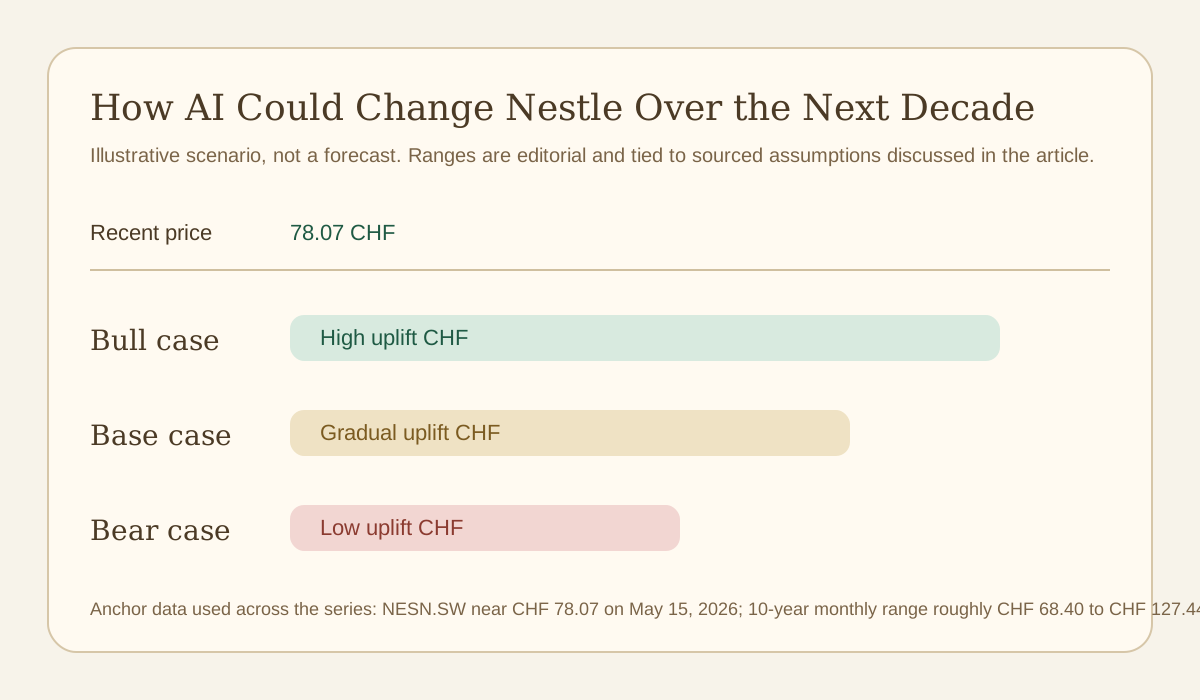
These are not price forecasts in the narrow sense. They are scenarios for how much AI changes Nestle's operating quality, which then feeds into the stock over time.
The crucial distinction is between illustrative productivity uplift and narrative inflation. AI could matter a lot strategically even if the share-price effect arrives slowly.
| Scenario | Range | What would likely drive it | Editorial probability |
|---|---|---|---|
| Bull | Material operating uplift | AI meaningfully improves forecasting, procurement, content efficiency, and speed-to-market, supporting better margins and a higher-quality multiple. | 27% |
| Base | Gradual, uneven uplift | AI helps several functions, but the payoff is incremental and partly absorbed by reinvestment needs. | 52% |
| Bear | Limited visible benefit | Adoption remains fragmented, data quality issues slow scaling, or gains are too small to change valuation materially. | 21% |
| Outcome | Probability | Interpretation |
|---|---|---|
| Rising | 41% | AI could help the stock if it becomes visible in margins and agility, especially from a compressed valuation base. |
| Falling | 18% | AI itself is unlikely to hurt the stock materially unless spending disappoints or execution stumbles. |
| Moving sideways | 41% | Most likely if AI helps operations but not enough for the market to rerate Nestle aggressively. |
| Risk | Why it matters | What to monitor |
|---|---|---|
| Overpromising AI benefits | Could create investor disappointment if numbers do not move. | Management language versus actual margin, working-capital, and growth outcomes. |
| Fragmented adoption | Use cases may stay local instead of scaling across the enterprise. | Evidence of rollout across zones, categories, and functions. |
| Data and governance issues | Poor data quality can limit the value of AI at scale. | Operational disruptions, compliance controls, and process standardization. |
| Reinvestment drag | Benefits may be consumed by ongoing tech and talent spending. | Net margin effect rather than isolated efficiency anecdotes. |
| Condition | Why it would change the view |
|---|---|
| Clear multi-year margin gains tied to digital execution | That would make this article's cautious base case too conservative. |
| Little enterprise-wide scaling beyond pilot projects | That would weaken the thesis that AI becomes strategically meaningful for Nestle. |
| Major shifts in regulation or data architecture | These could materially alter adoption speed and economic payoff. |
06. Investor Positioning
How investors might think about AI and Nestle without overreacting to hype
AI should be treated as a supporting factor in the Nestle thesis, not a substitute for classic staples metrics like RIG, margins, cash flow, and capital allocation.
| Investor type | Prudent stance | Why |
|---|---|---|
| Investor already in profit | Hold, but do not pay a software-like multiple for a food company | AI can help, yet the business model remains fundamentally physical and branded. |
| Investor currently at a loss | Use AI developments as evidence of execution quality, not as a reason to ignore valuation | The payoff still has to show up in the numbers. |
| Investor with no position | Wait for evidence that AI is improving margins or growth quality, or accumulate gradually | Story alone is not enough. |
| Trader | Avoid chasing AI headlines unless they are attached to financial guidance changes | Nestle is unlikely to respond like an AI infrastructure stock. |
| Long-term investor | Watch whether AI strengthens Nestle's moat through better speed, service, and efficiency | That is where the real long-run value could emerge. |
| Risk hedger | Do not assume AI investment eliminates staples risk | Macro, category, and company-specific issues still dominate downside scenarios. |
07. Conclusion
AI could make Nestle better, but probably not louder
That is the key investment implication. The most plausible AI outcome is a more efficient, more responsive, and more data-driven Nestle rather than a radically reimagined equity story.
If those operating improvements compound over time, the stock can benefit through better margins, steadier growth quality, and perhaps some rerating. If not, AI may still help the business internally while leaving the share-price narrative largely unchanged.
Disclaimer: This article is an editorial scenario analysis based on public information available as of May 16, 2026. It is not personalized investment advice, and the ranges above should be read as conditional outcomes rather than promises.
08. FAQ
Frequently asked questions
Is AI likely to transform Nestle's revenue growth dramatically?
Probably not on its own. The more realistic benefit is better execution, faster innovation, and improved cost discipline across a very large organization.
Where is Nestle already using AI?
Nestle has disclosed AI-linked work in digital twins for brand content, procurement tools, marketing mix modeling, and digital-core systems that support broader automation and analytics.
Why could AI still matter for investors if the share-price effect is slow?
Because small improvements in forecasting, working capital, procurement, and marketing efficiency can add up over time in a company of Nestle's scale.
What is the main risk in the AI thesis for Nestle?
The main risk is that adoption remains too fragmented or too incremental to produce visible financial improvement.
References
Sources
- Yahoo Finance chart API for NESN.SW 10-year monthly price history and recent price data
- Nestle annual report hub
- Nestle Annual Review 2025 PDF
- Nestle full-year results 2025 press release
- Nestle full-year results 2025 prepared remarks PDF
- Nestle full-year results 2025 transcript PDF
- Nestle three-month sales 2026 press release
- Nestle Q1 2026 investor call transcript PDF
- Company-compiled analyst consensus before Nestle Q1 2026 sales
- Nestle Capital Markets Day 2024
- Nestle investor strategy overview
- Nestle 2025 operating segment and product restatements PDF
- Nestle annual-report page on accelerating business transformation
- Nestle AI-powered digital twins announcement
- Nestle digital core upgrade enabling AI and automation at scale