01. Quick Answer
AI could change Novartis materially, but mostly by increasing the productivity of an already strong scientific machine
For Novartis, AI is not a branding accessory. It is a tool that may improve how the company discovers compounds, prioritizes targets, designs experiments, manages data, supports development, and commercializes medicines. That makes the economic relevance potentially greater than in many conventional blue chips.
The company has been explicit about this for years. Novartis announced an AI innovation lab with Microsoft in 2019, continues to describe AI as relevant from research through commercialization, and in 2025 disclosed AI-enabled R&D and commercial priority programs, including partnerships with Isomorphic Labs, Generate Bio, Profound Therapeutics, and Relation Therapeutics (Novartis and Microsoft; Form 20-F 2025).
| Point | Why it matters |
|---|---|
| AI matters most in R&D and development throughput | The biggest value may come from making the scientific pipeline more productive, not from flashy consumer tools. |
| Novartis already has an AI foundation | The company has formal governance, platform partnerships, and disclosed programs rather than just generic AI slogans. |
| The upside is more about probability than certainty | AI can improve hit rates and speed, but biology and regulation still dominate ultimate outcomes. |
| Commercial and operational gains also matter | AI can influence trial design, manufacturing planning, compliance monitoring, and go-to-market efficiency. |
02. Historical Context
Novartis has treated AI as a multi-function enterprise capability rather than a one-off experiment, which makes the next decade especially relevant
Novartis has discussed machine learning and AI in drug discovery for years, but the more relevant point now is institutionalization. The company created an AI innovation lab with Microsoft, continued AI-enabled R&D and commercial programs, and published a formal commitment to the responsible use of AI systems in 2026.
That is important because healthcare AI only becomes strategically valuable when it moves beyond isolated experiments and into governed, repeatable workflows. For a company with the scale of Novartis, even incremental productivity improvements across research, operations, and commercialization could be meaningful.
| Metric | Latest sourced reading | Why it matters |
|---|---|---|
| Microsoft alliance | Strategic AI and data-science collaboration announced in 2019 | Shows long-standing enterprise commitment rather than a late AI catch-up. |
| AI governance | Responsible-use framework published in 2026 | Important because highly regulated industries need governance as well as experimentation. |
| AI-enabled R&D and commercial programs | Disclosed in 2025 Form 20-F | Suggests AI is already influencing practical priorities rather than sitting on the sidelines. |
| AI-enabled discovery facilities | San Diego research center planned with AI-enabled discovery capabilities | Signals that future infrastructure is being designed around data and computational science. |
| Data point | Reading | Interpretation |
|---|---|---|
| Discovery effect | Potentially significant | AI can help prioritize targets, design molecules, and shorten iteration cycles. |
| Development effect | Moderate to significant | Trial design, patient selection, and data interpretation may become faster and more precise. |
| Commercial effect | Incremental but real | AI may help pricing strategy, engagement quality, forecasting, and market access preparation. |
| Equity-market effect | Gradual | Investors will probably reward AI only when it visibly improves productivity and returns. |
03. Main Drivers
Where AI could matter most for Novartis over the next decade
1. Target identification and molecule design
This is the most obvious high-value zone for AI in pharma. Novartis has long described machine learning as a way to accelerate discovery, and its collaboration ecosystem suggests the company still sees computational biology and generative design as meaningful strategic levers.
2. Earlier, smarter portfolio pruning
One underappreciated AI benefit is helping companies stop bad projects earlier. If Novartis can reduce late-stage waste and improve candidate quality, that may matter as much as finding one extra blockbuster.
3. Clinical-development speed and precision
AI can help with trial design, site selection, recruitment optimization, and data interpretation. In a company with dozens of important readouts, shaving friction out of development cycles compounds meaningfully.
4. Manufacturing and supply resilience
Advanced therapies such as radioligand treatments and biologics are operationally complex. AI can help planning, quality monitoring, and supply reliability, which are strategically important for Novartis.
5. Responsible AI and compliance
The company’s responsible-use document highlights patient access, predictive analytics, automation, and misconduct detection. In pharma, governance is part of the value proposition because unmanaged AI can create regulatory and trust problems just as easily as efficiency gains.
| Lever | Latest evidence | Forecast impact |
|---|---|---|
| Drug discovery | Novartis has discussed AI and machine learning in discovery for years and continues AI-enabled partnerships | Could improve hit quality and discovery speed over the decade. |
| Pipeline prioritization | AI can support faster go/no-go decisions across a broad portfolio | May improve capital efficiency and long-term R&D returns. |
| Manufacturing and supply | Complex platforms like RLT benefit from better planning and quality oversight | Could strengthen margins and service reliability. |
| Compliance and governance | Responsible AI framework now published | Reduces the risk that scaling AI creates avoidable regulatory problems. |
04. Institutional Forecasts and Analyst Views
The AI forecast for Novartis is mainly a productivity forecast
The strongest way to think about AI and Novartis is to ask whether AI raises the productivity of R&D and operations enough to improve the company’s hit rate, speed, and margin quality over time. That is a very different question from whether the stock becomes an “AI trade.”
Available evidence suggests the likely payoff is real but gradual. AI may not transform Novartis overnight, yet over a decade it could improve how capital, data, and scientific effort are converted into medicines and returns.
| Source | What it says | Implication for NOVN |
|---|---|---|
| AI innovation lab with Microsoft | Built to bolster AI capabilities from research through commercialization | Official proof that AI is intended as a company-wide capability. |
| Responsible AI policy | AI can improve access, customer experience, automation, predictive analytics, and drug development if used responsibly | Highlights both opportunity and governance requirements. |
| 20-F disclosure | AI-enabled R&D and commercial programs plus discovery partnerships | Suggests AI already influences priority work rather than sitting in pilot mode only. |
| San Diego research center | AI-enabled discovery capabilities planned in a major R&D hub | Shows infrastructure is being designed for the next operating model, not the last one. |
05. Scenarios
Bull, base, and bear scenarios for AI's impact on Novartis
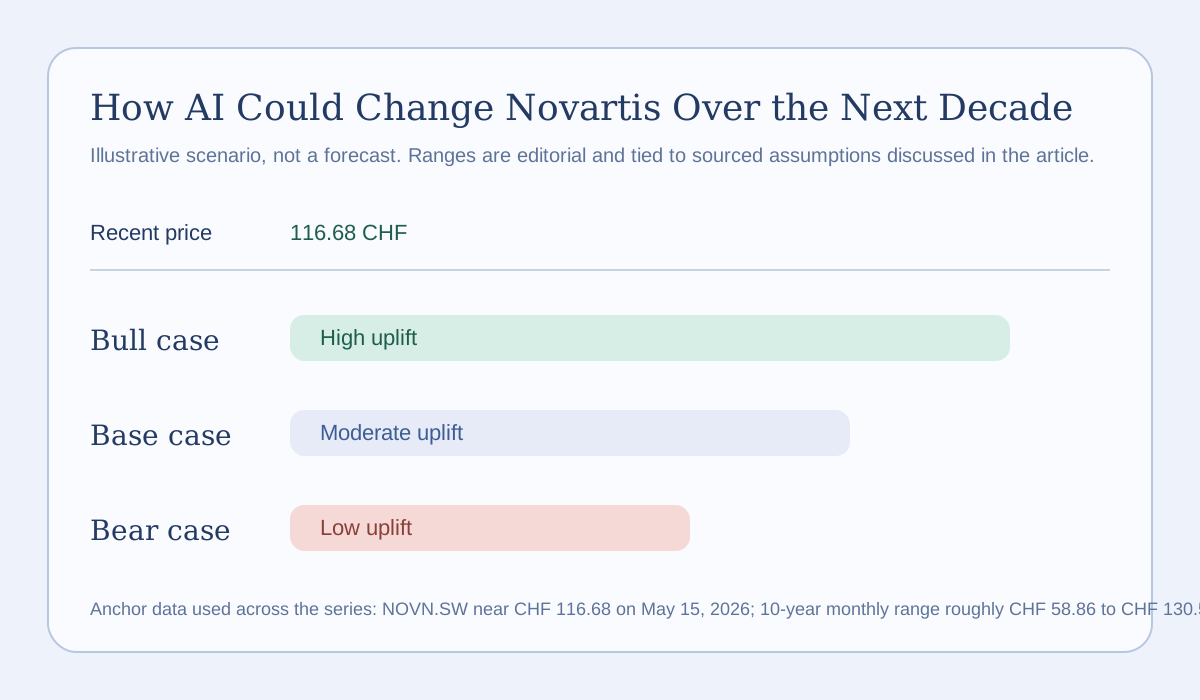
These are not narrow share-price targets. They are scenarios for how much AI changes Novartis’ ability to discover, develop, and commercialize medicines more efficiently over time.
The key distinction is between real productivity and AI theater. Novartis does not need AI headlines. It needs measurable improvement in output quality and speed.
| Scenario | Range | What would likely drive it | Editorial probability |
|---|---|---|---|
| Bull | High productivity uplift | AI materially improves discovery, portfolio pruning, development speed, and manufacturing reliability, helping Novartis sustain superior returns. | 29% |
| Base | Moderate productivity uplift | AI becomes a valuable but uneven enabler across R&D, development, and operations, improving quality without redefining the whole business. | 51% |
| Bear | Limited visible uplift | AI remains useful in pockets but does not materially change the economics or pace of innovation enough for investors to care much. | 20% |
| Outcome | Probability | Interpretation |
|---|---|---|
| Rising | 44% | AI could support a better long-term equity story if it measurably improves R&D productivity and launch quality. |
| Falling | 14% | AI itself is unlikely to hurt the stock materially unless investment is wasteful or governance fails. |
| Moving sideways | 42% | Likely if AI helps internally but the equity-market impact remains gradual and hard to isolate. |
| Risk | Why it matters | What to monitor |
|---|---|---|
| Overestimating AI’s economic impact | Biology and regulation still limit how quickly productivity gains show up in earnings. | Actual pipeline quality and cycle times, not just AI announcements. |
| Governance failures | Responsible use is essential in a regulated industry. | Compliance, oversight, and transparency around deployment. |
| Fragmented adoption | AI value may stay local instead of scaling across the enterprise. | Evidence of cross-function integration and repeatable use cases. |
| Competitive diffusion | If everyone adopts similar tools, advantage may narrow. | Signs that Novartis is creating proprietary data or workflow advantages. |
| Condition | Why it would change the view |
|---|---|
| Clear multi-year improvement in R&D productivity and speed | That would make the cautious base case too conservative and strengthen the bull case materially. |
| Minimal measurable change despite ongoing AI spending | That would weaken the thesis that AI becomes strategically important to Novartis over the decade. |
| Major regulatory or ethical setbacks tied to AI deployment | Those could materially change how investors view AI’s net value for the company. |
06. Investor Positioning
How investors might think about AI and Novartis without turning the stock into an AI meme
AI should be treated as an enhancer of the Novartis thesis, not a replacement for classical pharma analysis such as pipeline quality, launch uptake, margins, and capital discipline.
| Investor type | Prudent stance | Why |
|---|---|---|
| Investor already in profit | Hold, but do not assign a tech-style multiple just because Novartis uses AI | The likely payoff is real but still rooted in pharma economics. |
| Investor currently at a loss | Use AI developments as evidence of operating quality, not as an excuse to ignore valuation | AI only matters if it improves real outcomes. |
| Investor with no position | Wait for evidence that AI is helping pipeline quality or accumulate gradually | The strategic logic is better than the short-term hype value. |
| Trader | Avoid chasing generic AI headlines unless they alter financial expectations | Novartis is still primarily a pharma stock, not an AI infrastructure trade. |
| Long-term investor | Watch whether AI improves discovery speed, portfolio quality, and manufacturing resilience | Those are the channels through which AI could change the equity story. |
| Risk hedger | Do not assume AI removes classic biotech and pharma risk | Clinical, pricing, and patent risk still dominate the downside. |
07. Conclusion
AI could make Novartis a better company faster than it makes it a louder stock
That is probably the most accurate long-term frame. AI can help Novartis become more efficient in discovery, better at portfolio selection, and stronger in complex operations without necessarily turning the stock into a short-term AI sensation.
Over a decade, that quieter kind of value creation may matter a great deal. If the company turns AI into measurably better science and execution, the market will eventually care. If not, the impact may remain more internal than investable.
Disclaimer: This article is an editorial scenario analysis based on public information available as of May 16, 2026. It is not personalized investment advice, and the ranges above should be read as conditional outcomes rather than promises.
08. FAQ
Frequently asked questions
Is AI likely to transform Novartis more than a typical consumer blue chip?
Probably yes, because discovery, development, and manufacturing in pharma are highly data-intensive and can benefit materially from better prediction and automation.
Where is Novartis already using AI?
Novartis has disclosed AI efforts in discovery, development, commercial programs, enterprise capabilities, and responsible-use governance, including partnerships with Microsoft and others.
Will AI alone justify a higher valuation for Novartis?
Not by itself. Investors will likely care only if AI helps improve pipeline quality, cycle times, margins, or launch outcomes in measurable ways.
What is the main risk in the AI thesis?
The main risk is that AI remains incrementally helpful but not distinctive enough to change the company’s economics or market perception meaningfully.
References
Sources
- Yahoo Finance chart API for NOVN.SW 10-year monthly price history and recent price data
- Novartis annual results hub
- Novartis Annual Report 2025 landing page
- Novartis Annual Report 2025 PDF
- Novartis quarterly results hub
- Novartis Q1 2026 press release
- Novartis Q1 2026 interim financial report PDF
- Novartis mid-term outlook update, November 20, 2025
- Novartis San Diego research center press release
- Novartis Carlsbad radioligand therapy manufacturing press release
- Novartis remibrutinib positive CHMP opinion press release
- Novartis ianalumab FDA Breakthrough Therapy designation press release
- Novartis and Microsoft AI collaboration press release
- Novartis responsible use of AI systems document
- McKinsey on AI-driven drug discovery and biotech