01. Quick Answer
AI could reshape Shell more through operational efficiency and trading intelligence than through a flashy new revenue line
The likely AI story for Shell is not about becoming a software leader. It is about using AI across trading, predictive maintenance, refinery optimization, LNG logistics, shipping, safety systems, and commercial decision support. That can still matter financially because even modest efficiency gains scale meaningfully across an energy supermajor.
| Point | Why it matters |
|---|---|
| The AI story is indirect, not absent | Shell is still cyclical, but integration and LNG diversify the earnings mix more than many energy peers. |
| Trading and optimization could benefit most | Buybacks and dividends remain central to how the market values the equity. |
| Operational efficiency can support free cash flow | Oil and gas prices still drive the tape, but strategic portfolio decisions can change the long-run path. |
| AI can help quality without changing Shell into a tech stock | Scenario ranges are more credible than one-number certainty in a volatile energy market. |
02. Historical Context
Shell is still an integrated energy major first, but the modern investment case is increasingly about LNG resilience, capital returns, and transition discipline
SHEL moved from roughly $55.22 to about $84.51 over the last 10 years based on Yahoo Finance monthly data, implying a 10-year CAGR of about 4.35%. That is far below the long-run growth rates investors have seen in AI or software, but it is also not how most investors evaluate integrated energy majors. Shell's total-return case depends on cash generation, buybacks, dividend durability, LNG positioning, refining and trading strength, and how effectively management navigates the tension between hydrocarbons, capital discipline, and energy transition spending. Available data suggests the company remains more cyclical than a defensive compounder, but also more resilient than a pure upstream oil producer.
| Metric | Latest official reading | Why it matters |
|---|---|---|
| Q1 2026 adjusted earnings | `$6.92 billion | Shows Shell can still earn strongly in a volatile price environment |
| Q1 2026 adjusted EBITDA | `$17.7 billion | Useful gauge of integrated operating strength across segments |
| Q1 2026 free cash flow | `$2.9 billion | Cash generation matters because the stock case rests heavily on payouts and buybacks |
| Buyback pace | `$3.0 billion | Capital return policy remains central to shareholder return expectations |
| Feature | Shell implication | Forecast effect |
|---|---|---|
| Integrated LNG and trading platform | Gas, trading, and optimization can soften pure oil-price swings | Helps explain why Shell can outperform in volatile commodity environments |
| Large buyback and dividend culture | Capital returns shape sentiment as much as earnings do | Valuation support can remain firmer than for lower-payout energy peers |
| Energy-transition spending pressure | Investors must balance hydrocarbon returns with decarbonization demands | Can create both multiple support and political or strategic friction |
| Global macro sensitivity | Oil, LNG, refining, and geopolitics all feed into the thesis | Scenario ranges need to be wide and explicitly cyclical |
03. Main Drivers
Five forces are most likely to shape Shell stock over the next several years
1. Oil-price direction still matters, but less mechanically than for pure upstream producers
The IEA has become more cautious on 2026 oil demand, and its April 2026 report even projected a small decline in average demand for the year after geopolitical and macro conditions deteriorated. That matters because lower crude prices can compress upstream profitability. But Shell's integrated structure means the stock is not a one-factor oil chart.
2. LNG remains a strategic pillar of the long-run thesis
Shell's investor materials repeatedly emphasize LNG demand growth and the quality of the group's global portfolio. The strategic logic is clear: LNG offers a bridge fuel story, geographic diversification, and a large trading and optimization opportunity. The risk is that a supply wave pressures margins before demand fully absorbs it.
3. Buybacks and dividends remain critical to equity support
Reuters reporting on both Q4 2025 and Q1 2026 showed how closely investors watch payout pace. Shell's valuation can hold up even when commodity prices soften if capital returns stay credible. If buybacks slow too much, the stock can lose one of its most important supports.
4. Portfolio quality and reserve replacement are increasingly in focus
The ARC Resources acquisition matters because it adds low-cost gas and liquids exposure and supports a higher production CAGR through 2030. That helps offset the market's concern that mature oil majors can struggle to replace quality barrels and molecules organically.
5. The energy transition is both a strategic opportunity and a valuation constraint
Shell still has to balance affordability, security, and emissions. That creates strategic optionality in LNG, trading, power, and low-carbon solutions, but it also means the market may hesitate to assign a full commodity-cycle premium if long-term capital allocation looks too conflicted or politically constrained.
04. Institutional Forecasts and Analyst Views
Official company disclosures and energy-market reports provide a stronger evidence base than heroic single-number targets
There are fewer credible long-range institutional point forecasts for Shell than there are for major tech stocks, because the outcome depends so heavily on oil, gas, LNG, refining, trading conditions, and capital allocation. The better approach is to combine Shell's reported earnings, payout discipline, strategic LNG positioning, acquisition activity, and third-party energy-demand evidence from the IEA and Reuters market coverage.
| Source | What it says | Implication for SHEL |
|---|---|---|
| Shell Q1 2026 results | Strong adjusted earnings and EBITDA, lower buyback pace, volatile working-capital impact | Confirms resilience but reminds investors that cash flow can still swing with commodity conditions |
| Shell Annual Report 2025 | Reinforces value-with-lower-emissions strategy and capital-discipline framework | Supports the long-run case for a balanced but still hydrocarbon-heavy portfolio |
| Shell LNG Strategic Spotlight 2026 | Highlights Shell's confidence in long-term LNG demand growth | LNG remains one of the strongest structural arguments for the stock |
| IEA oil reports | Demand growth is slowing and 2026 looks more uncertain than prior years | Base-case energy-sector optimism should be tempered by macro and supply-risk realism |
| Reuters market coverage | Buybacks, Q1 beat, and ARC deal all moved the narrative in 2026 | The tape remains highly sensitive to capital returns, M&A, and commodity-market stress |
05. Scenarios
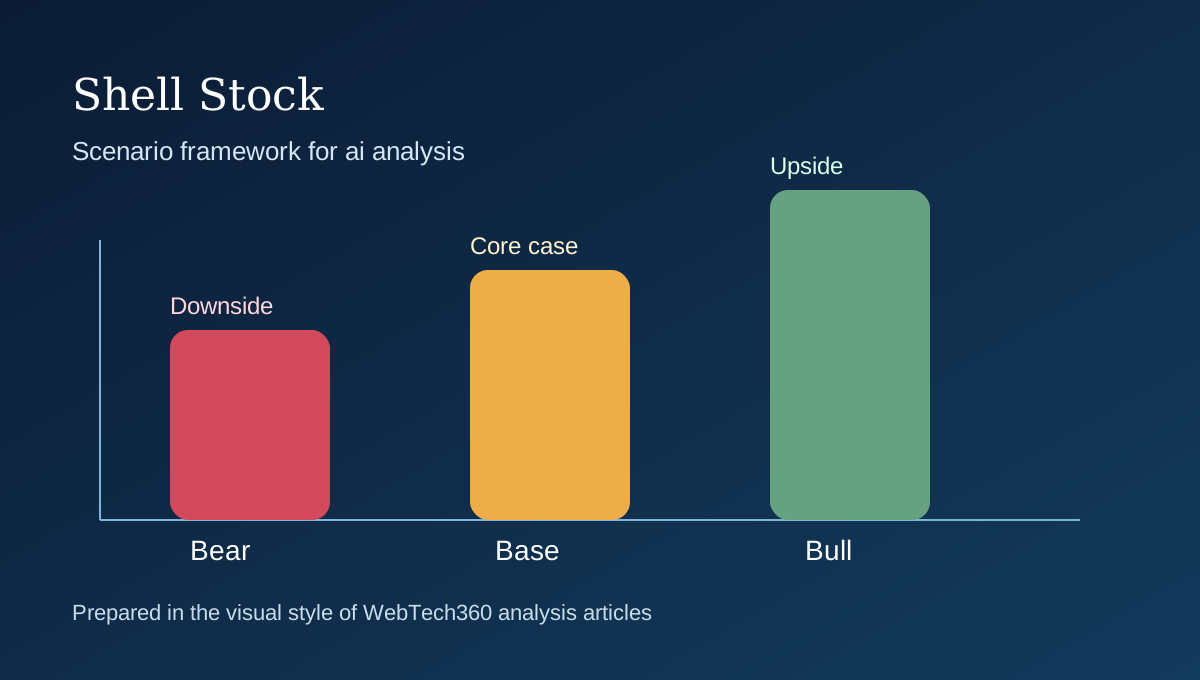
Bull, bear, and base-case scenarios for SHEL
| Scenario | Likely effect | Conditions | Probability |
|---|---|---|---|
| AI upside | `$120-`$145 by the mid-2030s | AI materially improves trading, maintenance, logistics, and capital efficiency without requiring large disruptive spending | 25% |
| Base | `$95-`$120 by the mid-2030s | AI helps margins and cash conversion gradually, but mostly through operational improvement | 50% |
| Limited impact | `$75-`$95 by the mid-2030s | AI benefits remain real but too diffuse to change valuation materially | 25% |
| AI outcome | Probability | Comment |
|---|---|---|
| AI materially improves Shell's earnings quality | 40% | Most plausible if cumulative operational gains become visible in margins and capital intensity |
| AI effect is mixed but positive | 40% | Likely if benefits are spread across many functions but not easy for the market to isolate |
| AI remains mostly incremental | 20% | Possible if the gains are useful but too small relative to commodity swings to drive valuation |
06. Investor Positioning
How different investors might respond
| Investor type | Prudent stance | Why |
|---|---|---|
| Investor already in profit | Hold core, trim into oil-driven spikes, rebalance if energy weight gets too large | Shell rallies can become crowded when crude and LNG prices spike on geopolitical stress |
| Investor currently at a loss | Reassess thesis around LNG, buybacks, and capital returns rather than spot oil alone | Shell is not a pure oil beta trade, so the reason for owning it matters |
| Investor with no position | Wait for pullbacks or build gradually | Energy majors can look cheap for long periods, but entry price still matters when macro turns |
| Trader | Use stop-losses and watch Brent, LNG pricing, buyback commentary, and geopolitical headlines | Short-term moves are often macro-driven and can reverse quickly |
| Long-term investor | Focus on free cash flow, payout durability, LNG quality, and reserve replacement | The long-run case is about disciplined cash generation more than quarterly commodity noise |
| Hedging-focused investor | Use Shell as part of an inflation and energy-security sleeve, not as a single-asset hedge | Integrated majors can help diversify growth-heavy portfolios, but they remain cyclical |
07. Risks to Watch
What could change the outlook quickly
The AI thesis for Shell can fail in two ways. First, AI-driven efficiency gains may be real but too small relative to commodity volatility to matter for the stock. Second, implementation costs and data complexity may dilute the payoff. Even so, available data suggests operational AI remains one of the more credible long-run ways a mature energy major can improve returns without relying solely on higher commodity prices.
| Possible invalidation | Why it matters |
|---|---|
| Oil and LNG prices stay structurally stronger than expected | Would support cash flow, buybacks, and a more constructive multiple than the bear case assumes |
| Buyback discipline remains steady despite volatility | Would reinforce valuation support and limit downside in softer commodity windows |
| Acquired production assets outperform expectations | Would strengthen reserve replacement and production-growth assumptions into 2030 |
| LNG oversupply proves worse than expected | Would pressure one of the most important long-run supports for Shell |
| Transition spending or politics become more disruptive | Would complicate capital-allocation confidence and compress valuation support |
08. Conclusion
Bottom line
Over the next decade, AI could change Shell more through cumulative improvements in trading, maintenance, and operational efficiency than through any single product line. That may not create tech-style excitement, but it can still matter for long-run cash generation and valuation support.
FAQ
Frequently asked questions
Is Shell mainly an oil stock or an LNG stock?
It is both, plus trading, refining, chemicals, and a transition portfolio. That is why the stock often behaves differently from pure upstream names.
Why do buybacks matter so much for SHEL?
Because payout credibility is a large part of the equity case. When buybacks weaken materially, investors often assume the company sees a tougher commodity or cash-flow outlook.
How were the forecast ranges built?
The ranges combine the current SHEL price, the 10-year CAGR, current energy-market conditions, Shell's integrated model, LNG strategy, buyback profile, and scenario analysis around oil, gas, and capital allocation. They are editorial scenario ranges, not guaranteed price targets.
What would most quickly change the thesis?
A sharp move in oil and gas prices, a material change in buyback policy, integration issues around acquisitions, or evidence that LNG margins and demand are evolving differently from current expectations.
Methodology and Invalidation
How these SHEL ranges were built and what would change them
These scenario ranges are editorial frameworks, not guarantees or institutional targets. They start with the live SHEL price near `$84.51` in mid-May 2026, then layer on the stock's 10-year CAGR of roughly 4.35%, the integrated earnings mix, Shell's buyback culture, LNG positioning, and the current macro backdrop across oil and gas. A purely mechanical extrapolation of the last decade would ignore how much Shell's path depends on cycles, capital returns, and portfolio quality. That is why a scenario matrix is more useful than a single number.
For risk language, a correction usually means about 10% down from a recent high, a bear market more like 20% down, and a crash something sharper tied to stress, forced selling, or a policy shock. Shell can experience all three, especially when energy-price volatility and geopolitics interact. But the stock can also outperform weaker commodity setups if trading, LNG, refining, and capital returns offset part of the pressure.
The evidence base here is intentionally current. Shell's Q1 2026 reporting showed strong earnings but a lower buyback pace and a working-capital hit linked partly to Middle East-driven volatility. Reuters highlighted how closely investors are watching buybacks, while the IEA has become more cautious on oil-demand growth and LNG supply balances. At the same time, Shell's ARC transaction and LNG strategy point to management's effort to strengthen long-duration cash flows. The evidence is mixed, which is exactly why cautious language is more appropriate than certainty.
What would invalidate the constructive case? A prolonged commodity downcycle, meaningfully weaker LNG economics, a major deterioration in payout support, or transition spending that looks strategically confused would all matter. What would invalidate the bearish case? Continued strong cash generation, resilient LNG and trading performance, successful integration of growth assets, and ongoing capital returns would weaken it. Investors should treat these articles as conditional research tools that need updating as energy prices, LNG balances, and company capital allocation evolve.
Disclaimer: This material is for research and editorial purposes only, does not constitute investment advice, and should not be treated as a recommendation to buy, sell, or hold Shell plc or any related security.
References
Sources
- Yahoo Finance chart API, SHEL 10-year monthly history and current price
- Shell Global, quarterly results hub including Q1 2026 materials
- Shell plc Q1 2026 unaudited results PDF
- Shell Annual Report and Accounts 2025
- Shell investor presentations, including LNG Portfolio Strategic Spotlight 2026
- Shell acquisition of ARC Resources, April 27, 2026
- IEA Global Energy Review 2026, oil section
- IEA Oil Market Report, April 2026
- IEA Oil Market Report, February 2026
- Reuters via Investing.com, Shell misses Q4 expectations but keeps buybacks, February 5, 2026
- Reuters via Investing.com, Shell tops Q1 2026 earnings forecasts and trims buyback pace, May 7, 2026
- Reuters via Investing.com, Shell flags Q1 hit from Middle East conflict, April 9, 2026
- Reuters via Investing.com, global LNG supply set to jump in 2026, January 21, 2026
- Reuters via Investing.com, Shell to buy ARC Resources in $16.4 billion deal, April 27, 2026