01. AI And Tencent
AI could change Tencent by deepening monetization inside products it already controls
The most important thing to understand about Tencent and AI is that Tencent does not need to win the global model leaderboard to create shareholder value. It needs to use AI to improve products that already have scale: WeChat search, video accounts, mini programs, ads, cloud services, customer support, recommendation engines, and game operations. That is a different investment case from a pure-model company (Tencent 1Q2026 results; Reuters on WeChat AI agent integration).
Tencent's management has already signaled materially higher AI investment, and reported capex rose sharply in 1Q2026. The opportunity is obvious: AI could increase engagement, conversion, ad pricing, and cloud demand. The risk is equally obvious: AI could stay expensive longer than bulls expect (Reuters on Tencent AI investment plans; Tencent 1Q2026 results).
02. Current Snapshot
Tencent is already spending like AI matters
The data no longer support the idea that Tencent is merely talking about AI. In 1Q2026, capex reached RMB31.9 billion, up from RMB27.5 billion a year earlier, while management commentary emphasized higher investment in infrastructure and new AI opportunities. Reuters coverage in March 2026 also highlighted Tencent's intention to step up AI investment after export controls held back some 2025 spending plans (Tencent 1Q2026 results; Reuters on Tencent AI investment plans).
That matters because Tencent starts from unusually strong consumer and merchant distribution. AI applied inside WeChat can matter economically faster than AI sold through a standalone app because Tencent already has traffic, merchants, and content inventory to optimize.
Historical context makes this more interesting. Tencent has repeatedly turned interface control into monetization leverage, whether through games, payments, or merchant services. AI could become the next layer of that pattern. But if history offers an upside template, it also offers a warning: the stock can remain skeptical until the market sees hard commercial proof, not just product ambition (CompaniesMarketCap Tencent price history; Tencent 2024 Annual Report PDF; Tencent 2025 Annual Report PDF).
| AI lever | Tencent asset base | Potential economic effect |
|---|---|---|
| Ad targeting | WeChat search, video accounts, mini programs | Higher yield per impression |
| Enterprise tools | Tencent Cloud and business services | Better attach rates and stickier services |
| Games | Large live-service portfolio | Lower development friction and stronger user retention tools |
| Agents | WeChat interface and merchant workflows | New utility layer across commerce and services |
03. How AI Could Reshape Tencent
Five channels through which AI may alter Tencent's earnings profile
Advertising. AI can improve targeting, matching, and content recommendation. Tencent's results already point to AI upgrades supporting stronger advertising demand and platform efficiency (Tencent 1Q2025 results; Tencent 1Q2026 results).
WeChat search and agents. If WeChat becomes a more effective answer, shopping, and service interface, Tencent gains another monetization layer on top of existing traffic.
Cloud and business services. Enterprise AI products, agent tooling, and productivity features can make Tencent Cloud more valuable even if hyperscale economics stay competitive (Reuters on Tencent AI investment plans).
Gaming operations. AI can shorten content cycles, improve live operations, and personalize player experiences. It does not eliminate hit risk, but it can improve execution quality.
Internal efficiency. AI also matters by reducing friction in coding, support, moderation, and recommendation operations. The market may miss these gains at first because they appear in margin quality rather than top-line headlines.
The strategic attraction is that these AI channels reinforce one another. Better recommendation improves content engagement. Better engagement improves ad inventory quality. Better merchant tools improve mini program economics. Better cloud tooling makes Tencent more relevant to enterprises building AI services on top of its infrastructure. That kind of internal flywheel is why Tencent could become one of the more interesting applied-AI stories in Asia even if it is not treated as the region's loudest model developer.
| AI channel | Bull case | Bear case |
|---|---|---|
| Ads | Stronger pricing and conversion | More spend but limited yield improvement |
| Agents / search | New monetizable behaviors inside WeChat | User adoption remains niche |
| Cloud | Higher-value enterprise services | Heavy competition and capex burden |
| Games | Better live-service economics | Creative gains prove incremental only |
| Internal productivity | Margin support over time | Savings are hard to see externally |
04. Institutional And Market Context
The market increasingly treats Tencent as an AI adopter, not just a China internet incumbent
That perception shift showed up in recent coverage. CNBC highlighted stronger results tied partly to AI demand and platform upgrades, while Reuters-linked coverage described Tencent's intent to spend more aggressively on AI and to integrate agent capabilities into WeChat. The market is therefore beginning to evaluate Tencent on a different framework from the purely regulatory framework that dominated 2021-2023 (CNBC Tencent Q1 2026 earnings; Reuters on Tencent AI investment plans; Reuters on WeChat AI agent integration).
Still, investors should be careful. AI narratives can outrun accounting reality. The evidence is mixed on how soon Tencent's AI investments will convert into cleaner free cash flow. That is why scenario analysis matters more than linear extrapolation.
The scenario ranges below are author-built ranges rather than broker price targets. They are anchored to Tencent's current ADR reference price of $58.69 on May 15, 2026, the Hong Kong line's 52-week range of HK$316.8 to HK$614.0, Tencent's past-decade trading history from roughly the mid-teens to a peak near $89.03, reported revenue and profit growth, and a qualitative assessment of regulation, macro conditions, AI monetization, and capital intensity (Stock Analysis TCEHY quote; CompaniesMarketCap Tencent price history; Tencent Investors). The probability table separates three paths: rising, falling, and sideways. 'Sideways' means a result that does not decisively confirm either a major rerating or a major derating.
05. AI Scenarios
What different AI outcomes could mean for Tencent over the next decade
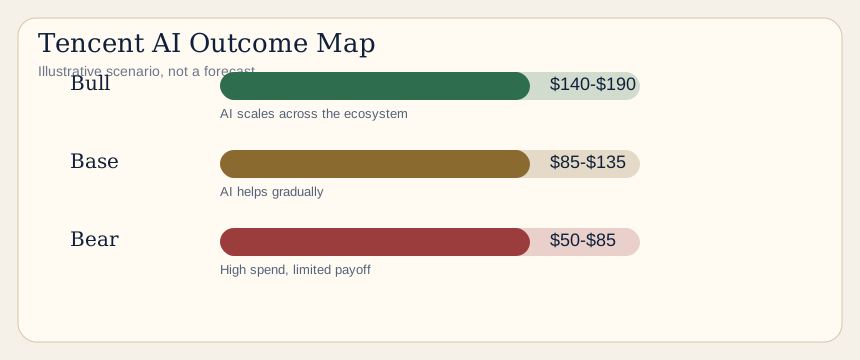
| Scenario | 2035 ADR range | AI outcome | Interpretation |
|---|---|---|---|
| Bull | $140 to $190 | AI improves monetization and productivity across multiple segments | Tencent becomes one of Asia's clearest applied-AI compounders |
| Base | $85 to $135 | AI helps, but slowly, and capex remains high | AI is additive rather than transformational |
| Bear | $50 to $85 | AI economics disappoint and discount rates stay high | Tencent spends heavily without a visible rerating |
| Path | Probability | Why |
|---|---|---|
| Probability of rising | 50% | Tencent has rare distribution and data-rich surfaces for applied AI |
| Probability of falling | 20% | The market may punish capex if monetization lags badly |
| Probability of moving sideways | 30% | AI progress may be real but gradual |
| Investor type | AI-themed positioning | Watch item |
|---|---|---|
| Investor already in profit | Let winners run but trim hype spikes | Capex trajectory versus margin progress |
| Investor currently at a loss | Do not rely on AI headlines alone to average down | Look for measured monetization evidence |
| Investor with no position | Wait for cleaner proof points or buy gradually | Entry discipline matters in narrative-heavy setups |
| Trader | Trade earnings and product announcements, not decade visions | Volatility around AI headlines can be sharp |
| Long-term investor | Own only if you believe Tencent can monetize AI inside existing products | Platform leverage is the thesis |
| Risk-hedging reader | Balance with non-China AI exposure | This theme mixes tech risk with geopolitical risk |
06. Risks And Invalidation
What could invalidate the AI thesis
The AI thesis would weaken if capex remains high while advertising yield, cloud demand, and workflow monetization fail to improve. It would also weaken if chip restrictions materially limit Tencent's ability to scale infrastructure or if users adopt AI features without creating incremental revenue. Conversely, the AI bear case would be invalidated if Tencent keeps showing that AI enhancements improve conversion, retention, and enterprise demand across products it already controls.
The practical lesson is that AI should be analyzed as a return-on-capital question, not just as a branding exercise. Tencent has the assets to benefit. It still has to prove the economics.
Investors should also remember that AI can change the timing of cash flows before it changes the level of cash flows. That means the next few quarters could look messier than the eventual outcome. A disciplined process therefore asks not only whether Tencent is spending more, but whether each reporting cycle shows better evidence of commercial traction, merchant adoption, ad relevance, or enterprise usefulness than the one before it.
If that evidence accumulates, Tencent could end the decade looking less like a legacy internet incumbent and more like a large applied-AI platform. If it does not, the market may keep rewarding the narrative more cautiously than the headlines imply. That difference between narrative and economics is the core risk to watch.
Seen that way, Tencent's AI future is neither automatic nor implausible. It is a conditional thesis with enough real operating leverage to matter and enough execution risk to require patience.
Disclaimer: This article is for research and educational purposes only. It is not individualized investment advice, and all scenario ranges are conditional estimates rather than promises of future performance.
07. FAQ
Frequently asked questions
Why is AI especially relevant for Tencent?
Because Tencent already controls large distribution surfaces where AI can be inserted directly into ads, search, commerce, games, and enterprise workflows.
Is Tencent trying to compete head-on with global frontier labs?
That is not the most important investment question. The more relevant question is whether Tencent can create applied-AI economics inside its ecosystem.
What should investors monitor first?
Capex, ad monetization quality, business-services growth, and evidence that AI features are changing user or merchant behavior.
Could AI hurt Tencent instead of help it?
Yes. If spending rises faster than monetization or if competitors narrow Tencent's edge, AI could pressure returns before it improves them.
References
Sources
- Tencent Investors
- Tencent 1Q2026 results
- Tencent 1Q2025 results
- Tencent FY2025 results
- Tencent 2025 Annual Report PDF
- Stock Analysis TCEHY quote
- CompaniesMarketCap Tencent price history
- CNBC Tencent Q1 2026 earnings
- Reuters on Tencent AI investment plans
- Reuters on WeChat AI agent integration
- IMF China 2025 Article IV
- World Bank China Economic Update
- Newzoo Global Games Market Report 2025