01. Quick Answer
AI could change the IBEX materially, but mostly through selected sectors rather than a market-wide transformation
The fast answer is that AI is likely to matter more for the composition and leadership of the IBEX 35 than for the headline index level all at once. Spain already has a policy push behind AI. The official national AI strategy page says the National Artificial Intelligence Strategy sits inside Digital Spain 2026, and the government said on March 3, 2026 that it would allocate EUR100 million to Spanish companies linked to European AI digital sovereignty under the IPCEI-AI framework.
That policy layer matters because the index already contains names with direct AI pathways: Telefonica in telecom and cybersecurity, Amadeus in travel technology, Indra in sovereign and defense AI, and Iberdrola in grid and energy optimization. But the benchmark is still bank- and utility-heavy, so AI is more likely to reshape relative winners than to magically rewrite the whole market in one stroke.
| Point | Why it matters |
|---|---|
| Spain has an official AI policy push | The AI story is backed by public strategy, not just marketing language. |
| AI exposure inside the IBEX is uneven | Telefonica, Amadeus, Indra, and Iberdrola have clearer pathways than many bank and utility names. |
| The benchmark will not become the Nasdaq | The IBEX's structure still anchors it to banks, utilities, and income-heavy sectors. |
| AI can still change relative leadership | Even if AI does not dominate the whole index, it can shift where earnings upgrades and investor attention concentrate. |
The working base case is that AI becomes a meaningful stock-selection and sector-rotation force inside the IBEX over the next decade, but not a clean one-directional lift for the whole benchmark.
02. Historical Context
The index's current structure explains why AI will arrive through selected channels
The IBEX 35 is Spain's flagship equity benchmark and tracks the 35 most liquid listed stocks on the Spanish market, weighted by free-float market capitalization, according to BME's own description and the latest factsheet. The composition makes one fact impossible to ignore: this is not a broad proxy for every Spanish business. It is a concentrated index dominated by banks, utilities, energy, and a handful of internationally exposed franchises such as Inditex, Iberdrola, Amadeus, Ferrovial, and Aena.
| Metric | Latest reading | Why it matters |
|---|---|---|
| Recent close | 17,622.70 | Forecast ranges should be anchored to the current market, not to an old high or a vague memory of the 2020 low. |
| 10-year starting point | 8,163.30 | The price-only series starts around 2016-05-31, which matters when estimating long-run compounding. |
| 10-year price CAGR | 8.04% | This is the strongest factual baseline for any long-range scenario work. |
| 10-year range | 6,452.20-18,360.80 | The index has already moved through deep drawdowns and fresh highs within the same decade. |
| Public index-level forward P/E | Not consistently disclosed by BME | Different vendors publish different snapshots, so this article avoids forcing a consensus number without a primary-source index vendor table. |
| Feature | Latest public evidence | Interpretation |
|---|---|---|
| Top sector | Financial services at 36.34% of index weight | Banks remain the single biggest driver of index beta. |
| Second-largest sector | Oil and energy at 20.04% | Utilities and energy still give the benchmark a different profile from the DAX or Nasdaq. |
| Top four weights | Santander 16.99%, Iberdrola 13.93%, BBVA 13.05%, Inditex 11.91% | A narrow leadership group can dominate outcomes in both bull and bear phases. |
| Income profile | BME said listed companies paid EUR37.7 billion in dividends in 2025 | Total return matters more in Spain than headline price return alone. |
The historical context is more constructive than Spain skeptics often admit. BME's December 17, 2025 market report said the IBEX gained roughly 41% through November and had climbed close to 46% by the prior close after breaking historical highs and touching 17,000. That move did not come from speculative technology alone. It came from banks, dividends, and a better-than-feared macro path. The history matters because it shows the index can rerate sharply when domestic growth, bank profitability, and capital returns line up.
The BME factsheet makes the structure clear. Financials account for 36.34% of the index and oil and energy for 20.04%, while technology and telecommunications account for 12.56%. That means AI's market impact will first pass through operational efficiency, network automation, industrial software, travel technology, grid management, and defense systems rather than through a pure software-multiple explosion.
| Company or cluster | Public evidence | Potential AI channel |
|---|---|---|
| Telefonica | MWC 2026 AI cybersecurity launch and AI telecom innovation hub announcements | Network automation, enterprise cybersecurity, and new telco AI services. |
| Amadeus | Q1 2026 results presentation says AI is being embedded into core travel processes | Travel search, pricing, servicing, and productivity gains. |
| Indra | IndraMind sovereign AI and defense-oriented AI positioning | Defense, mission systems, public-sector digitalization, and automation. |
| Iberdrola and power infrastructure | AI Centre of Excellence and grid/renewable optimization agenda | Grid management, predictive maintenance, and network capex productivity. |
03. Main Drivers
Six mechanisms could make AI relevant for the IBEX over the next decade
1. Spain's AI policy framework is real
The official AI strategy page says ENIA is one of the pillars of Digital Spain 2026, while the Digital Spain 2026 page frames AI and data economy development as a strategic national objective. This matters because policy support can accelerate infrastructure, regulation, and enterprise adoption.
2. The Spanish government is trying to build digital sovereignty
On March 3, 2026, the government announced EUR100 million for Spanish companies participating in European AI digital-sovereignty projects. The same announcement named large Spanish corporate participants including Telefonica and Indra. That is important evidence that the AI theme is already intersecting with listed-company strategy.
3. Public AI infrastructure lowers adoption barriers
The ALIA announcement said the public AI resource stack was being positioned to democratize AI for 90% of Spain's productive fabric. For the IBEX, the implication is indirect but important: broader enterprise adoption can strengthen demand for telecom, cloud, travel-tech, industrial, and consulting capabilities.
4. Enterprise adoption is already visible in listed-company ecosystems
Telefonica Tech launched an AI-enabled 'SOC of the Future' at MWC 2026. Telefonica and Mavenir announced an AI innovation hub for telecom core networks. Amadeus said it is embedding AI into core travel processes. Indra has been explicit about sovereign AI and defense use cases. The evidence is no longer abstract.
5. Grid and infrastructure AI can matter even in a utility-heavy index
Iberdrola's AI Centre of Excellence shows how AI can matter in a benchmark that is not tech-heavy. Predictive maintenance, grid balancing, renewable integration, and capex productivity can all improve the earnings quality of regulated or quasi-regulated businesses.
6. Spain is trying to position itself as a European digital hub
In an April 27, 2026 speech at the Invest in Spain Summit, Prime Minister Pedro Sanchez said AI usage in Spain was approaching 42%, above Italy and Germany. Speeches are not the same as audited market data, but they do show the government's intended narrative: Spain wants to be seen as a digital and AI adoption leader inside Europe.
| Factor | Latest public evidence | Current assessment | Bias |
|---|---|---|---|
| Government support | EUR100m IPCEI-AI announcement and ALIA rollout | Tangible and current | Bullish |
| Listed-company exposure | Telefonica, Amadeus, Indra, and Iberdrola all have public AI programs | Real, but unevenly distributed | Bullish to neutral |
| Index structure | Financials and utilities still dominate | Limits how fast AI can change the whole benchmark | Neutral |
| Adoption claims | Government said AI usage was approaching 42% | Encouraging, though not a substitute for company-level execution | Constructive |
| Execution risk | Many use cases are still early | Benefits may arrive gradually rather than all at once | Neutral |
04. Institutional Forecasts and Analyst Views
The institutional lens suggests AI is a medium-term breadth story, not a one-quarter miracle
There is no single official institution publishing a precise 'AI target' for the IBEX 35, and pretending otherwise would not be credible. The more defensible approach is to connect public policy, listed-company disclosures, and the index structure. OECD work on Spain keeps stressing productivity and business investment. AI matters here because it could be one of the few credible ways to lift productivity beyond the recent cyclical rebound.
The evidence is strongest where companies already disclose specific programs. Telefonica's MWC 2026 releases, Amadeus's Q1 2026 presentation, Indra's sovereign AI positioning, and Iberdrola's AI center all point to operational deployment rather than merely brand decoration. What remains mixed is whether those benefits become large enough to reshape the whole benchmark or mostly lift a subset of constituents.
| Source | What it says | IBEX implication |
|---|---|---|
| Spain's AI strategy | AI is embedded in Digital Spain 2026 | Policy support exists for a longer adoption cycle. |
| Government AI sovereignty funding | EUR100m for Spanish projects in the European AI value chain | Could help listed corporates tied to telecom, defense, and digital infrastructure. |
| OECD competitiveness focus | Spain needs productivity and business-investment gains | AI can matter if it improves productivity, not just headlines. |
| Company disclosures | Telefonica, Amadeus, Indra, and Iberdrola all describe specific AI use cases | The stock-selection effect is already more visible than a pure index-level effect. |
05. Bull, Bear, and Base Cases
AI changes the IBEX most plausibly through leadership shifts, not through a universal rerating
Bullish AI scenario
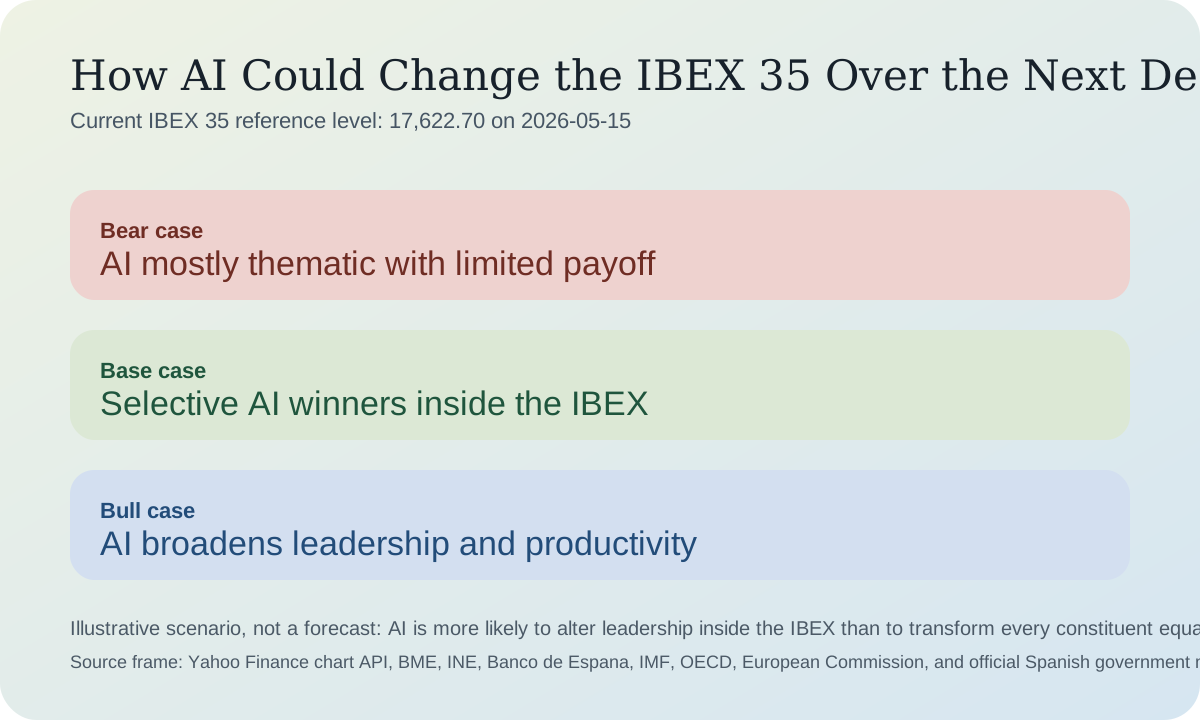
The bull AI scenario has a 25% probability. It assumes Spain's public AI push translates into sustained productivity gains and differentiated earnings upgrades for telecom, travel tech, defense systems, and grid infrastructure. In that world, AI helps the market earn a somewhat better multiple and broadens leadership beyond the classic bank-utility pair.
Base-case AI scenario
The base case has a 55% probability. AI matters, but selectively. Telefonica, Amadeus, Indra, and some infrastructure-linked names benefit more clearly, while the broader IBEX remains anchored to macro, rates, and bank profitability. This is the most evidence-based path today.
Bearish AI scenario
The bear AI scenario has a 20% probability. It assumes most AI spending stays in pilot mode, productivity gains are slow, and the benchmark's non-tech-heavy structure keeps the market from monetizing the theme in a meaningful way. In that world, AI changes the narrative more than the earnings.
| Scenario | Probability | What changes | Measured trigger |
|---|---|---|---|
| Bull AI | 25% | Broader earnings upgrades and better market breadth | Repeated company disclosures showing AI-linked revenue, margin, or efficiency gains |
| Base AI | 55% | Selective winners outperform inside an otherwise familiar index | Steady rollout of public and corporate AI use cases without market-wide transformation |
| Bear AI | 20% | AI remains mostly thematic and not financially material | Few tangible earnings gains beyond isolated pilots or partnerships |
| Path for AI's market impact | Estimated probability | Interpretation |
|---|---|---|
| Selective positive impact | 55% | Most likely outcome given current disclosures and index structure. |
| Broad positive rerating | 25% | Possible, but requires stronger productivity evidence and wider corporate execution. |
| Little net impact | 20% | Still possible if pilots fail to become financially material. |
Risks to watch
The biggest risks are execution and concentration. The index is still not a pure AI market, and much of the policy language is still ahead of quantified corporate payoff. Investors should look for real operating metrics, not just partnership headlines.
What could invalidate the framework
This framework would be too cautious if AI adoption inside the Spanish corporate base accelerates faster than current disclosures imply. It would be too optimistic if the market keeps talking about AI but few constituents show durable revenue or margin benefits from it.
Conclusion
AI could change the IBEX 35 over the next decade, but mainly by changing which sectors and stocks lead, not by turning the whole benchmark into a tech proxy. That still matters a lot for investors willing to analyze the index below the headline level.
Disclaimer: This article is for research and informational purposes only. It discusses public strategy documents and company disclosures, not guaranteed outcomes or personal investment advice.
06. Investor Positioning
AI creates different opportunities for different readers
| Investor profile | Cautious approach | What to monitor |
|---|---|---|
| Investor already in profit | Hold core exposure, trim if bank concentration has become too large, and rebalance rather than chasing new highs. | Bond yields, bank guidance, and whether leadership is broadening beyond the top financials. |
| Investor currently at a loss | Revisit the entry thesis before averaging down; a Spain thesis is only valid if growth and bank profitability still hold. | Macro slowdown, oil shocks, and any deterioration in sovereign spread narratives. |
| Investor with no position | Wait for either a pullback or clearer evidence that earnings breadth is improving, then scale in gradually. | Valuation discipline, support levels, and macro releases from INE, OECD, and Banco de Espana. |
| Trader | Respect volatility, avoid oversized directional bets, and use stop-loss discipline around central-bank, oil, and bank-news windows. | Short-term momentum, sector rotation, and headline risk from geopolitics. |
| Long-term investor | Dollar-cost averaging is more defensible than trying to time every macro wiggle, but only if the role of banks and utilities fits the portfolio. | Dividend sustainability, real GDP trend, and whether Spain's structural competitiveness keeps improving. |
| Risk-hedging investor | Use the IBEX more as a diversifier than as a pure growth engine, and pair it with assets that behave differently when oil or Europe rates jump. | Correlation shifts during stress and any spike in energy-linked inflation. |
07. FAQ
Common questions about AI and the IBEX 35
Will AI turn the IBEX into a tech-heavy index?
Probably not. The benchmark is still dominated by financials, utilities, and energy. AI is more likely to reshape relative winners than the entire sector mix.
Which IBEX names have the clearest public AI evidence today?
Telefonica, Amadeus, Indra, and Iberdrola currently have some of the clearest publicly documented AI initiatives relevant to earnings quality or strategic positioning.
What is the most important proof point to watch?
Tangible company disclosures around revenue, cost savings, productivity, or margin benefits tied to AI rather than partnership headlines alone.
08. Sources
Primary and high-credibility references used in this article
- Yahoo Finance chart API for ^IBEX, 10-year monthly history
- Yahoo Finance chart API for ^IBEX, recent daily closes
- BME IBEX 35 factsheet
- INE Q1 2026 GDP flash estimate
- OECD Spain economic snapshot
- Spain's official national AI strategy page
- Spanish government note on ALIA public AI infrastructure
- Spanish government note on EUR100 million AI digital sovereignty support
- April 27, 2026 Invest in Spain Summit speech
- Telefonica Tech AI cybersecurity launch at MWC 2026
- Telefonica and Mavenir AI innovation hub announcement
- Amadeus Q1 2026 results presentation
- IndraMind press release
- Iberdrola AI Centre of Excellence page
- Iberdrola Q1 2026 results page