01. Quick Answer
AI probably affects Brent indirectly, not by replacing traditional oil-market drivers overnight
Most discussions about artificial intelligence and oil drift into easy slogans. The evidence is more nuanced. The IEA Energy and AI and Goldman Sachs AI power demand note both argue that AI will materially raise electricity and data-center demand, but neither source says AI directly creates a clean oil supercycle. For Brent, AI matters through second-order channels: industrial buildout, logistics, power backup, metals and petrochemicals demand, productivity, and potentially lower oil intensity if optimization improves. That is why AI belongs in a Brent forecast, but not as a single-cause explanation.
| Category | Evidence-based read | Implication |
|---|---|---|
| Historical data | Brent's ten-year range from $16/bbl to $137/bbl still reflects classic oil shocks, not AI-driven demand Yahoo Finance | Traditional supply and geopolitics still dominate the tape. |
| Current market conditions | Spot Brent near $110.99/bbl is being driven mainly by disruption risk, not by AI narratives Reuters market report | AI is a medium-term modifier, not the main current catalyst. |
| Institutional signals | The IEA Energy and AI and Goldman Sachs AI power demand note show rising power demand from AI, while EIA global oil page and IMF WEO database still anchor near-term Brent below spot | AI should be integrated carefully into scenario work, not exaggerated. |
| Most important watchpoints | Data-center buildout, grid stress, diesel backup use, industrial capex, and productivity gains | AI can push Brent up or down depending on which channel dominates. |
02. Historical Context
The oil market still moves on old physics, but AI may change some of the inputs
Oil demand is still anchored in transport, petrochemicals, industry, and the reliability needs of large energy systems. That is why Brent's last decade remains dominated by classic shocks recorded by Yahoo Finance. But the next phase may be different at the margin. The IEA Energy and AI says data centers are set to become a larger electricity consumer, while Goldman Sachs AI grid note frames the AI buildout as a significant power and infrastructure event. Those changes do not replace oil-market fundamentals, but they can influence them.
| Metric | Latest read | Why it matters |
|---|---|---|
| Current Brent reference | $110.99/bbl | AI is not the main reason Brent is here today. |
| IEA AI signal | AI and data centers lift electricity demand materially | Indirect demand effects can matter via backup generation, construction, and logistics. |
| Goldman Sachs signal | Power demand from AI-related data centers could rise sharply through 2030 | Supports the idea that industrial buildout becomes an oil-adjacent demand driver. |
| Official Brent baseline | $76/b EIA 2027 average | Shows traditional oil forecasters still anchor prices mainly on supply-demand fundamentals. |
| Marker | Level | Interpretation |
|---|---|---|
| Classic downside regime | $16/bbl | Demand collapse still matters more than technology narratives in acute oil selloffs. |
| Classic upside regime | $137/bbl | War and sanctions remain more powerful immediate drivers than AI. |
| Pre-shock normalization | $60.85/b December 2025 close | Shows Brent can still trade on oversupply fears even in a tech-heavy market. |
| Current disruption premium | $110.99/bbl | Confirms that AI is an overlay, not the main live catalyst. |
| 2030 setup | Still open | AI could either reinforce industrial demand or improve efficiency enough to soften oil intensity. |
03. Main Drivers
Five AI channels could influence Brent in the coming years
1. AI-driven power demand can lift oil-adjacent fuel use
The IEA Energy and AI and Goldman Sachs AI power demand note suggest a substantial rise in data-center power demand. Most of that demand should be met by grids, gas, renewables, and new capacity, but some regions still rely on diesel backup, fuel logistics, and thermal generation buildout that indirectly support oil demand.
2. Industrial and construction buildout can raise oil consumption
Data centers are physical assets. Building them requires steel, cement, transport, mining, and heavy equipment. Those are oil-intensive activities, especially before power systems fully adapt.
3. AI can improve upstream efficiency
The bearish AI channel is equally real. Better field optimization, predictive maintenance, routing, and refinery analytics can improve supply efficiency and lower the cost of bringing barrels to market. That can soften Brent rather than lift it.
4. AI can reduce oil intensity in transport and logistics
Smarter freight routing, predictive maintenance, and traffic optimization can reduce fuel consumption. If those gains scale quickly, AI could become modestly bearish for Brent even while electricity demand rises.
5. AI productivity could shift the macro regime
A durable productivity boom could strengthen growth while also reducing unit energy intensity. The evidence is mixed. If productivity lifts demand more than efficiency, Brent benefits. If efficiency dominates, Brent loses some structural support.
04. Institutional Forecasts and Analyst Views
Institutional research suggests AI matters, but not in a simple one-direction way
The IEA Energy and AI and Goldman Sachs AI power demand note both support the view that AI is becoming a serious energy topic. But neither source says Brent should be forecast using a simple 'AI up equals oil up' rule. Traditional oil sources such as the EIA global oil page, IMF WEO database, and IEA Oil Market Report still frame Brent mainly around supply disruptions, inventories, and demand elasticity. The most reasonable interpretation is that AI changes the background conditions around oil rather than replacing core oil drivers.
| Source | Message | Interpretation |
|---|---|---|
| IEA Energy and AI | AI and data centers can materially lift electricity demand | Indirectly constructive for some oil-linked industrial and reliability demand. |
| Goldman Sachs AI power note | Power demand tied to AI infrastructure could rise sharply | Supports the industrial buildout channel. |
| Goldman Sachs grid note | The grid is undergoing an AI-driven investment wave | Helps explain why logistics and construction demand may matter. |
| EIA | Official Brent baseline remains focused on classic supply-demand normalization | AI is not yet the dominant official pricing variable. |
| IEA Oil Market Report | Oil balances remain sensitive to price, supply, and macro conditions | Traditional Brent drivers still set the main range. |
05. Bull, Bear, and Base Case
How AI is folded into a Brent scenario matrix
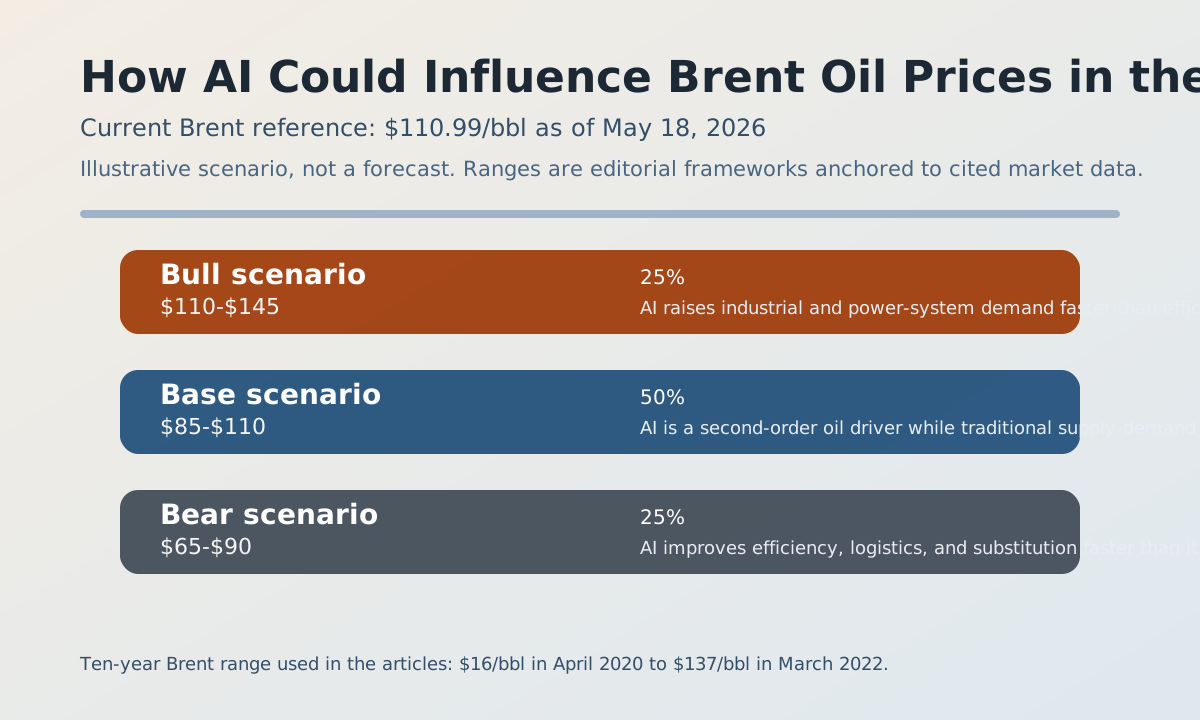
The ranges below are not forecasts from the IEA or Goldman Sachs. They are editorial Brent scenarios that incorporate AI as one variable among many. The key question is whether AI's demand and buildout effects outweigh its efficiency and substitution effects. Available data suggests traditional oil-market variables still dominate, so the widest weight remains on the base case.
| Scenario | Price range | Conditions | Probability |
|---|---|---|---|
| Bull | $110-$145 | AI raises industrial and power-system demand faster than efficiency gains offset it | 25% |
| Base | $85-$110 | AI is a second-order oil driver while traditional supply-demand variables still dominate | 50% |
| Bear | $65-$90 | AI improves efficiency, logistics, and substitution faster than it lifts oil-linked demand | 25% |
| Direction | Probability | Comment |
|---|---|---|
| Higher | 25% | AI becomes oil-supportive if industrial demand and power-system stress outweigh efficiency gains. |
| Lower | 25% | AI becomes oil-softening if optimization reduces fuel intensity and supply costs. |
| Mixed middle path | 50% | The most likely path is that AI matters, but traditional oil variables still dominate pricing. |
Bullish AI scenario. Brent trends into the $110-$145 area if AI-driven infrastructure spending raises industrial demand, if power-system fragility raises backup fuel use, and if the broader economy absorbs those costs without a demand shock.
Bearish AI scenario. Brent softens into the $65-$90 range if AI meaningfully improves logistics, lowers upstream costs, and helps reduce oil intensity faster than it creates new oil-linked demand.
Base case. The $85-$110 range assumes AI is relevant but not dominant. Oil still trades mainly on OPEC policy, conflict, inventories, and macro growth, while AI shifts the margins rather than the center of gravity.
06. Positioning, Risks, and Conclusion
Investor positioning should reflect that AI is a modifier, not a standalone oil thesis
| Investor type | Prudent approach | Main watchpoints |
|---|---|---|
| Investor already in profit | Do not over-credit AI for gains that are mostly coming from geopolitics or supply tightness. Trim or hedge if the position is being justified by a weak narrative. | Conflict premium versus industrial demand evidence. |
| Investor currently at a loss | Avoid forcing an AI explanation onto a timing mistake. Reassess whether the original Brent thesis still holds on classic fundamentals. | Inventories and supply growth. |
| Investor with no position | Wait for clearer data on the scale and geography of AI-driven power demand before building a large thematic oil position. | Data-center buildout and backup fuel trends. |
| Trader | Use AI news as a secondary catalyst, not as a substitute for physical-market data and headline risk controls. | Brent curve, power-market stress, and headlines. |
| Long-term investor | Prefer diversified energy and infrastructure exposure if the goal is to express an AI-energy view with less single-commodity risk. | Grid capex and fuel mix evolution. |
| Risk-hedging investor | Keep Brent exposure modest if the thesis is only partially linked to AI, and rebalance when geopolitical drivers dominate. | Correlation drift and thematic overreach. |
Risks to watch
Risks to watch include overestimating AI's direct oil demand, underestimating AI-driven efficiency gains, slower-than-expected data-center buildout, and the possibility that the main Brent story remains old-fashioned geopolitics. The evidence today strongly suggests the last point remains true.
Conclusion
AI could influence Brent in the coming years, but mostly through indirect channels. The most balanced conclusion is that AI slightly widens the oil distribution rather than replacing the classic oil script. Investors who understand both the demand and efficiency channels will have a better framework than those who force AI into a one-way commodity narrative. Disclaimer: This article is for informational and research purposes only and does not constitute personalized financial advice.
07. FAQ
Frequently asked questions
Does AI directly increase oil demand?
Not in a simple or immediate way. The biggest direct AI effect is on electricity demand, with oil influenced mainly through secondary channels.
Can AI lower Brent prices?
Yes. Better logistics, refinery optimization, and upstream efficiency could all soften oil intensity or lower supply costs.
Why is the base case still driven by traditional oil factors?
Because sources such as the EIA global oil page and IEA Oil Market Report still frame Brent primarily around classic supply-demand balances and geopolitics.
What would invalidate the AI base case?
Evidence that AI is materially changing fuel demand, backup generation, upstream productivity, or transport efficiency faster than expected would require a revised framework.
Methodology and Invalidation
How to interpret this framework and what would invalidate it
This article combines traditional Brent inputs from Yahoo Finance, the EIA global oil page, the IMF WEO database, and the IEA Oil Market Report with AI-energy research from the IEA Energy and AI, IEA Electricity 2026, Goldman Sachs AI power demand note, and Goldman Sachs AI grid note. The goal is not to force a direct AI-oil forecast, but to test where AI changes the probability distribution.
The probability table treats AI as a second-order variable because current evidence still shows that conflict, supply discipline, inventories, and macro demand dominate Brent's day-to-day and quarter-to-quarter pricing. AI matters most over a multi-year horizon and through indirect channels.
What would invalidate the framework? A much larger-than-expected AI-driven industrial and backup-fuel demand shock would move the distribution higher. A much faster AI-led efficiency wave in logistics and upstream operations would move it lower. Until one of those channels becomes dominant in the data, the base case should remain balanced.
References
Sources
- Yahoo Finance, Brent Crude Oil Futures quote page and historical chart
- U.S. EIA, Short-Term Energy Outlook global oil section
- IMF, World Economic Outlook database, April 2026
- IEA, Oil Market Report, May 2026
- IEA, Energy and AI
- IEA, Electricity 2026
- Goldman Sachs, AI poised to drive power demand higher
- Goldman Sachs, the U.S. power grid and AI transformation
- World Bank, Commodity Markets Outlook, April 2026
- OPEC, World Oil Outlook 2025
- Reuters via Investing.com, oil prices jump after ceasefire concerns