01. Quick Answer
How AI Could Influence Copper Prices in the Coming Years
The quick answer is that AI is more likely to push copper's floor higher than to create a one-off, isolated spike. That is because AI's physical build-out reinforces existing copper demand from grids, cooling, switchgear, transformers, and backup systems instead of creating a standalone niche market.
Still, the evidence is mixed on speed. If power constraints and permitting slow the data-center roll-out, AI may support prices without immediately transforming them. If hyperscalers keep expanding aggressively, AI can become a meaningful incremental tightening force much sooner.
| Category | Evidence-based read | Implication |
|---|---|---|
| AI matters indirectly | AI's biggest copper impact comes through power systems and data-center infrastructure. | The metal demand effect is broader than server racks alone. |
| Evidence is now concrete | S&P Global, BHP, and Banque de France all document material AI-related copper demand and volatility channels. | This is no longer a purely speculative narrative. |
| But uncertainty is high | Analysts remain divided on speed, copper intensity, and whether power constraints cap build-outs. | AI should be treated as a range of outcomes. |
| Price effect | AI likely raises the medium-term floor more reliably than it guarantees a near-term spike. | The impact is real, but timing remains uneven. |
02. Historical Context
Current market snapshot and historical context
AI should be placed in context. Copper was already a tight market because of electrification and supply constraints. AI matters because it adds another demand vector to a market that was not loose to begin with.
| Metric | Latest read | Why it matters |
|---|---|---|
| Direct AI/DC copper demand | 1.1 Mt in 2025 to 2.5 Mt by 2040 | S&P Global estimate of a real new demand vector |
| U.S. data-center electricity | 5% of demand in 2025 to 14% by 2030 | Shows how AI moves copper through the grid, not just the server |
| BHP digital demand | Data-center copper demand up six-fold by 2050 | Producer-side confirmation of a long runway |
| Volatility channel | Speculative activity can amplify copper swings | Banque de France highlights financial transmission, not just physical demand |
| Period marker | Approximate price | Interpretation |
|---|---|---|
| 10-year low | $2.02/lb | The monthly series bottomed near this level during the 2016 industrial slowdown. |
| 2020 shock reset | around $2.10/lb | Copper sold off during the pandemic shock before reopening demand changed the trend. |
| 2021 reopening high | near $4.89/lb | Electrification optimism and supply friction started to re-rate the metal. |
| 2024–2026 re-rating | $5.20 to $6.64/lb | Tighter supply, tariffs, AI-related power demand, and mine disruptions pushed HG into a higher regime. |
| Latest close | $6.247/lb | Yahoo daily data puts HG near cycle highs on May 18, 2026. |
03. Main Drivers
Main drivers of price movement
1. AI increases copper demand through power delivery
S&P Global notes that copper is critical inside data centers because of power distribution, density, and fire-safety properties. The real multiplier is the upstream electrical infrastructure needed to feed these sites.
2. Data-center copper demand is becoming measurable
S&P Global's base work lifts data-center copper demand from 1.1 million tons in 2025 to 2.5 million in 2040. BHP sees a six-fold rise to around 3 million tons by 2050.
3. AI can amplify volatility as well as demand
Banque de France highlights the way speculative positions and AI enthusiasm can intensify copper-price swings. That matters because markets often price the theme before the physical demand arrives in full.
4. Power constraints can both support and cap prices
If the grid cannot keep up, copper demand for upgrades rises, but AI build-out itself may bottleneck. That creates a more complex effect than a simple one-way demand surge.
5. AI also affects copper supply indirectly
BHP argues that AI-enabled productivity tools may improve mine efficiency over time. In other words, AI can raise demand and slowly help supply, though the timing is uneven and likely back-end loaded.
04. Institutional Forecasts and Analyst Views
Institutional forecasts and analyst views
AI does not yet justify a copper forecast by itself. It justifies a meaningful adjustment to the medium-term probability distribution because it adds a new and capital-intensive source of electricity demand to an already constrained market.
| Source | Forecast / signal | Interpretation |
|---|---|---|
| S&P Global | 1.1 Mt to 2.5 Mt in data-center copper demand by 2040 | Most concrete current AI-copper demand framework |
| BHP | Data-center copper demand up six-fold to around 3 Mt by 2050 | Confirms the direction of travel from a producer perspective |
| Banque de France | AI increases both physical demand pressure and market volatility | Useful because it covers the financial channel too |
| IEA | Electrification demand already strains copper pipelines | AI arrives on top of an existing transition story |
| UBS / Goldman | Constructive copper price views already reflect structural tightness | AI strengthens the narrative even if no single bank isolates it perfectly |
05. Bull, Bear, and Base Case
How the forecast range and probability table are built
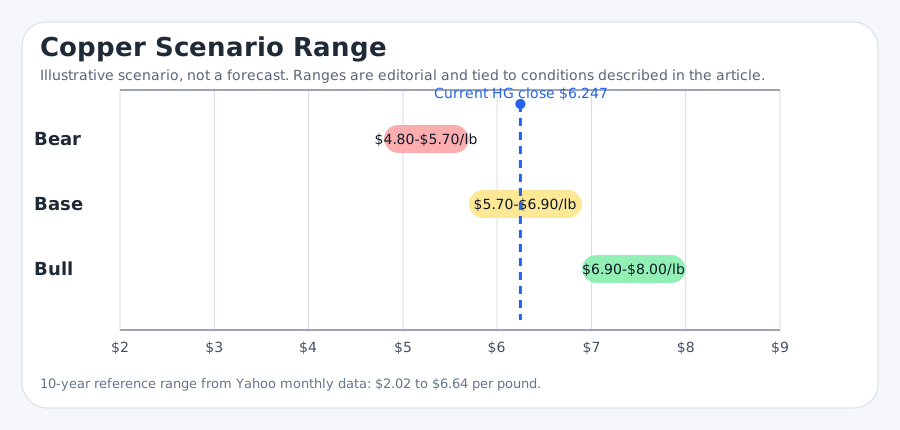
The range in this article is editorial and scenario-based rather than a deterministic forecast. It starts with current HG pricing, the 10-year trading band, the World Bank near-term baseline, ICSG balance data, and structural demand evidence from IEA, S&P Global, and BHP.
| Scenario | Price range | Conditions | Probability |
|---|---|---|---|
| Bull | $6.90-$8.00/lb | AI build-out stays aggressive, grid expansion accelerates, and mine supply remains sticky | 30% |
| Base | $5.70-$6.90/lb | AI supports copper's floor while broader electrification remains the main demand engine | 45% |
| Bear | $4.80-$5.70/lb | Power bottlenecks slow AI roll-outs and broader growth weakens enough to offset incremental demand | 25% |
| Direction | Probability | Comment |
|---|---|---|
| AI pushes prices higher | 40% | More likely over several years than over a few quarters |
| AI impact is overestimated | 25% | Possible if adoption outruns physical deployment or efficiency reduces copper intensity |
| AI is supportive but not decisive | 35% | A realistic path where AI adds demand but does not dominate the market alone |
| Investor type | Prudent approach | Main watchpoints |
|---|---|---|
| Investor already in profit | Treat AI as a thesis enhancer, not a reason to abandon risk controls. | Themes can get crowded before demand is monetized. |
| Investor currently at a loss | Avoid averaging solely on the AI narrative without checking actual capex and power-delivery data. | Story strength is not enough. |
| Investor with no position | Look for pullbacks caused by macro noise if the goal is to own the AI-infrastructure angle. | Chasing theme spikes is rarely necessary. |
| Trader | Trade around hyperscaler capex, power-grid stories, and positioning data, but expect narrative overshoot. | AI headlines can move copper before balance data confirms. |
| Long-term investor | A staged approach makes sense if you believe AI and electrification together raise copper's medium-term floor. | The thesis is cumulative, not instant. |
| Risk-hedging investor | Use copper as one piece of an AI-infrastructure basket that may also include grids, utilities, and industrials. | Commodity-only exposure can be too narrow. |
AI is unlikely to replace electrification as the core copper story, but it can reinforce it enough to keep the market tighter, pricier, and more volatile than many old-cycle models assume. The cleanest takeaway is not that AI guarantees higher copper prices. It is that AI makes the downside case harder to sustain for long unless broader growth weakens materially. Disclaimer: This article is for informational and research purposes only and does not constitute personalized financial advice.
06. FAQ
Frequently asked questions
Does AI use enough copper to move the whole market?
By itself not yet, but combined with grid and power-delivery needs it can become market-relevant.
Why is the grid more important than the server?
Because large data-center clusters require substantial upstream copper in transmission, distribution, and backup systems.
Could AI reduce copper demand through efficiency?
Over time it may reduce intensity in some applications or improve mining productivity, but current evidence suggests demand effects dominate near-term.
What would invalidate the AI-supportive copper view?
If power constraints materially slow data-center deployment or if copper intensity falls faster than expected, AI's price impact would be smaller.
Methodology and Invalidation
How to interpret this framework and what would change it
This article relies most heavily on S&P Global's dedicated AI-copper work, BHP's digital-demand analysis, and Banque de France's discussion of both physical demand and volatility channels (S&P Global, Copper in the Age of AI: Challenges of Electrification, January 2026; S&P Global, The Copper Conundrum, January 2026; BHP Insights, How copper will shape our future; Banque de France, AI and the growth of data centres: challenges for the copper market).
The scenario ranges then anchor those thematic drivers back to current HG pricing, the 10-year band, and the broader electrification backdrop from IEA and World Bank sources. That helps prevent the AI narrative from floating free of the actual copper market.
Invalidation would come from slower physical deployment, less copper-intensive architectures, or macro weakness strong enough to offset AI-related demand. Because AI is still an emerging driver, this framework should be updated as actual grid and data-center build-out data improves.
References
Sources
- Yahoo Finance chart API, HG=F 10-year monthly data
- Yahoo Finance chart API, HG=F recent daily data
- World Bank, Commodity Markets Outlook, April 2026
- ICSG, Table 1: World refined copper production and usage trends, April 2026
- Reuters on ICSG April 2026 forecast update
- IEA, Copper report within Global Critical Minerals Outlook 2024
- IEA, Global Critical Minerals Outlook 2025 overview
- IEA chart, mined supply and demand outlook for copper, 2026-2035
- S&P Global, Copper in the Age of AI: Challenges of Electrification, January 2026
- S&P Global, Plugged in and politicized: Copper in a fractured world
- BHP, Copper Growth
- BHP Insights, How copper will shape our future
- IMF, World Economic Outlook, April 2026
- USGS, Mineral Commodity Summaries 2026
- UBS CIO, commodities note, February 27, 2026
- Banque de France, AI and the growth of data centres: challenges for the copper market
- S&P Global, The Copper Conundrum, January 2026