01. Quick Answer
AI is likely to affect gold mostly through macro transmission channels, not through direct industrial demand alone
Gold futures (GC=F on Yahoo Finance) were trading around $4,545.2/oz on 2026-05-18. The same 10-year monthly series started near $1,318.4/oz on 2016-06-01 and most recently showed $4,545.2/oz, with a 10-year range of roughly $1,150.0 to $4,713.9 and a price-only CAGR near 15.51% (10-year monthly data).
The direct demand channel is real. The World Gold Council said Q1 2026 technology demand rose to 81.6 tonnes and highlighted AI infrastructure as a support for electronics demand (WGC technology section). But that is still small relative to investment, official-sector, and jewelry flows.
The more powerful AI effect is probably indirect. The IMF says AI could raise global productivity by up to 0.8 percentage points per year under the right conditions, while the IEA expects data-center and AI-related electricity demand to become a more visible driver of power consumption (IMF AI estimate; IEA Energy and AI). That means AI could push gold through rates, inflation, power demand, market leadership, and macro sentiment all at once.
| Point | Why it matters |
|---|---|
| Direct channel | AI infrastructure modestly supports gold use in electronics and other high-reliability applications. |
| Macro channel | If AI lifts productivity materially, higher real yields and stronger risk appetite could weigh on gold. |
| Energy channel | AI-driven electricity demand could reinforce inflation or grid stress narratives that are supportive for gold in some regimes. |
| Net effect | The most realistic outcome is mixed: AI changes the balance of gold drivers rather than unambiguously making gold bullish or bearish. |
02. Historical Context
The direct industrial gold effect from AI exists, but it remains smaller than the macro effect
Gold is not copper or silver. Its price is still dominated by macro and financial drivers rather than by industrial usage. That is why AI's direct impact on semiconductor and electronics demand, while real, should be kept in proportion.
WGC's Q1 2026 technology chapter said electronics demand rose 3% year over year to 69 tonnes and explicitly linked that strength to AI infrastructure, high-performance chips, data-center equipment, and related components (WGC technology analysis). WGC's full-year 2025 data also described AI-related applications and memory shortages as meaningful to the technology segment.
Even so, the sector remains small relative to investment and official demand. AI matters more because it can change growth, inflation, yields, electricity demand, and the market's appetite for hedges than because it directly consumes vast amounts of gold.
| Metric | Latest reading | Why it matters |
|---|---|---|
| Current gold price | $4,545.2/oz | Every long-range forecast needs a current anchor rather than an outdated cycle low. |
| 52-week range | $3,207.5 to $5,586.2 | Shows how much of the safe-haven and reserve-diversification story is already in the price. |
| 10-year monthly range | $1,150.0 to $4,713.9 | Useful for separating a normal correction from a genuine regime break. |
| 10-year price CAGR | 15.51% | A high recent compounding rate is a warning against naive straight-line extrapolation. |
| 10-year real yield | 2.00% on 2026-05-14 | Real yields remain one of the cleanest cyclical headwinds or tailwinds for a non-yielding asset. |
| Editorial base range | Mixed to mildly positive | Scenario ranges are more defensible than a single number for a macro asset. |
| Channel | Bullish for gold? | Why |
|---|---|---|
| High-performance electronics | Mildly bullish | AI servers, advanced chips, and reliability-critical components still use gold. |
| Productivity surge | Potentially bearish | Higher productivity can support higher real yields and a stronger risk appetite. |
| Power and grid demand | Conditionally bullish | More electricity demand can feed inflation or energy-security concerns. |
| Market concentration | Mixed | A tech-led bull market can crowd money away from hedges, but concentration risk can also increase demand for diversifiers. |
03. Main Drivers
Five AI transmission channels deserve close attention from gold investors
1. AI infrastructure increases direct electronics demand at the margin
WGC's latest technology data makes this point clearly. AI servers, advanced power modules, and high-reliability components support gold demand in electronics, PCBs, optical communications, and semiconductor applications.
2. AI could raise productivity enough to pressure gold through real yields
If AI adoption truly boosts productivity and growth, the market may accept higher real yields and stronger risk-on positioning. That would be a bearish transmission channel for gold even if technology demand rises.
3. AI-related electricity demand could support inflation or energy stress narratives
The IEA expects data centers and AI to become a more visible source of electricity demand growth. In some macro regimes, that can sustain inflation pressure or heighten concerns about energy resilience (IEA Electricity 2026).
4. AI can increase capital concentration and valuation risk in risk assets
If AI keeps capital concentrated in a handful of mega-cap winners, gold could benefit as a portfolio diversifier when investors start to worry about concentration and regime fragility.
5. AI may make markets faster and more flow-driven
The more markets rely on quantitative signals, faster news digestion, and thematic flow, the more gold may experience sharp short-term overshoots in both directions. That does not change gold's role, but it can change the path investors experience.
04. Institutional Forecasts and Analyst Views
No serious analyst can reduce the AI effect on gold to a single direction
The official evidence is already mixed. The IMF highlights AI's upside for productivity and growth, which could reduce the urgency to own non-yielding hedges if rates stay firm. Meanwhile, the World Gold Council documents a real direct-demand benefit for gold in AI-linked electronics.
The IEA adds another layer by showing that AI and data centers are now relevant to electricity-demand growth. That does not automatically mean higher gold prices, but it does mean AI can affect inflation, energy costs, and macro uncertainty in ways that matter for gold.
This is why the most reasonable forecast is a mixed one. AI could make gold more cyclical in the short run while leaving the long-run strategic case intact, or even stronger, depending on how productivity, inflation, and financial concentration evolve.
| AI effect | Likely price impact | Time horizon |
|---|---|---|
| Higher tech gold use | Small positive | Near term and ongoing |
| Higher productivity | Potential negative via real yields | Medium term |
| More power demand | Potential positive via inflation/energy stress | Medium term |
| Risk-asset concentration | Two-way, often supportive during stress | Medium to long term |
05. Bull, Bear, and Base Case
AI is more likely to reshape gold's macro context than to dictate its price directly
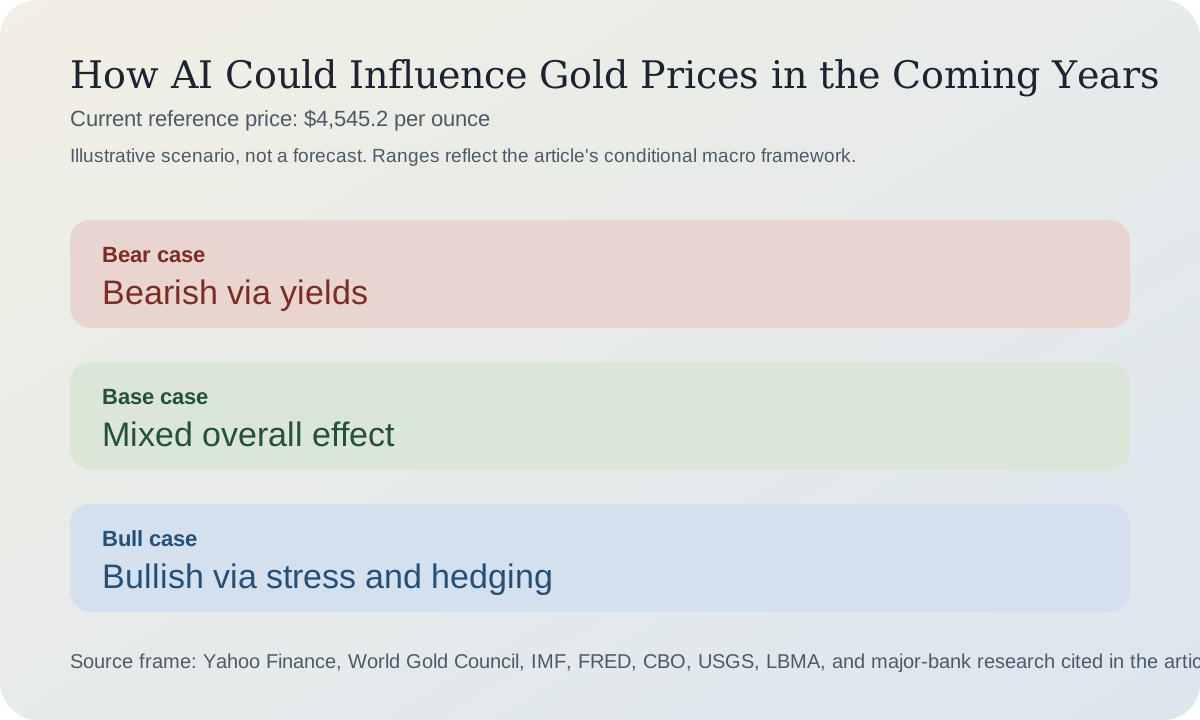
Bullish AI scenario
AI lifts industrial demand modestly, increases power and infrastructure stress, and makes investors more willing to own gold as a hedge against concentration, policy mistakes, or inflationary energy bottlenecks.
Base-case AI scenario
AI's direct impact on physical gold demand stays positive but limited, while the macro effects largely offset each other. That would make AI a secondary contributor to gold prices, not the primary driver.
Bearish AI scenario
The bearish AI case is a genuine productivity boom that keeps growth strong, lifts real yields, and channels capital into risk assets rather than into hedges. In that world, gold's direct tech benefit would be too small to offset the macro drag.
Risks to watch
Watch real yields, energy prices, grid investment, semiconductor-capex trends, and whether AI leadership broadens growth or merely inflates valuations.
What could invalidate the forecast
A mixed AI forecast would be too cautious if AI rapidly raises industrial gold usage or triggers sustained energy and inflation stress. It would be too bullish if AI delivers a broad productivity boom without the inflation side effects many investors currently fear.
Conclusion
How could AI influence gold prices? Mostly by changing the macro environment in which gold trades. The direct electronics effect exists, but the bigger story runs through productivity, energy demand, rates, concentration, and portfolio hedging behavior.
| Scenario | Illustrative effect on gold | Main mechanism | Probability |
|---|---|---|---|
| Bull | Mildly to moderately positive | Energy stress, concentration risk, and selective industrial demand support gold. | 25% |
| Base | Mixed to mildly positive | Direct tech demand helps, but macro effects mostly offset. | 50% |
| Bear | Moderately negative | Productivity and risk-on markets dominate the small physical-demand uplift. | 25% |
| Path | Estimated probability | Comment |
|---|---|---|
| Probability of rising | 35% | AI can help gold if it raises uncertainty, energy demand, or diversification needs. |
| Probability of falling | 25% | AI can hurt gold if it meaningfully lifts productivity and sustains higher real yields. |
| Probability of moving sideways | 40% | The mixed outcome is most likely because AI changes several gold drivers at once. |
06. Investor Implications
Investors should treat AI as a new variable inside the gold framework, not as a standalone gold thesis
For investors, the practical implication is to track AI through macro indicators rather than through headlines alone. A surge in data-center capex does not automatically mean gold should rise. The relevant question is whether AI is making real yields, inflation, energy demand, and concentration risk more or less supportive for gold.
| Investor type | Cautious approach | What to watch |
|---|---|---|
| Investor already in profit | Hold a core allocation if the hedge thesis still fits, but trim or rebalance if gold has become oversized. | ETF flows, real yields, and whether gold keeps failing at resistance after macro shocks. |
| Investor currently at a loss | Separate a broken thesis from a bad entry. Average in only if the time horizon is long and the macro case is intact. | Reserve diversification, official buying, and whether corrections remain orderly rather than structural. |
| Investor with no position | Prefer staged entries, wait-for-pullback plans, or dollar-cost averaging over panic buying after spikes. | The relationship between rates, the dollar, and follow-through demand after geopolitical headlines. |
| Trader | Respect volatility, use stop-losses, and trade the macro tape rather than a single long-term narrative. | TIPS yields, the U.S. dollar, ETF flow data, and momentum around prior highs. |
| Long-term investor | Think in terms of portfolio role, rebalance bands, and scenario probabilities instead of one heroic target. | Debt trends, reserve allocations, and whether gold still diversifies stock-and-bond risk. |
| Reader seeking a hedge | Use gold as one hedge among several and avoid assuming it will respond perfectly to every inflation or recession scare. | Correlation with equities and bonds during stress, not just headline inflation. |
Disclaimer: This article is for research and education only. AI's long-term impact on productivity, inflation, and market structure remains highly uncertain, so any gold outlook built on AI should be treated as conditional.
07. FAQ
Frequently asked questions about AI and gold prices
Does AI directly increase gold demand?
Yes, but only modestly. WGC's technology data shows AI infrastructure supports electronics demand, yet that channel is still much smaller than investment and official-sector demand.
Could AI be bearish for gold?
Yes. If AI materially lifts productivity and supports higher real yields and stronger risk appetite, it could reduce demand for gold as a hedge.
What is the most realistic AI effect on gold?
A mixed one. AI probably matters more through productivity, rates, energy demand, and market concentration than through direct physical consumption alone.
References
Sources
- Yahoo Finance GC=F recent daily chart
- Yahoo Finance GC=F 10-year monthly chart
- World Gold Council, Gold Demand Trends Q4 and Full Year 2025
- World Gold Council, Full-Year 2025 central banks
- World Gold Council, Full-Year 2025 supply
- World Gold Council, Gold Demand Trends Q1 2026
- World Gold Council, Q1 2026 outlook
- World Gold Council, Q1 2026 technology demand
- World Gold Council, Gold Outlook 2026
- World Gold Council, Why Gold in 2026? A cross-asset perspective
- World Gold Council, Gold Mid-Year Outlook 2025
- World Gold Council, Central Bank Gold Reserves Survey 2025
- IMF COFER Q4 2025 data brief
- FRED 10-year TIPS real yield series
- Congressional Budget Office, Long-Term Budget Outlook
- USGS Mineral Commodity Summaries 2026
- J.P. Morgan Global Research, gold price outlook
- J.P. Morgan Private Bank, Is it a golden era for gold?
- LBMA 2026 precious metals forecast survey
- LBMA 2026 analyst forecasts for gold
- IMF article on leveraging artificial intelligence
- IMF topic page on AI
- IMF working paper on AI and productivity in Europe
- IEA Energy and AI report
- IEA Electricity 2026 demand analysis